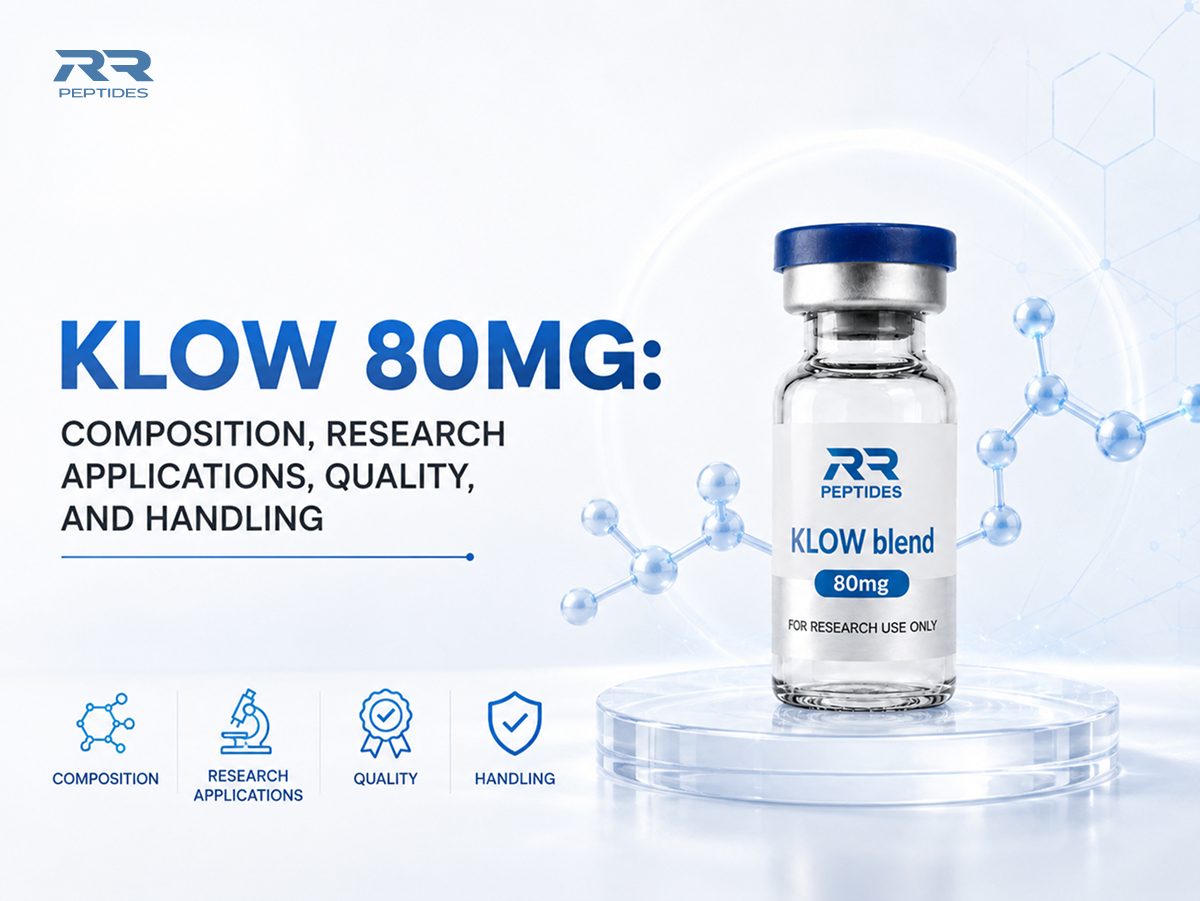
KLOW 80mg is a multi-component peptide blend developed for laboratory research. Unlike a single-peptide preparation, KLOW 80mg combines four distinct compounds: GHK-Cu, BPC-157, TB-500, and KPV. The commonly marketed formulation contains 50 mg of GHK-Cu and 10 mg each of BPC-157, TB-500, and KPV, creating a nominal total of 80 mg.
Understanding this composition is important because each component has its own molecular characteristics and research background. Studies involving an individual component should not automatically be interpreted as evidence for the complete KLOW formulation. Direct research examining all four components together remains considerably more limited than the literature available for the individual compounds.
For laboratory researchers, this distinction changes how the blend should be evaluated. Rather than treating the total 80 mg as a single research entity, researchers should consider component identity, formulation ratio, analytical quality, batch documentation, storage conditions, and the limitations of available evidence.
At RR Peptides, researchers can explore research-focused peptide products and educational information covering composition, analytical quality, storage, and laboratory handling. For researchers in Canada, careful evaluation of these factors can provide a stronger foundation for reproducible laboratory work involving multi-component peptide preparations.
What Is KLOW 80mg?
KLOW 80mg is generally described as a four-component lyophilized research blend containing GHK-Cu, BPC-157, TB-500, and KPV. The “80mg” designation refers to the combined nominal amount of all four components rather than the quantity of one individual peptide.
Component
Nominal Amount
Share of 80 mg Total
GHK-Cu
50 mg
62.5%
BPC-157
10 mg
12.5%
TB-500
10 mg
12.5%
KPV
10 mg
12.5%
Total
80 mg
100%
This distinction matters because KLOW is not a single 80 mg molecular entity. Each component remains chemically distinct within the preparation, so researchers should evaluate the blend at both the formulation and component levels.
Why Is KLOW Formulated as a Blend?
KLOW 80mg allows laboratories to investigate multiple peptide components within the same experimental system. The individual components found in KLOW appear in research involving extracellular matrix biology, cellular migration, inflammatory signalling, and tissue-related experimental models.
A combined preparation can also create research questions that would not arise when each compound is studied independently. Researchers may be interested in whether co-formulation changes analytical behaviour, stability, recovery, or interactions between components under defined experimental conditions.
However, combining individually researched compounds does not establish additive or synergistic activity. Any interaction between the components should be investigated experimentally rather than assumed from their separate research histories.
Research-Only Status
KLOW should be considered a laboratory research preparation rather than an approved therapeutic product. Research involving its individual components does not establish clinical efficacy, safety, or an approved human protocol for the complete formulation.
For researchers, the focus should remain on experimental design, analytical characterization, material quality, and appropriate interpretation of available evidence.
Explore research composition and quality with KLOW 80mg.
Understanding the Composition of KLOW 80mg
Understanding KLOW 80mg requires looking beyond its total 80 mg designation. Each component has a distinct molecular structure and research background, while the 50/10/10/10 formulation means they are not present in equal quantities.
GHK-Cu
GHK-Cu is the copper complex of the tripeptide glycyl-L-histidyl-L-lysine and represents the largest component of the formulation.
Experimental research involving GHK-Cu has examined extracellular matrix processes, collagen-related biology, tissue remodelling, and cellular responses. The copper complex can also contribute a characteristic blue appearance to preparations containing GHK-Cu, although visual characteristics alone cannot verify identity or purity.
Because GHK-Cu represents the majority of the nominal formulation by mass, its analytical behaviour may also have a substantial influence on the overall chromatographic profile of the preparation. Researchers should nevertheless avoid interpreting the prominence of one component by mass as evidence that it is necessarily the most important component in a particular experimental model.
BPC-157
BPC-157 is a synthetic pentadecapeptide investigated primarily in preclinical research.
Experimental literature has explored BPC-157 in gastrointestinal models, tissue injury, angiogenic signalling, and repair-related biological processes. These findings provide research context for the individual compound but should not automatically be extended to the complete KLOW blend.
When BPC-157 is studied as part of KLOW 80mg, researchers must account for the presence of three additional components. Experimental observations from the blend cannot necessarily be assigned to BPC-157 alone without an appropriate comparative design.
TB-500
TB-500 is commonly associated with experimental research involving cellular migration and tissue-related pathways.
Terminology surrounding TB-500 can vary among commercial and research sources. For this reason, researchers evaluating KLOW should rely on batch-specific analytical documentation to determine the identity of the component represented by the label rather than relying solely on a commercial product name.
Identity verification is especially valuable in multi-component preparations because uncertainty surrounding one component can affect interpretation of the entire formulation.
KPV
KPV is the tripeptide Lys-Pro-Val and corresponds to the C-terminal sequence of α-melanocyte-stimulating hormone.
Experimental studies have investigated KPV in relation to inflammatory signalling and associated biological pathways. Its inclusion also helps distinguish KLOW from three-component preparations containing GHK-Cu, BPC-157, and TB-500 without KPV.
Researchers studying KPV within a blend should distinguish between evidence generated using isolated KPV and observations made when it is present alongside other peptide components.
How KLOW 80mg Is Studied in Laboratory Research
Research involving KLOW 80mg requires an important distinction between evidence concerning individual ingredients and evidence concerning the complete formulation.
The individual components have established experimental research histories, but considerably less direct evidence is available for the four-component blend as a single research material.
Studying Multiple Pathways
A multi-component preparation may be relevant when a research question specifically examines interactions among several compounds or biological pathways.
Researchers might investigate whether co-formulation changes analytical behaviour, whether individual components remain detectable throughout storage, or whether combining the compounds alters observations within a controlled experimental model.
Researchers can also design comparative studies that evaluate an isolated component alongside the complete blend. Such designs may help determine whether an observed result is associated primarily with an individual peptide or emerges only when multiple components are present.
These questions are experimentally testable and allow researchers to evaluate the blend directly.
By contrast, assuming that several independently researched peptides automatically produce stronger or broader effects would go beyond what component-level evidence can demonstrate.
Analytical Research Applications
KLOW also creates analytical research opportunities because multiple compounds coexist within the same preparation.
Researchers may examine:
Component identity and relative quantity
Chromatographic separation
Analytical recovery
Degradation profiles
Stability under defined storage conditions
Changes in individual components over time
Analytical studies may also examine whether one component degrades faster than another or whether the overall chromatographic profile changes during storage. Such information can help researchers understand whether the preparation maintains its expected characteristics throughout an experimental period.
Quality and Purity Considerations
Evaluating KLOW 80mg quality involves more than looking for a high purity percentage. Because the formulation contains four separate components, analytical documentation should provide enough information to characterize the blend appropriately.
Component Identity, Purity, and Quantity
Identity, purity, and quantity answer different analytical questions.
Identity testing helps establish whether the expected compounds are present. Purity testing evaluates the proportion of detected material represented by the intended compound or compounds under the conditions of the analytical method. Quantitative testing evaluates how much material is actually present.
This distinction matters for KLOW because a high purity result does not automatically demonstrate that each component occurs at its nominal amount.
Similarly, confirming approximately 80 mg of total material would not by itself establish the identity and purity of all four expected components.
For multi-component preparations, researchers should therefore avoid interpreting a single analytical percentage as a complete description of quality. The strength of the documentation depends on what was measured, how it was measured, and whether the results can be linked to the actual batch under investigation.
HPLC and LC-MS
High-performance liquid chromatography can help characterize chromatographic profiles when an appropriate method is used. Depending on the analytical design, researchers may evaluate component-related peaks, impurities, or degradation-related changes.
Mass spectrometry can provide complementary molecular information and help support component identification.
Quality Question
Analytical Approach
What It Can Help Establish
Are expected components present?
Appropriate MS analysis
Molecular identity
What does the chromatographic profile show?
HPLC/UPLC
Component and purity-related information
Does content correspond to the label?
Quantitative analysis
Component quantity
Has material changed during storage?
Stability-indicating analysis
Changes over time
Does documentation match the sample?
Batch verification
Traceability
No single analytical result answers every quality question. Researchers should interpret results according to the capabilities and limitations of the method used.
Batch-Specific Certificates of Analysis
A Certificate of Analysis for KLOW 80mg is most informative when it corresponds directly to the batch being evaluated.
Researchers should compare the lot or batch identifier on the sample with the identifier shown on the analytical documentation. A report from a different production batch does not necessarily characterize the material currently under study.
Useful documentation may include:
Batch or lot identification
Analytical testing date
Component identity
Purity results
Quantitative content where tested
Analytical methodology
Laboratory information
For KLOW 80mg, component-level information can be particularly useful because a general blend result may not fully describe each compound. Clear documentation makes it easier to determine which analytical conclusions are supported and which remain uncertain.
Third-Party Testing
Independent laboratory testing can provide additional analytical information when appropriate methods are used.
However, “third-party tested” should not be treated as a quality conclusion by itself. Researchers should examine what was tested, which analytical methods were used, whether all relevant components were evaluated, and whether the report corresponds to the actual batch.
At RR Peptides, researchers can explore laboratory-focused information with an emphasis on analytical transparency, batch documentation, and research material quality.
Explore research composition and quality with KLOW 80mg.
Storage and Handling Guidelines
Storage and handling can influence the conditions under which KLOW 80mg is evaluated. Because the formulation contains multiple components, researchers should follow material- and batch-specific information rather than assume that every peptide blend has the same stability profile.
Lyophilized Material
KLOW 80mg is commonly supplied as a lyophilized research preparation. Removing much of the water from a preparation can reduce certain degradation pathways, but lyophilization does not make the material indefinitely stable.
Temperature, residual moisture, light, oxygen, packaging, and storage duration may still affect the preparation.
In a multi-component blend, researchers should also consider that individual compounds may have different stability characteristics under the same environment. Consequently, overall formulation stability cannot necessarily be predicted from information concerning only one component.
Moisture Control
Maintaining container integrity can help preserve the low-moisture environment of lyophilized KLOW 80mg.
Repeated unnecessary exposure to humid laboratory air or compromised packaging may change the environment surrounding the material. The significance depends on the formulation and duration of exposure.
Visual appearance alone cannot establish whether the chemical profile has remained unchanged.
Temperature Management
Storage temperatures should follow reliable material-specific documentation where available.
Researchers should distinguish between a short transfer during routine handling and prolonged exposure outside the intended environment. When a meaningful temperature deviation occurs, recording the event can provide useful context for later analytical interpretation.
Temperature history becomes particularly relevant in longitudinal research where samples are evaluated at multiple time points. Consistent storage records help researchers distinguish potential stability-related changes from variations introduced by different sample histories.
After Reconstitution
Reconstitution changes the sample from a dry material into an aqueous preparation.
Once water is introduced, solution-specific factors such as pH, concentration, buffer composition, dissolved oxygen, container interactions, and temperature can become more important.
Lyophilized stability information should therefore not automatically be used to establish post-reconstitution shelf life. This distinction is especially relevant for KLOW 80mg, where four components must be considered simultaneously.
Researchers evaluating reconstituted material should rely on formulation-specific stability evidence where available rather than assigning a universal timeframe to every peptide blend.
Labeling and Documentation
Clear laboratory records help connect experimental observations with the storage and handling history of KLOW 80mg.
Relevant information may include:
Blend and component identification
Batch or lot number
Storage location
Date received
Reconstitution date where applicable
Significant environmental deviations
Analytical testing dates
This information supports traceability without assuming that every routine handling event causes degradation.
KLOW 80mg is commonly described as a four-component research blend containing GHK-Cu, BPC-157, TB-500, and KPV. The nominal formulation contains 50 mg GHK-Cu and 10 mg of each remaining component.
Is KLOW 80mg one peptide?
No. It is a blend containing four separate components rather than one 80 mg molecular entity.
Why is GHK-Cu the largest component?
The commonly marketed formulation uses a 50/10/10/10 ratio, making GHK-Cu the largest component by nominal mass. This ratio describes formulation composition and should not be interpreted as evidence of biological importance or efficacy.
Has the complete KLOW blend been extensively studied?
Direct research evaluating the complete four-component formulation remains limited compared with the literature available for individual components.
Can findings about individual components be applied directly to KLOW?
Not automatically. Results from isolated GHK-Cu, BPC-157, TB-500, or KPV do not establish that the same observations will occur when all four are combined.
How should researchers evaluate KLOW quality?
Researchers can consider component identity, purity, quantitative content, analytical methodology, batch-specific documentation, and traceability rather than relying on one overall purity number.
Does a high purity percentage confirm the labeled quantities?
No. Purity and quantitative content are separate analytical measurements. High chromatographic purity does not by itself confirm that each component is present at its nominal amount.
Should KLOW be evaluated differently after reconstitution?
Yes. Reconstitution introduces an aqueous environment and additional stability variables, so dry-state storage information should not automatically determine post-reconstitution stability.
Why is batch-specific documentation important?
Batch-specific documentation connects analytical results to the physical material being studied. This is especially important for a multi-component preparation because researchers may need to confirm the identity and analytical characteristics of several components rather than a single peptide.
Is there an established human dosage for KLOW 80mg?
No validated human dosing protocol has been established for the complete KLOW formulation. The 80 mg designation describes the nominal composition of the research preparation rather than a recommended human dose.
Final Thoughts
KLOW 80mg is best understood as a multi-component research preparation containing GHK-Cu, BPC-157, TB-500, and KPV. Understanding the identity, ratio, and research context of each component is more informative than considering only the total 80 mg designation.
Research involving individual components provides useful scientific context, but it should remain distinct from evidence involving the complete blend. Direct KLOW-specific research remains more limited, making careful evidence interpretation particularly important when discussing potential laboratory applications.
Quality evaluation should focus on component identity, purity, quantitative content, analytical methodology, and batch-specific documentation. For a multi-component formulation, these measurements provide a more complete picture than relying on a single purity percentage or total mass claim.
Storage and handling also contribute to reliable research. Maintaining appropriate environmental conditions, documenting meaningful changes, and distinguishing lyophilized from reconstituted material can help researchers preserve a clear sample history throughout an experimental project.
At RR Peptides, researchers can explore additional educational resources covering peptide composition, analytical quality, batch verification, COAs, storage, and laboratory handling. For Canadian researchers evaluating KLOW 80mg, combining transparent documentation, controlled sample management, and careful interpretation of available evidence can provide a stronger foundation for reproducible laboratory research.
Disclaimer: All products and compounds referenced are intended strictly for laboratory and research purposes only. This content is provided for informational and educational purposes and is not intended as medical advice or to diagnose, treat, cure, or prevent any disease.
3 Comments
I found this overview of KLOW 80mg helpful, especially for understanding how the product is presented within a research context. The emphasis on product information and documentation makes the article easy to follow. I’d be interested in seeing more detail about the analytical testing associated with individual batches.
Really useful information for anyone researching KLOW 80mg. I appreciate the focus on specifications and quality documentation rather than making broad claims. A follow-up explaining how researchers review the relevant COA and batch information would add even more value.
I appreciate the straightforward presentation of KLOW 80mg. When evaluating research materials, having clear information about specifications, testing and traceability is important, so this type of overview provides useful context. It would be interesting to see a more detailed discussion of the quality-control process.




I found this overview of KLOW 80mg helpful, especially for understanding how the product is presented within a research context. The emphasis on product information and documentation makes the article easy to follow. I’d be interested in seeing more detail about the analytical testing associated with individual batches.
Really useful information for anyone researching KLOW 80mg. I appreciate the focus on specifications and quality documentation rather than making broad claims. A follow-up explaining how researchers review the relevant COA and batch information would add even more value.
I appreciate the straightforward presentation of KLOW 80mg. When evaluating research materials, having clear information about specifications, testing and traceability is important, so this type of overview provides useful context. It would be interesting to see a more detailed discussion of the quality-control process.