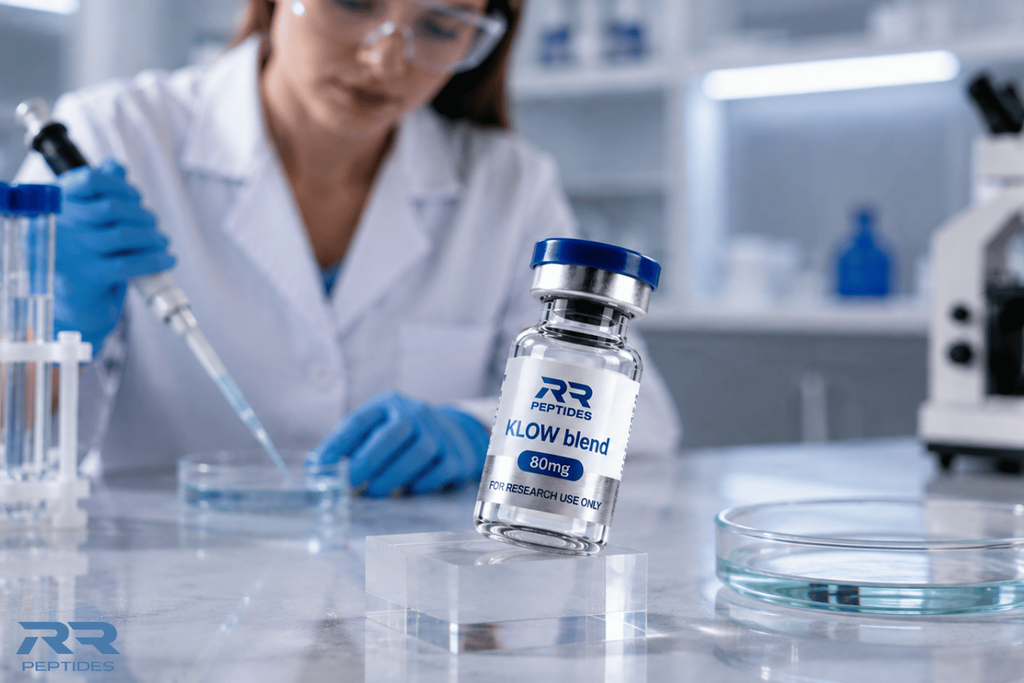
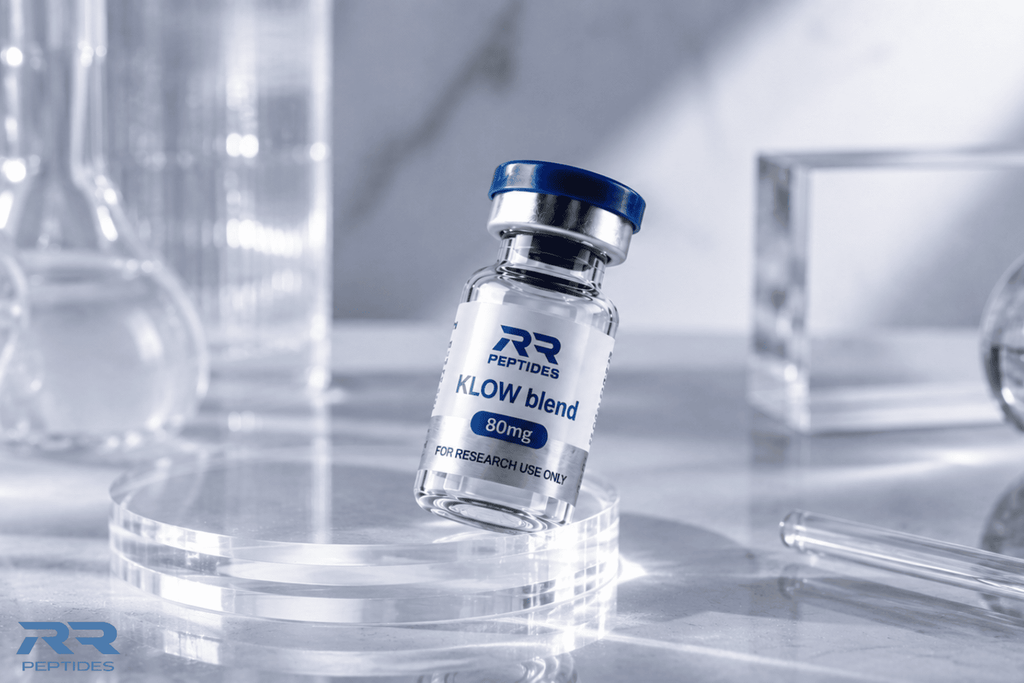
If you are asking what is KLOW 80mg, the most important point is that KLOW is not one peptide. It is a multi-component research formulation that combines GHK-Cu, BPC-157, TB-500, and KPV in a single lyophilized preparation. The standard 80 mg formulation is commonly described as 50 mg GHK-Cu, 10 mg BPC-157, 10 mg TB-500, and 10 mg KPV.
This distinction matters because each component has its own molecular identity, analytical characteristics, and research literature. The complete blend should therefore not be treated as a single 80 mg molecule or as though research involving one component automatically applies to the entire formulation.
For researchers asking what is KLOW 80mg, questions about composition, component identity, batch testing, purity, analytical documentation, and experimental design are more useful than relying on the total milligram number alone.
At RR Peptides, researchers can explore research-focused peptide products and educational resources covering peptide composition, analytical quality, batch documentation, storage, and laboratory handling. Understanding these factors provides a stronger foundation for evaluating multi-component preparations used in Canadian laboratory research.
What Is KLOW 80mg?
KLOW 80mg is generally described as a four-component peptide research blend supplied as a lyophilized preparation. The four components are GHK-Cu, BPC-157, TB-500, and KPV. The most commonly listed ratio is 50/10/10/10 mg, producing a nominal total of 80 mg per vial.
Component
Nominal Amount
Share of Total
GHK-Cu
50 mg
62.5%
BPC-157
10 mg
12.5%
TB-500
10 mg
12.5%
KPV
10 mg
12.5%
Total
80 mg
100%
When discussing what is KLOW 80mg, the 80 mg designation represents the combined nominal amount of all four components. It should not be interpreted as the quantity of one peptide or as the molecular weight of a single compound.
This is a central part of understanding what is KLOW 80mg. Each component remains a distinct research compound within the formulation, so laboratory evaluation may need to consider individual identity, quantity, analytical response, and stability rather than relying only on the total vial mass.
KLOW as a Multi-Component Research Formulation
A multi-peptide blend provides researchers with a preparation containing several compounds in a fixed ratio. This can be useful when an experimental question involves co-formulation, comparative signalling, component stability, or interactions among multiple compounds. This also provides useful context for researchers trying to understand what is KLOW 80mg from a formulation perspective.
However, combining four individually researched compounds does not automatically establish additive or synergistic biological activity. Direct evidence involving the full blend should be distinguished from evidence generated using individual components.
That distinction is particularly important for KLOW because much of the available scientific context comes from research involving GHK-Cu, BPC-157, thymosin-related peptides, or KPV separately rather than controlled studies of the complete 50/10/10/10 preparation.
Research-Only Context
KLOW should be considered a laboratory research preparation rather than an approved therapeutic product. Research involving its individual components does not establish clinical efficacy, safety, or an approved human protocol for the complete formulation.
For researchers, the relevant discussion should focus on composition, analytical characterization, experimental design, storage, and evidence limitations rather than clinical claims or dosing recommendations.
Explore research composition and quality with KLOW 80mg.
What Peptides Are Included in KLOW 80mg?
To better understand what is KLOW 80mg, researchers should examine the four components separately and consider their individual research backgrounds. Their individual research histories provide scientific context for why they may appear in a multi-component laboratory formulation, but individual findings should not automatically be attributed to the blend as a whole.
GHK-Cu
GHK-Cu is a copper-binding tripeptide complex composed of glycine, histidine, and lysine associated with copper.
It represents the largest component of the commonly marketed KLOW formulation at 50 mg per 80 mg vial. As a result, GHK-Cu accounts for approximately 62.5% of the nominal formulation by mass.
Experimental research involving GHK-Cu has explored extracellular matrix regulation, collagen-related biology, tissue remodelling, gene expression, and cellular signalling. These research areas provide a scientific basis for studying the compound individually.
When examining what is KLOW 80mg, researchers may also note that the GHK-Cu component can contribute characteristic blue coloration to the preparation. Visual appearance, however, is not a substitute for analytical identification or quantitative testing.
BPC-157
BPC-157 is a synthetic pentadecapeptide studied primarily in preclinical research.
Research has examined BPC-157 in experimental models involving gastrointestinal biology, tissue repair processes, vascular signalling, fibroblast activity, and cellular migration.
Within KLOW 80mg, BPC-157 is commonly listed at 10 mg.
An important limitation when evaluating what is KLOW 80mg is that experimental observations involving isolated BPC-157 cannot automatically be assigned to the complete formulation. Once BPC-157 is studied alongside GHK-Cu, TB-500, and KPV, researchers are evaluating a different experimental system.
TB-500
TB-500 is commonly included in research formulations associated with thymosin-related experimental pathways, including cellular migration, actin-associated processes, and tissue-related models.
In the standard KLOW formulation, TB-500 is commonly listed at 10 mg.
For researchers asking what is KLOW 80mg, identity documentation is especially important because commercial terminology around TB-500 can vary. For a multi-component blend, batch-specific analytical information is more useful than relying exclusively on a label name.
KPV
KPV is the tripeptide Lys-Pro-Val and corresponds to a short sequence associated with alpha-melanocyte-stimulating hormone.
Experimental research has investigated KPV in inflammatory signalling, epithelial models, immune-related pathways, and other cellular research contexts.
KPV is typically listed at 10 mg in the 80 mg KLOW formulation.
Another useful detail when understanding what is KLOW 80mg is that the inclusion of KPV distinguishes it from three-component formulations containing GHK-Cu, BPC-157, and TB-500.
Why the Ratio Matters
When researching what is KLOW 80mg, the unequal composition is important.
GHK-Cu represents most of the nominal material by mass, while the other three components are present at smaller but equal stated amounts. These differences may affect analytical detection, chromatographic response, quantitative recovery, and interpretation of stability results.
Researchers should therefore consider KLOW as a defined multi-component formulation rather than an equal-ratio combination of four peptides.
Why Multi-Peptide Blends Are Used in Research
Multi-peptide blends can create experimental questions that cannot be examined by studying one compound alone, which is an important consideration when evaluating what is KLOW 80mg in laboratory research.
Researchers may want to determine whether co-formulation influences analytical stability, whether multiple components remain chemically detectable over time, or whether a biological model responds differently to a blend compared with isolated compounds.
The important scientific principle is that these effects should be measured rather than assumed.
Comparing Single Components With a Blend
A well-designed comparative study could evaluate an individual component alongside a complete formulation.
For example, researchers might compare an isolated peptide with KLOW 80mg under the same analytical conditions. This could help determine whether co-formulation changes chromatographic behaviour, stability, recovery, or observations within an experimental model.
Such comparisons provide more useful evidence than assuming the complete blend behaves exactly like the sum of its ingredients.
Studying Multiple Pathways
When researchers investigate what is KLOW 80mg, they should consider that the four KLOW components have been associated with different experimental research areas. This creates potential interest in studies involving several biological or analytical pathways within the same model.
Possible laboratory questions may include:
Whether co-formulation alters component stability or analytical recovery
Whether individual components remain identifiable throughout a defined study period
Whether a combined formulation produces observations that differ from isolated-component controls
Whether environmental conditions affect individual components at different rates
These questions focus on measurable outcomes rather than unsupported claims about synergy.
Why Blend-Level Evidence Matters
Researchers asking what is KLOW 80mg should distinguish four evidence categories: individual-component research, pathway-level research, hypotheses about combined activity, and direct evidence generated using the complete blend.
These categories are not interchangeable.
For example, evidence showing that GHK-Cu interacts with a particular cellular pathway establishes information about GHK-Cu under the conditions studied. It does not establish that the complete KLOW formulation produces the same outcome.
Similarly, research involving BPC-157 does not determine how BPC-157 behaves when co-formulated with three other components.
Maintaining this distinction reduces overstatement and helps researchers identify where additional blend-specific investigation is needed.
Potential Laboratory Research Applications
When examining what is KLOW 80mg from a laboratory perspective, the most defensible research applications involve questions that can be directly evaluated under controlled conditions.
These applications can include analytical characterization, formulation stability, comparative research, and investigation of biological pathways already associated with individual components.
Analytical Characterization
Understanding what is KLOW 80mg also means recognizing that its four-component composition creates a more complex analytical system than a single-peptide sample.
Researchers may investigate component identity, chromatographic separation, quantitative content, degradation profiles, or changes occurring during controlled storage.
Analytical research is particularly useful because it helps answer basic quality questions before broader experimental interpretation begins. These analytical questions can also help researchers better understand what is KLOW 80mg beyond its stated total mass.
Stability Research
Another aspect of what is KLOW 80mg involves the unique stability questions that can arise with multi-component preparations.
Researchers can examine whether all four components retain their analytical characteristics over the same period, whether one component changes more rapidly than another, or whether the overall chromatographic profile changes under different storage environments.
This can include comparisons between lyophilized and reconstituted material where relevant to the experimental design.
Stability information generated for one component should not automatically determine the stability of the complete blend.
Comparative Research
Researchers may compare KLOW 80mg with individual components or other multi-peptide formulations.
For researchers studying what is KLOW 80mg, a comparative design could help determine whether observations are associated with one component, several components, or the complete co-formulated preparation.
Such studies may be particularly useful when investigating formulation-dependent behaviour.
Component-Related Biological Research
The individual KLOW components have been studied in experimental contexts involving extracellular matrix biology, cellular migration, inflammatory signalling, epithelial models, and tissue-related pathways.
Researchers may use these existing areas of investigation to develop hypotheses involving the complete formulation.
However, the hypothesis should remain distinct from the evidence. Individual-component findings provide scientific context, while experiments involving the full KLOW blend are needed to determine how the complete preparation behaves.
Explore research composition and quality with KLOW 80mg.
Purity, Testing, and Product Documentation
Understanding what is KLOW 80mg also requires understanding what analytical documentation can—and cannot—demonstrate.
A multi-component blend is more complex than a single-peptide sample because researchers may need information about four different compounds within the same preparation.
Identity, Purity, and Quantity Are Different
Identity testing asks whether the expected compound is present.
Purity testing examines the analytical profile of the material and the proportion represented by the target compound or relevant components under the conditions of the method.
Quantitative testing asks how much material is present.
These measurements should not be treated as interchangeable.
A high purity result does not automatically prove that GHK-Cu, BPC-157, TB-500, and KPV are each present at their stated quantities. Likewise, confirming approximately 80 mg of total material does not establish the identity or purity of every component.
HPLC and Mass Spectrometry
HPLC or UPLC can provide chromatographic information when methods are appropriate for a multi-component preparation.
Mass spectrometry can provide complementary information supporting molecular identity.
Quality Question
Useful Analytical Information
What It Helps Establish
Are expected components present?
Mass spectrometry or identity testing
Component identity
What does the chromatographic profile show?
HPLC/UPLC
Purity-related information
Are stated amounts supported?
Quantitative analysis
Component content
Does testing correspond to this vial?
Batch/lot verification
Traceability
Has the preparation changed over time?
Stability-indicating analysis
Storage-related changes
No single percentage answers every quality question.
Batch-Specific Documentation
A Certificate of Analysis is most useful when it corresponds to the actual batch being studied.
Researchers should confirm that the batch or lot number on the sample matches the analytical report. If the identifiers differ, the report may not describe the material currently being evaluated.
Useful documentation may include the batch identifier, testing date, component identity, purity data, quantitative content where measured, analytical methods, and testing laboratory.
For KLOW products, the exact scope of testing can vary between batches and analytical reports. Researchers should therefore examine the information contained in the relevant documentation rather than assuming that every COA evaluates the same characteristics. For researchers investigating what is KLOW 80mg, batch-specific documentation also helps connect analytical findings with the actual material used in an experiment.
Evaluating Testing Claims
“Third-party tested” is useful only when researchers can determine what the laboratory actually tested.
Was identity confirmed? Was purity evaluated? Was total mass measured? Were individual component quantities assessed? Does the certificate correspond to the current batch?
These questions are especially important when evaluating what is KLOW 80mg, because a four-component preparation requires more analytical context than a generic overall purity percentage.
At RR Peptides, researchers can explore additional educational material covering COA interpretation, batch verification, analytical testing, peptide quality, and laboratory traceability.
If you are asking what is KLOW 80mg, it is commonly described as a four-component research blend containing GHK-Cu, BPC-157, TB-500, and KPV. The standard marketed formulation contains 50 mg GHK-Cu and 10 mg each of the remaining three components.
Is KLOW 80mg a single peptide?
No. It contains four separate components rather than one 80 mg molecular entity.
What peptides are included in KLOW 80mg?
The commonly marketed formulation contains GHK-Cu, BPC-157, TB-500, and KPV.
Why is GHK-Cu present at a higher amount?
The standard commercial formulation uses a 50/10/10/10 ratio. This describes formulation composition and should not be interpreted as evidence that GHK-Cu is biologically more important than the other components.
Has the complete KLOW blend been extensively researched?
Direct evidence involving the complete four-component formulation is more limited than the research literature available for individual components. Researchers should therefore distinguish component-level findings from blend-level evidence.
Can research on individual ingredients be applied directly to KLOW?
Not automatically. Findings from isolated GHK-Cu, BPC-157, TB-500, or KPV do not establish how the four-component formulation behaves under the same experimental conditions.
Why is analytical testing important for KLOW?
Testing can help establish component identity, chromatographic purity, quantitative content, and batch traceability. These are separate quality questions and may require different analytical approaches.
Does a high purity percentage confirm that the vial contains exactly 80 mg?
No. Purity and quantity are different analytical measurements. A high chromatographic purity result does not automatically establish the quantity of each component.
Why should researchers check the batch number?
The batch number connects the physical sample with its analytical documentation. Matching identifiers help researchers determine whether a particular COA or laboratory report actually corresponds to the material being studied.
Is KLOW 80mg approved for therapeutic use in Canada?
KLOW should be treated as a research-use preparation rather than an approved therapeutic product. Researchers should not interpret its laboratory research status as authorization for therapeutic or human use.
Final Thoughts
Understanding what is KLOW 80mg starts with recognizing that it is a multi-component research formulation rather than one peptide. The standard 80 mg composition combines GHK-Cu, BPC-157, TB-500, and KPV in a 50/10/10/10 ratio, with each component retaining its own molecular identity and research context.
The individual compounds have been investigated across several experimental fields, but those studies should remain separate from conclusions about the complete formulation. Blend-level hypotheses require direct testing before they can be treated as established findings.
For laboratory researchers, analytical quality is equally important. Component identity, purity, quantitative content, batch-specific documentation, and appropriate analytical methods provide a more complete picture of KLOW than a single overall purity percentage.
At RR Peptides, researchers can explore additional educational resources covering multi-peptide formulations, peptide quality, COA evaluation, batch verification, analytical testing, storage, and laboratory practices. For Canadian researchers asking what is KLOW 80mg, careful interpretation of composition and evidence can provide a more reliable foundation for controlled laboratory research.
Disclaimer: All products and compounds referenced are intended strictly for laboratory and research purposes only. This content is provided for informational and educational purposes and is not intended as medical advice or to diagnose, treat, cure, or prevent any disease.
3 Comments
Really clear introduction to KLOW 80mg. I appreciate that the article takes time to explain what the material is and how it is positioned in a research context rather than jumping straight into broad claims. More detail about the individual components and their research backgrounds would be interesting.
I found this overview helpful for getting a basic understanding of KLOW 80mg. The focus on research context and product information makes the subject easier to evaluate without oversimplifying it. A follow-up comparing KLOW with related research formulations would be a useful addition.
Appreciate the straightforward approach to explaining KLOW 80mg. There is often a lot of terminology surrounding research materials, so having the basics clearly outlined makes this easier to follow. I’d be interested in seeing more about how the formulation is characterized and documented for research purposes.




Really clear introduction to KLOW 80mg. I appreciate that the article takes time to explain what the material is and how it is positioned in a research context rather than jumping straight into broad claims. More detail about the individual components and their research backgrounds would be interesting.
I found this overview helpful for getting a basic understanding of KLOW 80mg. The focus on research context and product information makes the subject easier to evaluate without oversimplifying it. A follow-up comparing KLOW with related research formulations would be a useful addition.
Appreciate the straightforward approach to explaining KLOW 80mg. There is often a lot of terminology surrounding research materials, so having the basics clearly outlined makes this easier to follow. I’d be interested in seeing more about how the formulation is characterized and documented for research purposes.