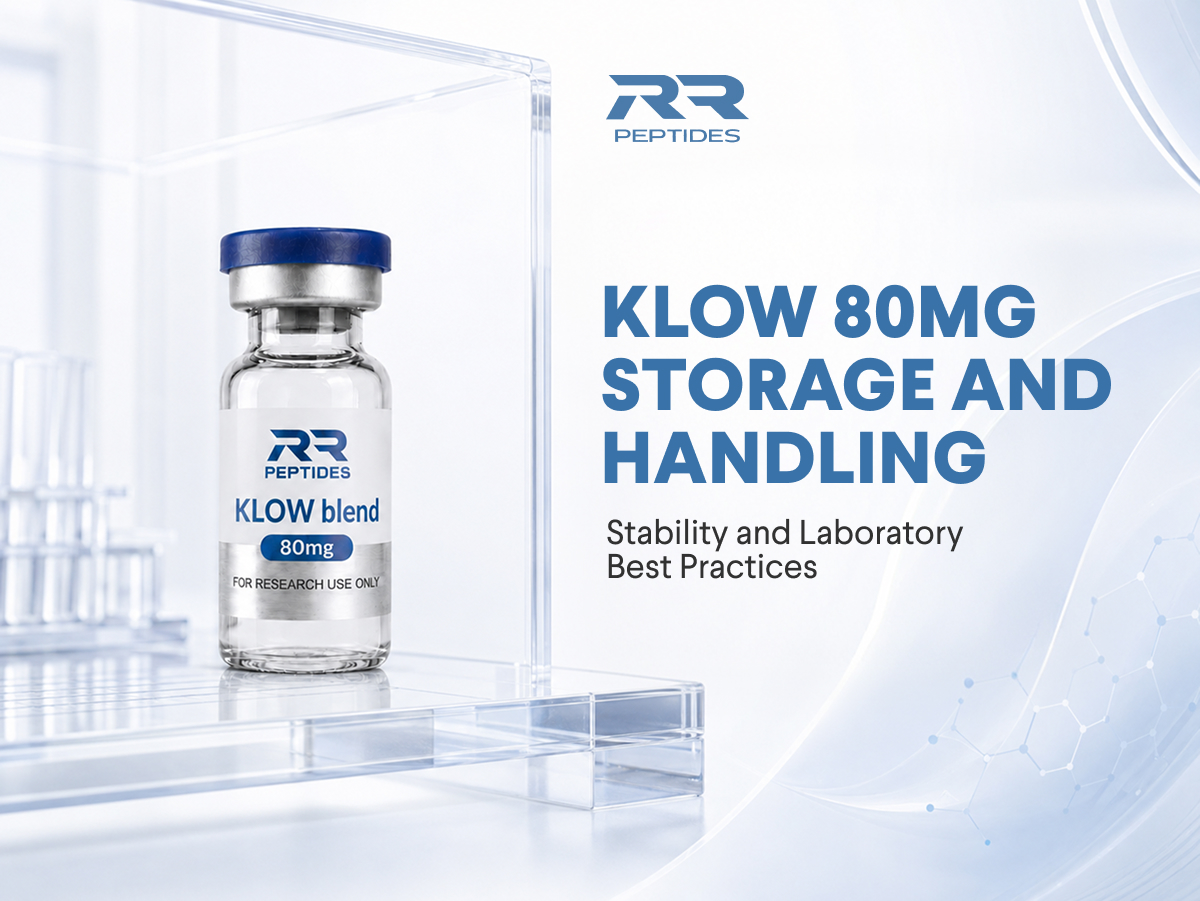
Proper KLOW 80mg storage and handling begins with a simple principle: laboratories should control the condition of the material before they try to interpret experimental results. KLOW 80mg is commonly described in the Canadian research market as a lyophilized blend containing GHK-Cu, BPC-157, TB-500, and KPV. Because the formulation contains four distinct research compounds, storage decisions should be based on the specific product, its batch documentation, and the laboratory’s own procedures rather than on a single universal rule for all peptides.
For researchers, KLOW 80mg storage and handling is less about memorizing one temperature and more about limiting unnecessary heat, light, moisture, contamination, and undocumented environmental changes. Lyophilization reduces water availability and can improve practical storage characteristics, but it does not make the blend permanently stable or eliminate the need for controlled conditions.
At RR Peptides, researchers can explore research-focused peptide products and educational material related to analytical quality, laboratory handling, storage, and batch documentation. A consistent approach to KLOW 80mg storage and handling can help reduce avoidable pre-analytical variation and support more reproducible laboratory work.
Why KLOW 80mg Storage and Handling Matter
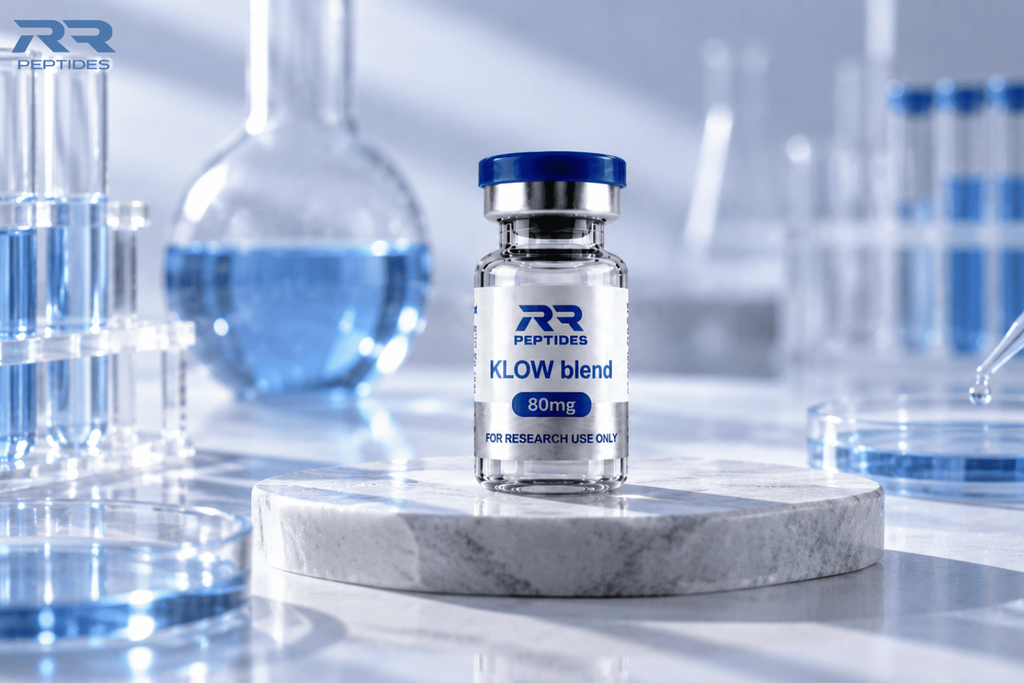
The importance of KLOW 80mg storage and handling comes from the fact that KLOW is a multi-component formulation rather than a single 80 mg molecular entity. The commonly marketed composition is 50 mg GHK-Cu, 10 mg BPC-157, 10 mg TB-500, and 10 mg KPV.
Component
Commonly Listed Amount
Share of Total
Storage-Relevant Point
GHK-Cu
50 mg
62.5%
Copper-containing complex that represents most of the nominal mass
BPC-157
10 mg
12.5%
Separate peptide component with its own chemical properties
TB-500
10 mg
12.5%
Identity and formulation details should be assessed at batch level
KPV
10 mg
12.5%
Short peptide component within the same preparation
Total
80 mg
100%
Four-component lyophilized research blend
The main practical concern is not that all four compounds will necessarily change in the same way. Different components may respond differently to environmental conditions. If one component changes more rapidly than another, the original formulation ratio may no longer describe the sample accurately.
That is why KLOW 80mg storage and handling should be viewed as part of experimental control. Researchers can carefully standardize an assay yet still introduce variation if the samples entering that assay have different storage histories.
Explore research composition and quality with KLOW 80mg.
Storage Conditions for Lyophilized KLOW 80mg
KLOW 80mg is commonly supplied as a lyophilized preparation. Removing much of the water can improve storage practicality, but lyophilized material is not chemically inert.
For that reason, KLOW 80mg storage and handling should prioritize the storage information supplied with the specific material. Product labels, technical documents, batch information, available stability data, and laboratory SOPs provide a stronger basis than generic claims assigning one temperature or shelf life to every peptide blend.
Follow Product-Specific Instructions
The most defensible storage recommendation is one supported by information for the actual formulation being used. A condition suitable for an isolated component does not automatically establish the ideal condition for a four-component preparation.
This is particularly important for KLOW 80mg storage and handling because the formulation combines compounds with different molecular structures and chemical environments. Stability information for GHK-Cu alone, for example, cannot establish the stability of GHK-Cu when combined with BPC-157, TB-500, and KPV.
Where formulation-specific stability data are limited, laboratories should follow the designated storage instructions while keeping records of how the material is maintained.
Maintain Consistent Storage Conditions
Consistency reduces unnecessary experimental variables. Samples should remain in their designated storage environment except when required for legitimate laboratory procedures.
A practical laboratory record may include the product name, batch or lot number, date received, designated storage condition, important handling dates, and any meaningful environmental excursion.
For KLOW 80mg storage and handling, this documentation creates a traceable history for the material used in an experiment. If unexpected analytical findings occur later, researchers have a clearer basis for determining whether sample history may have contributed.
Avoid Unsupported Shelf-Life Claims
A common weakness in peptide-related content is the use of fixed shelf-life claims without formulation-specific evidence. Statements suggesting that all lyophilized peptides remain stable for the same number of months are too broad.
Stability can depend on formulation chemistry, residual moisture, packaging, container closure, temperature, light exposure, and manufacturing conditions. KLOW 80mg storage and handling should therefore avoid presenting a universal expiry period unless it is supported by appropriate data for the relevant preparation.
Protecting the Blend from Heat, Light, and Moisture
Heat, light, and moisture are common environmental factors considered in laboratory storage. Their exact effects vary by material and formulation, but unnecessary exposure can introduce variables without providing scientific value.
A sensible KLOW 80mg storage and handling strategy focuses on maintaining specified conditions and reducing avoidable exposure.
Heat and Temperature Excursions
Temperature can influence chemical reaction rates and physical stability, but the magnitude of its effect depends on the material being studied.
A brief deviation from designated storage conditions should not automatically be described as harmless. At the same time, it should not automatically be assumed to make the sample unusable.
For KLOW 80mg storage and handling, the better approach is to document the excursion and evaluate it using available product information, stability evidence, and institutional procedures.
In temperature-controlled laboratory environments, monitoring equipment should also be appropriate for its purpose. Where temperature records are critical to research quality, maintenance, calibration, alarms, and equipment performance may become part of the broader quality system.
Light Exposure
Light can contribute to chemical change in some susceptible research materials. The degree of sensitivity varies considerably, so a specific degradation rate should not be claimed without direct evidence.
Within KLOW 80mg storage and handling, laboratories should minimize unnecessary light exposure when protection from light is specified in product documentation or laboratory procedures.
Maintaining the sample in its intended container and using an appropriate secondary storage environment can help reduce avoidable exposure.
Moisture and Container Integrity
Lyophilization reduces the water content of a preparation, but dry material can still interact with its surrounding environment.
Repeated exposure to humidity may alter the physical conditions of the sample, particularly if the vial or closure system has been compromised.
For this reason, KLOW 80mg storage and handling should include inspection of container integrity. Damage, poor sealing, or visible abnormalities should be recorded before the material enters an experiment.
Environmental Factor
Why It May Matter
Practical Laboratory Response
Temperature
May influence chemical or physical stability
Maintain specified conditions and document excursions
Light
May affect susceptible materials
Limit unnecessary exposure when required
Moisture
May alter the environment of dry material
Preserve container integrity
Repeated transfers
Can create avoidable environmental variation
Limit movement to necessary laboratory procedures
Container damage
May compromise environmental protection
Inspect and document abnormalities
This framework keeps KLOW 80mg storage and handling focused on measurable and controllable laboratory variables instead of unsupported assumptions.
Laboratory Handling and Contamination Prevention
Even carefully controlled storage cannot compensate for poor laboratory technique. KLOW 80mg storage and handling should therefore include procedures designed to reduce contamination, misidentification, and unnecessary manipulation.
Use a Controlled Work Area
Research samples should be handled in an environment appropriate to the experimental procedure and the laboratory’s contamination-risk assessment.
Work surfaces, equipment, protective measures, and handling techniques should follow established institutional procedures.
This matters for KLOW 80mg storage and handling because a multi-component preparation already creates a more complex analytical profile than a single compound. External contamination can make unexpected peaks or measurements more difficult to interpret.
Maintain Clear Sample Identification
Every sample should remain traceable from receipt through storage and experimental use.
Laboratory labels and records may include the product identity, batch or lot number, preparation status, and other information required by the research institution.
Good KLOW 80mg storage and handling reduces the possibility that sample mix-ups become hidden experimental variables. Clear identification is particularly important when researchers are comparing multiple KLOW batches or related peptide formulations.
Limit Unnecessary Handling
Every additional handling event creates an opportunity for environmental exposure, contamination, labeling errors, or incomplete documentation.
Researchers should therefore organize workflows so samples are accessed only when needed for the experimental protocol. In KLOW 80mg storage and handling, fewer unnecessary manipulations also make the sample history easier to reconstruct if an unexpected result appears later.
The objective is not to eliminate legitimate laboratory handling. Instead, each manipulation should have a defined research purpose.
Record Significant Deviations
Equipment failures, delayed shipments, damaged containers, and environmental excursions may occur even in well-managed laboratories.
The appropriate response is to document the event and evaluate its possible significance rather than relying on memory.
A KLOW 80mg storage and handling system should make meaningful deviations visible in the experimental record. This information can become particularly useful when comparing different batches or attempting to reproduce an earlier study.
Explore research composition and quality with KLOW 80mg.
Factors That May Affect Blend Stability
Stability depends on more than storage temperature. KLOW 80mg storage and handling should account for formulation chemistry, container conditions, residual moisture, preparation state, and other variables that may influence how a sample behaves over time.
Component-Specific Behavior
GHK-Cu, BPC-157, TB-500, and KPV are chemically distinct compounds. Researchers should not assume that all four have identical degradation pathways or rates under every experimental condition.
This creates an important implication for KLOW 80mg storage and handling: apparent stability of the vial as a whole does not prove that every individual component remains unchanged.
One component could potentially change while others remain comparatively stable. For this reason, analytical measurements provide stronger evidence than visual inspection alone when researchers need to assess component-level stability.
Residual Moisture and Formulation Variables
Lyophilized preparations may differ in residual moisture, formulation composition, manufacturing conditions, and container characteristics.
These factors can influence stability and help explain why products with similar component lists may not necessarily share identical storage profiles.
For KLOW 80mg storage and handling, product-specific technical information should therefore take priority over broad assumptions based only on the names of the ingredients.
Lyophilized Versus Reconstituted Material
Reconstitution changes the chemical environment of a sample.
Once liquid is introduced, pH, concentration, solution composition, dissolved oxygen, temperature, and container interactions may become more relevant. The aqueous state should therefore be treated separately from the original lyophilized state.
This means KLOW 80mg storage and handling after reconstitution should not simply copy dry-state assumptions. Where post-reconstitution stability data are unavailable, laboratories should avoid assigning a fixed storage period without supporting evidence.
This distinction also matters when comparing experimental results. A stability observation involving the dry preparation may not accurately predict behavior after the material has entered an aqueous system.
Analytical Monitoring of Stability
Researchers interested specifically in stability can evaluate material at defined time points under controlled conditions.
Depending on the analytical method and study objective, investigators may monitor chromatographic profiles, molecular identity, component quantity, degradation-related peaks, or other relevant quality attributes.
A controlled KLOW 80mg storage and handling study could compare samples maintained under different defined environments while keeping the analytical method and sampling schedule consistent.
Stability Variable
Example Research Question
Time
Does the analytical profile change across defined time points?
Temperature
Do controlled temperature conditions produce different analytical profiles?
Light
Does defined exposure alter measurable attributes?
Moisture
Does environmental moisture affect the preparation?
Reconstitution
How does the aqueous state differ from the dry state?
Batch
Are stability-related measurements consistent across lots?
Baseline measurements are particularly important. Without an initial reference point, researchers may have difficulty determining whether a later analytical difference represents degradation, batch variation, method variability, or another experimental factor.
Proper KLOW 80mg storage and handling helps laboratories maintain consistent sample conditions, reduce avoidable environmental exposure, prevent contamination, and improve traceability. These factors support more reliable interpretation of experimental findings.
What form is KLOW 80mg commonly supplied in?
In the Canadian research market, KLOW 80mg is commonly described as a lyophilized blend containing 50 mg GHK-Cu, 10 mg BPC-157, 10 mg TB-500, and 10 mg KPV.
Does lyophilization guarantee long-term stability?
No. Lyophilization reduces water availability but does not establish indefinite stability. KLOW 80mg storage and handling should still follow product-specific storage information and appropriate laboratory procedures.
What temperature should KLOW 80mg be stored at?
Researchers should follow the storage conditions specified for the actual material they are using. Product labeling, technical documentation, available stability information, and institutional SOPs provide a more appropriate basis than assuming one universal temperature applies to every KLOW formulation.
Should KLOW 80mg be protected from light?
When product documentation or laboratory procedures specify protection from light, those requirements should be followed. Unnecessary exposure can also be minimized as part of a controlled laboratory workflow.
Why does moisture matter for lyophilized material?
Lyophilization reduces water content, but environmental moisture can still change the physical conditions surrounding the material. Maintaining container integrity is therefore part of KLOW 80mg storage and handling.
Is reconstituted KLOW equivalent to lyophilized KLOW for storage purposes?
No. Reconstitution creates a different chemical environment. Dry-state stability should not automatically be used to establish post-reconstitution stability without supporting information.
What should researchers do after a temperature excursion?
The event should be documented and evaluated against available technical information, stability evidence, and institutional procedures. Researchers should avoid assuming automatically that a brief excursion is either harmless or destructive.
Can visual appearance confirm stability?
No. Visual inspection may identify obvious physical abnormalities, but it cannot establish molecular identity, purity, component quantity, or the absence of degradation.
What records are useful for storage traceability?
A KLOW 80mg storage and handling record can include product identity, lot number, date received, designated storage conditions, important handling events, preparation status, monitoring information, and documented deviations.
How should Canadian laboratories interpret broader storage guidance?
Canadian laboratories can use broader quality principles involving environmental control, monitoring, traceability, and excursion documentation as useful context. However, research-only KLOW should not be presented as an approved therapeutic product, and general drug-storage guidance should not be described as KLOW-specific stability evidence.
Final Thoughts
Reliable storage and laboratory handling are primarily about controlling variables before those variables affect experimental interpretation. KLOW combines four distinct research compounds, so the complete formulation should not automatically be assumed to share the exact stability characteristics of any individual component.
The most defensible laboratory approach is straightforward: follow product-specific information, maintain consistent environmental conditions, protect container integrity, reduce unnecessary handling, prevent sample mix-ups, and document meaningful deviations. Researchers should also distinguish clearly between lyophilized and reconstituted preparations because they represent different chemical environments.
For Canadian laboratories, storage decisions should remain grounded in batch-specific documentation and institutional procedures. General principles involving temperature control, light, moisture, traceability, and deviation management can support good research practice, but they should not replace formulation-specific stability evidence.
Researchers looking for research-focused peptide products and educational resources can explore RR Peptides for further information on analytical quality, peptide storage, laboratory handling, and batch documentation. Consistent laboratory procedures provide a stronger foundation for reproducible experiments and more defensible interpretation of research findings.
Disclaimer: All products and compounds referenced are intended strictly for laboratory and research purposes only. This content is provided for informational and educational purposes and is not intended as medical advice or to diagnose, treat, cure, or prevent any disease.
3 Comments
This is a helpful overview of the storage and handling considerations for KLOW 80mg. I appreciate the practical focus on maintaining sample integrity, since proper handling is an important part of obtaining reliable results in research settings.
I found the discussion of storage and handling particularly useful because these details can easily be overlooked when working with research compounds. Having clear guidance on factors such as storage conditions and sample handling helps create more consistent research practices
A straightforward and informative resource for anyone interested in the research handling of KLOW 80mg. The emphasis on protecting sample quality is a good reminder that careful storage and documentation can be just as important as the experimental design itself.





This is a helpful overview of the storage and handling considerations for KLOW 80mg. I appreciate the practical focus on maintaining sample integrity, since proper handling is an important part of obtaining reliable results in research settings.
I found the discussion of storage and handling particularly useful because these details can easily be overlooked when working with research compounds. Having clear guidance on factors such as storage conditions and sample handling helps create more consistent research practices
A straightforward and informative resource for anyone interested in the research handling of KLOW 80mg. The emphasis on protecting sample quality is a good reminder that careful storage and documentation can be just as important as the experimental design itself.