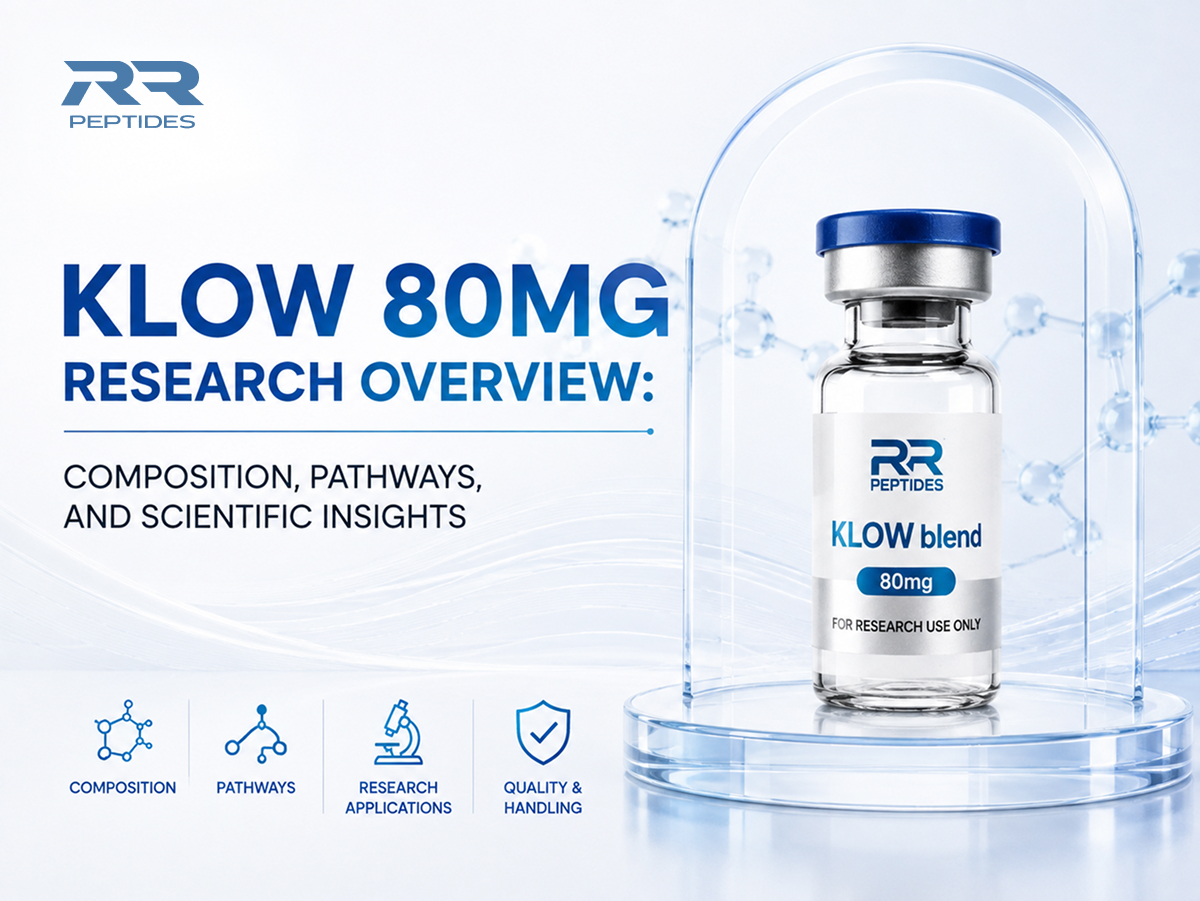
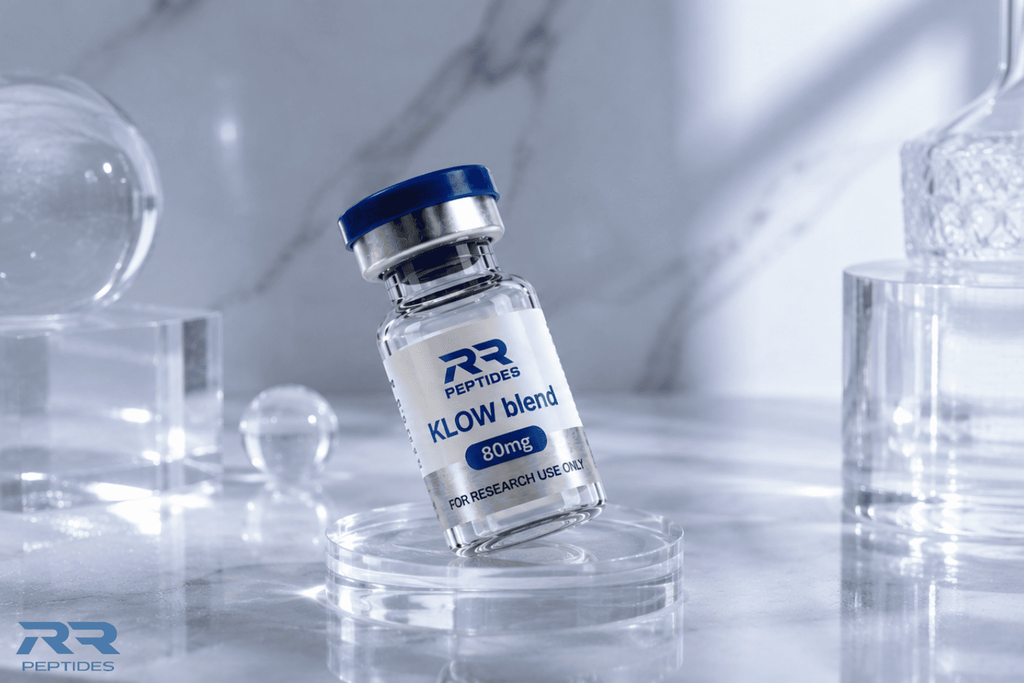
A KLOW 80mg research overview starts with the formulation itself. KLOW 80mg is commonly described as a four-component lyophilized research blend containing GHK-Cu, BPC-157, TB-500, and KPV. The commonly marketed 80 mg composition uses 50 mg of GHK-Cu and 10 mg each of BPC-157, TB-500, and KPV. Each component has a distinct molecular identity, research history, analytical profile, and set of experimental limitations.
For researchers, the key issue is separating what is known about the individual components from what has actually been demonstrated with the complete blend. This distinction helps avoid treating component-level evidence as proof of blend-level activity. Existing literature provides useful scientific context for the four compounds, but direct evidence involving the complete KLOW formulation remains comparatively limited.
At RR Peptides, researchers can explore research-focused peptide products and educational material covering composition, quality testing, batch documentation, storage, and laboratory handling. For Canadian laboratories, evaluating these factors together offers a more reliable basis for studying multi-component peptide preparations.
Introduction to KLOW 80mg Research
The first step in a KLOW 80mg research overview is understanding what the 80 mg designation means. It represents the combined nominal amount of four separate components rather than one 80 mg molecular entity.
Component
Commonly Listed Amount
Share of Total
GHK-Cu
50 mg
62.5%
BPC-157
10 mg
12.5%
TB-500
10 mg
12.5%
KPV
10 mg
12.5%
Total
80 mg
100%
This ratio is important because the four components are not present in equal quantities. GHK-Cu accounts for most of the nominal mass, while the remaining three compounds are each listed at 10 mg.
A useful research overview should therefore look beyond total vial mass and consider the identity and quantity of each component. Analytical methods may need to distinguish several compounds within one preparation, and any change in one component may alter the overall profile of the blend.
Why KLOW Is Treated as a Multi-Component Formulation
KLOW is best understood as a fixed-ratio research formulation. Researchers may use such preparations to investigate co-formulation, analytical stability, comparative biological responses, or interactions among multiple compounds under defined experimental conditions.
However, the presence of several peptides does not prove that their effects are additive or synergistic. Those outcomes must be demonstrated experimentally.
For that reason, a scientifically careful KLOW 80mg research overview treats synergy as a hypothesis rather than an established property of the blend.
Why the Research Context Matters
The individual components have been investigated in different experimental fields. GHK-Cu has a broad literature involving extracellular matrix biology and tissue remodelling. BPC-157 appears mainly in preclinical models. Thymosin-related compounds have been studied in cell migration and actin-associated processes, while KPV has been investigated in inflammatory and epithelial signalling.
These research histories explain why the combination may attract laboratory interest. They do not, however, establish how the full four-component formulation behaves.
Explore research composition and quality with KLOW 80mg.
Understanding the Components of the KLOW Blend
A KLOW 80mg research overview becomes more useful when each component is considered independently before the formulation is evaluated as a whole.
GHK-Cu
GHK-Cu is a copper-binding tripeptide complex composed of glycine, histidine, and lysine associated with copper. In the commonly marketed KLOW formulation, it is listed at 50 mg and represents 62.5% of the nominal mass.
Experimental research involving GHK-Cu has examined extracellular matrix processes, fibroblast activity, collagen-related biology, tissue remodelling, and gene expression. These findings provide useful mechanistic context, but they remain evidence about GHK-Cu rather than direct evidence about KLOW.
The copper complex may also contribute a characteristic blue appearance to preparations containing GHK-Cu. Visual appearance, however, cannot establish identity, purity, or quantity.
From an analytical perspective, a KLOW 80mg research overview should note that GHK-Cu may strongly influence the overall chromatographic or visual profile simply because it is the largest component by mass.
BPC-157
BPC-157 is a synthetic pentadecapeptide studied mainly in preclinical research. Experimental work has explored gastrointestinal models, tissue injury, angiogenic signalling, vascular responses, and cellular migration.
Within KLOW 80mg, BPC-157 is commonly listed at 10 mg.
The important limitation is that observations from isolated BPC-157 should not be transferred directly to the blend. Once BPC-157 is combined with GHK-Cu, TB-500, and KPV, researchers are evaluating a different experimental system.
A balanced KLOW 80mg research overview therefore presents BPC-157 as a source of component-level research context, not as proof of how the entire formulation will behave.
TB-500
TB-500 is commonly associated with thymosin beta-4-related research involving cell migration, cytoskeletal behaviour, actin-associated processes, and tissue-related experimental models.
In the standard 80 mg blend, TB-500 is commonly listed at 10 mg.
One analytical issue deserves special attention: commercial terminology around TB-500 can vary. Researchers should confirm the identity represented by the product label rather than relying on the name alone.
For this reason, any KLOW 80mg research overview should emphasize batch-specific identity information when discussing TB-500-containing formulations.
KPV
KPV is the tripeptide Lys-Pro-Val and corresponds to the C-terminal sequence of alpha-melanocyte-stimulating hormone. Experimental research has explored KPV in inflammatory signalling, epithelial models, and immune-related pathways.
KPV is commonly listed at 10 mg in KLOW 80mg.
Its inclusion distinguishes KLOW from related three-component formulations that contain GHK-Cu, BPC-157, and TB-500 without KPV. This makes KPV particularly relevant in comparative blend research.
In a KLOW 80mg research overview, KPV should therefore be treated both as an individual research compound and as a formulation variable that may help differentiate KLOW from similar multi-peptide preparations.
Biological Pathways Studied with KLOW 80mg
The phrase biological pathways studied with KLOW requires careful interpretation. Most mechanistic information comes from the individual components rather than from controlled studies of the complete four-component blend.
A responsible KLOW 80mg research overview should make that distinction clear.
Tissue-related models, vascular signalling, gastrointestinal research
Evidence is largely preclinical
TB-500 / thymosin-related material
Cell migration, actin-associated processes, cytoskeletal research
Material identity may vary
KPV
Inflammatory signalling, epithelial and immune-related models
Blend-specific contribution remains uncertain
Extracellular Matrix and Tissue-Remodelling Pathways
GHK-Cu provides much of the extracellular matrix context associated with KLOW. Research has examined collagen-related processes, fibroblast behaviour, and tissue remodelling.
These findings may support hypotheses for laboratory studies using the full blend, but they do not establish that KLOW reproduces the same effects.
A KLOW 80mg research overview should therefore frame matrix-related activity as an area informed by GHK-Cu research rather than as a validated property of the complete formulation.
Cellular Migration and Cytoskeletal Processes
Thymosin-related research has frequently focused on cellular migration and actin-associated processes. BPC-157 has also appeared in experimental work involving tissue-related signalling and cell behaviour.
The overlap creates an interesting research question: does combining these compounds produce a measurable difference compared with studying them separately?
That question must be tested directly. A KLOW 80mg research overview should not assume that overlapping research pathways automatically create stronger biological activity.
Inflammatory and Epithelial Signalling
KPV has been investigated in experimental models involving inflammatory pathways and epithelial biology. Its inclusion creates a distinct research variable within KLOW.
Researchers may compare KLOW with a three-component formulation lacking KPV to determine whether measured outcomes differ under controlled conditions.
This type of comparative design is more informative than assuming KPV produces a predictable contribution simply because of its individual research history.
Explore research composition and quality with KLOW 80mg.
Current Areas of Laboratory Investigation
The most useful current research questions involve direct measurement rather than broad claims about what the blend might do.
A KLOW 80mg research overview can therefore focus on four practical areas: comparative component studies, analytical characterization, stability, and batch consistency.
Comparative Component Studies
One informative design is to compare the complete blend with selected individual components.
Researchers may examine isolated GHK-Cu, BPC-157, TB-500, or KPV alongside KLOW under identical experimental conditions. They may also compare KLOW with a related three-component formulation.
This approach can help identify whether an observation is primarily associated with one compound or whether co-formulation changes the result.
For a KLOW 80mg research overview, comparative controls are especially important because they reduce the risk of attributing a blend-level observation to the wrong component.
Analytical Characterization
A four-component formulation creates greater analytical complexity than a single-peptide sample.
Researchers may investigate:
Component identity
Chromatographic separation
Relative or absolute quantity
Degradation-related peaks
Analytical recovery
Changes in the overall profile during storage
HPLC or UPLC may provide chromatographic information when the method is suitable for the compounds present. Mass spectrometry can provide complementary molecular identity information.
A KLOW 80mg research overview should also distinguish purity from quantity. A high chromatographic purity result does not automatically demonstrate that each component is present at its labeled amount.
Stability Investigation
Stability is particularly important in a multi-component formulation because the four compounds may not degrade at identical rates.
Researchers can study whether each component remains detectable over time, whether one component changes faster than the others, or whether the overall blend ratio shifts under defined conditions.
A KLOW 80mg research overview should also distinguish lyophilized material from reconstituted material. Reconstitution creates an aqueous environment in which pH, buffer composition, dissolved oxygen, temperature, concentration, and container interactions may become more important.
Dry-state stability data should therefore not be used automatically to establish post-reconstitution stability.
Batch-to-Batch Comparison
Batch consistency is another valuable research area.
Researchers can compare chromatographic profiles, molecular identity, component quantities, total material, and degradation-related signals across multiple batches.
This is particularly relevant when a commercial formulation is being used in repeated experiments. A KLOW 80mg research overview should note that reproducibility depends not only on experimental technique but also on the consistency of the material being studied.
Canadian Laboratory Context
For Canadian researchers, a KLOW 80mg research overview should also consider product documentation at the batch level. Research suppliers may provide COAs, chromatographic data, mass-spectrometry information, or third-party laboratory reports, but the scope of testing can differ.
The useful question is not simply whether a product is tested. Researchers should determine what was tested, how it was tested, whether the report corresponds to the correct lot, and whether the data answer the quality questions relevant to the experiment.
Limitations of Existing Research Evidence
No KLOW 80mg research overview is complete without a clear discussion of evidence limitations.
The most important limitation is that the literature surrounding the four individual compounds is much broader than the evidence specifically examining the complete KLOW formulation. Researchers should therefore avoid converting component-level observations into conclusions about the blend.
Component Evidence Is Not Blend Evidence
This principle applies throughout the article.
If isolated GHK-Cu influences an extracellular matrix marker in a particular model, that establishes information about GHK-Cu under those conditions. It does not prove that KLOW produces the same result.
Likewise, if KPV affects an inflammatory pathway in an experimental system, that does not establish an anti-inflammatory property for the complete blend.
A KLOW 80mg research overview should maintain this distinction consistently because the blend introduces additional variables, including concentration, component ratio, chemical interactions, and differential stability.
Synergy Requires Direct Evidence
Terms such as additive and synergistic have specific experimental meanings.
To demonstrate synergy, researchers would need appropriate controls comparing individual components, relevant combinations, and the complete formulation under standardized conditions. Statistical analysis would then be required to determine whether the combined response exceeds what would be expected from the separate components.
Without those data, synergy remains a hypothesis.
For this reason, a KLOW 80mg research overview should describe complementary research pathways without presenting them as proof of synergistic activity.
Evidence Quality Is Uneven Across Components
The four components do not share identical evidence bases.
GHK-Cu has an extensive experimental history. BPC-157 is discussed largely through preclinical studies. KPV has a narrower but distinct research literature, while TB-500 terminology and identity can introduce additional uncertainty.
Researchers should account for these differences rather than presenting all four components as equally established.
Analytical Documentation Has Boundaries
A COA can provide valuable information, but its meaning depends on the tests performed.
Identity, purity, quantity, and stability answer different questions. One analytical result should not be expected to establish all four.
For example, high HPLC purity does not automatically confirm component identity by mass spectrometry, labeled quantity, batch stability, or consistency with another lot.
A rigorous KLOW 80mg research overview should therefore encourage researchers to evaluate the complete analytical context instead of relying on a single percentage or marketing claim.
What should a KLOW 80mg research overview include?
A KLOW 80mg research overview should explain blend composition, the research background of the four components, relevant biological pathways, current laboratory applications, analytical testing considerations, and the limitations of available evidence.
What is the commonly listed composition of KLOW 80mg?
The commonly marketed formulation contains 50 mg GHK-Cu, 10 mg BPC-157, 10 mg TB-500, and 10 mg KPV, for a nominal total of 80 mg.
Is KLOW 80mg one peptide?
No. It is a multi-component formulation containing four distinct research compounds rather than one 80 mg molecular entity.
What research areas are associated with the components?
Component-level studies have examined extracellular matrix biology, collagen-related processes, tissue remodelling, cellular migration, vascular signalling, inflammatory pathways, epithelial biology, and other experimental areas.
Has the complete four-component blend been extensively studied?
Direct research on the exact four-component formulation is much more limited than the literature surrounding the individual compounds. This is one of the central limitations highlighted in a KLOW 80mg research overview.
Can component-level findings be applied directly to KLOW?
No. Results involving isolated GHK-Cu, BPC-157, TB-500, or KPV do not automatically establish how the complete blend behaves.
Can researchers assume KLOW is synergistic?
No. Synergy requires controlled comparative evidence. Complementary research pathways alone do not prove synergistic activity.
Why is analytical testing important?
Within a KLOW 80mg research overview, testing can help answer separate questions about component identity, chromatographic purity, quantity, and batch traceability. Multi-component formulations often require more analytical context than single-compound preparations.
Why does batch documentation matter?
Batch-specific documentation helps connect analytical results to the actual material used in an experiment. A report from a different lot may not characterize the current sample.
Is KLOW intended as an approved therapeutic product in Canada?
KLOW should be treated as a laboratory research preparation rather than an approved therapeutic product. Research discussions should remain focused on experimental and analytical use rather than human dosing or treatment claims.
Final Thoughts
A KLOW 80mg research overview is most useful when it separates established information from research hypotheses. The standard formulation is commonly described as 50 mg GHK-Cu, 10 mg BPC-157, 10 mg TB-500, and 10 mg KPV, but each component remains a distinct research compound.
The available literature provides meaningful component-level context. GHK-Cu contributes research involving extracellular matrix and collagen-related biology. BPC-157 is represented mainly by preclinical tissue and vascular models. Thymosin-related research provides context for cell migration and actin-associated processes, while KPV contributes inflammatory and epithelial research questions.
The central limitation is that these separate research histories do not establish how the complete blend behaves. Direct blend-level experiments, appropriate controls, analytical characterization, and stability testing are needed before broader conclusions can be made.
For researchers in Canada, a strong KLOW 80mg research overview should also include attention to batch documentation, component identity, purity, quantitative content, and traceability. These factors support more reproducible interpretation of any experimental work involving a multi-component preparation.
At RR Peptides, researchers can explore additional educational resources covering peptide research, blend composition, analytical quality, COA interpretation, batch verification, storage, and laboratory handling. For researchers evaluating KLOW formulations, careful evidence interpretation remains more valuable than assuming that the combined preparation behaves exactly like its individual components.
Disclaimer: All products and compounds referenced are intended strictly for laboratory and research purposes only. This content is provided for informational and educational purposes and is not intended as medical advice or to diagnose, treat, cure, or prevent any disease.
3 Comments
Really interesting overview of KLOW 80mg from a research perspective. I appreciate that the article focuses on the composition, documentation and research context rather than making broad claims about outcomes. A comparison of the available analytical data across batches would be a useful follow-up.
I found this research overview helpful for understanding the background behind KLOW 80mg. The focus on specifications and quality documentation provides useful context when evaluating research materials. I’d be interested in seeing more about the testing methods used to characterize the material.
Appreciate the straightforward, research-focused approach. Having clear information about batch documentation, analytical testing and traceability is important when reviewing research materials, so this overview provides a useful starting point. A follow-up explaining how to evaluate the supporting documentation would be valuable.





Really interesting overview of KLOW 80mg from a research perspective. I appreciate that the article focuses on the composition, documentation and research context rather than making broad claims about outcomes. A comparison of the available analytical data across batches would be a useful follow-up.
I found this research overview helpful for understanding the background behind KLOW 80mg. The focus on specifications and quality documentation provides useful context when evaluating research materials. I’d be interested in seeing more about the testing methods used to characterize the material.
Appreciate the straightforward, research-focused approach. Having clear information about batch documentation, analytical testing and traceability is important when reviewing research materials, so this overview provides a useful starting point. A follow-up explaining how to evaluate the supporting documentation would be valuable.