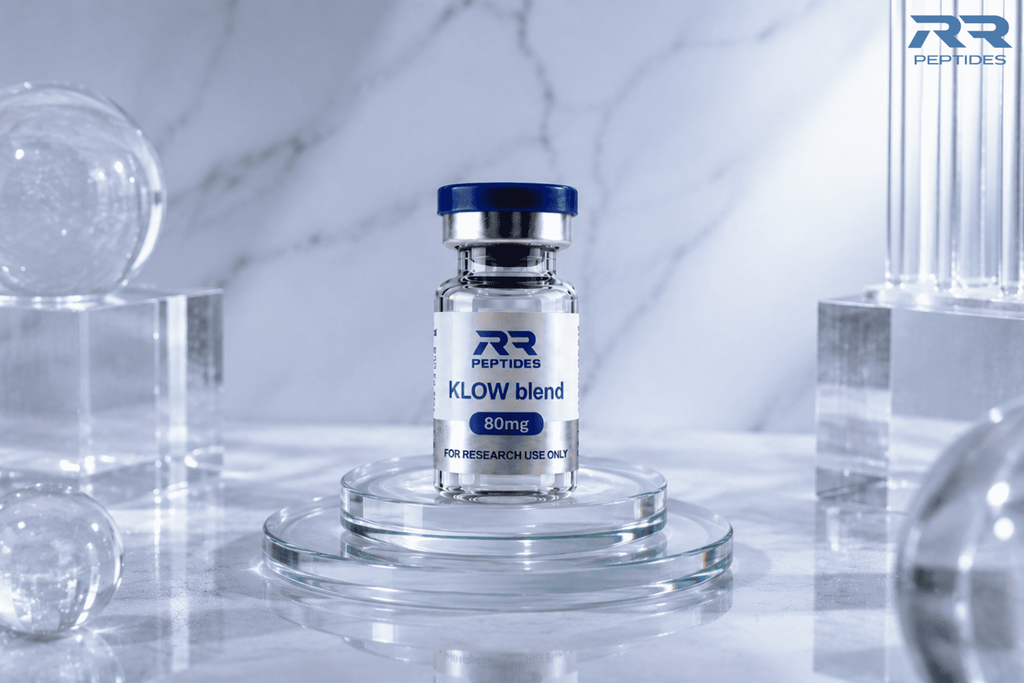
Interest in KLOW 80mg research applications is growing as laboratories explore multi-component peptide formulations across cellular, molecular, tissue, and inflammatory research models. KLOW is commonly described as an 80 mg research blend containing 50 mg GHK-Cu, 10 mg BPC-157, 10 mg TB-500, and 10 mg KPV. Rather than representing a single molecular entity, the formulation combines four distinct research compounds with different experimental backgrounds.
Understanding KLOW 80mg research applications requires an important distinction: research involving individual components does not automatically establish the behavior of the complete blend. GHK-Cu, BPC-157, thymosin-related compounds, and KPV have each appeared in experimental literature, but direct controlled evidence examining the exact four-component KLOW formulation remains comparatively limited. This makes careful experimental design especially important.
For laboratories evaluating multi-component research materials, RR Peptides provides access to research-focused peptide products and educational information covering composition, analytical quality, laboratory applications, and research considerations. Researchers interested in KLOW 80mg research applications should approach the formulation as an experimental system in which individual components, combinations, controls, and measured outcomes need to be clearly distinguished.
Understanding KLOW 80mg Research Applications
The starting point for understanding KLOW 80mg research applications is the composition of the formulation. The commonly marketed 80 mg format uses a 50:10:10:10 mg ratio, meaning GHK-Cu accounts for the majority of the nominal material while BPC-157, TB-500, and KPV are present in equal listed amounts.
The table helps explain why the blend attracts research interest. Its components have been studied in partially overlapping but distinct biological contexts, creating opportunities for comparative experiments and multi-pathway investigation.
However, KLOW 80mg research applications should not be described as established therapeutic effects. A laboratory application is a question that can be investigated experimentally, not evidence that a specific outcome has already been proven.
Why Multi-Component Models Are Scientifically Interesting
Single-compound studies allow researchers to isolate a variable. Multi-component formulations introduce additional complexity but can answer different questions.
Researchers can investigate whether co-formulation alters measurable responses, whether one component dominates an assay, whether overlapping pathways produce distinguishable effects, or whether the presence of one compound changes the stability or analytical behavior of another.
This makes KLOW 80mg research applications particularly relevant to comparative experimental designs. Instead of asking only what each component does independently, researchers can compare isolated compounds with defined combinations and the complete formulation.
The strongest studies still require suitable controls. Without them, an observed change cannot easily be assigned to GHK-Cu, BPC-157, TB-500, KPV, or an interaction among several components.
Explore research composition and quality with KLOW 80mg.
Cellular and Molecular Research Models
Cellular models are among the most practical areas for investigating KLOW 80mg research applications because researchers can control experimental conditions more precisely than in complex biological systems.
Cell culture studies can examine defined molecular markers, cellular responses, signaling pathways, migration behavior, extracellular matrix-related processes, or changes associated with controlled experimental stressors.
Extracellular Matrix and Fibroblast Models
GHK-Cu provides much of the extracellular matrix context associated with the formulation. Experimental literature has examined GHK-Cu in relation to fibroblast activity, collagen-associated processes, extracellular matrix regulation, and tissue remodeling.
These observations make matrix-focused cellular systems a logical research area. Researchers could compare GHK-Cu alone with the complete blend while measuring predefined endpoints related to matrix biology.
Within KLOW 80mg research applications, this type of model is valuable because it allows researchers to determine whether a response associated with isolated GHK-Cu remains similar when GHK-Cu is studied alongside the other three components.
It is important not to reverse that logic. Evidence that GHK-Cu affects a particular marker does not demonstrate that KLOW produces the same response. The blend must be tested directly.
Cell Migration and Cytoskeletal Models
Cell migration provides another potential laboratory model.
Thymosin beta-4-related research has examined actin-associated processes, cytoskeletal organization, and cellular migration. BPC-157 has also appeared in preclinical studies involving cellular and tissue-related responses.
Consequently, KLOW 80mg research applications may include controlled migration assays in which researchers compare individual components, selected combinations, and the complete formulation.
For example, an experimental design could include:
Untreated control
Individual component controls
Selected two- or three-component combinations
Complete four-component KLOW formulation
Standardized assay conditions and predefined endpoints
This structure is more informative than studying the blend alone because it provides a framework for identifying which experimental variable may be associated with a measured response.
Molecular Signaling Models
Researchers may also investigate molecular markers connected to the pathways represented in component-level literature.
Depending on the experimental question, KLOW 80mg research applications could involve analysis of signaling proteins, gene-expression changes, extracellular matrix markers, inflammatory mediators, or other predefined molecular endpoints.
The goal should not be to search broadly for any positive result. A stronger study begins with a defined hypothesis, an appropriate model, suitable controls, and a measurement strategy selected before the experiment begins.
Tissue Repair and Recovery Research
Tissue-related research is frequently associated with several components of the blend, but terminology must be used carefully. “Repair” and “recovery” in a research article refer to experimental models and measured biological processes, not established clinical benefits.
This distinction is essential when discussing KLOW 80mg research applications.
Experimental Tissue Models
BPC-157 has been investigated predominantly in preclinical models involving different forms of tissue-related biology. GHK-Cu has a research history involving extracellular matrix processes and remodeling, while thymosin-related research provides additional context involving migration and cytoskeletal organization.
Because these areas overlap conceptually, researchers may be interested in determining whether the complete formulation produces responses that differ from its components studied independently.
A well-designed KLOW 80mg research applications study might therefore compare changes in predefined tissue-related markers across several experimental groups.
The critical question is not whether all four compounds are associated with “repair” in broad descriptions. The useful scientific question is whether measurable differences appear under the specific conditions of the experiment.
Extracellular Matrix Remodeling
The extracellular matrix provides structural and biochemical support to cells and is dynamically regulated during many biological processes.
GHK-Cu research has contributed significantly to interest in collagen-related biology, fibroblast behavior, and matrix remodeling. These pathways create a potential foundation for studying KLOW 80mg research applications in controlled extracellular matrix models.
Researchers could measure specific matrix-associated endpoints and determine whether results differ between GHK-Cu alone and the complete blend.
Such comparisons are important because GHK-Cu represents 62.5% of the commonly listed KLOW formulation by nominal mass. Without an isolated GHK-Cu control, researchers may have difficulty determining whether an observed matrix-related result reflects the dominant component or the multi-component formulation.
Inflammation and Cellular Signaling Studies
Inflammatory signaling is another area in which KLOW 80mg research applications may be investigated, particularly because KPV has a distinct research background involving inflammatory and epithelial pathways.
KPV is the tripeptide Lys-Pro-Val and corresponds to the C-terminal sequence associated with alpha-melanocyte-stimulating hormone. Experimental work has explored KPV in models involving inflammatory signaling and epithelial biology.
KPV as a Distinct Formulation Variable
KPV is particularly interesting because its inclusion differentiates KLOW from related formulations built around GHK-Cu, BPC-157, and TB-500.
This creates a straightforward comparative research question.
Researchers examining KLOW 80mg research applications could compare a three-component formulation with the four-component KLOW blend while keeping other experimental conditions consistent. Differences between groups could then be evaluated using predefined inflammatory or epithelial markers.
Such an experiment would provide more meaningful evidence about the contribution of KPV than simply extrapolating from studies of isolated KPV.
Inflammatory Signaling Models
Inflammation is not a single pathway. It involves networks of mediators, receptors, transcriptional processes, cellular responses, and feedback mechanisms.
Therefore, KLOW 80mg research applications involving inflammatory models should specify which markers or pathways are being measured rather than using general terms such as “inflammation control.”
Researchers may investigate changes in selected inflammatory mediators, cellular signaling markers, epithelial responses, or gene-expression patterns under standardized laboratory conditions.
Importantly, evidence involving KPV alone should remain clearly labeled as component-level evidence.
Multi-Pathway Investigation
One reason multi-component formulations attract research interest is the possibility of studying several biological pathways within the same experimental framework.
Research Model
Component Providing Major Research Context
Example Experimental Question
Extracellular matrix
GHK-Cu
Does the complete blend alter matrix-related markers differently from GHK-Cu alone?
Cell migration
TB-500-related material, BPC-157
Does co-formulation change migration-related measurements?
Tissue-related signaling
BPC-157, GHK-Cu
Are responses different between individual compounds and the blend?
Inflammatory signaling
KPV
Does adding KPV alter selected inflammatory markers?
Epithelial models
KPV
Are epithelial responses different between KPV alone and KLOW?
Comparative blend research
All four
Does the four-component formulation differ measurably from selected controls?
This table illustrates the most scientifically useful way to approach KLOW 80mg research applications: as testable questions rather than predetermined conclusions.
Explore research composition and quality with KLOW 80mg.
Considerations for Designing KLOW Research Studies
Good experimental design is essential when evaluating KLOW 80mg research applications. Multi-component formulations introduce more variables than single-compound experiments, making controls, material characterization, and endpoint selection particularly important.
Start With a Defined Research Question
A study should begin with a specific question.
Instead of asking whether KLOW “supports recovery,” researchers might ask whether the complete formulation produces a measurable difference in a defined cellular marker compared with GHK-Cu alone under identical assay conditions.
Instead of asking whether KLOW “reduces inflammation,” researchers could compare selected inflammatory markers between KPV, a three-component blend without KPV, and the complete formulation.
This approach makes KLOW 80mg research applications easier to evaluate objectively.
Use Appropriate Experimental Controls
Controls are central to blend research.
If researchers test only KLOW and an untreated group, they may detect a difference but still have limited information about which component contributed to it.
Individual component controls and selected combination controls can provide greater interpretive value.
For KLOW 80mg research applications, a useful experimental structure may therefore involve untreated controls, isolated components, selected combinations, and the complete formulation whenever the model and resources allow.
Verify the Material Being Studied
Composition should not be assumed solely from a product name.
In the Canadian research market, KLOW 80mg is commonly listed as a lyophilized four-component preparation containing GHK-Cu 50 mg, BPC-157 10 mg, TB-500 10 mg, and KPV 10 mg. However, researchers should evaluate the documentation associated with the specific batch used in an experiment.
Analytical questions can include identity, chromatographic purity, component quantity, lot traceability, and whether the available documentation corresponds to the material actually received.
This is important for KLOW 80mg research applications because a multi-component sample requires researchers to understand more than a single overall purity percentage.
Distinguish Identity, Purity, and Quantity
These terms answer different analytical questions.
Identity asks whether the expected compound is present. Purity examines the proportion of the detected material represented by the target compound or relevant chromatographic peak under a specified method. Quantity addresses how much material is present.
HPLC or UPLC can provide useful chromatographic information when an appropriate validated or fit-for-purpose method is used. Mass spectrometry can provide complementary evidence about molecular identity.
For KLOW 80mg research applications, researchers should avoid treating one analytical result as proof of every quality attribute.
Account for Blend-Level Evidence Limitations
Perhaps the most important design consideration is the limited direct evidence surrounding the exact four-component formulation.
The components have different research histories, and their evidence bases are not equally developed. Combining them does not automatically establish additive or synergistic behavior.
A scientifically careful discussion of KLOW 80mg research applications should therefore distinguish among three levels of evidence:
Findings involving an individual component.
Findings involving selected combinations of components.
Findings generated directly with the complete KLOW formulation.
Only the third category directly characterizes the full blend under the conditions tested.
Reproducibility and Batch Documentation
Researchers should also consider whether experimental results can be reproduced across batches.
A repeated study using material from different lots may provide an opportunity to examine whether analytical profiles and experimental outcomes remain consistent.
For Canadian laboratories exploring KLOW 80mg research applications, batch-specific COAs and traceable analytical documentation can provide useful context when comparing results across experiments.
Documentation does not replace experimental controls, but it helps researchers understand the material entering those experiments.
What are the main KLOW 80mg research applications?
The main KLOW 80mg research applications involve laboratory investigation of extracellular matrix biology, cellular migration, cytoskeletal processes, tissue-related experimental models, inflammatory signaling, epithelial biology, analytical characterization, and comparative multi-component studies. These areas are primarily informed by research involving the individual components.
What compounds are included in KLOW 80mg?
The commonly marketed formulation contains 50 mg GHK-Cu, 10 mg BPC-157, 10 mg TB-500, and 10 mg KPV, giving a nominal total of 80 mg.
Is KLOW a single peptide?
No. KLOW is a multi-component research formulation rather than a single 80 mg peptide molecule. Each component has a distinct molecular identity and research background.
Can KLOW be studied in cellular models?
Yes, cellular systems represent one potential area for KLOW 80mg research applications. Depending on the research question, investigators may examine extracellular matrix markers, migration, cytoskeletal processes, inflammatory signaling, epithelial responses, or other predefined cellular endpoints.
Are tissue repair findings established for the complete blend?
No. Research involving individual components should not be interpreted automatically as evidence for the complete formulation. Direct experiments using the blend are necessary to establish blend-specific observations.
Why is KPV important in KLOW research?
KPV provides a distinct inflammatory and epithelial research component and differentiates KLOW from related formulations containing GHK-Cu, BPC-157, and TB-500 without KPV.
Can researchers assume the four components are synergistic?
No. Synergy is an experimental conclusion that requires appropriate comparative controls and statistical evidence. The fact that compounds are associated with complementary research pathways does not by itself demonstrate synergy.
Why are individual component controls useful?
Individual controls help researchers determine whether an observed result is associated primarily with one component or appears only when multiple compounds are studied together.
Why does analytical documentation matter?
Analytical documentation can provide information about identity, purity, quantity, and batch traceability. These factors are particularly relevant when studying a multi-component formulation in which each component may need to be considered separately.
Are KLOW products approved therapeutic products in Canada?
KLOW should be treated as a research formulation rather than an approved therapeutic product. Canadian research discussions should remain focused on laboratory and analytical investigation rather than human treatment, dosing, or therapeutic claims.
Final Thoughts
The scientific value of KLOW 80mg research applications lies in the questions the formulation allows researchers to test. Its four components bring together research contexts involving extracellular matrix biology, cellular migration, cytoskeletal behavior, tissue-related processes, inflammatory signaling, and epithelial models.
However, the presence of multiple research compounds also increases experimental complexity. Component-level findings cannot automatically be transferred to the complete blend, and overlapping pathways do not establish synergy. Appropriate controls, clearly defined endpoints, analytical characterization, and direct comparison remain essential.
For Canadian laboratories, KLOW 80mg research applications are best approached through reproducible experimental design and batch-specific material evaluation. Researchers should understand what is present in the formulation, distinguish component evidence from blend evidence, and interpret measured outcomes within the limitations of the model being used.
Researchers looking to explore high-quality research materials and educational resources can turn to RR Peptides for additional information on peptide composition, laboratory research, analytical quality, and multi-component formulations. As research continues to develop, KLOW 80mg research applications should remain grounded in measurable laboratory evidence rather than assumptions about how individual compounds will behave when combined.
Disclaimer: All products and compounds referenced are intended strictly for laboratory and research purposes only. This content is provided for informational and educational purposes and is not intended as medical advice or to diagnose, treat, cure, or prevent any disease.
3 Comments
This was a useful overview of KLOW 80mg and its current research context. I particularly appreciated the focus on the proposed mechanisms and research applications rather than presenting preliminary findings as established conclusions.
The discussion around KLOW 80mg provides an interesting look at why this compound is attracting attention in experimental research. The emphasis on understanding the available evidence and remaining research questions makes the information feel balanced and informative.
I liked the research-oriented approach to explaining KLOW 80mg, particularly the distinction between potential research applications and conclusions that still require further validation. For emerging compounds, having this kind of context is helpful when assessing the current state of the scientific literature.




This was a useful overview of KLOW 80mg and its current research context. I particularly appreciated the focus on the proposed mechanisms and research applications rather than presenting preliminary findings as established conclusions.
The discussion around KLOW 80mg provides an interesting look at why this compound is attracting attention in experimental research. The emphasis on understanding the available evidence and remaining research questions makes the information feel balanced and informative.
I liked the research-oriented approach to explaining KLOW 80mg, particularly the distinction between potential research applications and conclusions that still require further validation. For emerging compounds, having this kind of context is helpful when assessing the current state of the scientific literature.