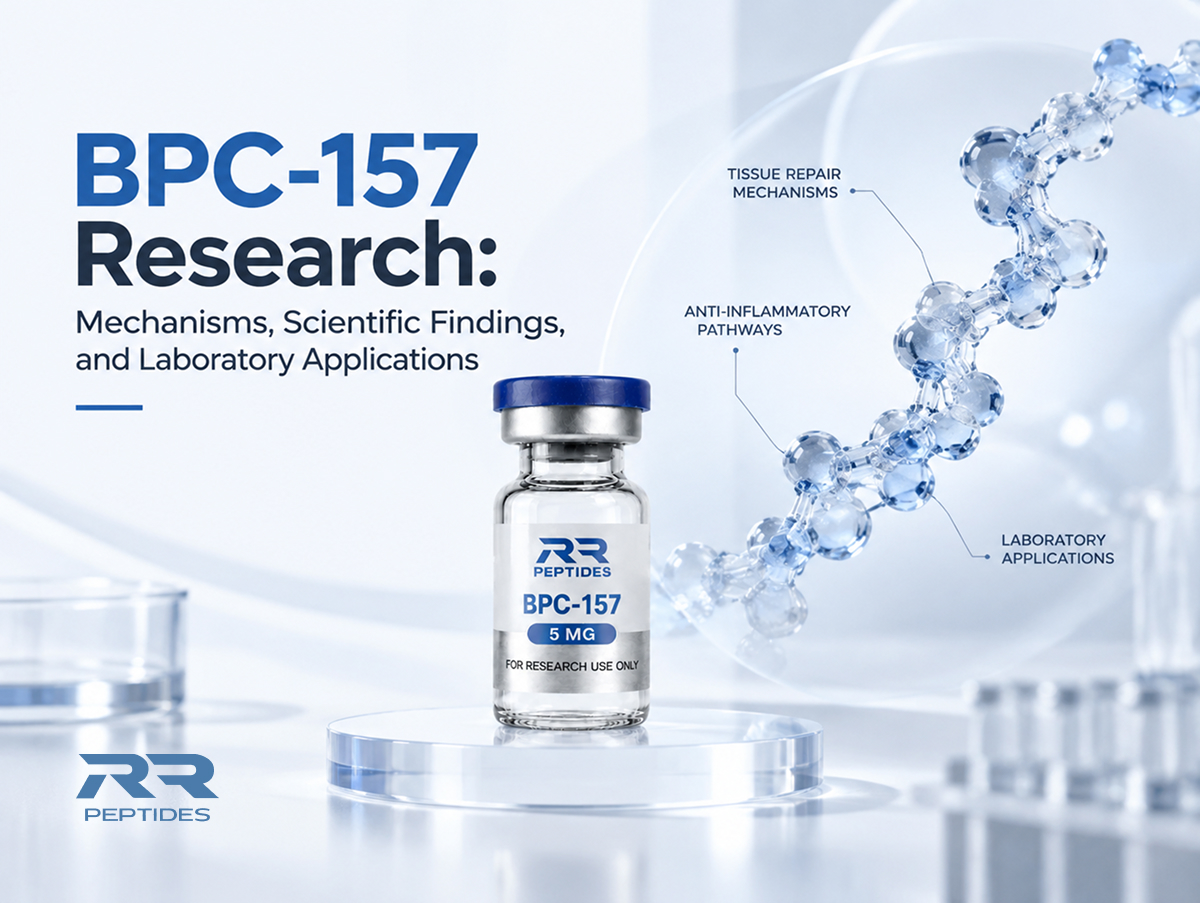
BPC-157 research has attracted attention in preclinical science because investigators have explored this synthetic peptide across several biological and cellular models. Rather than treating early findings as proof of therapeutic effects, a scientific approach focuses on molecular pathways, experimental models, measurable endpoints, and the limitations of available evidence.
For researchers evaluating BPC-157 research materials in Canada, understanding the difference between experimental evidence and therapeutic claims is particularly important. Research-use materials should be evaluated according to their documented specifications, analytical information, and intended laboratory context.
This article examines BPC-157 research from a laboratory perspective, covering proposed biological pathways, major areas of investigation, findings from preclinical models, evidence limitations, and considerations for interpreting scientific literature. For research-focused peptide materials and educational resources, RR Peptides provides information designed to support more informed laboratory research and material evaluation.
What Is BPC-157 Research?
BPC-157 research refers broadly to laboratory and preclinical investigation involving BPC-157, a synthetic peptide that has been studied in experimental models involving cellular, tissue, gastrointestinal, vascular, inflammatory, and other biological processes.
The phrase BPC-157 research should not be interpreted as evidence that BPC-157 is an established therapeutic treatment. Much of the scientific discussion remains based on preclinical work, including animal studies, cellular experiments, and mechanistic investigations. Results from these models can help researchers formulate hypotheses, but they do not automatically establish safety, efficacy, or clinical usefulness in humans.
One reason the subject continues to attract scientific interest is the range of biological systems investigated. Researchers have examined cellular signaling, tissue responses, angiogenesis-related processes, gastrointestinal models, vascular responses, oxidative stress, and cell migration.
Research area
Example experimental focus
Cellular signaling
Molecular responses and signaling pathways
Tissue models
Cellular and structural responses
Gastrointestinal models
Experimental gastrointestinal processes
Vascular research
Blood vessel-related responses
Cell migration
Movement and repair-associated cellular behavior
Inflammatory models
Molecular and cellular inflammatory responses
A useful way to approach BPC-157 research is to distinguish molecular or cellular observations, preclinical animal findings, and human clinical evidence. These levels are not interchangeable, and findings from laboratory or animal models cannot automatically be applied to humans.
Responsible BPC-157 research should consider experimental reproducibility. Researchers should document the peptide material, concentration, model, controls, study duration, analytical methods, and measured endpoints to support accurate interpretation and comparison.
Laboratory documentation also matters. Product identity, batch information, analytical testing, and storage conditions can influence experimental reliability and reproducibility. BPC-157 research is therefore best approached as an evidence-evaluation process rather than a collection of claims about potential benefits.
Explore laboratory research applications with BPC-157 10mg.
Biological Pathways Associated with BPC-157
The biological mechanisms investigated in BPC-157 research are complex and should generally be described as proposed or experimentally observed pathways rather than established mechanisms of clinical action.
Research has examined BPC-157 in relation to cellular signaling, vascular responses, tissue-related processes, inflammatory pathways, and gastrointestinal models. However, the exact molecular mechanisms responsible for reported observations remain an active area of investigation.
Cellular Signaling
Cellular signaling is one of the broader areas associated with BPC-157 research. Investigators have examined how experimental exposure may influence signaling processes involved in cellular responses and tissue behavior.
Signaling pathways are networks rather than isolated switches. A change observed in one signaling molecule does not necessarily mean that an entire biological process has been activated or improved. Researchers therefore need to interpret molecular measurements within the context of the complete experimental system.
Cell Migration and Tissue-Related Processes
Another area investigated in BPC-157 research involves cell migration. Cell movement is an important biological process involved in many forms of tissue organization and remodeling.
Experimental studies examining cell migration can provide useful mechanistic information, but laboratory observations should not be translated directly into claims about healing or therapeutic outcomes.
Vascular-Related Pathways
Preclinical research has also explored vascular responses. Some experimental models investigate processes associated with endothelial cells, blood vessel formation, or vascular signaling.
These findings can help researchers understand how BPC-157 may interact with vascular biology under specific experimental conditions. However, the presence of an observed vascular response in an experimental model does not establish a clinical effect.
Inflammatory Signaling
Inflammatory processes have also appeared in experimental investigations. Researchers may examine inflammatory mediators, cellular responses, oxidative stress, or related molecular markers.
Pathway area
What researchers may measure
Cellular signaling
Protein expression or signaling activity
Cell migration
Changes in cellular movement
Vascular biology
Endothelial or vessel-related responses
Inflammatory processes
Molecular inflammatory markers
Oxidative stress
Oxidative and antioxidant-related markers
The complexity of these pathways explains why BPC-157 research cannot be reduced to a single mechanism. Different experimental models may produce different observations depending on the biological system, concentration, timing, and endpoint.
Researchers should also distinguish correlation from causation. If a molecular marker changes following experimental exposure, the observation does not necessarily demonstrate that the marker is directly responsible for the resulting biological response.
This is particularly relevant when interpreting literature summaries, because secondary sources may describe proposed pathways more confidently than the original experimental evidence allows.
Current Areas of BPC-157 Laboratory Investigation
Current BPC-157 research spans multiple laboratory areas, with a substantial portion of the literature remaining preclinical.
Researchers have investigated gastrointestinal models, tissue-related responses, vascular systems, cellular signaling, inflammation, oxidative stress, and cell migration. The breadth of these research areas is one reason BPC-157 continues to appear in experimental discussions.
Gastrointestinal Research
Gastrointestinal models are among the commonly discussed areas of BPC-157 research. Experimental studies have investigated responses associated with gastrointestinal tissues and related biological processes.
Such models can be useful for exploring molecular and physiological mechanisms. However, observations from animal or laboratory models should not be presented as evidence of an established human treatment.
Tissue and Cellular Models
Laboratory research can also examine cellular responses and tissue-associated processes. These studies may focus on cellular viability, migration, signaling, molecular markers, or structural changes.
Cell-based models offer controlled environments that can help isolate particular biological variables. Their limitation is that isolated cells do not reproduce the full complexity of an organism.
Vascular Models
Vascular research represents another area of investigation. Experimental work can examine endothelial behavior, vascular signaling, and related biological responses.
These models may contribute to mechanistic understanding, but they require careful interpretation because vascular biology involves multiple interacting systems.
Inflammatory and Oxidative Stress Models
Researchers have also examined inflammatory signaling and oxidative stress. Experimental endpoints may include inflammatory mediators, oxidative markers, cellular responses, or tissue-level observations.
Laboratory area
Potential research questions
Gastrointestinal models
How does experimental exposure affect selected gastrointestinal endpoints?
Cellular models
Which signaling or behavioral changes can be measured?
Vascular models
What vascular-related responses occur under controlled conditions?
Inflammation
Which inflammatory markers change?
Oxidative stress
Are oxidative or antioxidant-related markers altered?
Cell migration
Does experimental exposure change cellular movement?
The diversity of BPC-157 research means that researchers should avoid describing the peptide as having one universal biological function.
Instead, each study should be assessed according to its model, experimental conditions, controls, and measured endpoint.
This approach also helps distinguish genuine scientific findings from generalized statements found in commercial or promotional material.
For Canadian laboratories, documentation of research-use materials is equally important. Researchers should maintain clear records of material identity, batch information, analytical documentation, and experimental conditions.
Findings from Preclinical Research Models
Much of the available BPC-157 research comes from preclinical models. These studies can provide valuable information about biological responses, but their findings should be interpreted within the limitations of the experimental model.
Animal studies can investigate complex interactions that cannot be reproduced easily in isolated cells. They may provide information about physiological responses, tissue changes, biochemical markers, and systemic interactions.
Cell-based experiments provide a different type of evidence. They allow researchers to investigate molecular mechanisms under controlled conditions and can help identify potential pathways for further study.
Animal Models
Animal models have been used to investigate gastrointestinal, vascular, inflammatory, and tissue-related responses associated with BPC-157.
A major advantage of these models is their biological complexity. However, species differences can affect metabolism, receptor interactions, immune responses, and physiological outcomes.
Therefore, an observation in an animal model should be described as preclinical evidence rather than direct evidence of human efficacy.
Cellular Models
Cellular models allow researchers to isolate specific biological variables. BPC-157 research using cells can investigate signaling, migration, viability, gene expression, or other measurable endpoints.
These models are useful for mechanistic research because experimental conditions can be tightly controlled.
Their limitation is that cells in culture do not reproduce the complete environment of living tissue. Results can therefore provide hypotheses without establishing how the same process behaves in a whole organism.
Comparative Interpretation
Model
Main strength
Main limitation
Cell culture
High experimental control
Limited biological complexity
Animal model
More complex physiological environment
Species differences
Ex vivo tissue
Preserves some tissue characteristics
Limited systemic interaction
Human clinical study
Direct human evidence
Requires rigorous clinical methodology
When reviewing BPC-157 research, the strength of a finding should therefore be evaluated according to both the result and the model that produced it.
A repeated finding across different models may strengthen a research hypothesis, but it still does not automatically establish therapeutic effectiveness.
Researchers should also examine study controls. Without appropriate controls, it can be difficult to determine whether an observed response is specifically associated with BPC-157 or influenced by another experimental variable.
The concentration used in an experiment is another important consideration. A result obtained under one concentration cannot automatically be generalized to another experimental condition.
Likewise, differences in peptide identity, purity, formulation, storage, and analytical characterization can affect reproducibility.
These considerations make BPC-157 research more nuanced than a simple list of positive or negative findings.
Explore laboratory research applications with BPC-157 10mg.
Limitations of Current Scientific Evidence
One of the most important aspects of BPC-157 research is recognizing what the current evidence cannot establish.
The first limitation is the predominance of preclinical evidence. Laboratory and animal studies are valuable for understanding biological mechanisms, but they are not equivalent to well-controlled human clinical trials.
A second limitation is variation between experimental models. Different studies may use different species, tissues, concentrations, endpoints, and experimental protocols. This makes direct comparison challenging.
Limited Human Evidence
Human evidence is an especially important consideration. Researchers should not assume that extensive preclinical literature means that clinical evidence is equally established.
A scientifically responsible article should therefore avoid statements suggesting that BPC-157 is proven to treat a medical condition.
Model-to-Human Translation
Biological differences between laboratory models and humans create uncertainty when translating findings. Pharmacokinetics, metabolism, immune responses, tissue distribution, and molecular interactions can differ substantially.
Consequently, BPC-157 research should be viewed as a developing scientific field rather than a completed body of clinical evidence.
Reproducibility
Reproducibility is another concern. Researchers need sufficient methodological detail to reproduce an experiment, including material identity, concentration, model, controls, timing, and analytical measurements.
If these details are missing, comparing results between studies becomes more difficult.
Product Documentation
Research involving commercial peptide materials introduces another variable: material quality.
A batch-specific COA may provide information about identity, purity, measured content, or other analytical characteristics depending on the tests performed. However, a single purity percentage does not necessarily verify every aspect of a formulation.
Evidence consideration
Why it matters
Study model
Determines how broadly findings can be interpreted
Experimental concentration
Influences biological observations
Controls
Helps establish causality
Material identity
Supports experimental reproducibility
Analytical testing
Provides evidence about material characteristics
Batch information
Connects testing to a specific material
Study replication
Strengthens confidence in findings
This framework is particularly useful for evaluating BPC-157 research because it prevents individual experimental findings from being presented as universal conclusions.
For Canadian researchers, regulatory status should also remain distinct from scientific evidence. Research-use peptide materials should not be described as Health Canada-approved therapies simply because they are available through a Canadian research supplier.
The strongest scientific approach is therefore to describe what has been observed, identify the model in which it was observed, and clearly state what remains uncertain.
BPC-157 is a synthetic peptide that has primarily been investigated in preclinical research. BPC-157 research includes experimental studies involving cellular, tissue, gastrointestinal, vascular, inflammatory, and related biological models.
What does BPC-157 research investigate?
Researchers have investigated cellular signaling, cell migration, gastrointestinal models, vascular responses, inflammatory processes, oxidative stress, and tissue-related responses.
Is BPC-157 research based mainly on human studies?
No. A substantial portion of the available evidence is preclinical, including animal and laboratory models. Human evidence should be evaluated separately and should not be inferred from preclinical findings.
Does BPC-157 have one confirmed mechanism?
No single mechanism should be treated as definitively established across all experimental systems. Research has investigated multiple biological pathways and cellular processes.
Why are animal models used?
Animal models allow researchers to examine biological interactions in a more complex physiological environment than isolated cells. However, species differences limit how directly these findings can be translated to humans.
What can cell studies tell researchers?
Cell studies can help investigate molecular signaling, cellular behavior, migration, viability, and other controlled endpoints. They are useful for mechanism-oriented research but cannot reproduce the complete physiology of an organism.
Does a positive preclinical result prove therapeutic effectiveness?
No. A positive preclinical finding can support further investigation, but it does not establish human safety or therapeutic efficacy.
Why is experimental concentration important?
Biological responses can depend on concentration and experimental conditions. Therefore, results from one concentration should not automatically be generalized to other conditions.
How important is peptide quality?
Material identity and analytical characterization can be important for reproducibility. Researchers should review available product specifications, batch information, and analytical documentation before interpreting experimental results.
Can a COA prove every characteristic of a peptide?
Not necessarily. A COA provides information based on the analytical tests performed. Researchers should review the actual methods and reported parameters rather than assuming that one document establishes every characteristic.
Is BPC-157 approved by Health Canada?
BPC-157 research should not be confused with therapeutic authorization. Research-use materials and scientific investigation are separate from Health Canada authorization of therapeutic products.
Why should researchers distinguish individual findings?
A result involving BPC-157 under a particular experimental condition does not necessarily apply to every biological model or formulation. Keeping evidence connected to its original experimental context improves scientific accuracy.
What is the best way to evaluate BPC-157 research?
Researchers should examine the original study design, model, controls, concentration, endpoints, material characterization, reproducibility, and limitations. This provides a more reliable interpretation than relying on generalized claims.
Final Thoughts
BPC-157 research remains an active area of preclinical investigation, with studies examining cellular signaling, gastrointestinal models, vascular biology, inflammation, oxidative stress, tissue-related processes, and cell migration. The breadth of these studies makes the subject scientifically interesting, but it also makes careful evidence evaluation essential.
The most important distinction is between experimental findings and established clinical evidence. Laboratory and animal models can reveal biological signals and generate hypotheses, but they cannot independently establish human safety or therapeutic effectiveness.
For researchers, the quality of an investigation depends not only on the peptide being studied but also on experimental design, controls, concentration, analytical characterization, and reproducibility. Batch-specific documentation can provide additional information when evaluating research materials.
In Canada, research-use materials should likewise be considered within their appropriate laboratory context and should not be presented as therapeutically authorized products.
At RR Peptides, researchers can explore research-focused peptide materials and educational resources covering formulation, analytical considerations, and laboratory research. A careful, evidence-based approach can help researchers interpret BPC-157 research more accurately and distinguish established observations from questions that still require further investigation.
Disclaimer:All products and compounds discussed are intended strictly for laboratory and research purposes. This article is provided for educational and informational purposes only and is not medical advice, therapeutic guidance, or instructions for human administration.
3 Comments
I found this overview of BPC-157 research quite interesting, especially the discussion of its proposed biological mechanisms. The focus on available evidence and ongoing research makes it easier to understand where the current knowledge stands.
The range of research surrounding BPC-157 raises some interesting questions about its biological activity. I appreciate the research-focused perspective and the distinction between preclinical findings and conclusions that would require stronger human evidence.
I liked the balanced approach to BPC-157 research presented here. Understanding the proposed mechanisms alongside the limitations of existing studies provides a more objective way to evaluate the scientific literature.
Comments are closed.
×
Subscribe & Get 10% Off!
Enter your email address below to subscribe to our newsletter and receive an instant 10% OFF discount coupon code sent directly to your inbox!
Thank you for subscribing! Your 10% discount coupon has been sent to your email. Please check your inbox!





I found this overview of BPC-157 research quite interesting, especially the discussion of its proposed biological mechanisms. The focus on available evidence and ongoing research makes it easier to understand where the current knowledge stands.
The range of research surrounding BPC-157 raises some interesting questions about its biological activity. I appreciate the research-focused perspective and the distinction between preclinical findings and conclusions that would require stronger human evidence.
I liked the balanced approach to BPC-157 research presented here. Understanding the proposed mechanisms alongside the limitations of existing studies provides a more objective way to evaluate the scientific literature.