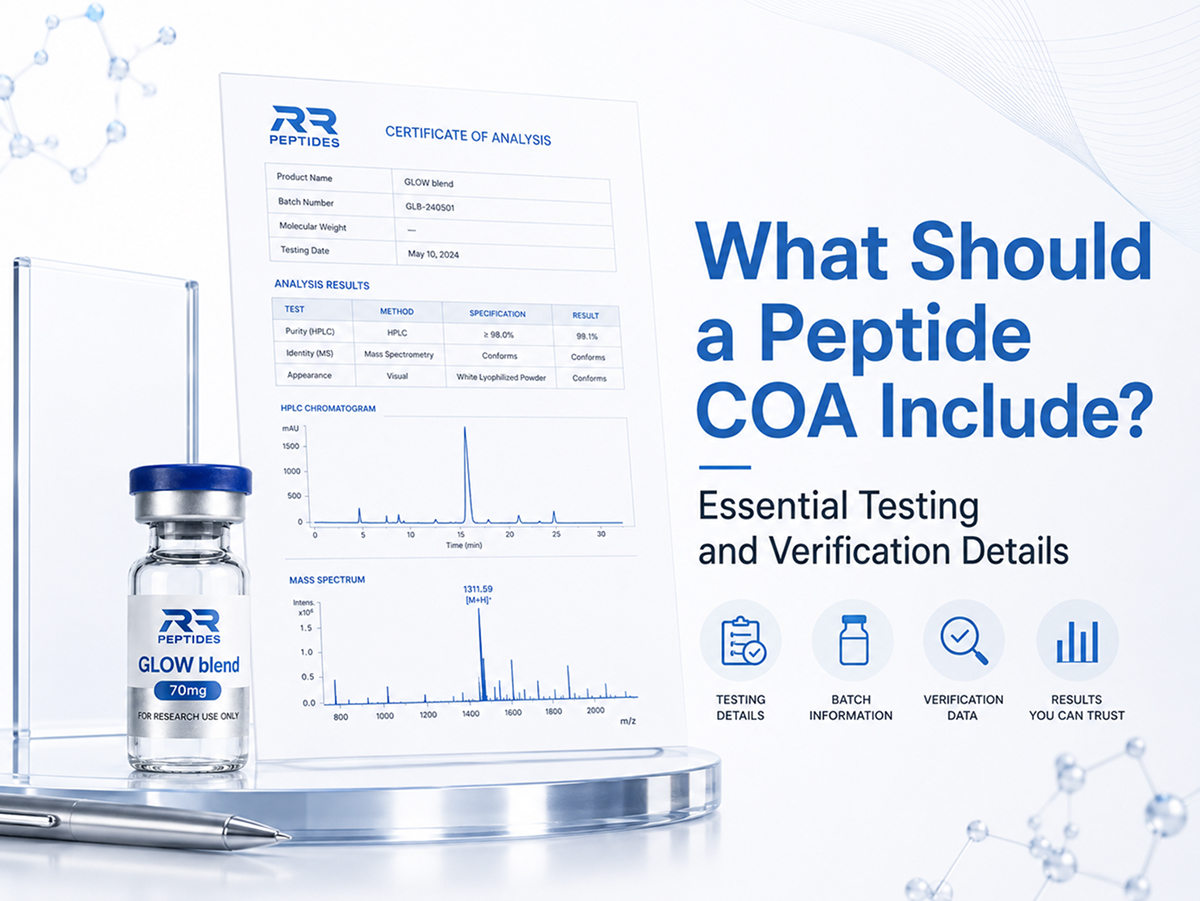
Understanding what should a peptide COA include requires more than checking the highest purity percentage on a Certificate of Analysis. A useful COA should connect a specific peptide sample or production batch with the analytical methods used to evaluate it and the results produced from those methods.
When considering what should a peptide COA include, valuable documentation typically covers product identity, batch information, testing methods, numerical results, purity data, molecular identity, testing dates, and laboratory details. Supporting chromatograms or spectra can provide additional context where available.
The most useful COA is not necessarily the one with the most impressive-looking number. Instead, it is the document that clearly shows what material was tested, how it was tested, and what the analysis actually demonstrated.
For additional research-focused peptide information and analytical resources, explore RR Peptides.
What Should a Peptide COA Include?
When researchers ask what should a peptide COA include, the most useful answer is a clear relationship between the material, batch, analytical method, acceptance criteria, actual results, and testing source.
A practical COA can be viewed as:
Product Identity → Batch → Test Method → Specification → Actual Result → Laboratory Record
COA Element
What It Provides
Why It Matters
Product / peptide name
Identifies the material
Confirms what was tested
Batch / lot number
Identifies the production lot
Supports traceability
Sample ID
Laboratory or product identifier
Links analytical records
Analytical method
Shows how testing was performed
Gives context to results
Specification
Defines acceptance criteria
Allows comparison
Actual result
Shows measured value
More informative than “Pass”
HPLC / UPLC purity
Chromatographic purity data
Evaluates relative detected components
Mass spectrometry data
Molecular information
Supports identity evaluation
Testing date
Indicates when analysis occurred
Establishes timeline
Laboratory identity
Identifies testing source
Improves traceability
Supporting data
Chromatogram, spectrum, or report
Adds analytical context
Not every COA needs to follow the same format. The appropriate testing scope depends on the peptide, analytical objective, and laboratory program.
Understanding what should a peptide COA include means checking whether the document provides enough information to understand the testing that actually occurred.
Specifications vs Actual Results
When evaluating what should a peptide COA include, researchers should distinguish a specification from the actual measured result.
For example:
Test
Specification
Actual Result
HPLC Purity
≥98.0%
99.2%
The specification represents the predefined acceptance criterion. The actual result shows what the laboratory measured for that particular sample.
Therefore, seeing: Specification ≥98% does not mean that the tested batch measured exactly 98%.
Likewise, a simple “Pass” provides less analytical information than a numerical result when the test produces quantitative data.
Explore quality research peptides in Canada at RR Peptides
Product Identity and Batch Information
Product and batch information should appear clearly on the COA because these fields establish which material the test results represent.
Peptide or Compound Name
One basic answer to what should a peptide COA include is clear identification of the peptide or compound submitted for analysis.
Depending on the documentation, additional information may include the peptide sequence, molecular formula, theoretical molecular mass, product code, sample identifier, and material description. These details help define the submitted material and provide additional context for laboratory traceability and analytical review.
These details help define the submitted material, but the name printed on a document should not be confused with analytical confirmation of identity.
Batch or Lot Number
When deciding what should a peptide COA include, the batch number is one of the most important fields.
Ideally, researchers should be able to follow this relationship:
Physical Sample → Batch Number → COA → Analytical Results
If a product label displays one batch number while the COA shows another, the report should not automatically be assumed to characterize that material.
Batch-specific documentation matters because analytical characteristics can differ between production lots.
Sample IDs and Product Codes
An external laboratory may assign its own sample identifier in addition to the supplier’s batch number.
Identifier
Example
Purpose
Product name
Example Peptide
Identifies compound
Supplier batch
RP-0826-A
Identifies production lot
Laboratory sample ID
LAB-46821
Tracks submitted sample
Report number
COA-1842
Tracks laboratory report
Understanding what should a peptide COA include means checking whether multiple sample and product identifiers maintain clear traceability.
Testing Date
When reviewing what should a peptide COA include, the testing date is important because it shows when the analytical work was completed.
An older COA may accurately describe the batch tested at that time, but researchers should avoid assuming it also represents newly produced material.
Testing dates are especially useful when comparing multiple production batches or updated laboratory reports.
Purity and HPLC Analysis Results
When researchers ask what should a peptide COA include, HPLC or UPLC results are commonly expected when chromatographic purity is being reported.
High-performance liquid chromatography separates sample components according to their interactions with the chromatographic system.
In reversed-phase HPLC, different components can move through the column at different rates and appear as separate detector peaks.
Understanding HPLC Purity
A simplified result might look like this:
Peak
Relative Area
Principal peak
98.9%
Minor peak A
0.5%
Minor peak B
0.4%
Minor peak C
0.2%
Total
100.0%
The laboratory may report: HPLC Purity: 98.9%
This generally means that the principal integrated peak accounts for approximately 98.9% of the relevant detected chromatographic area under the analytical conditions used.
HPLC Purity Is Not Automatically Peptide Content
A result of 99% HPLC purity does not automatically mean that 99% of the total vial weight is target peptide.
A lyophilized sample may also contain water, counterions, salts, residual solvents, or other substances that are not represented proportionally in an HPLC area-normalization calculation.
Therefore: 99% HPLC area purity ≠ automatically 99% peptide content by weight
Understanding what should a peptide COA include also requires recognizing that chromatographic purity and quantitative peptide content are different measurements.
If the analytical objective is to determine the amount of target analyte present, a separate quantitative assay may be required.
Why the Chromatogram Matters
When evaluating what should a peptide COA include, a chromatogram can provide useful context beyond the headline purity percentage.
Researchers can examine:
Retention time: when a component elutes from the column under specified conditions.
Peak area: the integrated detector response associated with a component.
Peak separation: how clearly the main component is separated from nearby detectable species.
Minor peaks: other detectable components that may represent peptide-related impurities, degradation products, synthesis-related species, or other substances.
The exact identity of a minor peak generally cannot be determined from appearance alone.
Molecular Identity and Mass Spectrometry Data
A high HPLC purity percentage does not independently establish peptide identity.
For this reason, understanding what should a peptide COA include also involves looking for a method that can provide molecular identity information.
Mass spectrometry is commonly used for this purpose.
What Mass Spectrometry Measures
Mass spectrometry analyzes ions according to their mass-to-charge ratio (m/z).
The theoretical molecular characteristics of a peptide can be calculated from its composition. Observed MS data can then be compared with the expected values.
Understanding what should a peptide COA include means recognizing that MS results consistent with theoretical expectations can provide evidence supporting peptide identity.
Molecular Weight and m/z Are Not Always the Same
Peptides can form ions with different charge states, producing several m/z signals associated with the same molecular species.
When considering what should a peptide COA include, deconvoluted molecular mass data can provide additional context for comparison with the theoretical molecular weight.
Therefore, the most prominent signal in a mass spectrum should not automatically be expected to numerically match the peptide’s neutral molecular weight.
HPLC and Mass Spectrometry Answer Different Questions
Method
Main Analytical Purpose
Does Not Establish Alone
HPLC / UPLC
Chromatographic purity
Definitive molecular identity
Mass spectrometry
Molecular-mass information
HPLC purity percentage
LC-MS
Separation plus molecular information
Every sample characteristic
MS/MS
Additional structural information
Complete quality profile
HPLC and mass spectrometry provide complementary information. A COA containing both can offer broader analytical context than either result alone.
Purity, Identity, and Content Should Be Distinguished
A useful answer to what should a peptide COA include should distinguish the main analytical attributes clearly.
Analytical Attribute
Main Question
Chromatographic purity
How dominant is the principal detected component?
Molecular identity
Is molecular information consistent with the expected peptide?
Content / assay
How much target analyte is actually present?
Knowing what should a peptide COA include also means recognizing that purity, identity, and peptide content should not be treated as interchangeable measurements.
A high HPLC purity percentage does not automatically establish peptide content by weight. Likewise, molecular information consistent with the expected peptide can support identity without independently establishing chromatographic purity.
Researchers should also avoid assuming that unreported characteristics were tested. If water, residual solvents, counterions, specific impurities, or peptide content do not appear on the COA, their evaluation should not be inferred from unrelated HPLC or MS results.
Explore quality research peptides in Canada at RR Peptides
Laboratory Credentials and Testing Dates
Laboratory information is another important part of understanding what should a peptide COA include.
A useful COA should ideally identify the laboratory responsible for generating the analytical results and provide enough information to trace the report.
Relevant information may include:
laboratory name;
laboratory sample ID;
report or certificate number;
analytical methods;
testing date; and
report approval information.
These details help connect the COA with the analytical source.
Third-Party Testing
If a peptide is described as independently or third-party tested, the laboratory should ideally be identifiable.
When considering what should a peptide COA include, independent testing can add verification, but a “third-party tested” claim alone does not establish analytical reliability.
Researchers should still consider whether the batch can be traced, the methods are identified, numerical results are provided, and supporting data can be connected to the report.
Supporting Analytical Data
When considering what should a peptide COA include, remember that a COA is generally a summary document rather than a complete collection of raw instrument data. However, supporting analytical records can provide valuable context.
For example:
HPLC result → Chromatogram
MS identity result → Mass spectrum
Batch result → Laboratory sample identifier
A chromatogram helps researchers examine the separation behind a purity result, while a mass spectrum provides context behind molecular identity information.
The most useful documentation makes it possible to connect the reported result, analytical method, supporting data, and tested batch.
Supporting information may also appear in a separate laboratory report, provided its relationship with the COA remains traceable.
Why Consistency Across COA Documentation Matters
When considering what should a peptide COA include, researchers should also check whether information remains consistent throughout the document. Product names, batch numbers, laboratory sample IDs, analytical methods, and reported results should correspond across the COA and any supporting reports.
For example, an HPLC chromatogram should ideally be traceable to the same batch identified on the main COA. If mass spectrometry data are provided separately, the sample or report identifiers should also connect those results to the relevant material. This becomes especially important when several analytical documents are provided for one production batch.
Researchers should also look for consistent terminology. A report that lists “HPLC purity” in one section but simply states “purity” elsewhere should make clear whether both values refer to the same analytical measurement.
Consistent documentation reduces ambiguity and makes analytical results easier to interpret. A strong COA therefore does more than present individual test results. It creates a coherent record connecting the sample, batch, analytical method, laboratory data, and reported findings in a way that researchers can trace and evaluate.
Clear documentation also makes comparisons between different production batches more meaningful. When identifiers, analytical terminology, and reporting structure remain consistent, researchers can more easily identify changes between batches and confirm whether individual results belong to the correct analytical record rather than relying on isolated values.
Common Red Flags When Reviewing a Peptide COA
Knowing what should a peptide COA include also makes it easier to identify when important analytical context may be missing.
Potential Red Flag
Why It Matters
No batch / lot number
Weak connection between report and material
Purity result without method
Unclear how purity was measured
No actual numerical result
Limited analytical detail
Identity claim without method
Weak support for identification
No testing date
Analytical timeline unclear
No laboratory identity
Reduced traceability
Batch mismatch
Report may represent another lot
Unsupported third-party claim
Testing source cannot be evaluated
No supporting data
Less context behind analytical claims
Knowing what should a peptide COA include helps researchers recognize these gaps without automatically assuming that the COA is invalid. Instead, they indicate that additional documentation may be useful before drawing strong conclusions.
Do Not Rank COAs Only by Purity Percentage
A 99.8% result should not automatically be considered better documentation than a 99.1% result.
Small percentage differences can be influenced by chromatographic conditions, column selection, detector settings, sample preparation, peak integration, and other methodological variables.
Knowing what should a peptide COA include helps researchers recognize that clear batch matching, stated methods, and identity data may be more informative than a slightly higher purity percentage with limited documentation.
Peptide COAs in the Canadian Research Context
For researchers in Canada, quality principles found in regulated Health Canada frameworks provide useful context for evaluating analytical documentation.
In regulated pharmaceutical settings, documentation commonly emphasizes areas such as batch identification, analytical procedures, specifications, numerical results, laboratory traceability, and Certificates of Analysis.
These requirements should not automatically be treated as universal legal requirements for every research peptide or research-material supplier in Canada.
For Canadian researchers asking what should a peptide COA include, these underlying analytical and documentation principles remain useful. A transparent analytical document should clearly identify the tested material, connect it with a batch, state the methods used, and report results in a form that researchers can meaningfully interpret.
When determining what should a peptide COA include, look for product identity, batch or lot number, analytical methods, specifications, actual results, purity data, molecular identity information where tested, testing dates, and laboratory identification.
Should a peptide COA include a batch number?
Yes. Batch identification improves traceability by connecting the analytical results with the specific production lot being evaluated.
Is HPLC purity enough to confirm peptide identity?
No. HPLC primarily provides chromatographic information. Molecular identity generally requires complementary analytical evidence, for which mass spectrometry is commonly used.
Does 99% HPLC purity mean 99% peptide content?
Not necessarily. HPLC area purity and peptide content by total sample weight are different measurements.
Should a COA report actual numerical results?
For quantitative tests, numerical results provide more analytical information than a simple “Pass” or “Conforms” statement.
Should the testing laboratory be identified?
Ideally, yes. Laboratory identification improves traceability and helps establish who generated the analytical results.
Why is the testing date important?
The testing date helps connect the report with a specific analytical event and production batch.
Is third-party testing always more reliable?
No. Independent testing can provide another analytical perspective, but reliability still depends on laboratory competence, suitable methods, sample traceability, and reporting quality.
Does a peptide COA prove every possible quality attribute?
No. A COA only provides evidence for the analytical characteristics that were actually tested and reported.
Final Thoughts
Understanding what should a peptide COA include requires looking beyond the headline purity percentage.
A useful COA should clearly identify the material and production batch, state the analytical methods used, distinguish specifications from actual results, and provide enough laboratory information to support traceability.
HPLC can provide information about chromatographic purity, while mass spectrometry can provide complementary evidence supporting molecular identity. Peptide content and other sample characteristics may require separate analytical methods.
Researchers should therefore evaluate the complete analytical record rather than ranking COAs solely according to purity percentages. Clear links between the sample, batch, method, result, laboratory, and supporting evidence provide a stronger basis for interpreting peptide analytical documentation.
For additional research-focused information about peptide testing, Certificates of Analysis, batch verification, and laboratory documentation, visit RR Peptides.
Disclaimer: All products and compounds referenced are intended strictly for laboratory and research purposes only. This content is provided for informational and educational purposes and is not intended as medical advice or to diagnose, treat, cure, or prevent any disease.
3 Comments
Really useful guide to what a peptide COA should contain. I liked the focus on looking at the full analytical picture rather than relying on a single purity percentage. A practical example of a complete COA with each section explained would be especially helpful for researchers who are new to this type of documentation.
I found the discussion of identity, purity and supporting analytical data particularly helpful. These details can be easy to overlook when reviewing supplier documentation, so having a clear framework makes the process much easier. I’d be interested in a follow-up explaining which missing details should raise questions when reviewing a COA.
Appreciate how clearly this article explains the components of a peptide COA. Understanding what analytical methods, sample information and test results should be included gives useful context when assessing research materials. A checklist for comparing COAs from different suppliers would make a great addition.




Really useful guide to what a peptide COA should contain. I liked the focus on looking at the full analytical picture rather than relying on a single purity percentage. A practical example of a complete COA with each section explained would be especially helpful for researchers who are new to this type of documentation.
I found the discussion of identity, purity and supporting analytical data particularly helpful. These details can be easy to overlook when reviewing supplier documentation, so having a clear framework makes the process much easier. I’d be interested in a follow-up explaining which missing details should raise questions when reviewing a COA.
Appreciate how clearly this article explains the components of a peptide COA. Understanding what analytical methods, sample information and test results should be included gives useful context when assessing research materials. A checklist for comparing COAs from different suppliers would make a great addition.