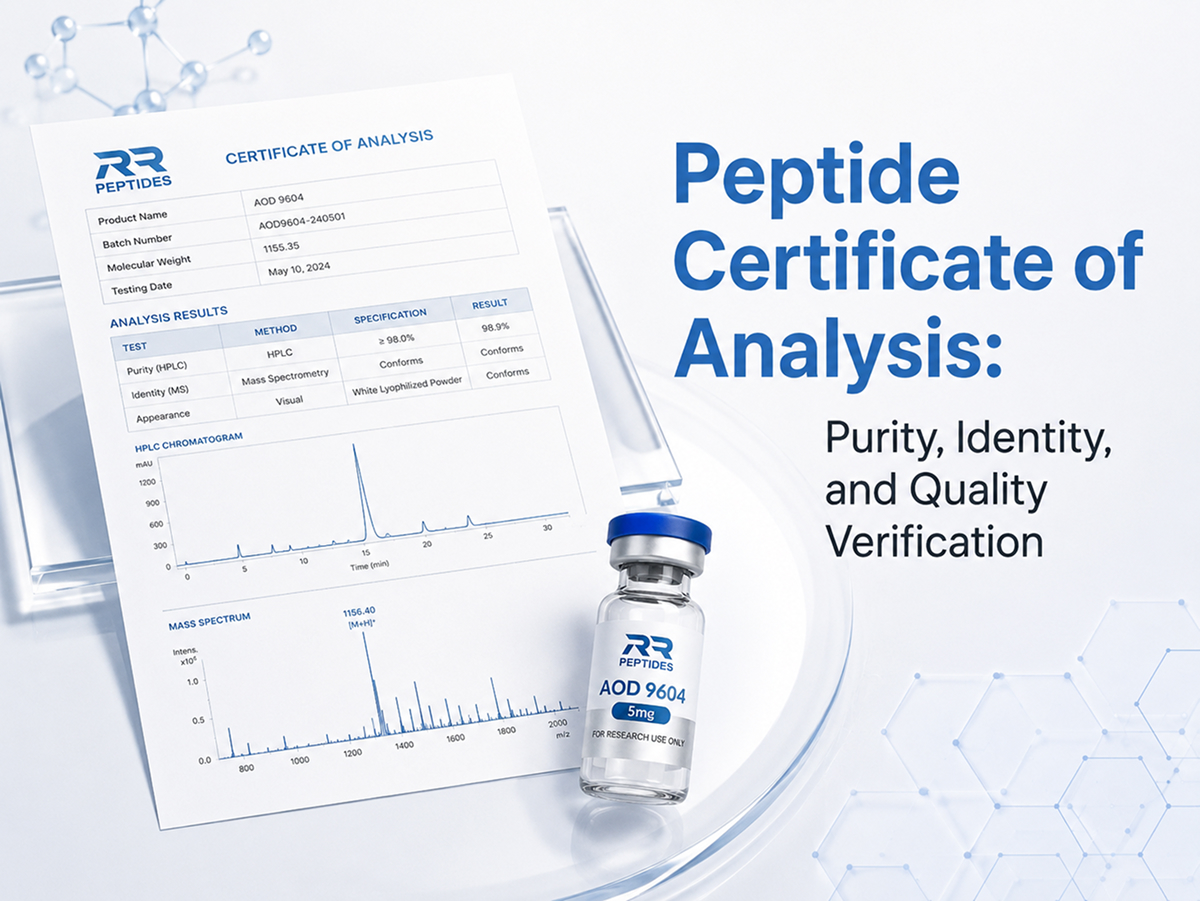
A peptide certificate of analysis (COA) is an important laboratory document for researchers evaluating the analytical characteristics of a peptide batch. It can provide information about purity, molecular identity, batch traceability, testing methods, and other quality-related measurements.
However, a peptide certificate of analysis should not be judged by the purity percentage alone. A result such as “99% purity” becomes more meaningful when researchers know which batch was tested, which analytical method generated the result, and whether supporting chromatographic or molecular data are available.
In peptide research, HPLC is commonly used to evaluate chromatographic purity, while mass spectrometry can provide complementary evidence supporting molecular identity. These techniques answer different analytical questions and should not be interpreted as interchangeable measurements.
For researchers reviewing peptide specifications, testing methods, and laboratory documentation, explore RR Peptides for additional research-focused resources.
What Is a Peptide Certificate of Analysis?
A peptide certificate of analysis is a document summarizing analytical results associated with a specific peptide sample or production batch.
Depending on the testing program, a peptide certificate of analysis may contain the compound name, batch number, analytical methods, specifications, purity results, identity data, and testing date.
A useful COA establishes a clear relationship between:
Sample → Batch → Analytical Method → Test Result
This relationship is important because analytical results should be traceable to the material that was actually tested.
For example, a COA may state: HPLC Purity: 99.1%
That percentage summarizes an analytical result. The underlying HPLC chromatogram provides additional information about the principal peak, minor peaks, retention characteristics, and integration used to calculate the result.
Similarly, a mass spectrometry result may summarize whether observed molecular information is consistent with the expected peptide.
Therefore, the COA serves primarily as an organized summary of analytical testing rather than replacing the underlying laboratory evidence.
For additional research-focused peptide information and analytical resources, explore RR Peptides.
Why Peptide COAs Matter in Laboratory Research
The main value of a peptide certificate of analysis comes from analytical transparency and traceability.
Unlike a vial label, a peptide certificate of analysis provides information about how the material was analytically characterized. A COA adds context by connecting the research material with specific laboratory results.
Batch Traceability
Batch or lot identification is one of the most useful elements of a peptide certificate of analysis.
Synthetic peptide production involves several stages, including peptide assembly, cleavage, purification, processing, drying, and storage. Analytical characteristics can vary between production lots.
For this reason, results from one batch should not automatically be assumed to characterize every future batch of the same peptide.
Ideally: Product batch number = COA batch number = laboratory sample identifier
This connection allows researchers to determine whether the analytical documentation corresponds to the material being evaluated.
Analytical Transparency
A peptide certificate of analysis also helps researchers understand the scope of laboratory testing.
For example, an HPLC purity result does not automatically establish that molecular identity was evaluated. Likewise, a mass spectrometry result does not demonstrate that every possible impurity, residual solvent, or other sample characteristic was measured.
The value of the COA therefore depends partly on how clearly it identifies what was tested and how it was tested.
Key Information Found on a Peptide COA
The exact structure of a peptide certificate of analysis varies between laboratories and suppliers. However, several elements can make the document substantially more informative.
COA Element
What It Shows
Why It Matters
Compound name
Identifies the reported peptide
Confirms which material was analyzed
Batch / lot number
Identifies the production lot
Supports batch traceability
Testing date
Shows when analysis occurred
Provides timing context
Analytical method
Identifies how testing was performed
Helps researchers interpret results
Specification
Defines an acceptance criterion
Provides a reference for evaluation
Actual result
Shows the measured value
More informative than “Pass” alone
HPLC purity
Reports chromatographic purity
Evaluates relative detected peak area
MS data
Provides molecular information
Supports identity evaluation
Laboratory identity
Identifies who performed testing
Improves analytical traceability
Chromatogram / spectrum
Provides supporting evidence
Adds context to reported results
Specifications and Actual Results
On a peptide certificate of analysis, a specification should not be confused with the measured result.
For example:
Test
Specification
Actual Result
HPLC Purity
≥98.0%
99.1%
The specification defines the expected acceptance criterion. The actual result describes what was measured for that particular sample.
Therefore, a numerical result generally provides more analytical information than a simple statement such as “Pass” or “Conforms.”
Understanding Purity and Identity Test Results
One of the most important parts of evaluating a peptide certificate of analysis is understanding that purity and identity are different analytical characteristics.
A peptide can produce a high chromatographic purity result, but that percentage alone does not prove that the dominant chromatographic component has the expected molecular identity.
HPLC and Chromatographic Purity
High-performance liquid chromatography (HPLC) is widely used to evaluate peptide chromatographic purity.
During reversed-phase HPLC analysis, sample components interact differently with the stationary phase and mobile phase. These differences allow components to separate as they move through the chromatographic system.
The detector records these components as peaks.
A simplified example might look like this:
Component
Relative Peak Area
Main peptide-related peak
98.9%
Minor peak A
0.6%
Minor peak B
0.3%
Minor peak C
0.2%
Total
100.0%
Using peak-area normalization, the laboratory may report approximately 98.9% HPLC purity.
What Does 99% HPLC Purity Mean?
A result of 99% HPLC purity generally indicates that the principal integrated component represents approximately 99% of the relevant detected chromatographic area under the analytical conditions used.
It does not necessarily mean that 99% of the total sample mass consists of the target peptide.
This distinction matters because the sample may also contain water, counterions, salts, residual solvents, or other components that are not represented proportionally by the HPLC area calculation.
Therefore: HPLC area purity ≠ automatically peptide content by weight
This is one of the most important distinctions when interpreting a peptide certificate of analysis.
Why the Chromatogram Matters
A peptide certificate of analysis becomes more informative when researchers can review the corresponding chromatogram.
The chromatogram may show:
the principal peak;
minor detectable peaks;
retention information;
chromatographic separation; and
integrated peak areas.
This allows researchers to see the analytical data behind the reported percentage instead of relying exclusively on the summary value.
Mass Spectrometry and Peptide Identity
On a peptide certificate of analysis, mass spectrometry provides different analytical information from HPLC.
The technique analyzes ions according to their mass-to-charge ratio (m/z). Observed molecular information can then be compared with the theoretical molecular mass expected for the peptide.
When the observed data are appropriately consistent with the expected value, mass spectrometry can provide evidence supporting peptide identity.
The distinction can be summarized as follows:
Analytical Method
Primary Information
HPLC / UPLC
Chromatographic purity and separation
Mass spectrometry
Molecular identity support
LC-MS
Chromatographic separation plus molecular information
MS/MS
Additional structural information through fragmentation
This is why a peptide certificate of analysis may include both HPLC and mass spectrometry results.
HPLC can characterize the relative chromatographic composition of the sample, while MS provides complementary information about whether the detected molecular characteristics are consistent with the expected peptide.
A Molecular Mass Match Is Not a Purity Result
When reading a peptide certificate of analysis, mass spectrometry should not be interpreted as a substitute for chromatographic purity testing.
A molecular mass consistent with the expected peptide supports identity, but it does not independently establish that the sample is 98%, 99%, or another percentage pure.
Likewise, a high HPLC purity percentage does not independently establish molecular identity.
Combining complementary analytical methods can therefore provide a more informative characterization of the sample.
Purity, Identity, and Peptide Content Are Different
Three measurements frequently appear on a peptide certificate of analysis: purity, identity, and peptide content.
Understanding their differences prevents misleading interpretations of COA results.
Purity
Purity generally describes the relative presence of the principal chromatographic component compared with other detectable components under specified analytical conditions.
Identity
Identity addresses whether the analyzed material is consistent with the expected peptide.
Mass spectrometry is commonly used to provide molecular information supporting this assessment.
Content or Assay
Content or assay addresses how much target analyte is actually present.
A quantitative assay may require calibration against an appropriate reference standard and a method specifically designed for quantitative measurement.
Therefore, a sample can potentially show high HPLC chromatographic purity without the reported percentage representing the total peptide content by mass.
This is why researchers should avoid treating purity, identity, and assay values as interchangeable measurements.
Explore quality research peptides in Canada at RR Peptides
How to Evaluate the Reliability of a Peptide COA
The appearance of a professional laboratory report does not automatically determine its analytical value.
Researchers can evaluate a peptide certificate of analysis using several practical criteria.
1. Confirm the Batch or Lot Number
The batch identifier on the COA should correspond to the material being evaluated.
If the batch numbers do not match, the report may describe a different production lot.
2. Identify the Analytical Methods
A result becomes easier to interpret when the testing method is clearly identified.
For example: Purity: 99.2% provides less analytical context than: HPLC Purity: 99.2%
Similarly, an identity statement is more informative when the COA identifies the method used to generate it.
3. Review Actual Numerical Results
When an analytical procedure produces quantitative data, the measured result can provide more useful information than a simple pass/fail statement.
For example: Specification: ≥98.0% ; Result: 99.1%
provides clearer analytical information than: Purity: Pass
4. Review Supporting Analytical Data
When reviewing a peptide certificate of analysis, researchers can examine available chromatograms, spectra, or associated laboratory reports.
These materials help connect the summarized COA result with the underlying analytical evidence.
5. Check the Laboratory and Testing Date
A peptide certificate of analysis should ideally identify the laboratory responsible for the analysis and the testing date.
Testing dates provide useful context because an older report may represent a historical production lot rather than current material.
Why Batch-Specific COAs Matter
Batch-specific testing provides stronger traceability than a generic COA used across multiple production lots.
Peptide synthesis and purification involve several processes that may introduce some variation between batches. Consequently, analytical results from one lot should not automatically be extended to another.
A batch-specific peptide certificate of analysis allows researchers to connect the reported purity and identity information with the actual material being evaluated.
Repeated testing across production lots can also provide useful information about consistency.
Researchers may compare:
chromatographic purity values;
chromatographic profiles;
molecular identity results;
analytical methods;
specifications; and
testing dates.
Small differences between batches do not automatically indicate a quality problem. Analytical variability, sample preparation, storage conditions, and normal manufacturing differences can all influence measured results.
The important point is that each result should remain connected to the batch from which the tested sample originated.
Common Red Flags When Reviewing a Peptide COA
A peptide certificate of analysis should provide enough information to understand what was tested and what the reported results represent.
Several features may indicate that additional analytical context is needed.
Missing Batch or Lot Number
Without a batch identifier, researchers may be unable to connect the COA with the material they are evaluating.
Purity Percentage Without a Method
A statement such as “99% purity” provides limited information when the analytical method is not identified.
Identity Claim Without Supporting Method
If identity is reported, the document should ideally indicate how the determination was made.
Only “Pass” or “Conforms”
These statements may communicate whether a specification was met, but numerical results provide more detail when the underlying test is quantitative.
Missing Testing Date
Without a testing date, a peptide certificate of analysis may be difficult to connect with current or historical material.
Limited Supporting Data
A COA becomes more informative when major analytical claims can be connected to chromatograms, spectra, or related laboratory documentation where appropriate.
These factors do not automatically mean that a COA is invalid. Instead, they identify areas where researchers may need additional information before drawing conclusions.
How to Read a Peptide Certificate of Analysis Step by Step
Researchers can make COA evaluation more efficient by following a consistent review process.
Step 1 — Confirm the compound. Check that the peptide name corresponds to the research material.
Step 2 — Match the batch. Verify that the batch or lot number on the report corresponds to the sample.
Step 3 — Identify the analytical methods. Determine which techniques were used for purity, identity, and other measurements.
Step 4 — Compare specifications and results. Distinguish the acceptance criterion from the actual measured value.
Step 5 — Review supporting data. Examine chromatograms, spectra, or related laboratory reports when available.
Step 6 — Separate analytical conclusions. Avoid treating purity, identity, content, or other measurements as if they demonstrate the same characteristic.
Step 7 — Maintain batch records. Keeping the COA associated with the corresponding experimental material improves laboratory traceability.
This structured approach allows researchers to focus on the analytical value of the document rather than simply looking for the highest purity percentage.
Peptide COAs in the Canadian Research Context
For Canadian researchers, Health Canada guidance for regulated pharmaceutical products provides useful examples of established analytical-documentation principles.
In regulated contexts, Health Canada emphasizes areas such as batch identification, analytical procedures, actual numerical results, Certificates of Analysis, method suitability, and traceability.
These regulatory requirements should not automatically be assumed to apply to every research peptide sold or studied in Canada. Research materials may fall under different regulatory circumstances.
However, these analytical principles remain useful when evaluating a peptide certificate of analysis in a Canadian research context.
A well-documented analysis should clearly identify the material tested, connect the results to a specific batch, describe the analytical method, and report measurements in a form that researchers can meaningfully interpret.
This approach is more informative than evaluating a peptide exclusively according to a headline purity claim.
SEE MORE:
How to Read a Peptide COA: Purity Results, Batch Data, and Testing Methods
What Should a Peptide COA Include? Essential Testing and Verification Details
Peptide COA vs Laboratory Report: Key Differences and Quality Documentation
Peptide Batch Number Verification: Traceability, COA Matching, and Quality Control
Peptide COA Red Flags: How to Identify Incomplete or Unreliable Test Result
FAQ About Peptide Certificates of Analysis
What is a peptide certificate of analysis?
A peptide certificate of analysis is a document summarizing analytical information associated with a peptide sample or production batch. It may include batch identification, testing methods, specifications, purity results, identity information, and testing dates.
What should a peptide COA include?
Useful information may include the compound name, batch or lot number, analytical methods, specifications, actual numerical results, testing date, laboratory identity, and supporting chromatographic or mass spectrometry data.
What does HPLC purity mean on a peptide COA?
HPLC purity generally describes the relative chromatographic area associated with the principal component compared with other relevant integrated peaks under specified analytical conditions.
Does 99% HPLC purity mean 99% peptide by weight?
Not necessarily. HPLC area purity and total peptide content by mass are different measurements.
Does high HPLC purity confirm peptide identity?
No. Chromatographic purity and molecular identity are separate analytical characteristics. Mass spectrometry can provide complementary molecular information supporting identity.
Why is mass spectrometry included on a peptide COA?
Mass spectrometry provides molecular-mass information that can be compared with the expected peptide, supporting identity evaluation.
Why is a batch number important?
A batch number connects analytical results with a specific production lot, improving traceability between the tested sample and its COA.
Is a COA enough to verify peptide quality?
A COA provides valuable analytical information, but its usefulness depends on the scope of testing, methods, batch traceability, actual results, and supporting evidence.
Can two laboratories report different peptide purity results?
Yes. Differences in chromatographic methods, instrumentation, sample preparation, integration procedures, or sample condition may contribute to different reported values.
Final Thoughts
A peptide certificate of analysis is most valuable when it provides clear, batch-specific analytical information rather than simply displaying a high purity percentage.
HPLC can provide evidence about chromatographic purity, while mass spectrometry can support molecular identity. Peptide content and other quality characteristics may require separate analytical procedures depending on the research objective.
Researchers should therefore evaluate COAs according to batch traceability, analytical methods, actual numerical results, testing dates, and supporting laboratory data. These elements provide the context needed to understand what an analytical result actually demonstrates.
Ultimately, transparent and well-organized documentation makes it easier to connect laboratory findings with the specific research material being evaluated and supports more informed interpretation of peptide analytical data.
For additional research-focused peptide information, testing education, and laboratory resources, explore RR Peptides.
Disclaimer: All products and compounds referenced are intended strictly for laboratory and research purposes only. This content is provided for informational and educational purposes and is not intended as medical advice or to diagnose, treat, cure, or prevent any disease.
3 Comments
Really useful overview of peptide certificates of analysis. I liked the emphasis on reviewing analytical documentation rather than relying solely on a supplier’s stated purity. A practical example showing how to evaluate the main sections of a COA would be especially helpful.
I found the explanation of peptide COAs easy to follow, especially the discussion around purity and identity testing. It’s helpful to understand what the analytical data actually tells researchers about a sample. I’d be interested in seeing a guide to spotting incomplete or questionable documentation.
Appreciate the research-focused approach to understanding peptide COAs. Looking at purity, identity and supporting analytical information together seems much more useful than focusing on a single specification. A follow-up comparing common analytical methods found in peptide COAs would make a great addition.
Comments are closed.
×
Subscribe & Get 10% Off!
Enter your email address below to subscribe to our newsletter and receive an instant 10% OFF discount coupon code sent directly to your inbox!
Thank you for subscribing! Your 10% discount coupon has been sent to your email. Please check your inbox!




Really useful overview of peptide certificates of analysis. I liked the emphasis on reviewing analytical documentation rather than relying solely on a supplier’s stated purity. A practical example showing how to evaluate the main sections of a COA would be especially helpful.
I found the explanation of peptide COAs easy to follow, especially the discussion around purity and identity testing. It’s helpful to understand what the analytical data actually tells researchers about a sample. I’d be interested in seeing a guide to spotting incomplete or questionable documentation.
Appreciate the research-focused approach to understanding peptide COAs. Looking at purity, identity and supporting analytical information together seems much more useful than focusing on a single specification. A follow-up comparing common analytical methods found in peptide COAs would make a great addition.