When researchers begin examining semaglutide, the first question is often what is Semaglutide peptide and how should this molecule be understood in a laboratory context? Semaglutide is a modified peptide analogue related to human glucagon-like peptide-1, commonly called GLP-1. Its research profile involves receptor pharmacology, intracellular signaling, metabolic biology, and experimental models.
Understanding what is Semaglutide peptide requires more than a simple definition. This also clarifies what is Semaglutide peptide. Researchers also need to consider molecular structure, biological characteristics, receptor interaction, analytical identity, purity, experimental models, and evidence limitations. RR Peptides provides research-focused information about peptide materials and laboratory research, helping readers place semaglutide findings within an appropriate scientific context.
For Canadian laboratories, research planning should also consider institutional procedures, laboratory safety, material documentation, and applicable requirements for the specific study. Research-use material should be distinguished from products authorized for therapeutic use. Commercial availability alone does not establish therapeutic authorization.
What is Semaglutide peptide? Semaglutide is a modified peptide analogue of human GLP-1 that acts as an agonist of the glucagon-like peptide-1 receptor, or GLP-1R. Native GLP-1 is an endogenous peptide hormone involved in glucose-dependent insulin secretion, glucagon regulation, gastrointestinal processes, and appetite-related signaling. Semaglutide was designed to retain GLP-1 receptor activity while incorporating structural changes that substantially extend its persistence compared with native GLP-1.
Understanding what is Semaglutide peptide also means separating molecular identity from biological conclusions. A research material should be considered according to its sequence, chemical modifications, formulation, purity, analytical profile, and batch information. These characteristics provide the foundation for interpreting experimental observations.
Semaglutide contains 31 amino acids and is structurally related to human GLP-1. That context helps define what is Semaglutide peptide. It includes specific substitutions and a modified lysine side chain containing a linker and fatty-acid-derived group. These features influence enzymatic stability and reversible association with albumin. The resulting molecular properties contribute to a prolonged pharmacological profile.
A concise research description can be summarized as follows:
Characteristic
Research description
Molecular class
Modified GLP-1 analogue
Primary target
GLP-1 receptor
Peptide length
31 amino acids
Main research areas
Receptor signaling, metabolic biology, cellular research
Important quality factors
Identity, purity, formulation, batch consistency
Researchers should distinguish semaglutide from native GLP-1 and from other GLP-1 receptor agonists. Similar receptor activity does not mean that different molecules have identical structures, stability, pharmacokinetics, or experimental behavior. This distinction is particularly important when comparing findings from separate studies.
For research purposes, the most useful definition of what is Semaglutide peptide connects molecular identity with experimental purpose. Each model answers a different question.
RR Peptides focuses on research-oriented peptide information, including material characteristics, laboratory applications, and analytical considerations. Researchers can use such information alongside primary literature and laboratory documentation when assessing experimental materials.
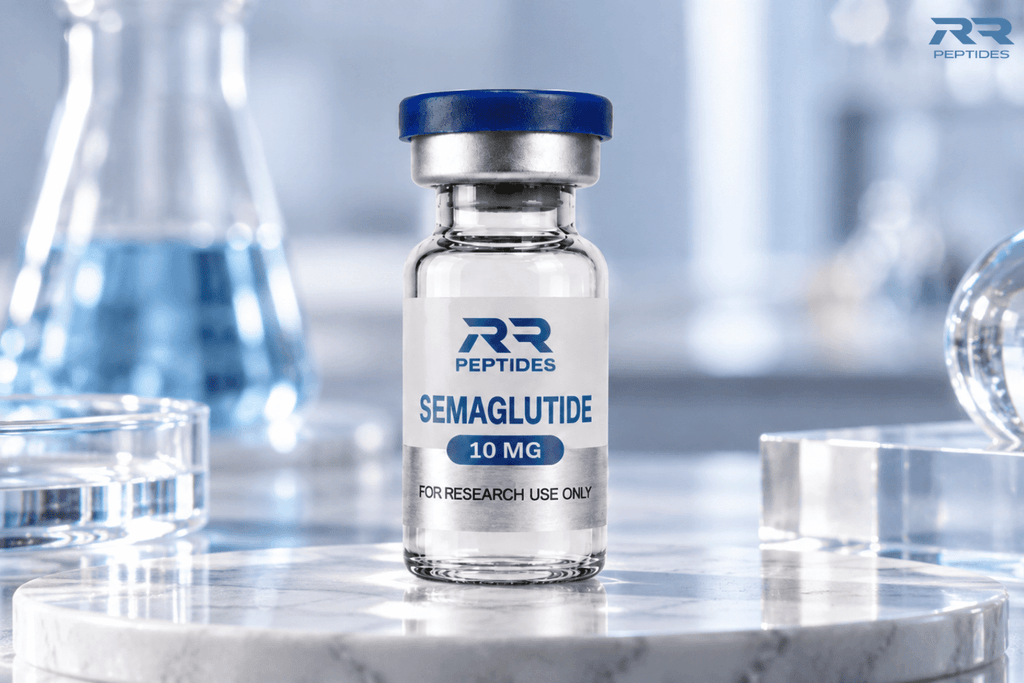
Explore the research specifications and laboratory information available from RR Peptides for Semaglutide 10 mg.
Structure and Biological Characteristics of Semaglutide
Understanding what is Semaglutide peptide at the structural level begins with its relationship to endogenous GLP-1. The structure helps establish what is Semaglutide peptide. Semaglutide is a long-acting GLP-1 analogue with modifications that affect degradation, protein association, and biological persistence. These modifications are central to its molecular identity and help explain why its behavior differs from native GLP-1.
One important feature is an amino-acid substitution that contributes to resistance against enzymatic degradation. Another involves modification of a lysine side chain with a linker and fatty-acid-derived group. This modification promotes reversible binding to albumin, which can reduce renal clearance and contribute to prolonged exposure.
The molecule also contains structural features that preserve interaction with the GLP-1 receptor. However, structural similarity should not be interpreted as complete biological equivalence. Researchers should evaluate the exact material used in an experiment and consider whether the study describes semaglutide itself, another GLP-1 analogue, or native GLP-1.
Structural characteristics relevant to research
Researchers evaluating semaglutide may examine:
Amino-acid sequence and molecular identity
Chemical modifications relative to native GLP-1
Molecular mass and analytical profile
Albumin-associated behavior
Resistance to enzymatic degradation
Purity and batch consistency
These characteristics help explain what is Semaglutide peptide from a chemistry and research-design perspective. This distinction further explains what is Semaglutide peptide. A properly characterized material allows researchers to connect observed biological responses with a defined experimental substance.
Structural feature
Potential research relevance
GLP-1-related peptide sequence
Supports GLP-1 receptor interaction
Amino-acid substitution
Influences enzymatic stability
Modified lysine side chain
Supports lipid-associated modification
Fatty-acid-derived group
Contributes to protein association
Analytical characterization
Supports identity and reproducibility
Biological characteristics should be interpreted together with experimental conditions. Concentration, assay format, cell type, receptor expression, incubation period, and analytical method can all influence observed results. Consequently, a molecular property does not automatically predict the response in every biological system.
Researchers comparing semaglutide with other GLP-1-related compounds should therefore document the specific material, model, endpoint, and assay conditions. This approach helps avoid attributing findings from one compound to another simply because they share a receptor target.
For Canadian research settings, documentation can be especially useful when studies are performed across laboratories or when results are compared with published literature. Batch identifiers, certificates of analysis, storage records, and analytical testing can support traceability and help researchers investigate differences between experimental results.
How Semaglutide Interacts with GLP-1 Receptors
A central aspect of what is Semaglutide peptide is its interaction with the GLP-1 receptor. Receptor biology helps explain what is Semaglutide peptide. GLP-1R is a class B G protein-coupled receptor expressed in tissues including pancreatic beta cells. When an agonist activates the receptor, intracellular signaling networks can change, with cyclic adenosine monophosphate, or cAMP, serving as an important second messenger.
Semaglutide binds to GLP-1R and promotes receptor activation. In pancreatic beta-cell research, receptor activation can increase cAMP and influence signaling associated with glucose-dependent insulin secretion. The magnitude and characteristics of the response depend on the cellular system, glucose environment, receptor expression, experimental conditions, and endpoint selected.
Downstream signaling can involve protein kinase A, exchange proteins directly activated by cAMP, calcium-related processes, phosphorylation events, gene expression, and changes in cellular activity. Researchers may examine one pathway or several endpoints together to develop a more complete mechanistic picture.
Signaling level
Examples of laboratory observations
Receptor
GLP-1R binding and activation
Second messenger
cAMP generation
Intracellular pathways
PKA and EPAC-associated signaling
Cellular response
Changes in signaling or secretion-related markers
Molecular endpoints
Gene expression, phosphorylation, protein abundance
Understanding what is Semaglutide peptide therefore requires more than confirming receptor activity. Researchers should ask how receptor activation was measured, which model was used, what controls were included, and whether the observation was reproduced.
Receptor signaling across experimental models
Cell-based systems can provide detailed information about receptor signaling while offering controlled experimental conditions. Researchers may use pancreatic beta-cell models, engineered receptor-expressing cells, or other cellular systems to investigate signaling events.
Animal models introduce greater physiological complexity. They can be used to examine glucose regulation, food intake, energy balance, metabolic markers, and other endpoints. However, animal findings remain dependent on species, experimental design, and biological context.
Human research represents another level of evidence. Clinical findings can provide information that cannot be obtained from isolated cells or animal models, but they require appropriate protocols, oversight, and interpretation. A cellular signaling observation should therefore not be presented as equivalent to a human clinical outcome.
Researchers may also study receptor trafficking, internalization, desensitization, and downstream signaling. These processes are dynamic and can vary with exposure conditions and experimental duration. Careful design is therefore important when interpreting receptor-related results.
The receptor relationship is one reason what is Semaglutide peptide remains a useful research question. The molecular definition provides a starting point, while receptor pharmacology explains how the material can be examined experimentally.
Laboratory research involving semaglutide can extend from analytical characterization to receptor assays, cellular systems, tissue models, animal research, and clinical literature. Each level contributes different information, and results should remain connected to the model that produced them. The model also determines what is Semaglutide peptide.
Molecular and analytical studies
Analytical work can investigate identity, molecular mass, purity, chromatographic behavior, formulation, and batch consistency. High-performance liquid chromatography and mass spectrometry are commonly used analytical approaches for characterizing peptide materials. These methods help establish what material was tested but do not independently demonstrate biological activity. Analytical data helps confirm what is Semaglutide peptide.
Cellular and receptor models
Cell-based research can examine GLP-1R signaling, cAMP production, phosphorylation, gene expression, protein abundance, receptor trafficking, and pancreatic beta-cell responses. The selected model should match the scientific question because different cells can express receptors and signaling components at different levels.
Metabolic and animal models
Animal studies can provide broader physiological context. Researchers may investigate glucose-related endpoints, food intake, energy balance, metabolic markers, or tissue-associated observations. Species differences, experimental conditions, and study duration should be considered when interpreting these findings.
A practical research workflow can include:
Define the research question and hypothesis.
Confirm material identity and available analytical information.
Select an experimental model appropriate to the question.
Establish controls and measurable endpoints.
Record experimental conditions and interpret findings within model limitations.
Model
Typical research focus
Important limitation
Receptor assay
Binding or receptor activation
Limited biological complexity
Cell culture
Signaling and cellular responses
Does not reproduce whole-organism biology
Tissue model
Local biological responses
Limited systemic context
Animal model
Metabolic and physiological observations
Species-specific differences
Clinical research
Human outcomes
Requires appropriate oversight and protocols
For Canadian laboratories, research planning may also involve institutional requirements, safety procedures, sample traceability, and applicable ethical or regulatory frameworks. Human and animal research can require additional oversight depending on the study.
The question of what is Semaglutide peptide should therefore be considered together with experimental design. Study design shapes how what is Semaglutide peptide is interpreted. A well-characterized material cannot compensate for an unsuitable model, while an advanced model cannot compensate for inadequate material characterization.
RR Peptides provides research-focused educational information about peptide materials and laboratory considerations. Researchers should combine this information with primary scientific literature, analytical documentation, institutional procedures, and appropriate professional oversight.
Explore the research specifications and laboratory information available from RR Peptides for Semaglutide 10 mg.
Purity, Quality, and Research Considerations
A meaningful discussion of what is Semaglutide peptide should include the quality of the material used in research. Identity, purity, batch consistency, formulation, storage history, and analytical characterization can all influence experimental interpretation.
Researchers may review certificates of analysis, chromatographic data, mass spectrometry results, batch or lot identifiers, and storage documentation. These records can help establish traceability and identify differences between research materials.
Key quality variables
Quality variable
Why researchers may review it
Identity
Confirms the material being studied
Purity
Helps assess related substances and impurities
Batch information
Supports traceability
Analytical method
Shows how identity or purity was assessed
Formulation
May affect experimental behavior
Storage history
Provides context for material condition
Documentation
Supports reproducibility
Purity should not be confused with biological activity. A highly characterized material does not automatically produce a particular response, and an observed biological response does not independently prove chemical purity. Analytical and biological evidence answer different questions.
Storage and handling records can also matter when experiments are repeated. Temperature exposure, moisture, formulation, container conditions, and preparation procedures may influence peptide materials. Researchers should follow validated laboratory procedures and relevant supplier documentation rather than assuming that one storage approach applies to every formulation.
When comparing published semaglutide studies, researchers should consider whether the material, model, assay, endpoint, and experimental conditions are sufficiently comparable. This is particularly relevant when interpreting what is Semaglutide peptide across studies that use different preparations or analytical methods. Evidence level matters when considering what is Semaglutide peptide.
For Canadian research environments, documentation should align with institutional quality systems and applicable requirements. The exact requirements can differ according to the laboratory, study type, and research population. Research-use materials should not be presented as therapeutic products solely because they are commercially available.
A reproducible research record can include material identity, batch number, analytical results, storage history, preparation procedure, experimental conditions, controls, and endpoints. Such documentation helps researchers investigate unexpected results and distinguish biological variation from methodological or material-related variation.
Researchers should also distinguish experimental evidence from therapeutic claims. Semaglutide has extensive scientific and clinical literature, but an educational research article should not convert laboratory observations into instructions for human use.
RR Peptides supports research-oriented education on peptide identity, quality, analytical considerations, and laboratory study design.
Yes. Semaglutide is a modified peptide analogue related to human GLP-1 and acts as a GLP-1 receptor agonist. This is the basic answer to what is Semaglutide peptide.
What is semaglutide structurally related to?
Semaglutide is structurally related to human GLP-1. It contains modifications that affect enzymatic stability and protein association, distinguishing it from native GLP-1.
How does semaglutide interact with GLP-1 receptors?
Semaglutide activates GLP-1 receptors and influences intracellular signaling, including cAMP-associated pathways. Experimental responses depend on the model and endpoint.
What models are used to study semaglutide?
Researchers may use receptor assays, cultured cells, tissue models, animal models, and clinical research. Each model provides different evidence and has different limitations.
Why is analytical characterization important?
Analytical characterization helps researchers confirm identity, evaluate purity, document batch information, and improve reproducibility. It also helps distinguish material variability from biological variability.
Is semaglutide research the same as GLP-1 research?
No. Semaglutide is one specific GLP-1 receptor agonist, whereas GLP-1 research encompasses the endogenous hormone, its receptor, signaling pathways, and multiple related compounds. Findings should therefore be attributed to the specific material studied.
Can laboratory findings be directly applied to humans?
Not automatically. Cell and animal findings provide useful mechanistic or preclinical information, but they do not independently establish human outcomes. Evidence should be interpreted according to the research model and study design.
What should Canadian researchers consider?
Researchers in Canada should consider institutional procedures, laboratory safety, material documentation, and applicable ethical or regulatory requirements. Human or animal research may require additional oversight.
Final Research Perspective
Understanding what is Semaglutide peptide requires a connected view of molecular structure, biological characteristics, receptor signaling, laboratory models, analytical quality, and evidence limitations. Semaglutide is a modified GLP-1 analogue whose structural features influence stability, protein association, and receptor pharmacology.
For laboratory research, a strong approach begins with a defined scientific question and a well-characterized research material.
For Canadian laboratories, documentation and appropriate institutional procedures are important parts of responsible research planning. Researchers should also distinguish research-use materials from therapeutic products and avoid interpreting commercial availability as proof of authorization.
If you are evaluating semaglutide for laboratory research, RR Peptides provides research-focused information about peptide materials, scientific evidence, analytical considerations, and experimental study areas. Such information should be considered alongside primary literature, supplier documentation, institutional procedures, and appropriate scientific oversight.
A careful answer to what is Semaglutide peptide therefore goes beyond a definition. These distinctions clarify what is Semaglutide peptide. It connects molecular identity with experimental purpose, evidence quality, and responsible interpretation. This approach can help researchers understand published findings without overstating what any individual laboratory model can demonstrate.
Disclaimer: All products and compounds discussed are intended strictly for laboratory and research purposes. This article is provided for educational and informational purposes only. This article is not medical advice, therapeutic guidance, or instructions for human administration.
3 Comments
This article provides a clear introduction to semaglutide and its peptide-based structure. I found the explanation of its relationship with GLP-1 receptor signaling particularly useful for understanding why this compound has received so much research attention.
I liked the straightforward explanation of what semaglutide is and how it relates to the GLP-1 pathway. Having the basic structure and mechanism explained first makes it easier to follow more detailed research later.
The article is a useful starting point for readers who are new to semaglutide research. I appreciate the focus on its molecular characteristics and proposed biological activity rather than treating the compound as simply another peptide.
Comments are closed.
×
Subscribe & Get 10% Off!
Enter your email address below to subscribe to our newsletter and receive an instant 10% OFF discount coupon code sent directly to your inbox!
Thank you for subscribing! Your 10% discount coupon has been sent to your email. Please check your inbox!






This article provides a clear introduction to semaglutide and its peptide-based structure. I found the explanation of its relationship with GLP-1 receptor signaling particularly useful for understanding why this compound has received so much research attention.
I liked the straightforward explanation of what semaglutide is and how it relates to the GLP-1 pathway. Having the basic structure and mechanism explained first makes it easier to follow more detailed research later.
The article is a useful starting point for readers who are new to semaglutide research. I appreciate the focus on its molecular characteristics and proposed biological activity rather than treating the compound as simply another peptide.