Semaglutide is a synthetic peptide-based molecule designed to activate the glucagon-like peptide-1 receptor, or GLP-1 receptor. Semaglutide research has expanded across molecular pharmacology, metabolic biology, receptor signaling, glucose regulation, appetite-related pathways, and experimental disease models. Understanding these areas requires separating established pharmacological mechanisms from findings that remain dependent on a specific model.
For laboratories studying peptide materials, the most useful starting point is not a broad claim about what semaglutide can do, but a clear examination of molecular identity, receptor activity, experimental endpoints, and study design. RR Peptides provides research-focused information on peptide materials, laboratory models, analytical characterization, and scientific literature for researchers evaluating experimental compounds.
In Canada, research planning should also consider institutional procedures, laboratory safety, sample documentation, and requirements relevant to the specific research environment. Therapeutic products and research materials are not automatically equivalent. This article discusses semaglutide research from a scientific and laboratory perspective and does not provide dosing, administration, or treatment instructions.
Semaglutide research refers to laboratory and preclinical investigation of semaglutide, its molecular properties, GLP-1 receptor activity, downstream signaling, and biological responses in experimental systems. The field includes receptor pharmacology, pancreatic cell biology, glucose metabolism, appetite-related signaling, lipid metabolism, cardiovascular-related endpoints, and other metabolic questions.
Semaglutide is a modified peptide based on the structure of human GLP-1. Its molecular design allows it to interact with the GLP-1 receptor while possessing properties that extend its activity compared with native GLP-1. Researchers therefore examine both receptor-level activity and downstream biological responses.
Semaglutide research can involve several levels of investigation. Biochemical assays may examine receptor binding or activation. Cell-based experiments can evaluate signaling responses in relevant cell types. Animal models may examine glucose regulation, food intake, body-weight-related observations, or metabolic biomarkers. Each model answers a different question and should not be treated as interchangeable.
Core research areas
Common areas include:
GLP-1 receptor pharmacology
Intracellular signaling and second-messenger pathways
Pancreatic beta-cell research
Glucose and metabolic regulation
Appetite and energy-balance models
Lipid and cardiovascular-related research
Pharmacokinetic and pharmacodynamic characterization
A useful framework for semaglutide research connects the compound, experimental model, endpoint, and analytical method. This prevents a finding from one system from being presented as though it automatically applies to every biological context.
Research level
Example question
Typical information
Molecular
How does the compound interact with GLP-1R?
Receptor activity
Cellular
What signaling response occurs?
cAMP, phosphorylation
Tissue
How does a biological system respond?
Functional markers
Animal
What metabolic changes are observed?
Glucose, food intake
Analytical
Is the material characterized?
Identity, purity
The term semaglutide research therefore describes a broad scientific field rather than one experimental method. Strong interpretation depends on matching the method to the question.
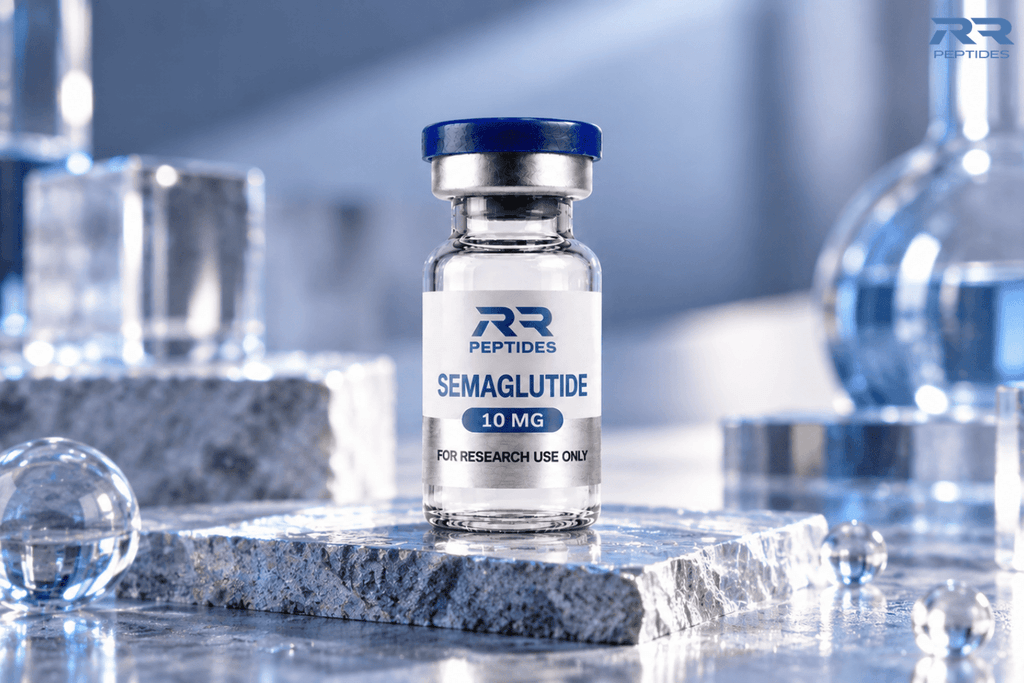
Explore the research specifications and laboratory information available from RR Peptides for Semaglutide 10 mg.
Biological Properties of Semaglutide
Semaglutide is a long-acting GLP-1 receptor agonist. It is structurally related to GLP-1 but contains modifications that contribute to its pharmacological properties. One important feature is its prolonged persistence relative to native GLP-1, allowing researchers to study sustained receptor-mediated signaling in appropriate experimental systems.
Semaglutide research often focuses on how molecular structure relates to receptor activity and biological duration. The molecule contains a peptide backbone with specific modifications that influence enzymatic stability and association with circulating proteins. These properties are relevant when interpreting experiments involving exposure duration or pharmacological response.
Molecular and pharmacological characteristics
The GLP-1 receptor belongs to the class B family of G protein-coupled receptors. Activation can stimulate intracellular signaling pathways, with cyclic adenosine monophosphate, or cAMP, serving as an important second messenger in many experimental systems.
Researchers may investigate receptor activation using cellular assays that measure second-messenger responses, downstream phosphorylation, transcriptional changes, or other pathway-associated endpoints. The choice of endpoint depends on the experimental hypothesis.
Semaglutide research may also consider pharmacokinetic and pharmacodynamic relationships. Pharmacokinetic analysis examines how a compound is absorbed, distributed, metabolized, and eliminated, while pharmacodynamic analysis considers measurable biological responses associated with exposure. These concepts should be distinguished when interpreting experimental data.
Property
Research relevance
GLP-1 receptor activity
Supports receptor pharmacology studies
Peptide structure
Determines molecular characteristics
Proteolytic stability
Relevant to exposure duration
Protein association
Can influence circulating persistence
Signaling activity
Enables cellular pathway studies
Material characterization remains important. Researchers should verify the identity and quality of the specific semaglutide material used in an experiment rather than assuming that every commercially available sample has identical characteristics.
GLP-1 receptor signaling is central to semaglutide research because semaglutide produces its primary pharmacological effects through this receptor. The GLP-1 receptor is expressed in several tissues and cell types, and receptor activation can initiate intracellular signaling cascades.
After receptor activation, G protein-mediated signaling can increase intracellular cAMP. Depending on the cell type and experimental conditions, this can influence protein kinase activity, ion-channel behavior, gene expression, and other downstream processes. Researchers therefore examine multiple endpoints when studying receptor signaling.
cAMP and downstream pathways
cAMP is an important experimental readout in GLP-1 receptor pharmacology. Researchers may compare cAMP responses under different conditions to evaluate receptor activation. Additional measurements can include phosphorylation markers, intracellular calcium-related signals, transcriptional responses, and changes in protein abundance.
A single downstream marker does not establish the complete mechanism. Experimental interpretation is stronger when multiple relevant measurements support a consistent pathway model.
Semaglutide research may also examine receptor desensitization, internalization, trafficking, and signaling duration. These processes can influence how cells respond to prolonged receptor activation and may vary according to cell type and experimental conditions.
Pancreatic and metabolic signaling
In pancreatic beta-cell models, GLP-1 receptor activation is associated with signaling processes that influence glucose-dependent insulin secretion. Experimental studies can examine receptor signaling, insulin-related measurements, cellular metabolism, and beta-cell responses under controlled conditions.
Researchers should distinguish glucose-dependent experimental responses from simplified descriptions of receptor activity. Biological signaling depends on cellular context, nutrient conditions, receptor expression, and experimental design.
Signaling area
Example endpoint
Interpretation
Receptor activation
cAMP
GLP-1R pathway activity
Kinase signaling
Phosphorylation
Downstream pathway response
Gene regulation
Transcript levels
Cellular response
Protein response
Protein abundance
Molecular context
Cellular function
Functional assay
Biological consequence
For semaglutide research, combining receptor-level measurements with functional endpoints can provide stronger mechanistic context than relying on a single assay.
Findings from Metabolic Research Models
Metabolic models are an important area of semaglutide research because GLP-1 receptor signaling is closely associated with glucose regulation, appetite-related biology, and energy metabolism. Researchers may use cell systems, isolated tissues, and animal models to examine different components of these processes.
Glucose and pancreatic models
Cell-based studies can investigate pancreatic beta-cell signaling and glucose-responsive processes. Researchers may examine insulin-related endpoints, intracellular signaling, gene expression, and cellular responses under controlled glucose conditions.
These models provide useful mechanistic information but have limitations. A cultured cell does not reproduce the complete endocrine, neural, gastrointestinal, and metabolic environment of an intact organism.
Animal models can provide greater biological complexity. Researchers may evaluate glucose-related biomarkers, food intake, body-weight-associated observations, and other metabolic endpoints. However, species differences must be considered when interpreting these results.
Appetite and energy-balance models
Another area of semaglutide research involves appetite and energy-balance pathways. GLP-1 signaling can interact with neural and gastrointestinal systems involved in food intake and metabolic regulation. Experimental models may therefore examine feeding behavior, energy intake, gastric-related measurements, or relevant neural signaling.
Such findings require careful interpretation because food intake and body-weight changes can be influenced by multiple biological and environmental variables.
Model
Research focus
Key limitation
Beta-cell culture
Receptor and insulin signaling
Limited systemic context
Metabolic cell model
Cellular metabolism
Simplified biology
Rodent model
Glucose and feeding behavior
Species differences
Tissue model
Local biological response
Limited whole-body integration
Semaglutide research can also examine lipid-related and cardiovascular-associated endpoints. These studies may measure circulating biomarkers, vascular responses, cardiac-related observations, or metabolic changes. The specific interpretation depends on the model and endpoint rather than the compound name alone.
For Canadian laboratories, experimental metabolic research should follow appropriate institutional procedures. Animal studies may require institutional animal-care oversight, while studies involving human participants require appropriate ethics and regulatory processes.
Explore the research specifications and laboratory information available from RR Peptides for Semaglutide 10 mg.
Current Evidence and Research Limitations
Current evidence surrounding semaglutide research includes pharmacological, cellular, animal, and clinical literature. However, the evidence available for one research question may not directly answer another. Researchers should distinguish receptor-level evidence, preclinical findings, and clinical evidence rather than treating them as one category.
Semaglutide research can provide strong information about GLP-1 receptor signaling and metabolic biology, but experimental limitations remain important. Model selection, material characterization, exposure conditions, assay methods, and endpoint definitions can influence results.
Evidence interpretation
Researchers reviewing a study should consider:
What material was tested?
Which model was used?
What was the experimental endpoint?
Which controls were included?
Was the experiment replicated?
How were the data analyzed?
Do independent studies report consistent findings?
A mechanistic observation becomes more informative when supported by multiple experimental approaches. For example, receptor activation, cAMP signaling, downstream phosphorylation, and functional cellular responses may be evaluated together.
Material and analytical limitations
Material identity is another important consideration. Researchers should review available certificates of analysis, batch information, purity data, and analytical characterization where relevant. Differences between batches or preparation methods can complicate comparisons.
Semaglutide research should also distinguish experimental evidence from therapeutic conclusions. A finding in a cell or animal model does not independently establish human efficacy or safety. Likewise, commercial availability of a research material does not establish that it is authorized for therapeutic use.
In Canada, researchers should follow applicable institutional policies, laboratory safety procedures, supplier documentation, and requirements relevant to the research setting. The exact framework can vary according to whether work involves biochemical materials, cell systems, animals, or human participants.
Reproducibility and study design
Reproducibility depends on clear documentation. Researchers should record material identity, batch information, experimental conditions, controls, assay methods, observation periods, and relevant environmental factors.
Quality factor
Why it matters
Material identity
Confirms what was tested
Purity
Helps interpret sample composition
Batch information
Supports traceability
Controls
Helps isolate experimental effects
Endpoint definition
Clarifies the research question
Replication
Supports reproducibility
A careful evidence framework allows semaglutide research to be interpreted without overstating what an individual experiment demonstrates. The strongest conclusions remain proportional to the evidence generated by the specific model.
Interpreting results across models
Another useful consideration in this field is the relationship between experimental complexity and evidence strength. A controlled cellular assay can isolate a receptor-associated response, but it may omit interactions that occur in an organism. Conversely, a complex animal model can capture multiple biological systems at once, yet it can be harder to identify which pathway produced an observed outcome.
Researchers can improve interpretation by comparing complementary endpoints within the same study. For example, receptor activation can be considered alongside cAMP measurements, downstream signaling markers, and functional cellular observations. If several endpoints change in a consistent pattern, the combined findings may provide stronger support for a proposed biological explanation than one isolated measurement.
Study timing is also important. Short exposure experiments may answer questions about early signaling, whereas longer studies can examine sustained biological responses. These designs should not be directly compared without considering exposure duration, model characteristics, and endpoint selection. Documentation of timing allows researchers to understand why apparently similar experiments may produce different results.
Analytical quality should remain connected to experimental interpretation. Researchers may review identity data, purity measurements, batch records, formulation information, and storage history before comparing results from different sources. When these variables are poorly documented, it becomes more difficult to determine whether an observed difference reflects biology or material variability.
For Canadian research environments, transparent documentation can support collaboration and reproducibility. Depending on the setting, records may include sample identifiers, experimental dates, assay procedures, controls, environmental conditions, and relevant analytical results. Human and animal studies can also involve additional institutional requirements that should be addressed before research begins.
The broader lesson is that semaglutide research is most informative when conclusions remain proportional to the evidence. Molecular findings can explain receptor behavior, cellular models can clarify signaling, and animal models can provide additional physiological context. None should automatically replace the others. A structured approach allows researchers to connect findings across levels while preserving the limitations of each model.
Clear reporting also helps readers distinguish pharmacological observations from interpretations. When authors describe the model, material, controls, and endpoints precisely, other researchers can evaluate whether a finding is reproducible and whether it is relevant to their experimental question.
Semaglutide research includes laboratory and preclinical studies investigating semaglutide structure, GLP-1 receptor signaling, cellular pathways, metabolic responses, pharmacological properties, and experimental models.
How does semaglutide interact with the GLP-1 receptor?
Semaglutide acts as a GLP-1 receptor agonist. Receptor activation can stimulate intracellular signaling pathways that include cAMP-related processes, with downstream effects depending on the cell type and experimental conditions.
What models are used to study semaglutide?
Researchers may use biochemical assays, receptor-expressing cell systems, pancreatic beta-cell models, metabolic cell models, tissue systems, and animal models. Each model provides different evidence.
Why is cAMP important in semaglutide research?
cAMP is an important second messenger associated with GLP-1 receptor signaling. Measuring cAMP can help researchers evaluate receptor activation and compare responses under controlled experimental conditions.
Can cell studies establish human effects?
No. Cell studies provide controlled mechanistic information but cannot independently establish human efficacy, safety, or clinical outcomes.
Are animal findings directly applicable to humans?
Not automatically. Animal models provide greater biological complexity than cell systems, but species-specific differences can affect receptor expression, metabolism, physiology, and experimental responses.
Why is material characterization important?
Material identity, purity, batch information, formulation, and analytical data can influence interpretation. Researchers should verify the characteristics of the material used in their specific experiment.
What should Canadian researchers consider?
Canadian laboratories should follow applicable institutional procedures, laboratory safety practices, supplier documentation, and requirements relevant to their research setting. Animal or human research may require additional institutional oversight.
Does semaglutide research establish therapeutic use?
No. Laboratory and preclinical evidence should be interpreted according to the model and endpoint in which it was generated. Research findings do not independently establish therapeutic efficacy or safety.
Final Research Perspective
Semaglutide research covers molecular pharmacology, GLP-1 receptor signaling, cellular pathways, pancreatic biology, glucose regulation, appetite-related models, and broader metabolic research. Each area provides different evidence and requires an appropriate experimental framework.
A reliable study begins with a clearly defined question, well-characterized material, suitable model, relevant controls, measurable endpoints, and transparent documentation. Researchers should distinguish receptor-level observations from broader biological conclusions and preclinical findings from evidence generated in humans.
For Canadian laboratories, appropriate institutional procedures, laboratory safety, sample traceability, and research oversight are important parts of responsible experimental planning. RR Peptides provides research-focused information on peptide materials, analytical considerations, laboratory models, and scientific evidence for researchers evaluating semaglutide and related research topics.
Ultimately, the value of semaglutide research comes from connecting molecular identity, receptor biology, experimental design, analytical quality, and evidence strength. A careful approach allows researchers to interpret findings more accurately while recognizing the limitations of each experimental model.
Disclaimer: All products and compounds discussed are intended strictly for laboratory and research purposes. This article is provided for educational and informational purposes only. This article is not medical advice, therapeutic guidance, or instructions for human administration.
3 Comments
This article provides a useful overview of the research surrounding semaglutide. I found the explanation of its interaction with GLP-1 receptors particularly helpful for understanding the biological basis behind ongoing research.
I appreciate the research-focused approach to semaglutide rather than presenting broad claims without context. Looking at the available evidence and understanding the mechanisms being investigated makes the topic much easier to evaluate.
The overview of semaglutide research is informative, especially for readers trying to understand how GLP-1 receptor activity is being studied. I liked the emphasis on interpreting research findings within the appropriate scientific context.
Comments are closed.
×
Subscribe & Get 10% Off!
Enter your email address below to subscribe to our newsletter and receive an instant 10% OFF discount coupon code sent directly to your inbox!
Thank you for subscribing! Your 10% discount coupon has been sent to your email. Please check your inbox!







This article provides a useful overview of the research surrounding semaglutide. I found the explanation of its interaction with GLP-1 receptors particularly helpful for understanding the biological basis behind ongoing research.
I appreciate the research-focused approach to semaglutide rather than presenting broad claims without context. Looking at the available evidence and understanding the mechanisms being investigated makes the topic much easier to evaluate.
The overview of semaglutide research is informative, especially for readers trying to understand how GLP-1 receptor activity is being studied. I liked the emphasis on interpreting research findings within the appropriate scientific context.