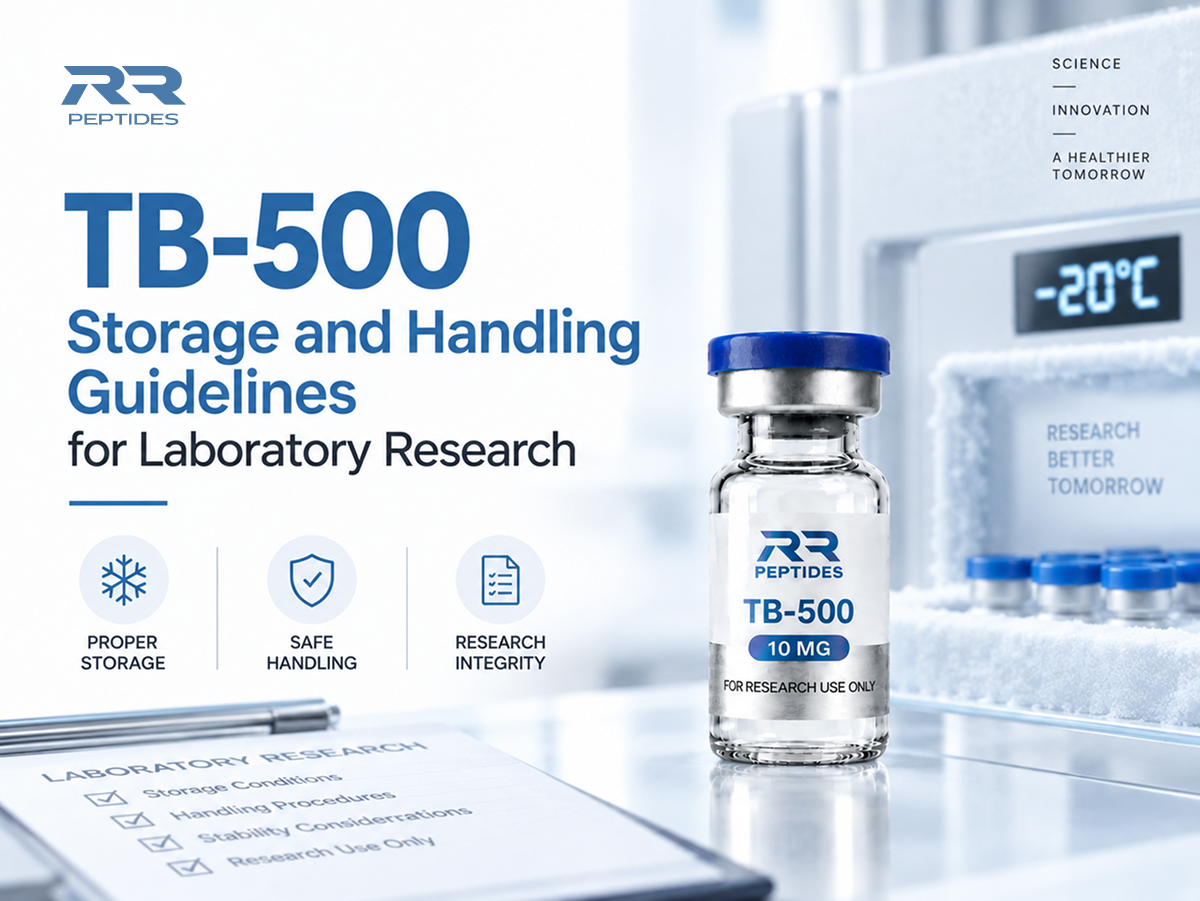
Proper sample management is an important part of peptide research. Even when a study has a well-defined hypothesis and appropriate controls, poorly documented storage or handling conditions can introduce uncertainty into the results. For laboratory materials such as TB-500, researchers therefore need to consider temperature, moisture, light exposure, container integrity, contamination, labeling, and traceability.
TB-500 is commonly discussed as a research peptide related to thymosin beta-4. Because terminology and material specifications can vary between sources, researchers should rely on the documentation associated with the exact material and batch being evaluated. The objective of storage is not to guarantee biological activity, but to maintain sample integrity according to the supplier’s specifications and the laboratory’s validated procedures.
RR Peptides presents research-focused peptide information from a laboratory perspective. This guide explains practical principles for TB-500 storage and handling guidelines, with emphasis on sample integrity, documentation, contamination prevention, and responsible research practices. For laboratories in Canada, local institutional procedures and applicable requirements should take precedence whenever they provide more specific instructions.
Why Proper TB-500 Storage Matters
TB-500 storage and handling guidelines are important because environmental and procedural conditions can influence the condition of a research sample. Peptides are chemical materials, and their stability can depend on formulation, physical state, packaging, temperature, moisture, light, time, and other factors. A sample that has experienced uncontrolled conditions may introduce an additional variable into an experiment.
Researchers should therefore treat TB-500 storage and handling guidelines as part of experimental quality control rather than as a separate administrative task. Consistent conditions make it easier to determine whether an unexpected result is related to the experimental variable or sample condition.
Sample integrity and experimental interpretation
The purpose of TB-500 storage and handling guidelines is to support reliable sample management. If material identity or condition becomes uncertain, researchers may have difficulty interpreting subsequent results. This is particularly relevant when experiments compare multiple batches or when a study is designed to be repeated over time.
A useful storage program should consider receipt, inspection, storage, access, preparation, and documentation because each stage can introduce variation.
Researchers should avoid assuming that general TB-500 storage and handling guidelines apply to every preparation. Lyophilized material, prepared solutions, and different formulations may have different stability characteristics. The exact product documentation should therefore be reviewed before establishing laboratory procedures.
Why consistency matters
TB-500 storage and handling guidelines can help laboratories establish repeatable practices. A documented procedure can specify who has access to samples, how containers are identified, where they are stored, and how unusual storage events are recorded.
Storage consideration
Why it matters
Temperature
May influence chemical stability
Moisture
Can affect dry peptide material
Light
May be relevant for sensitive compounds
Container integrity
Limits environmental exposure
Access
Reduces unnecessary handling
Documentation
Supports traceability
Batch identity
Connects samples to analytical records
Storage conditions should always be interpreted together with the material’s physical state and documentation. A condition that is suitable for one preparation may not be appropriate for another.
For Canadian laboratories, researchers should also consider institutional standard operating procedures, laboratory safety requirements, and any applicable rules governing research materials. The appropriate procedure may vary by institution and study type.
Learn more about the specifications and research overview of this peptide from RR Peptides featuring TB-500 10mg.
Storage Conditions for Lyophilized TB-500
Lyophilized peptides are dry preparations designed to provide a relatively stable physical form, but they still require controlled storage. TB-500 storage and handling guidelines for a lyophilized material should begin with the supplier’s stated conditions and any validated laboratory procedure.
Researchers should not infer a universal temperature or storage period simply from the fact that a peptide is lyophilized. Product formulation, container, packaging, residual moisture, and analytical stability data can affect how a specific material behaves.
Temperature management
Temperature is an important variable in TB-500 storage and handling guidelines. Laboratories should use storage equipment appropriate for the conditions specified for the material and should avoid unnecessary fluctuations.
TB-500 storage and handling guidelines should include a defined response to temperature excursions. If a sample is exposed to conditions outside the specified range, the event should be documented and evaluated according to the laboratory’s procedures rather than automatically assuming that the material is unaffected.
Temperature records can support traceability during long-term experiments. Depending on the laboratory environment, monitoring may involve routine checks, electronic logging, alarms, or other validated methods.
Moisture and humidity
Moisture is another important consideration for lyophilized materials. Opening a container can expose the contents to ambient humidity. Repeated or prolonged exposure may affect sample condition, depending on the material and packaging.
TB-500 storage and handling guidelines should therefore emphasize keeping containers properly closed when not being accessed. Researchers should minimize unnecessary opening and avoid storing dry peptide materials in environments where humidity is difficult to control.
Damaged, poorly sealed, or compromised packaging can increase environmental exposure. Before storage, researchers should verify that the container and labeling are intact and that the material corresponds to the expected product and batch.
Light exposure
The effect of light depends on the chemical characteristics of the material and its formulation. Researchers should follow the TB-500 storage and handling guidelines supplied for the material rather than assuming universal light sensitivity.
When light protection is specified, samples should be stored in a way that is consistent with the documented procedure. Any unusual exposure should be recorded if it could affect subsequent interpretation.
Recommended storage record
TB-500 storage and handling guidelines should include a practical record such as:
Product or material name
Batch or lot number
Date received
Storage location
Specified storage condition
Relevant temperature records
Observed storage excursions
Person responsible for the record
This information supports traceability and can become valuable when an experimental result needs to be reviewed months after the original sample was received.
Factors That May Affect TB-500 Stability
TB-500 stability can be influenced by several interacting factors. TB-500 storage and handling guidelines should therefore consider more than temperature alone. Time, moisture, light, oxygen, container integrity, physical state, and repeated environmental changes may all be relevant depending on the material.
Temperature and time
Temperature and exposure duration can interact. A brief excursion may have a different significance from prolonged exposure, while repeated temperature changes can create additional uncertainty.
Researchers should document excursions as part of TB-500 storage and handling guidelines, including the affected batch and action taken.
TB-500 storage and handling guidelines should not be interpreted as evidence that a particular excursion is harmless or harmful without supporting stability information. If validated stability data are unavailable, laboratories should follow their established quality procedures for evaluating the affected sample.
Moisture exposure
For dry materials, moisture can be particularly relevant. Repeated opening of a container may increase exposure to ambient humidity, especially in environments with variable conditions.
Researchers can reduce exposure by organizing work before opening a container and following contamination-control procedures.
Light and oxygen
Light and oxygen can affect some chemical materials, although the extent depends on molecular and environmental characteristics. Researchers should not assume that an observed color or appearance change alone confirms degradation.
TB-500 storage and handling guidelines should therefore rely on documented specifications and, where needed, analytical testing rather than visual inspection alone. If sample integrity is questioned, the laboratory can determine whether an appropriate analytical method is available to evaluate the material.
Physical state and preparation
Storage considerations can differ between lyophilized material and prepared solutions. Once a peptide is placed into a solution, its environment changes, and stability may depend on concentration, solvent or buffer composition, container characteristics, temperature, and time.
Researchers should therefore avoid transferring storage assumptions from dry material directly to prepared samples. Prepared material should be managed according to validated procedures or relevant product documentation.
Potential factor
Possible research concern
Temperature fluctuation
May alter chemical stability
Humidity
May affect dry material
Light exposure
May influence sensitive compounds
Oxygen exposure
May contribute to oxidation in susceptible materials
Time
Longer exposure can increase uncertainty
Preparation conditions
Can change the sample environment
Container damage
Can increase environmental exposure
One risk factor does not establish degradation; stability assessment requires appropriate evidence.
Good handling practices are an essential part of TB-500 storage and handling guidelines. TB-500 storage and handling guidelines are less effective if the sample is repeatedly exposed to uncontrolled environments or handled without appropriate laboratory procedures.
Researchers should establish a consistent workflow for accessing research materials. Before opening a container, the work area should be prepared, relevant documentation checked, and the material identified against the intended experiment.
Preventing sample contamination
Contamination can introduce variables that are unrelated to the research question. Depending on the laboratory environment, contamination may involve microorganisms, particles, chemicals, or accidental cross-contact with another research material.
TB-500 storage and handling guidelines should therefore be integrated with the laboratory’s established contamination-control procedures. Researchers should use appropriate clean handling practices, suitable personal protective equipment, and equipment that is maintained according to institutional procedures.
Minimizing unnecessary exposure
Repeated handling can increase exposure and sample mix-ups, so an organized workflow is useful.
Researchers should also avoid returning a sample to storage without documenting relevant changes when the laboratory’s procedure requires it. If a sample is compromised, mislabeled, or exposed to an uncertain condition, the event should be documented and evaluated.
Cross-contamination control
When multiple peptide materials are handled in the same laboratory, clear separation becomes particularly important. Containers, work areas, equipment, and documentation should be managed according to procedures designed to prevent accidental cross-contact.
Handling practice
Research benefit
Verify identity before access
Reduces sample mix-ups
Prepare the workspace first
Limits unnecessary exposure
Keep containers closed
Reduces environmental contact
Use appropriate clean procedures
Helps control contamination
Document unusual events
Supports later interpretation
Separate materials where appropriate
Reduces cross-contact risk
Researchers should follow TB-500 storage and handling guidelines and the laboratory’s validated procedures. This is especially important when the same workspace contains multiple compounds with different handling requirements.
Learn more about the specifications and research overview of this peptide from RR Peptides featuring TB-500 10mg.
Sample Labeling and Documentation Practices
Documentation is one of the simplest ways to strengthen TB-500 storage and handling guidelines. A sample that cannot be reliably identified is difficult to connect with an analytical report or experimental result.
Essential sample information
Researchers should maintain clear labels and records for each batch. Depending on the laboratory’s system, documentation may include:
Material or product name
Batch or lot number
Date received
Storage location
Physical state
Relevant supplier documentation
Analytical information
Storage events or excursions
Research project or sample identifier
Fields can be adapted to the laboratory’s quality system, with traceability as the main objective.
Connecting storage with analytical records
Batch-specific documentation can help connect a physical sample to analytical information. A Certificate of Analysis may contain product identification, batch information, purity measurements, testing dates, and analytical methods, depending on the report.
TB-500 storage and handling guidelines should therefore be considered alongside documentation practices. If a sample is transferred between storage locations, the record should be updated according to laboratory procedures so that its history remains clear.
Access history can also support TB-500 storage and handling guidelines and investigations when required by the laboratory. This can be especially useful during investigations of unexpected experimental results.
Handling storage excursions
Storage excursions should not automatically be interpreted as proof of degradation. Their significance depends on the material, exposure conditions, duration, and available stability information.
TB-500 storage and handling guidelines should define a consistent process for recording and evaluating such events. Suitability decisions should follow laboratory quality procedures and available evidence.
Documentation item
Purpose
Product name
Identifies the material
Lot number
Supports batch traceability
Storage location
Shows where the sample is held
Condition record
Documents relevant storage history
COA or analytical report
Connects material with testing
Access history
Supports accountability
Excursion record
Documents unusual conditions
For Canadian research environments, documentation practices should align with institutional requirements and the laboratory’s quality management system. Where an institution has a specific standard operating procedure, that procedure should take precedence over a general online guideline.
What are the main TB-500 storage and handling guidelines?
The main principles involve following the exact product documentation, maintaining appropriate environmental conditions, protecting the container from unnecessary exposure, preventing contamination, and keeping clear batch and storage records.
Should lyophilized TB-500 be stored under one universal temperature?
No universal condition should be assumed. Storage requirements can depend on the specific material, formulation, packaging, and supplier documentation. Researchers should follow the applicable specification or validated laboratory procedure.
Does lyophilized material remain stable indefinitely?
No. Lyophilization can provide a useful dry physical state, but it does not establish indefinite stability. Stability depends on the material and storage environment, and researchers should use available stability information when evaluating storage duration.
What should happen after a temperature excursion?
The event should be documented and evaluated according to the laboratory’s procedures. Researchers should not automatically assume that an excursion has no effect or that the material is unusable without evidence.
Can visual appearance confirm peptide stability?
No. Appearance can provide useful observations, but it cannot independently confirm chemical identity, purity, or stability. Analytical testing may be needed when sample integrity is uncertain.
Why is moisture important?
Moisture can be relevant to dry peptide materials because environmental exposure may affect sample condition. Keeping containers properly closed and minimizing unnecessary exposure can support better sample management.
Are prepared peptide solutions stored the same way as lyophilized material?
Not necessarily. Once a peptide is prepared in a solution, factors such as solvent or buffer, concentration, container, temperature, and time can affect the sample environment. The appropriate procedure should be established for the specific preparation.
Why is batch documentation important?
Batch documentation connects the physical material with its associated specifications and analytical records. This improves traceability and can make experimental results easier to interpret.
What should Canadian laboratories consider?
Canadian laboratories should follow their institutional procedures and applicable requirements for research materials, laboratory safety, quality systems, and any relevant biological or animal research activities. Requirements can vary according to the institution and study design.
Can storage practices guarantee biological activity?
No. Proper storage can support sample integrity, but it does not independently establish biological activity or experimental efficacy. Biological activity requires an appropriately designed research assessment.
Final Research Perspective
Effective TB-500 storage and handling guidelines are fundamentally about controlling variables. Temperature, moisture, light, container integrity, contamination, labeling, and storage history can all influence how confidently a research sample can be interpreted.
The most reliable approach is to combine documented product information with laboratory-specific procedures. Researchers should identify the exact material and batch, maintain appropriate storage conditions, record unusual events, and preserve traceability throughout the sample lifecycle.
RR Peptides emphasizes research-focused information that helps readers understand peptide materials within an appropriate laboratory context. For Canadian laboratories, general guidance should be adapted to institutional requirements and validated procedures rather than treated as a substitute for them.
When sample condition is uncertain, researchers should avoid making assumptions based only on appearance or a product name. Analytical characterization may provide more useful evidence when the research question requires confirmation of identity, purity, or other material characteristics.
Ultimately, TB-500 storage and handling guidelines support a broader principle of research quality: the experimental material should be managed with the same attention given to controls, endpoints, and data collection. Good sample management does not prove a biological effect, but it can reduce avoidable sources of uncertainty and improve reproducibility.
RR Peptides provides research-oriented peptide information for readers seeking a clearer understanding of laboratory materials and scientific practices. Applying careful TB-500 storage and handling guidelines can help researchers maintain organized sample records, protect material integrity, and interpret experimental findings within the limits of the available evidence.
Disclaimer: All products and compounds discussed are intended strictly for laboratory and research purposes. This article is provided for educational and informational purposes only and is not medical advice, therapeutic guidance, or instructions for human administration.
3 Comments
The storage and handling guidelines are a useful reminder that proper sample management is an important part of laboratory research. I especially found the discussion of maintaining appropriate storage conditions helpful for preserving consistency when working with research compounds.
I appreciate the practical focus of this guide. Clear information about storage conditions, handling procedures, and minimizing unnecessary exposure can make laboratory workflows more consistent and easier to document.
This is a helpful reference for researchers working with TB-500 samples. Paying attention to storage and handling practices is easy to overlook, but these details can be important when trying to maintain reliable and reproducible research conditions.
Comments are closed.
×
Subscribe & Get 10% Off!
Enter your email address below to subscribe to our newsletter and receive an instant 10% OFF discount coupon code sent directly to your inbox!
Thank you for subscribing! Your 10% discount coupon has been sent to your email. Please check your inbox!





The storage and handling guidelines are a useful reminder that proper sample management is an important part of laboratory research. I especially found the discussion of maintaining appropriate storage conditions helpful for preserving consistency when working with research compounds.
I appreciate the practical focus of this guide. Clear information about storage conditions, handling procedures, and minimizing unnecessary exposure can make laboratory workflows more consistent and easier to document.
This is a helpful reference for researchers working with TB-500 samples. Paying attention to storage and handling practices is easy to overlook, but these details can be important when trying to maintain reliable and reproducible research conditions.