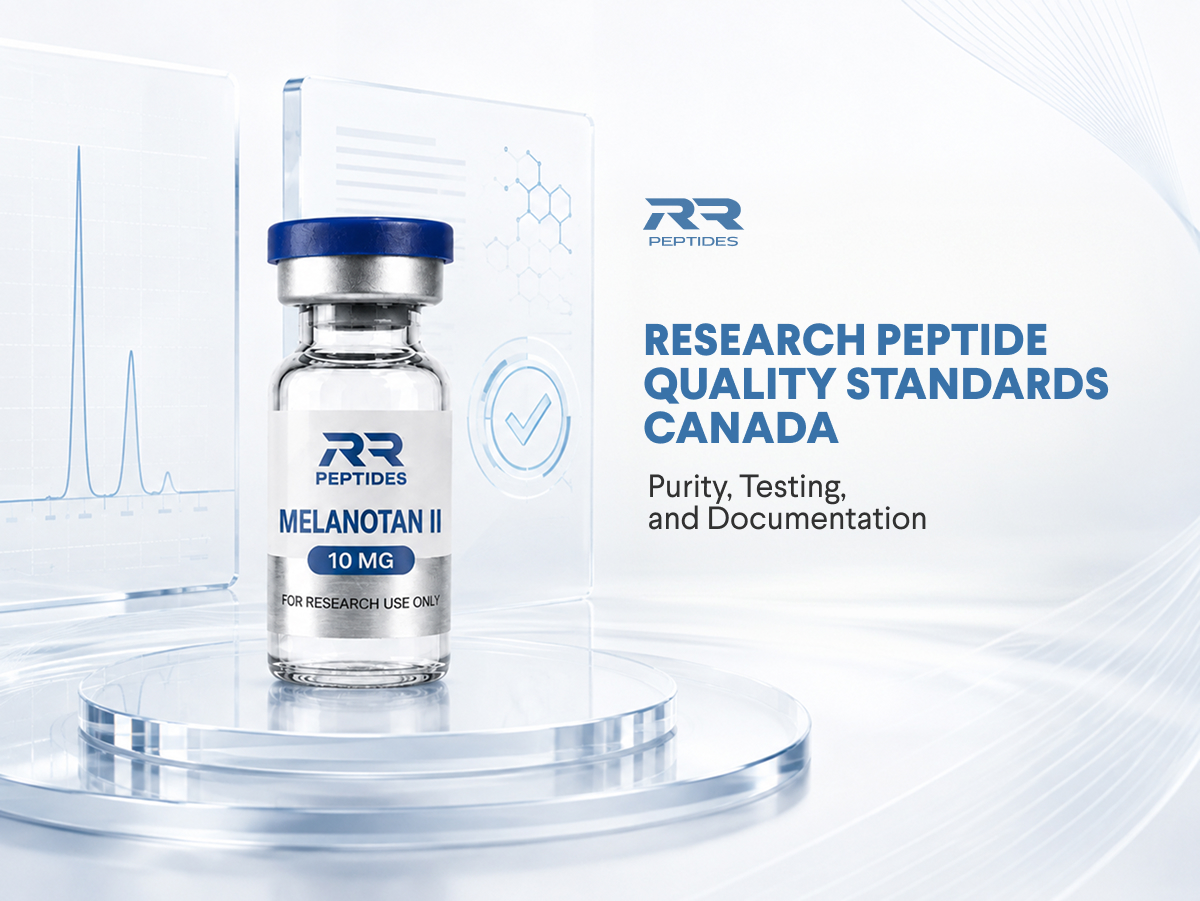
Research peptide quality standards Canada involve more than a reported purity percentage. For laboratory researchers, meaningful quality evaluation also requires attention to peptide identity, analytical testing, batch traceability, Certificates of Analysis, documentation, packaging, storage conditions, and stability.
Importantly, there is not one universal Canadian regulatory standard specifically defining the quality of every material marketed as a research peptide. Requirements depend on the context and intended use. For example, drugs used in human clinical trials in Canada fall under specific Health Canada requirements, including applicable Good Manufacturing Practices (GMP), whereas general laboratory research materials should not automatically be treated as clinical-trial drugs or authorized therapeutic products.
For researchers evaluating peptide materials, RR Peptides provides research-focused compounds and supporting laboratory information. Reviewing available analytical documentation alongside the needs of a specific experiment can support more informed material selection.
Understanding Research Peptide Quality Standards
When discussing research peptide quality standards Canada, it is useful to separate analytical quality from regulatory status. A research laboratory may evaluate peptide identity, purity, batch consistency, stability, and documentation, but these characteristics do not independently establish that a product is authorized for human use.
From an analytical perspective, quality begins with a simple question: Does the available evidence adequately characterize the material being used in the experiment?
Answering that question may require multiple forms of information rather than one purity number.
Explore quality research peptides in Canada at RR Peptides
Quality Is a Multi-Factor Concept
Researchers can evaluate peptide quality across several interconnected areas.
Identity considers whether the material is consistent with the intended peptide.
Purity examines the relative composition of detectable material under a defined analytical method.
Batch traceability connects analytical results with the particular production lot.
Documentation records how the material was tested and what results were obtained.
Stability considers whether relevant characteristics remain sufficiently controlled during storage and handling.
Together, these factors provide a more useful framework for evaluating research peptide quality standards Canada than a purity claim alone.
Quality Standards Depend on Context
The phrase research peptide quality standards Canada can create confusion because applicable standards differ depending on how a material will be used.
For regulated clinical-trial drugs in Canada, Health Canada requires applicable GMP compliance. Its 2026 clinical-trial guidance states that sponsors must ensure investigational drugs are manufactured, handled, and stored according to applicable GMP requirements.
Health Canada’s updated Annex 13 also addresses pharmaceutical quality systems, specifications, analytical methods, documentation, stability data, storage, shipment, quality control, and batch release for drugs used in clinical trials.
However, these clinical-trial requirements should not be presented as though they automatically regulate every laboratory research peptide sold in Canada.
That distinction is essential for scientifically accurate content.
Learn more about laboratory peptide quality and available research materials at RR Peptides.
Peptide Identity and Purity Requirements
Identity and purity are among the most frequently discussed characteristics when researchers assess peptide materials.
However, they answer different analytical questions.
Identity asks: Is the detected material consistent with the intended peptide?
Purity asks: How much of the detected sample corresponds to the principal component relative to other detectable components under the analytical method?
Researchers evaluating research peptide quality standards Canada should avoid treating these terms as interchangeable.
Why Peptide Identity Matters
Under research peptide quality standards Canada, researchers need reasonable confidence that a peptide material corresponds to its intended molecular identity and defined amino-acid sequence.
A purity result by itself does not necessarily establish this.
For example, a chromatogram might show one dominant peak. That observation indicates that one component dominates the chromatographic signal under the testing conditions, but researchers still need information supporting the identity of that component.
Mass spectrometry can provide mass-related data that help determine whether a detected compound is consistent with the expected molecular mass of the peptide.
As a result, identity information can complement chromatographic purity analysis.
Understanding Peptide Purity
Peptide purity commonly refers to the relative amount of the principal detectable component compared with other detectable components under a defined analytical procedure.
High-performance liquid chromatography, particularly reversed-phase HPLC, is commonly used for this purpose.
During analysis, components separate according to their interactions with the chromatographic system. The resulting chromatogram displays detectable components as peaks.
Researchers can then evaluate the relative peak areas under the specified method.
However, a reported purity value remains method-dependent.
A statement such as:
Purity: 99%
provides less context than:
Purity: 99% by RP-HPLC under the reported analytical conditions
The latter explains how the laboratory generated the result.
Why High Purity Does Not Equal Complete Quality
When assessing research peptide quality standards Canada, researchers should not interpret a high chromatographic purity value as complete characterization.
For example, a reported HPLC purity of 99% does not independently establish:
molecular identity;
exact peptide quantity;
sterility;
endotoxin status;
absence of every possible contaminant;
stability over time; or
suitability for every experimental model.
These characteristics require different evidence or analytical approaches when relevant.
Therefore:
High chromatographic purity ≠ complete peptide quality verification
Purity remains valuable, but it should form one part of a broader analytical assessment.
How Research Peptide Quality Is Tested
Analytical testing helps researchers characterize different properties of peptide materials.
Because no single analytical technique necessarily answers every quality question, laboratories may combine multiple methods according to the material and research objective.
For peptide research, HPLC and mass spectrometry are two commonly discussed complementary techniques.
HPLC for Chromatographic Purity
High-performance liquid chromatography separates sample components under specified analytical conditions.
The resulting chromatogram can provide information about:
Retention time — when a detected component passes through the chromatographic system.
Peak area — the detector response associated with a component.
Additional peaks — other components detected and separated by the method.
Researchers can use relative peak areas to estimate chromatographic purity.
Nevertheless, the analytical method matters. Different columns, mobile phases, gradients, detectors, and integration procedures can influence what the chromatogram reveals.
For this reason, research peptide quality standards Canada should emphasize transparent analytical methods rather than purity percentages without context.
Mass Spectrometry for Identity Support
Mass spectrometry provides another type of analytical information.
The technique measures mass-related characteristics of ionized molecules. Researchers can compare observed data with the expected molecular mass of the intended peptide.
In simplified terms:
HPLC → Relative chromatographic composition and purity
Mass spectrometry → Molecular-mass information supporting identity
These methods complement one another because purity and identity are separate analytical questions.
Why Multiple Analytical Methods Can Be Useful
Suppose HPLC analysis produces one dominant peak.
That finding supports the conclusion that one detectable component dominates the chromatographic profile under the method used.
However, it does not by itself identify that component.
Mass spectrometry can then provide additional evidence regarding whether the molecular mass is consistent with the expected peptide.
Conversely, detecting the expected molecular mass does not necessarily prove that the entire sample consists exclusively of that peptide.
Therefore, researchers should interpret analytical results collectively rather than asking one method to answer every quality question.
Explore quality research peptides in Canada at RR Peptides
Batch Testing and Quality Verification
Peptide synthesis and purification occur in batches. As a result, analytical information should ideally remain connected to the particular lot being evaluated.
This concept is known as batch traceability.
A useful documentation chain is:
Peptide → Batch/Lot → Analytical Testing → COA → Laboratory Record
When evaluating research peptide quality standards Canada, maintaining this connection helps researchers determine whether analytical results actually correspond to the material incorporated into an experiment.
Why Batch-Specific Testing Matters
When evaluating research peptide quality standards Canada, researchers should not assume that two batches produced through the same process have identical analytical characteristics.
Potential variation can arise during synthesis, purification, processing, storage, or other stages.
Therefore, researchers should avoid relying on analytical data from an unrelated or unidentified batch whenever batch-specific information is important to the experiment.
Health Canada’s clinical-trial guidance illustrates the importance of traceability in the regulated drug context. For investigational drugs, sponsors should maintain systems that trace materials through sourcing, manufacturing, packaging, storage, transportation, delivery, use, and final reconciliation or disposal.
Again, these requirements specifically concern clinical-trial drugs, but the underlying concept demonstrates why traceability is valuable for rigorous research documentation.
Third-Party Testing
Third-party testing means an external analytical laboratory performs testing separately from the organization supplying the research material.
This can add an independent source of analytical information.
However, researchers should not stop at the phrase third-party tested.
Instead, they should examine:
Who performed the analysis?
Which method was used?
What batch was tested?
When did testing occur?
What results were reported?
Does the analytical report correspond to the supplied batch?
These questions make third-party testing more meaningful.
Verification Is More Than a Testing Badge
A third-party testing claim does not automatically establish that every relevant characteristic has been evaluated.
For example, an external laboratory may perform HPLC testing without evaluating other characteristics.
Therefore, researchers should examine the scope of the actual testing rather than interpreting third-party testing as a universal quality guarantee.
A better framework is:
Claim → Analytical Method → Result → Batch → Documentation
This approach aligns more closely with meaningful research verification.
Certificates of Analysis and Laboratory Documentation
A Certificate of Analysis (COA) summarizes analytical information associated with a particular material or production batch.
For researchers evaluating research peptide quality standards Canada, the quality of the documentation itself is almost as important as whether a COA exists.
A document labelled COA provides limited value if researchers cannot determine what material was tested, which method was used, or whether the document corresponds to the relevant batch.
What Should a Peptide COA Include?
When reviewing documentation for research peptide quality standards Canada, useful COA information may include:
peptide or compound name;
batch or lot identifier;
testing date;
analytical method;
reported chromatographic purity;
molecular-mass or identity-related information;
HPLC chromatogram;
mass spectrometry results; and
testing laboratory information.
Not every COA will contain every item because testing programs vary.
Nevertheless, researchers should be able to understand what was tested and what the reported result actually demonstrates.
Why Batch Numbers Matter
The batch or lot identifier connects analytical documentation with physical research material.
Without this connection, researchers may be unable to determine whether the COA describes the material used in their experiment.
For example:
COA A → Batch A → Experiment A
provides stronger traceability than:
Generic COA → Unknown Batch → Experiment A
This distinction becomes especially important when laboratories conduct long-running studies involving multiple purchases or production lots.
COAs in the Canadian Clinical-Trial Context
Health Canada’s current clinical-trial guidance specifically recognizes Certificates of Analysis as relevant documentation. It states that a CoA for investigational drugs can serve as adequate evidence of GMP compliance, while sponsors must maintain appropriate GMP documentation.
Health Canada’s clinical-trial inspection policy similarly identifies certificates of manufacture and certificates of analysis or batch certificates as examples of evidence inspectors may review for imported clinical-trial material.
These requirements concern regulated investigational drugs used in human trials, not every product marketed as a laboratory research peptide.
Still, they demonstrate the importance of documented analytical evidence and batch traceability in formal quality systems.
Documentation Supports Reproducibility
Good documentation can also improve experimental reproducibility.
Researchers may record:
Peptide name → Supplier → Batch → COA → Storage history → Experimental conditions
If results differ between studies, these records can help researchers identify potential sources of variation.
Documentation should therefore be viewed as part of the research workflow rather than an administrative afterthought.
Researchers reviewing analytical documentation and laboratory-focused materials can explore RR Peptides.
Product Transparency and Quality Verification
Transparency allows researchers to determine what evidence supports a product’s stated characteristics.
When comparing research peptide quality standards Canada, product information, labels, batch identifiers, and analytical documentation should remain reasonably consistent.
Product Information Should Match the COA
Researchers can compare several basic data points:
Compound Name → Batch Number → Stated Quantity → Analytical Documentation
If these elements conflict, further verification may be necessary before researchers rely on the material.
For example, a COA describing one batch should not automatically be treated as evidence for another batch.
Similarly, analytical information associated with one compound should not be generalized to a related peptide without appropriate evidence.
Marketing Terms Are Not Analytical Results
Terms such as:
high purity
premium quality
laboratory tested
third-party tested
can communicate general product positioning, but they do not provide the same information as an analytical report.
Researchers should ask what evidence supports the statement.
For example, if a product claims high purity, the supporting documentation should ideally identify the analytical method and reported result.
If a material is described as third-party tested, researchers should determine what the external laboratory actually measured.
This distinction helps keep quality evaluation evidence-based.
Packaging, Storage, and Stability Standards
Quality control does not end when analytical testing is complete.
Environmental conditions after testing can affect some peptide materials. Therefore, research peptide quality standards Canada should also consider packaging, storage, transportation, and laboratory handling.
Why Stability Matters
Peptide stability can depend on several factors, including:
amino-acid sequence;
formulation;
temperature;
moisture;
oxygen exposure;
light;
pH;
solvent conditions; and
storage duration.
Different peptides may respond differently to these variables.
Consequently, researchers should follow compound-specific documentation and validated laboratory procedures rather than applying one universal storage rule to every peptide.
Temperature and Environmental Conditions
Temperature can influence chemical degradation rates.
However, the appropriate temperature depends on the specific material and available stability information.
Moisture may also affect some peptide preparations, while oxidation can become relevant for sequences containing susceptible amino-acid residues.
Light exposure may contribute to degradation in certain materials as well.
Therefore, researchers should consider the peptide’s individual physicochemical characteristics when establishing storage conditions.
Lyophilized Peptides
Many peptide research materials are supplied in lyophilized form.
Lyophilization removes much of the water from a preparation and may support stability under suitable conditions.
However:
Lyophilized does not mean indefinitely stable.
Temperature, moisture, light, oxygen exposure, packaging, and time may still influence material characteristics.
Researchers should therefore maintain appropriate storage records even for dry peptide preparations.
Peptides in Solution
Once researchers prepare a peptide in solution, its stability profile can change.
Relevant variables may include concentration, solvent composition, pH, temperature, storage duration, oxidation, adsorption to laboratory surfaces, and repeated environmental exposure.
As a result, storage information for lyophilized material should not automatically be applied to peptide solutions.
Packaging and Transportation
Packaging should help protect research materials against environmental conditions relevant to their stability.
Shipping also forms part of the material’s history.
Health Canada’s Annex 13 for clinical-trial drugs similarly emphasizes documented stability data, storage conditions, shipment conditions, packaging information, and supply-chain traceability within the regulated clinical-trial quality system.
For laboratory researchers, considering the entire material history can provide a more complete quality assessment than focusing only on the original purity result.
Research Peptide Quality Standards Canada and Regulatory Context
Canadian researchers should clearly distinguish laboratory quality evaluation from regulatory authorization.
This distinction is especially important because the phrase research peptide does not create a regulatory exemption for products represented or sold as drugs for human use.
Laboratory Research vs. Clinical-Trial Drugs
Laboratory research can involve biochemical assays, cell models, molecular analysis, and other experimental systems.
Human clinical trials represent a different regulatory context.
Health Canada’s current guidance states that Part C, Division 5 of the Food and Drug Regulations applies to clinical trials involving drugs in human participants in Canada. Sponsors have overall responsibility for ensuring compliance with those requirements.
For clinical-trial drugs, applicable GMP requirements cover manufacturing, handling, and storage, while Health Canada’s Annex 13 provides additional guidance covering documentation, quality control, batch release, stability, storage, and shipment.
These regulated requirements should not be misrepresented as a universal Canadian certification scheme for all research-only peptide materials.
Unauthorized Injectable Peptides in Canada
The distinction also matters because Health Canada has taken enforcement action against unauthorized injectable peptide drugs.
In July 2026, Health Canada announced a permanent injunction preventing a Canadian seller from selling unauthorized injectable peptides. Health Canada states that injectable peptides are regulated as prescription drugs in Canada and must be authorized before they can legally be sold as such.
Health Canada has separately warned about unauthorized injectable peptide products marketed online.
Therefore, analytical purity, a COA, or research-related labelling should never be interpreted as proof that a product is authorized for therapeutic use.
Three Questions to Keep Separate
When examining research peptide quality standards Canada, researchers should distinguish three questions:
What does scientific research show? This addresses experimental findings and biological mechanisms.
What does analytical testing show? This addresses characteristics such as identity, chromatographic purity, composition, and batch data.
What is the regulatory status of the specific product and intended use? This addresses Canadian regulatory requirements.
Keeping these questions separate helps prevent analytical quality claims from becoming unsupported clinical or regulatory claims.
Building a Research Peptide Quality Evaluation Framework
Researchers can evaluate peptide quality more systematically by moving through a series of connected checks.
A practical framework is:
Research Requirement → Product Identification → Batch Verification → Analytical Review → COA Review → Stability Assessment → Storage and Handling → Experimental Documentation
First, researchers should identify the exact material required for the experiment.
Next, they can confirm product and batch information before reviewing analytical documentation.
HPLC results can provide information about chromatographic composition, while mass spectrometry can provide complementary identity-related information.
Researchers can then evaluate the COA, storage requirements, packaging, and other relevant material characteristics.
Finally, laboratories should maintain records connecting the research material with the experiment in which it was used.
This approach provides a more complete interpretation of research peptide quality standards Canada than relying on a single advertised purity percentage.
Common Quality Documentation Red Flags
Researchers may want to investigate further when they encounter:
purity claims without an identified analytical method;
COAs without batch or lot numbers;
analytical documents that cannot be connected to the supplied material;
conflicting product and COA information;
missing identity-related information where identity verification is important;
generic third-party testing claims without supporting documentation;
unclear testing dates; or
therapeutic claims unsupported by the product’s regulatory status.
No single factor automatically determines whether a material is appropriate for a research project.
Instead, researchers should evaluate the available evidence as a whole.
FAQ About Research Peptide Quality Standards in Canada
What are research peptide quality standards Canada?
Research peptide quality standards Canada can refer to the analytical and documentation criteria researchers use to evaluate peptide materials, such as identity, purity, batch traceability, testing methods, COAs, stability, and storage. However, Canada does not have one universal regulatory standard that applies specifically to every material marketed as a research peptide. Requirements vary according to the material’s intended and represented use.
Is there an official purity requirement for all research peptides in Canada?
There is no single universal purity percentage that establishes the quality of every research peptide in Canada. Appropriate specifications depend on the material, analytical method, research purpose, and regulatory context.
Why is peptide identity important?
Identity helps researchers determine whether a material is consistent with the intended peptide. A high chromatographic purity percentage alone does not necessarily establish molecular identity.
How is research peptide purity evaluated?
HPLC is commonly used to separate detectable sample components and estimate relative chromatographic purity under defined analytical conditions. Researchers should interpret the result according to the method used.
What role does mass spectrometry play in peptide quality testing?
Mass spectrometry provides mass-related information that can support molecular identity. It complements chromatographic analysis because purity and identity address different analytical questions.
Does 99% HPLC purity prove that a peptide meets all quality standards?
No. A 99% HPLC result describes relative chromatographic purity under specific analytical conditions. It does not independently establish identity, quantity, sterility, endotoxin status, long-term stability, or suitability for every research application.
Why are batch-specific COAs important?
Batch-specific COAs connect analytical results with the material actually supplied and used in an experiment. This improves traceability and can help researchers investigate potential differences between production lots.
What information should researchers look for in a peptide COA?
Depending on the testing performed, useful information may include the peptide name, batch number, testing date, analytical method, purity result, molecular-mass information, chromatographic data, mass spectrometry data, and laboratory identification.
Do Canadian GMP requirements apply to all research peptides?
Not automatically. Health Canada’s GMP requirements apply in defined regulated contexts, including drugs used in human clinical trials. General laboratory research materials should not automatically be described as GMP-regulated clinical-trial drugs.
Can packaging and storage affect peptide quality?
Yes. Depending on the peptide, environmental factors such as temperature, moisture, oxygen, light, formulation, and storage duration may influence stability. Researchers should follow material-specific documentation and validated laboratory procedures.
Does a COA mean a research peptide is authorized for human use?
No. A COA provides analytical information; it does not establish therapeutic authorization. Health Canada regulates injectable peptide drugs as prescription drugs and has taken enforcement action against unauthorized injectable peptide products.
Final Thoughts
Understanding research peptide quality standards Canada requires researchers to look beyond purity percentages. Identity, analytical methods, batch-specific testing, COAs, documentation, stability, packaging, and storage all contribute to a more complete assessment of laboratory research materials.
At the same time, analytical quality should remain separate from regulatory or therapeutic claims. Researchers can strengthen experimental traceability by reviewing the evidence associated with each material and documenting the specific batch used. To explore research-focused peptide materials and available laboratory information, visit RR Peptides.
Disclaimer: All products and compounds referenced are intended strictly for laboratory and research purposes only. This content is provided for informational and educational purposes and is not intended as medical advice or to diagnose, treat, cure, or prevent any disease.
3 Comments
Really useful overview of research peptide quality standards in Canada. I especially liked the focus on purity, consistency and documentation, since these factors can have a major impact on the reliability of laboratory research. It would be interesting to see more detail on the testing methods commonly used to verify peptide quality.
I found this article helpful because quality standards can be easy to overlook when discussing research peptides. The Canada-specific perspective makes the information particularly relevant for researchers who need to understand expectations around sourcing and quality control. A checklist for evaluating a peptide supplier’s documentation would be a useful follow-up.
I found the Canada-specific perspective particularly helpful. Quality standards for research materials can be easy to overlook when comparing suppliers, so the emphasis on documentation and verification provides useful context. I’d be interested in learning more about how laboratories typically assess certificates of analysis.
Comments are closed.
×
Subscribe & Get 10% Off!
Enter your email address below to subscribe to our newsletter and receive an instant 10% OFF discount coupon code sent directly to your inbox!
Thank you for subscribing! Your 10% discount coupon has been sent to your email. Please check your inbox!




Really useful overview of research peptide quality standards in Canada. I especially liked the focus on purity, consistency and documentation, since these factors can have a major impact on the reliability of laboratory research. It would be interesting to see more detail on the testing methods commonly used to verify peptide quality.
I found this article helpful because quality standards can be easy to overlook when discussing research peptides. The Canada-specific perspective makes the information particularly relevant for researchers who need to understand expectations around sourcing and quality control. A checklist for evaluating a peptide supplier’s documentation would be a useful follow-up.
I found the Canada-specific perspective particularly helpful. Quality standards for research materials can be easy to overlook when comparing suppliers, so the emphasis on documentation and verification provides useful context. I’d be interested in learning more about how laboratories typically assess certificates of analysis.