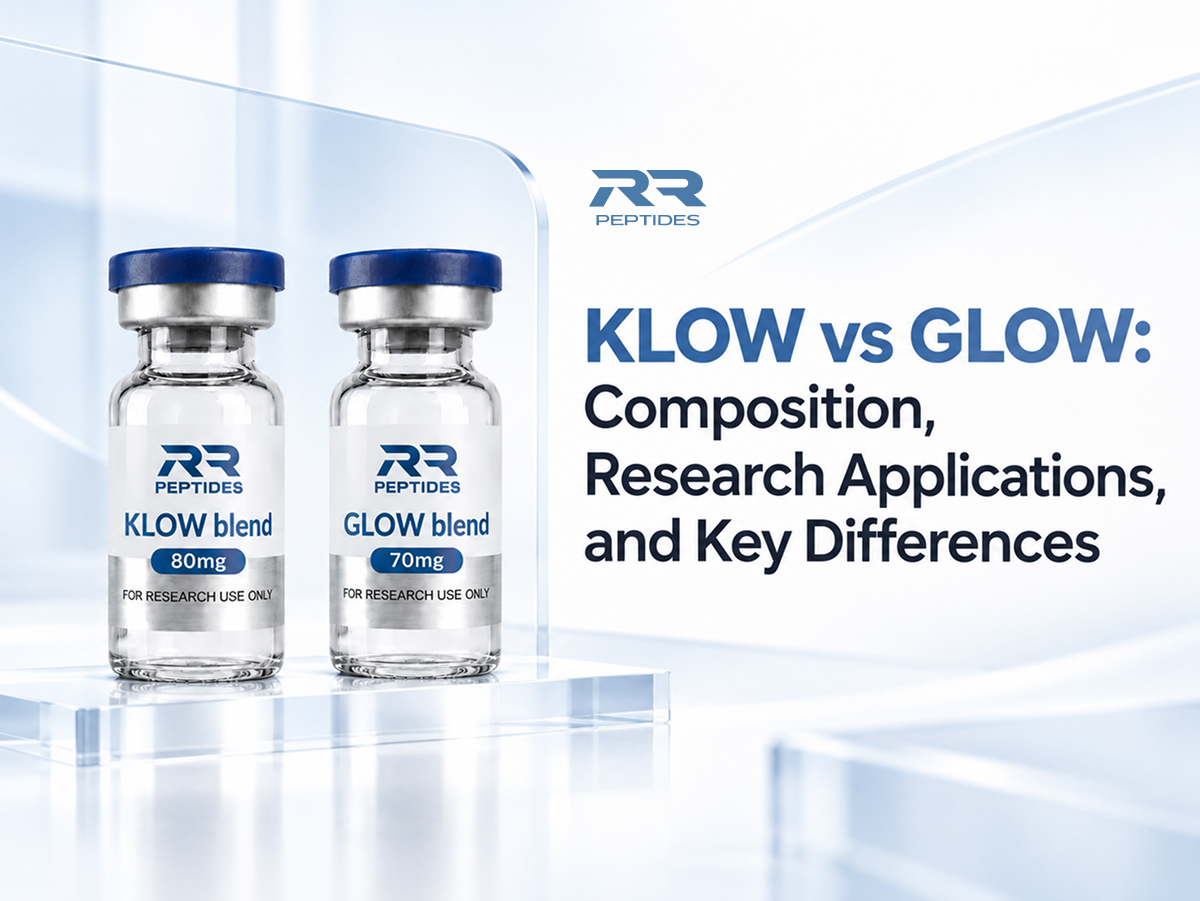
When comparing research peptide blends, KLOW vs GLOW should be evaluated based on documented composition rather than the product name alone. Researchers need to understand what each formulation contains, how its ingredients are distributed, and whether the available documentation supports those claims.
This makes KLOW vs GLOW an important comparison for researchers evaluating multi-component peptide formulations. A blend name does not automatically represent a standardized scientific formula, and different products may have different specifications.
KLOW is commonly presented in the Canadian research market as an 80 mg multi-component formulation containing GHK-Cu, BPC-157, TB-500, and KPV. The commonly listed nominal distribution is 50 mg GHK-Cu and 10 mg each of BPC-157, TB-500, and KPV.
GLOW should be evaluated according to the exact product specification provided by the supplier. Unless individual ingredients and quantities are documented, researchers should avoid assuming that every product using the GLOW name has the same composition.
For Canadian researchers, this distinction is especially relevant when reviewing research-use materials. Product labels, batch information, and analytical documentation should be considered together rather than relying on a blend name or marketing description alone.
At RR Peptides, researchers can explore research-focused peptide materials and educational information covering formulation, analytical testing, and laboratory material evaluation.
Overview of KLOW and GLOW Peptide Blends
The first step in understanding KLOW vs GLOW is to separate the commercial product name from the actual formulation.
KLOW has a commonly documented four-component formulation. GLOW, however, should be assessed from its specific product documentation rather than from assumptions based on the name.
For KLOW vs GLOW, a useful formulation profile should identify the individual components, their stated amounts, the total nominal quantity, and the relevant batch information.
The commonly listed KLOW formulation can be summarized as follows:
Ingredient
Nominal amount
Share of total
GHK-Cu
50 mg
62.5%
BPC-157
10 mg
12.5%
TB-500
10 mg
12.5%
KPV
10 mg
12.5%
Total
80 mg
100%
In a KLOW vs GLOW comparison, these values describe nominal mass rather than molecular concentration. The four compounds have different molecular characteristics, so equal milligram quantities do not necessarily represent equal numbers of molecules.
This is one of the most important points when evaluating KLOW vs GLOW. A researcher should compare the actual formulation rather than simply comparing the total milligram value.
Why product-specific documentation matters
In a KLOW vs GLOW comparison, commercial blend names are not substitutes for analytical specifications. The most reliable information comes from the exact product documentation associated with the material being evaluated.
A useful review should establish:
What ingredients are listed?
How much of each ingredient is declared?
Is the ratio based on mass or molar quantity?
Is the lot number provided?
Is a batch-specific COA available?
What analytical methods were used?
If any of these details are unavailable, the limitation should be recorded rather than filled with assumptions.
Ingredient composition is the clearest starting point for a KLOW vs GLOW evaluation.
KLOW’s commonly listed formulation contains four distinct research compounds: GHK-Cu, BPC-157, TB-500, and KPV. In KLOW vs GLOW, each component should be considered according to its molecular structure and research background.
GLOW should be assessed using the same criteria. If its exact ingredients are not disclosed in the documentation being reviewed, it is more accurate to describe the composition as unspecified than to assign ingredients based on unrelated sources.
GHK-Cu
GHK-Cu is a copper-binding complex associated with the tripeptide glycyl-L-histidyl-L-lysine. Research involving GHK-Cu has examined areas including extracellular matrix biology, fibroblast responses, collagen-related processes, cellular signaling, and gene expression.
In the commonly listed KLOW 80 mg formulation, GHK-Cu accounts for 50 mg, making it the largest component by nominal mass.
In a KLOW vs GLOW comparison, its larger mass contribution should not automatically be interpreted as proof that it is the most biologically important component in every experimental model. Research outcomes depend on concentration, assay design, molecular characteristics, and experimental conditions.
BPC-157
BPC-157 is a synthetic peptide that has primarily appeared in preclinical research. Experimental literature has investigated areas including cellular signaling, tissue-related models, gastrointestinal systems, vascular responses, and cell migration.
In the commonly listed KLOW formulation, BPC-157 represents 10 mg of the total 80 mg nominal mass.
When evaluating KLOW vs GLOW, researchers should distinguish findings involving BPC-157 alone from observations generated using a complete multi-component formulation. The presence of other components creates a different experimental system.
TB-500
TB-500 is associated with thymosin beta-related research and is commonly discussed in connection with actin-associated processes, cytoskeletal organization, and cell movement.
Commercial terminology surrounding TB-500 can vary, making clear material identification particularly important when comparing products or research results.
For KLOW vs GLOW, this illustrates why the commercial name of an ingredient should not replace precise product documentation.
KPV
KPV is the tripeptide Lys-Pro-Val. Experimental research has examined KPV in contexts involving inflammatory signaling, epithelial models, and molecular interactions.
KPV is commonly listed at 10 mg in the 80 mg KLOW formulation.
In a KLOW vs GLOW comparison, its presence is an important compositional characteristic because it distinguishes the commonly documented four-component KLOW formulation from some related peptide blends.
Composition versus purity
Composition and purity should not be treated as the same measurement.
Term
What it describes
Identity
Whether the expected compound is present
Composition
Which components are present and their stated amounts
Purity
Analytical proportion of a specified analyte
Quantity
Amount measured in the sample
A reported purity value does not automatically verify the complete formulation. For KLOW vs GLOW, researchers should therefore examine ingredient-level evidence rather than using one purity percentage as a complete comparison.
Differences in Blend Concentration and Composition
Concentration is another major consideration in KLOW vs GLOW because the total amount of a blend does not reveal how that amount is distributed among individual components.
KLOW provides a clear example. In KLOW vs GLOW, the commonly listed KLOW 80 mg formulation uses a 50/10/10/10 mg mass distribution.
This means GHK-Cu represents 62.5% of the nominal mass, while BPC-157, TB-500, and KPV each represent 12.5%.
Mass ratio versus molar ratio
The 50/10/10/10 mg distribution is a mass ratio. It should not be interpreted as a molar ratio.
When comparing KLOW vs GLOW, researchers should account for the fact that different peptides have different molecular weights. Therefore, 10 mg of BPC-157, 10 mg of TB-500-related material, and 10 mg of KPV do not necessarily correspond to the same number of molecules.
For laboratory experiments where molecular concentration matters, researchers should calculate molar quantities using the appropriate molecular information.
The same principle should be applied when evaluating GLOW. If the product specification reports only total mass without individual quantities, researchers cannot reliably calculate the component ratio.
Fixed-ratio implications
In KLOW vs GLOW, a fixed-ratio blend means that changing the total amount of the blend changes the amounts of its components together.
For example, a researcher cannot independently increase one component of a fixed formulation while keeping the others unchanged unless separate materials or another formulation are used.
This can be useful when the research question concerns the complete formulation. However, it creates limitations when the objective is to determine the contribution of individual ingredients.
Experimental requirement
Fixed-ratio blend
Individual ingredients
Study complete formulation
Suitable conceptually
Less representative
Change one ingredient independently
Limited
More flexible
Compare individual effects
Requires controls
Straightforward
Study component interactions
Requires additional groups
More experimental flexibility
Reproduce a fixed formulation
Potentially useful
Requires controlled mixing
Nominal amount versus measured amount
The amount printed on a product specification represents the intended formulation. Analytical testing can provide information about the material actually measured in a particular batch.
These values should not automatically be expected to match to every decimal place. Manufacturing variation, sampling, storage, and analytical uncertainty can influence measurements.
When evaluating KLOW vs GLOW, researchers should therefore distinguish between:
Declared formulation
Batch-specific documentation
Analytical findings
Agreement among these sources provides a stronger basis for evaluating a research material.
Comparing Potential Research Applications
Research applications should be discussed at the level supported by available evidence.
In KLOW vs GLOW, the individual components associated with each documented formulation should be evaluated according to their respective research backgrounds. This makes the blend potentially relevant to studies investigating multi-component formulations, but the composition itself does not prove a specific biological outcome.
For KLOW vs GLOW, the same principle applies: potential research relevance depends on the documented ingredients and the scientific question.
KLOW as a multi-component research variable
A KLOW formulation can be studied as a complete fixed-ratio material or compared with individual components.
A conceptual experimental design could include:
Experimental group
Purpose
Untreated control
Establish baseline observations
GHK-Cu
Examine component-specific observations
BPC-157
Examine component-specific observations
TB-500
Examine component-specific observations
KPV
Examine component-specific observations
Selected combinations
Investigate component interactions
Complete KLOW blend
Evaluate the fixed formulation
The exact experimental design should depend on the model, endpoint, and research question.
Why individual studies should not be generalized
Research involving GHK-Cu alone does not automatically establish the behavior of the complete KLOW formulation. The same applies to BPC-157, TB-500, and KPV.
The presence of several compounds can change the experimental system through differences in concentration, molecular behavior, analytical characteristics, and interactions.
Therefore, overlapping research backgrounds should be viewed as a basis for investigation rather than proof of synergy.
GLOW research applications
GLOW should be evaluated according to its documented formulation.
If the product specification identifies particular peptide components, researchers can review the scientific literature associated with those individual compounds and determine whether they are relevant to the research question.
However, individual-component evidence should remain separate from evidence about the complete GLOW blend unless the blend itself has been directly studied.
This distinction makes KLOW vs GLOW more scientifically useful because it focuses the comparison on documented formulation and experimental design rather than broad product claims.
Selecting between KLOW vs GLOW should begin with the laboratory objective rather than the product name.
When evaluating KLOW vs GLOW, a researcher should first determine whether the study requires a fixed multi-component formulation or independent control over individual compounds.
1. Define the research objective
Ask what the experiment is designed to investigate.
If the complete blend is the research variable, a documented fixed-ratio formulation may be appropriate.
If the study requires individual concentration control, separate peptide materials may provide greater flexibility.
2. Compare documented ingredients
Do not compare products based solely on total milligrams.
Review:
Individual ingredients
Amount per unit
Total nominal mass
Ratio basis
Molecular information
Batch information
Available analytical documentation
3. Review the COA
A useful COA should be connected to the specific material being evaluated.
Researchers should look for:
COA element
Why it matters
Product identification
Confirms the material tested
Lot number
Establishes batch traceability
Test date
Provides analytical timing
Analytical method
Explains how testing was performed
Identity result
Supports compound identification
Purity result
Describes analytical purity
Quantitative result
May establish measured content
Laboratory information
Provides testing context
A generic certificate without a matching lot number provides weaker evidence about the specific material used in an experiment.
4. Consider analytical requirements
HPLC or UPLC can provide chromatographic information about separation and purity. Mass spectrometry can add mass-based evidence that supports molecular identity.
Neither technique should automatically be interpreted as proving every characteristic of a multi-component blend. The analytical method must be considered in relation to what it was designed to measure.
5. Prioritize reproducibility
Record the product name, lot number, formulation, storage conditions, preparation details, and analytical documentation.
This becomes especially important when comparing results from different experiments or batches.
For Canadian laboratories, research materials should also be distinguished from products authorized for therapeutic use. Institutional and applicable regulatory requirements should be followed according to the specific research setting.
Differences Between KLOW and GLOW Peptide Blends: A Research Comparison
FAQ About KLOW vs GLOW
What is the main difference between KLOW and GLOW?
The main difference should be established from the documented formulation rather than the product names. KLOW has a commonly listed four-component 80 mg formulation, while the exact GLOW composition should be verified from its product-specific documentation.
What ingredients are commonly listed in KLOW?
The commonly listed 80 mg KLOW formulation contains GHK-Cu, BPC-157, TB-500, and KPV, with 50 mg GHK-Cu and 10 mg each of the other three components.
Is GLOW a standardized peptide formulation?
The name GLOW alone should not be treated as evidence of a universal standardized formula. Researchers should verify the exact ingredient list and quantities provided for the specific product.
Does a higher total milligram amount mean a stronger blend?
No. In a KLOW vs GLOW comparison, total mass does not establish biological activity, molecular concentration, or research suitability. Component identity and quantity must be evaluated separately.
Are the KLOW ingredients present in equal amounts?
No. In the commonly listed 80 mg formulation, GHK-Cu is listed at 50 mg, while BPC-157, TB-500, and KPV are each listed at 10 mg.
Is the KLOW 50/10/10/10 ratio a molar ratio?
No. It is a mass-based ratio. Molecular concentrations can differ because the components have different molecular weights.
Can a COA confirm the entire blend?
A COA provides evidence only for the information and tests it reports. A batch-specific document with component-level analytical results provides more useful evidence than a generic certificate.
Which is better for laboratory research, KLOW or GLOW?
There is no universal answer. The appropriate choice depends on the research objective, documented composition, concentration requirements, analytical evidence, and experimental design.
Does either blend have proven synergy?
The presence of multiple research compounds does not prove synergy. Synergy requires appropriate experimental comparisons involving the individual components and the complete formulation.
What should Canadian researchers check before comparing the two?
Researchers should review the exact product specification, ingredient quantities, lot number, COA, analytical methods, storage information, and applicable institutional requirements.
Final Thoughts
A useful KLOW vs GLOW comparison should focus on documented composition, concentration, analytical evidence, and research relevance rather than product names alone.
KLOW is commonly documented as an 80 mg four-component formulation containing GHK-Cu, BPC-157, TB-500, and KPV. Its 50/10/10/10 mg distribution demonstrates why total mass should not be confused with molar concentration or individual component contribution.
For GLOW, the exact product specification should determine the comparison. Researchers should not assume a universal composition without supporting documentation.
The most reliable evaluation combines the product specification, batch information, COA, and appropriate analytical testing. HPLC or UPLC can provide chromatographic evidence, while mass spectrometry can add information relevant to molecular identity. Each method has a defined scope, so no single result should be treated as proof of every characteristic.
For laboratory research in Canada, careful documentation also supports reproducibility. Recording the exact material, lot, formulation, storage conditions, and analytical information makes it easier to interpret results and compare experiments.
If you are evaluating research peptide materials, RR Peptides provides research-focused products and educational resources to help researchers examine formulation and documentation more systematically.
Disclaimer: All products and compounds discussed are intended strictly for laboratory and research purposes. This content is provided for educational and informational use and is not medical advice or guidance for human administration.
3 Comments
I found the comparison between KLOW and GLOW useful, especially the way it breaks down the differences between the two blends. Looking at their individual compositions and research backgrounds provides a clearer basis for understanding how they differ rather than treating them as interchangeable.
The side-by-side comparison makes the discussion around KLOW and GLOW much easier to follow. I appreciate the focus on their respective components and proposed research roles, since those details provide useful context when evaluating different multi-component blends.
I liked the straightforward approach to comparing these two blends. Understanding differences in composition, research context, and available evidence is a useful starting point for anyone trying to make sense of the information surrounding KLOW and GLOW.




I found the comparison between KLOW and GLOW useful, especially the way it breaks down the differences between the two blends. Looking at their individual compositions and research backgrounds provides a clearer basis for understanding how they differ rather than treating them as interchangeable.
The side-by-side comparison makes the discussion around KLOW and GLOW much easier to follow. I appreciate the focus on their respective components and proposed research roles, since those details provide useful context when evaluating different multi-component blends.
I liked the straightforward approach to comparing these two blends. Understanding differences in composition, research context, and available evidence is a useful starting point for anyone trying to make sense of the information surrounding KLOW and GLOW.