KLOW vs GLOW composition is an important starting point for researchers comparing multi-peptide formulations. A product name alone does not explain which compounds are present, how much of each component is declared, or whether the stated ratio reflects mass or molar quantities. Looking at these details helps researchers build a more precise understanding of the material before designing a laboratory study.
At RR Peptides, researchers can explore research-focused peptide materials and educational resources covering formulation, analytical testing, batch documentation, and laboratory considerations. Reviewing the product specification and available documentation can provide a clearer foundation for comparing formulations and planning controlled research. KLOW vs GLOW composition should remain tied to specifications when researchers compare materials across studies.
For Canadian researchers, KLOW vs GLOW composition should be considered in the context of research-use materials rather than therapeutic products. Product descriptions should not be interpreted as evidence of therapeutic efficacy or regulatory authorization. Researchers should also follow applicable institutional, laboratory, safety, and regulatory requirements for their specific setting.
This article examines ingredient identity, nominal ratios, concentration considerations, research design, and batch-level verification. The goal is to explain how researchers can evaluate composition accurately.
Understanding KLOW and GLOW Composition
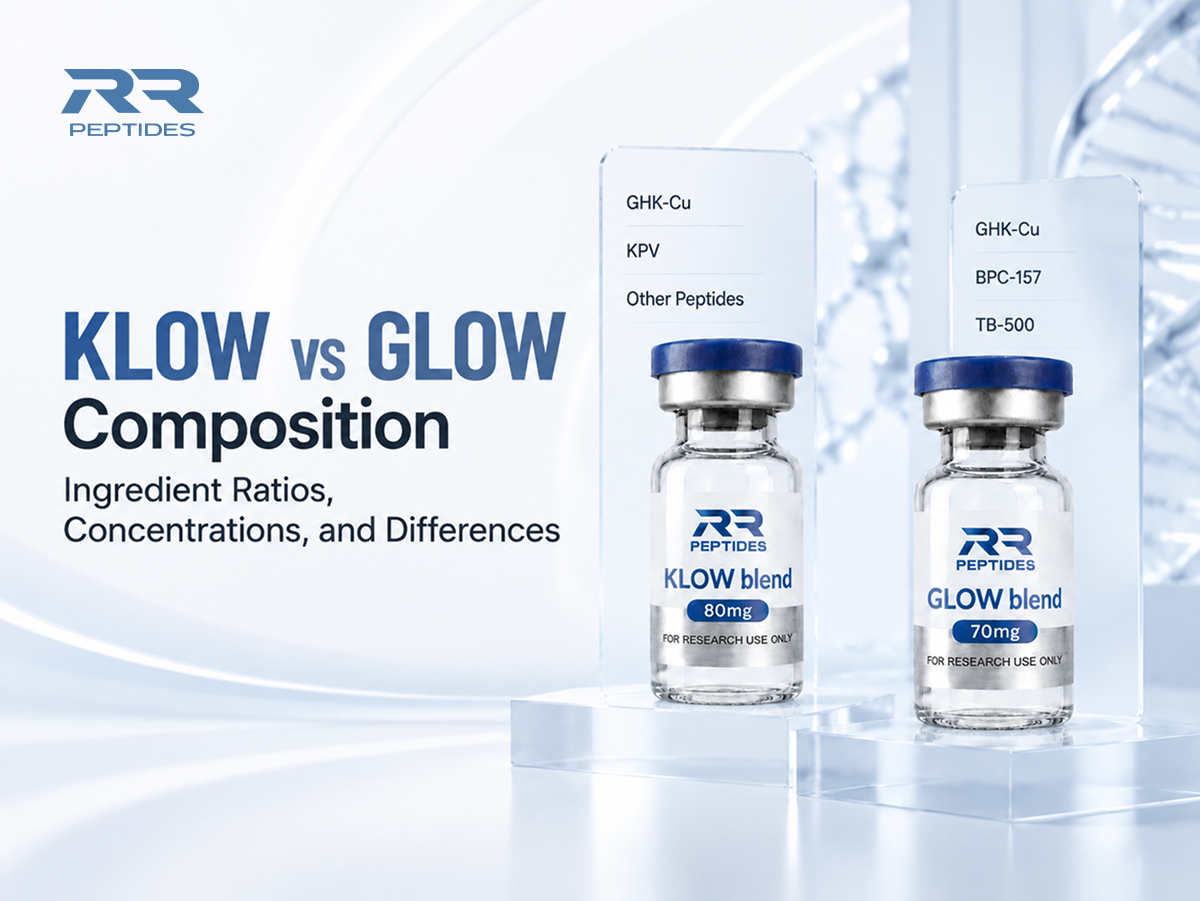
KLOW vs GLOW composition begins with the ingredient list. The commonly listed KLOW 80 mg formulation contains four components: GHK-Cu, BPC-157, TB-500, and KPV. The nominal amounts are 50 mg GHK-Cu, 10 mg BPC-157, 10 mg TB-500, and 10 mg KPV. This produces an 80 mg total based on nominal mass.
The GLOW 70 mg formulation considered in this comparison contains GHK-Cu, BPC-157, and TB-500. Its listed amounts are 50 mg GHK-Cu, 10 mg BPC-157, and 10 mg TB-500, producing a 70 mg nominal total. KPV is not listed in this formulation.
Component
KLOW 80 mg
GLOW 70 mg
KLOW nominal share
GHK-Cu
50 mg
50 mg
62.5%
BPC-157
10 mg
10 mg
12.5%
TB-500
10 mg
10 mg
12.5%
KPV
10 mg
Not listed
12.5%
Total
80 mg
70 mg
100%
These figures are nominal formulation values, not automatically measured batch concentrations. KLOW vs GLOW composition should therefore be separated into two questions: what the manufacturer or supplier declares, and what analytical testing demonstrates for a particular lot.
The distinction matters because a nominal 80 mg blend represents the combined mass of its listed components, not one peptide with an 80 mg molecular concentration. The 50/10/10/10 distribution is also mass-based, not an equal molar ratio.
The same ingredient can represent a different percentage of two blends. GHK-Cu is 50 mg in both formulations, but it represents 62.5% of KLOW and approximately 71.4% of GLOW. BPC-157 and TB-500 each represent 12.5% of KLOW but approximately 14.3% of GLOW.
This makes KLOW vs GLOW composition more useful than comparing only total milligrams. Researchers should record the exact product specification, relevant study question, controls, and batch documentation.
A closer look at KLOW vs GLOW composition shows that three listed components are shared: GHK-Cu, BPC-157, and TB-500. KPV is the additional listed component in KLOW. These differences create distinct formulation profiles even though most of the named ingredients overlap.
GHK-Cu
GHK-Cu is a copper-binding complex associated with the tripeptide glycyl-L-histidyl-L-lysine. Research literature has examined GHK-Cu in areas including extracellular matrix biology, fibroblast responses, collagen-related processes, cellular signaling, gene expression, and peptide-metal interactions.
In both formulations considered here, GHK-Cu is listed at 50 mg. It is therefore a shared component and the largest individual component by nominal mass. However, its mass contribution should not be interpreted as proof that it determines every experimental response. Research outcomes depend on concentration, molecular characteristics, assay design, model selection, and the endpoint being measured.
BPC-157
BPC-157 is a synthetic peptide that has primarily appeared in preclinical research literature. Experimental studies have examined areas involving cellular signaling, tissue-related models, gastrointestinal systems, vascular responses, and cell migration.
Both formulations list BPC-157 at 10 mg. The shared amount supports component-level comparison, but isolated BPC-157 findings should not automatically be applied to either complete blend.
TB-500
TB-500 is associated with thymosin beta-related research and is commonly discussed in connection with actin-associated processes, cytoskeletal organization, and cell movement. Both formulations considered here list 10 mg.
Commercial terminology surrounding TB-500 can vary, so precise material identification is particularly important when researchers compare suppliers, batches, or experimental results. A product label may provide a starting point, but analytical documentation can provide additional evidence about the material being studied.
KPV
KPV is the tripeptide Lys-Pro-Val. Experimental research has examined KPV in areas involving inflammatory signaling, epithelial models, and molecular interactions.
KPV is commonly listed at 10 mg in the KLOW formulation considered here and is not listed in GLOW. This makes KPV the clearest compositional distinction between the two formulations.
Researchers should document KLOW vs GLOW composition. The presence of KPV does not establish a particular biological effect, nor does its absence establish that GLOW is more suitable for a specific experiment. Interpretation depends on the research question and study design.
For KLOW vs GLOW composition, this component-level view prevents treating shared ingredients as proof that two complete formulations are equivalent.
Ingredient
Shared?
KLOW
GLOW
Main research context
GHK-Cu
Yes
50 mg
50 mg
Matrix and cellular research
BPC-157
Yes
10 mg
10 mg
Preclinical cellular and tissue models
TB-500
Yes
10 mg
10 mg
Cytoskeletal and cell-migration research
KPV
No
10 mg
Not listed
Inflammatory and epithelial models
Differences in Concentration and Component Ratios
KLOW vs GLOW composition becomes more nuanced when concentration and ratio are considered. Total mass is only one dimension of a formulation. Researchers also need to know how that mass is distributed among the components and whether calculations are based on mass or molar quantity.
Nominal mass distribution
KLOW contains 80 mg total nominal mass. Its 50/10/10/10 mg distribution gives GHK-Cu a 62.5% mass share, while BPC-157, TB-500, and KPV each represent 12.5%.
GLOW contains 70 mg total nominal mass. With 50/10/10 mg listed for GHK-Cu, BPC-157, and TB-500, the approximate mass shares are 71.4%, 14.3%, and 14.3%.
Ratio measure
KLOW
GLOW
GHK-Cu
62.5%
71.4%
BPC-157
12.5%
14.3%
TB-500
12.5%
14.3%
KPV
12.5%
Not listed
The table demonstrates why KLOW vs GLOW composition cannot be summarized simply as 80 mg versus 70 mg because the relative distribution also changes.
Mass ratio versus molar ratio
A mass ratio tells researchers how many milligrams of each component are declared. A molar ratio describes the relative amount of substance based on molecular quantity. Since peptide components have different molecular weights, the two approaches can produce different ratios.
For this reason, a laboratory protocol requiring molar concentration should not assume that the labeled milligram ratio is a molar ratio. The appropriate molecular weights and analytical values should be used according to the study requirements.
Nominal amount versus measured amount
Another important distinction is between the amount stated in a product specification and the amount measured analytically in a particular sample.
The declared formulation describes the intended composition. Batch testing may provide measured results for identity, purity, quantity, or other characteristics, depending on the analytical methods used. These values should be interpreted within the scope of the actual test.
For KLOW vs GLOW composition, researchers should therefore avoid treating a nominal formulation as if it were automatically an analytical measurement. Both forms of information have value, but they answer different questions.
Why concentration calculations matter
Concentration affects experimental interpretation because a combined blend mass does not automatically provide the concentration of each component. Accurate KLOW vs GLOW composition supports reproducibility. A careful analysis of KLOW vs GLOW composition should record total nominal mass and each declared amount. If molar calculations are required, researchers should explicitly convert the relevant quantities rather than relying on mass percentages.
This is particularly relevant when comparing two blends with different total masses but shared components. The same nominal amount of GHK-Cu can represent a different fraction of the overall formulation, as shown above.
How Composition May Influence Research Design
The value of KLOW vs GLOW composition is not limited to describing a product label. Composition can affect how a study is structured, how controls are selected, and how results are interpreted.
Defining the research question
Researchers should begin with a measurable research question. For example, a study may investigate cellular signaling, extracellular matrix behavior, epithelial models, cytoskeletal processes, or cell migration.
The question determines which component-level evidence is relevant. It also determines whether the study should evaluate an individual peptide, a complete formulation, or a comparison between formulations.
Choosing controls
A multi-component formulation creates a more complex experimental system than an isolated compound. If a study compares KLOW with GLOW, researchers should define what the comparison is intended to measure.
A formulation-level comparison can determine whether two materials produce different observations under controlled conditions. However, it may not establish which component caused the difference. If attribution is important, additional controls may be required.
For example, individual-component controls can help separate an observation associated with the complete blend from an observation associated with one listed peptide. The exact control structure should be determined by the research question and experimental model.
Separating evidence levels
One of the most important principles in KLOW vs GLOW composition is separating three levels of evidence: ingredient-level, formulation-level, and batch-level.
Ingredient-level evidence concerns a specific peptide studied independently. Formulation-level evidence concerns the complete combination of components. Batch-level evidence concerns the actual material and lot tested.
A finding at one level should not automatically be transferred to another. Research on GHK-Cu, for example, provides information about GHK-Cu under the tested conditions. It does not by itself establish the behavior of an entire multi-peptide blend.
Supporting reproducibility
Good documentation supports reproducibility. Researchers should record the exact formulation, lot number, nominal component amounts, COA information, analytical methods, experimental conditions, controls, and study endpoints.
Avoiding unsupported conclusions
Composition alone does not prove synergy, efficacy, safety, or superiority. Even when peptides are researched in related areas, their combination requires direct experimental evaluation. Conclusions should remain specific to the tested model and conditions.
Verifying Composition Through COA and Batch Testing
Always verify KLOW vs GLOW composition first. A reliable KLOW vs GLOW composition comparison should extend beyond the product label to the exact formulation and available analytical documentation.
What a COA can provide
A certificate of analysis may include information such as product identification, lot number, test date, analytical method, reported result, and acceptance specification. The exact information varies by document.
A batch-specific COA is generally more useful for traceability than a generic document because it connects the analytical report to a particular production lot.
However, a COA only confirms what it actually reports. A general purity result does not automatically establish the identity and quantity of every component in a multi-peptide blend.
HPLC and UPLC
High-performance liquid chromatography and ultra-performance liquid chromatography can provide chromatographic information. Depending on the method, they can support separation and assessment of chromatographic purity.
Researchers should not interpret retention time alone as definitive molecular identification. Analytical conclusions should remain within the scope of the method and supporting evidence.
LC-MS
Liquid chromatography-mass spectrometry combines chromatographic separation with mass-based information. It can provide additional evidence useful for identifying peptide components.
For KLOW vs GLOW composition, combining complementary analytical information can provide a stronger basis for evaluating material identity than relying on a product name or a single purity value.
Batch traceability
Document KLOW vs GLOW composition by batch. The lot number connects the physical material with its production and analytical documentation. If the lot number on the material does not match the documentation, researchers should resolve the discrepancy before relying on that document to characterize the sample.
A reproducible research record should preserve the relevant product identifier, lot information, test documentation, and experimental conditions.
Verification item
Why it matters
Product specification
Defines intended formulation
Ingredient list
Identifies declared components
Nominal amounts
Defines stated mass distribution
Lot number
Supports batch traceability
Batch-specific COA
Links results to a tested lot
Analytical method
Defines how the result was obtained
Reported result
Provides the measured finding
Acceptance criteria
Provides the relevant comparison standard
Researchers evaluating KLOW vs GLOW composition should distinguish purity from composition. Purity describes a specified analyte under a particular method, while composition describes the components and their amounts.
For Canadian researchers, documentation should be considered alongside applicable institutional and regulatory requirements. Research-oriented materials should not be represented as therapeutically authorized products.
What is the main difference in KLOW vs GLOW composition?
The commonly listed KLOW 80 mg formulation contains GHK-Cu, BPC-157, TB-500, and KPV. The GLOW 70 mg formulation considered here lists GHK-Cu, BPC-157, and TB-500, without listed KPV. The total nominal masses are therefore different.
Are GHK-Cu, BPC-157, and TB-500 present in both blends?
Yes, in the formulations considered in this comparison, all three are shared. KLOW lists 50 mg GHK-Cu and 10 mg each of BPC-157 and TB-500. GLOW lists the same nominal amounts for those three components.
Is KPV included in GLOW?
KPV is not listed in the GLOW 70 mg formulation considered here. It is commonly listed at 10 mg in KLOW.
Is the KLOW 50/10/10/10 ratio a molar ratio?
No. It is a mass-based distribution. Because the components have different molecular weights, the corresponding molar proportions are not identical to the milligram proportions.
Does KLOW vs GLOW composition prove that one blend is better?
No. Composition alone cannot establish superiority, therapeutic efficacy, safety, or a specific biological outcome. Those questions require appropriate experimental evidence.
Can a COA confirm the entire formulation?
Only to the extent that the COA provides relevant analytical information. A COA with a general purity result may not individually verify every component. Researchers should examine the methods and results reported.
Final Thoughts
KLOW vs GLOW composition provides the baseline for interpreting formulation differences in controlled laboratory comparisons. KLOW is commonly listed as an 80 mg formulation containing GHK-Cu, BPC-157, TB-500, and KPV, while the GLOW formulation considered here is listed at 70 mg with GHK-Cu, BPC-157, and TB-500.
KLOW vs GLOW composition should also be connected to study design. Researchers can use the formulation to define relevant controls, identify appropriate research questions, document experimental materials, and separate ingredient-level evidence from formulation-level findings.
Analytical verification adds another layer of confidence. A product specification explains the intended formulation, while batch-specific documentation and suitable analytical methods can provide evidence about the material actually tested. HPLC, UPLC, and LC-MS may each answer different analytical questions, so results should be interpreted within their stated scope.
At RR Peptides, researchers can explore research-focused peptide materials and educational resources covering formulation, testing, and batch documentation. For Canadian laboratories, use documented information, maintain traceability, follow applicable requirements, and keep findings within the tested conditions.
Disclaimer: All products and compounds discussed are intended strictly for laboratory and research purposes. This article is provided for educational and informational purposes only and is not medical advice, therapeutic guidance, or instructions for human administration.
3 Comments
The comparison of KLOW and GLOW compositions is quite helpful for understanding how the two blends differ at the component level. Breaking down the individual ingredients gives a clearer basis for evaluating their respective research characteristics.
I found the composition breakdown useful, particularly because it shows why KLOW and GLOW should not simply be treated as interchangeable blends. Looking at the individual components provides more context for understanding their intended research applications.
Having the compositions compared directly provides a useful reference when researching these two blends. It also helps clarify how differences in their individual components can influence the way each formulation is discussed in research.




The comparison of KLOW and GLOW compositions is quite helpful for understanding how the two blends differ at the component level. Breaking down the individual ingredients gives a clearer basis for evaluating their respective research characteristics.
I found the composition breakdown useful, particularly because it shows why KLOW and GLOW should not simply be treated as interchangeable blends. Looking at the individual components provides more context for understanding their intended research applications.
Having the compositions compared directly provides a useful reference when researching these two blends. It also helps clarify how differences in their individual components can influence the way each formulation is discussed in research.