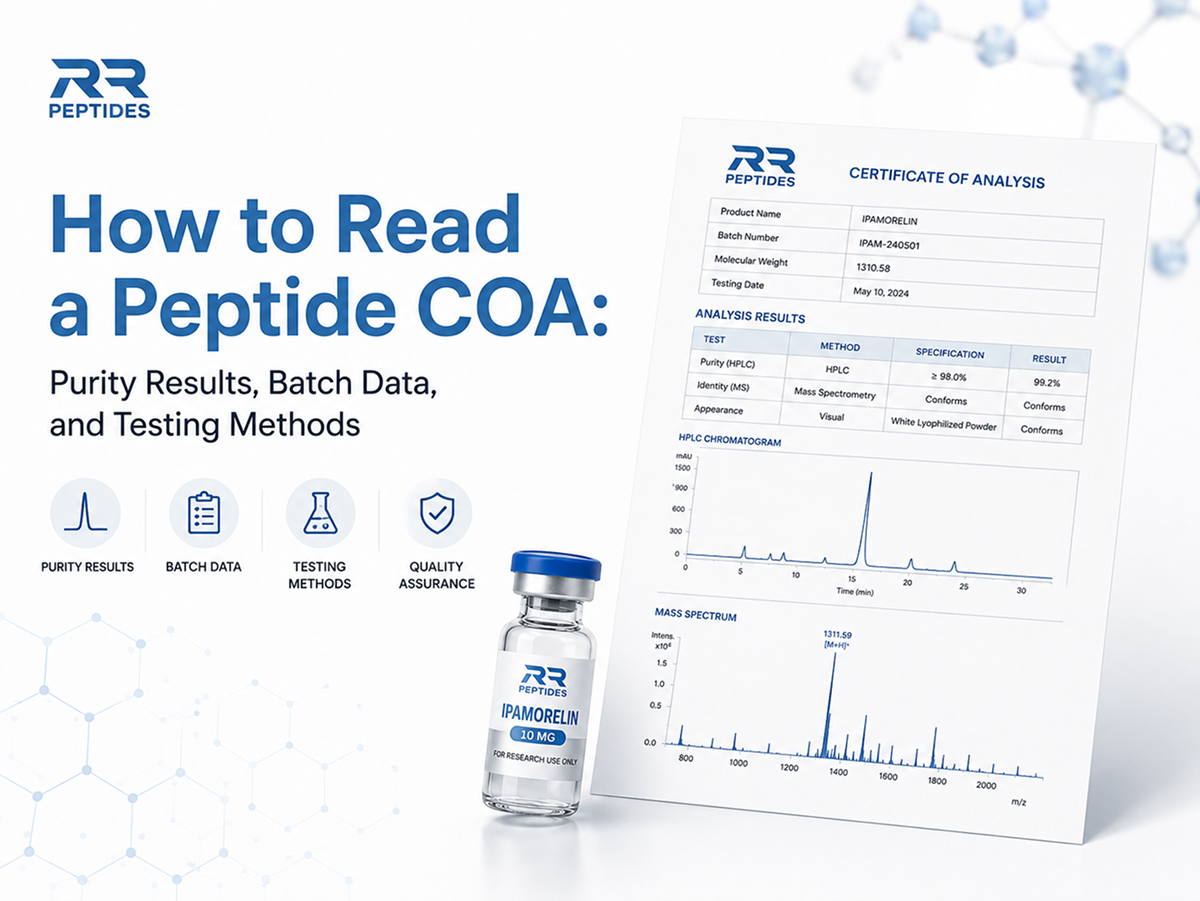
Knowing how to read a peptide COA helps researchers evaluate analytical documentation without relying on a single purity percentage. A Certificate of Analysis (COA) should connect a specific peptide sample or production batch with the methods and results used to characterize it.
For example, HPLC can provide information about chromatographic purity, while mass spectrometry can provide complementary molecular information supporting identity. Batch numbers, specifications, testing dates, laboratory details, chromatograms, and spectra add further context.
Learning how to read a peptide COA means looking beyond the highest purity value. A useful review considers what was tested, which batch the results represent, how the analysis was performed, and what each result actually demonstrates.
For additional research-focused peptide information and analytical resources, explore RR Peptides.
How to Read a Peptide COA
The easiest way to understand how to read a peptide COA is to treat the document as a connected analytical record:
Compound → Batch → Method → Specification → Result → Supporting Data
Each part answers a different question.
COA Field
Example
What to Check
Compound
Example Peptide
Matches the research material
Batch / Lot
RP-260401
Matches the sample or vial
HPLC specification
≥98.0%
Defined acceptance criterion
HPLC result
99.1%
Actual measured result
Identity test
Mass spectrometry
Method used for identity
MS result
Consistent with expected mass
Supports molecular identity
Testing date
April 2026
Establishes testing timeline
Laboratory
Example Analytical Lab
Identifies testing source
A result such as “99.1%” has limited meaning without this surrounding information.
Identify the Scope of Testing
Not every COA contains the same analytical tests. One report may include HPLC and mass spectrometry, while another may contain additional measurements.
Therefore:
HPLC purity reported does not automatically mean mass spectrometry was performed.
Likewise, MS identity data does not mean that water, residual solvents, peptide content, or every possible impurity was evaluated.
Understanding how to read a peptide COA means interpreting only the tests actually performed rather than assuming additional characteristics were evaluated.
Explore quality research peptides in Canada at RR Peptides
Reviewing Product and Batch Information
When learning how to read a peptide COA, first confirm that the identification information corresponds to the research material.
Compound Name
The compound listed on the COA should match the peptide being evaluated.
Depending on the report, additional identifiers may include:
peptide sequence;
molecular formula;
theoretical molecular weight;
product code; or
laboratory sample ID.
These details are important when learning how to read a peptide COA because they establish what material the laboratory analyzed.
Batch or Lot Number
The batch number is one of the most important fields when learning how to read a peptide COA.
Ideally, researchers should be able to follow this relationship:
Physical Sample → Batch Number → COA → Laboratory Record
If the physical sample and COA display different lot numbers, the report should not automatically be assumed to characterize that material.
When understanding how to read a peptide COA, batch-specific documentation matters because analytical characteristics can differ between production lots. Analytical characteristics may differ between production lots.
Sample IDs and Product Codes
A testing laboratory may assign its own sample identifier in addition to the manufacturer’s batch number.
Different identifiers are not necessarily a problem. What matters is whether the documentation provides a traceable relationship between the laboratory sample and the production batch.
Testing Date
The testing date shows when the analysis was performed.
An older COA is not automatically invalid, but researchers should determine whether it represents the current batch or a historical production lot.
Comparing the COA With the Physical Sample
A simple comparison can help identify traceability gaps:
Physical Sample
COA
What to Confirm
Compound name
Compound name
Same peptide
Batch number
Batch number
Matching lot
Product code
Sample / product ID
Traceable relationship
Labeled amount
Product information
Consistent description
Current batch
Testing date
Relevant analytical record
A mismatch does not necessarily mean the analytical result itself is incorrect. However, it reduces confidence that the report specifically represents the material being evaluated.
Specifications vs Actual Test Results
Another important part of understanding how to read a peptide COA is distinguishing a specification from an actual result.
Consider this example:
Test
Specification
Actual Result
HPLC Purity
≥98.0%
99.2%
The specification is the predefined acceptance criterion.
The actual result is the value measured for the tested sample.
Therefore: Purity specification: ≥98%
does not mean that the sample was measured at exactly 98%.
A supplier describing a peptide as “≥98% purity” may be referring to its specification rather than the individual batch result.
Numerical Results vs “Pass”
A COA may state: HPLC Purity: Pass
This indicates that the stated acceptance criterion was reportedly met, but it provides less analytical information than: HPLC Purity: 99.2%
An important part of how to read a peptide COA is recognizing that numerical results generally provide more analytical detail than a simple “Pass.”
Explore quality research peptides in Canada at RR Peptides
Understanding HPLC Purity Results
High-performance liquid chromatography (HPLC) is one of the most common methods encountered when learning how to read a peptide COA.
HPLC separates components according to their interactions with a stationary phase and mobile phase. During reversed-phase peptide analysis, different components move through the chromatographic system at different rates and are recorded by a detector as peaks.
Understanding HPLC Peak Area
A simplified chromatographic result might look like this:
Peak
Relative Integrated Area
Main peak
98.8%
Minor peak 1
0.7%
Minor peak 2
0.3%
Minor peak 3
0.2%
Total
100.0%
Using area normalization, the laboratory might report: HPLC Purity: 98.8%
When understanding how to read a peptide COA, this result indicates that the principal component accounts for approximately 98.8% of the relevant detected chromatographic area.
However, this percentage should not automatically be interpreted as the percentage of total sample mass consisting of the intended peptide.
HPLC Purity Is Not the Same as Peptide Content
A lyophilized peptide sample may also contain water, counterions, salts, residual solvents, or other components.
Not all of these substances are necessarily represented proportionally by an HPLC area-purity calculation.
Therefore: 99% HPLC area purity ≠ automatically 99% peptide content by weight
Understanding how to read a peptide COA requires recognizing that chromatographic purity and quantitative peptide content answer different analytical questions.
A separate quantitative assay may be needed when the research objective is to determine how much target analyte is actually present.
Reading the Chromatogram
An important part of how to read a peptide COA is knowing which elements of an HPLC chromatogram deserve attention.
Retention time indicates when a component elutes from the column under specified chromatographic conditions. It can be useful for comparison, but retention time alone should not generally be treated as definitive molecular identification.
Peak area represents the integrated detector response associated with a chromatographic peak. Relative peak areas may be used to calculate purity when area normalization is applied.
Peak separation is also important. Clear separation between the principal peak and nearby components helps support meaningful integration.
Minor peaks may represent peptide-related impurities, degradation products, synthesis-related species, or other detectable components. Their specific identities generally cannot be determined from appearance alone.
Interpreting Mass Spectrometry Data
Mass spectrometry provides complementary information when learning how to read a peptide COA.
While HPLC primarily provides information about chromatographic separation and purity, mass spectrometry provides molecular information that can support peptide identity.
What Mass Spectrometry Measures
Mass spectrometry analyzes ions according to their mass-to-charge ratio (m/z).
The expected molecular characteristics of a peptide can be calculated from its composition. Observed mass-spectrometry data can then be compared with theoretical expectations.
When learning how to read a peptide COA, researchers can compare observed molecular information with expected values to evaluate evidence supporting peptide identity.
Molecular Weight and m/z Are Not Always Identical
A peptide can form ions carrying different numbers of charges during analysis. As a result, the spectrum may show several m/z signals instead of one peak numerically identical to the peptide’s neutral molecular mass.
Depending on the analytical system, the report may also provide a deconvoluted molecular mass that can be compared more directly with the theoretical molecular weight.
For this reason, the most prominent m/z signal should not automatically be expected to equal the peptide’s listed molecular weight.
HPLC vs Mass Spectrometry
Method
Primary Analytical Role
Does Not Establish Alone
HPLC / UPLC
Chromatographic purity and separation
Definitive molecular identity
Mass spectrometry
Molecular information supporting identity
HPLC purity percentage
LC-MS
Separation plus molecular information
Every quality attribute
MS/MS
Additional structural information
Complete sample characterization
Knowing how to read a peptide COA also means recognizing that HPLC and mass spectrometry answer different analytical questions and provide complementary evidence.
Purity, Identity, and Content Explained
A common mistake when learning how to read a peptide COA is treating purity, identity, and content as interchangeable measurements.
They are not.
Measurement
Main Question
HPLC purity
How chromatographically pure is the sample?
Molecular identity
Is the molecular information consistent with the expected peptide?
Content / assay
How much target analyte is actually present?
A sample can have high chromatographic purity without the HPLC percentage representing its total peptide content by weight.
Likewise, molecular-mass data consistent with the expected peptide can support identity without independently establishing chromatographic purity.
These measurements provide complementary information and should be interpreted according to the analytical method used.
Why Testing Methods Matter When Comparing Peptide COAs
Researchers may encounter two COAs with slightly different purity results.
For example:
Laboratory A: 99.0% HPLC purity
Laboratory B: 99.4% HPLC purity
The higher number does not automatically mean that one sample is analytically superior.
When understanding how to read a peptide COA, researchers should consider whether the results were generated under comparable analytical conditions.
HPLC results can be influenced by factors such as:
column chemistry;
mobile-phase composition;
gradient conditions;
detector wavelength;
sample concentration;
chromatographic resolution; and
integration parameters.
Consequently, a difference of several tenths of a percentage point may reflect analytical conditions rather than a meaningful difference between samples.
This is particularly important when comparing reports from different laboratories.
For this reason, meaningful COA comparison should consider the analytical conditions behind each result. Two laboratories may test similar peptide samples but use different chromatographic procedures, producing slightly different purity values. Reviewing the method alongside the numerical result provides researchers with a more accurate context for interpreting those differences.
Instead of ranking COAs exclusively by purity percentage, researchers should also consider method transparency, chromatographic quality, batch traceability, identity data, and overall documentation.
Verifying Laboratory and Testing Details
Knowing how to read a peptide COA also requires checking who performed the testing and whether the results connect with identifiable laboratory records.
Useful information may include:
laboratory name;
testing date;
report or certificate number;
sample identifier;
analytical methods; and
relevant supporting data.
A unique report number can be particularly useful when chromatograms or mass spectra are provided separately from the main COA.
Third-Party Laboratory Testing
If a report is described as third-party or independently tested, researchers should ideally be able to identify the laboratory responsible for the analysis.
Independent testing can provide another layer of analytical review, but the phrase “third-party tested” alone does not establish reliability.
Method suitability, laboratory competence, sample traceability, and documentation quality remain important regardless of whether testing is performed internally or externally.
Common Red Flags When Reading a Peptide COA
Knowing how to read a peptide COA also involves recognizing when important analytical context is missing.
Potential Red Flag
Why It Matters
No batch number
Difficult to connect results with specific material
Purity percentage without method
Unclear how purity was determined
Identity claim without method
Limited evidence supporting identification
Only “Pass” reported
Numerical result unavailable
No testing date
Analytical timeline is unclear
No laboratory identification
Reduced testing traceability
Batch mismatch
COA may represent different material
Limited supporting data
Less context behind analytical claims
These features do not automatically prove that a COA is unreliable. Instead, they identify areas where additional documentation may be useful.
Avoid Focusing Only on the Highest Purity Number
Understanding how to read a peptide COA helps researchers recognize why a 99.9% result should not automatically be considered stronger evidence than a well-documented 99.1% result.
Chromatographic separation, method suitability, batch matching, integration, and identity testing provide important context.
A well-documented 99.1% result can therefore provide more useful analytical information than an unsupported 99.9% claim.
Reading Peptide COAs in the Canadian Research Context
For Canadian researchers, analytical principles used in Health Canada’s regulated pharmaceutical frameworks provide useful context for evaluating laboratory documentation.
In regulated pharmaceutical settings, documentation commonly emphasizes areas such as batch identification, specifications, analytical procedures, numerical results, method suitability, and traceability.
These requirements should not automatically be assumed to apply to every research peptide or research-material supplier in Canada because the regulatory context may differ.
Nevertheless, the underlying principles remain useful when understanding how to read a peptide COA. Analytical results are more informative when they are connected to an identifiable batch, generated using a stated method, and reported with sufficient information to understand what was actually measured.
To understand how to read a peptide COA, begin with the compound and batch number. Then review the analytical methods, specifications, actual results, testing date, laboratory information, and available supporting data.
What should I check first on a peptide COA?
Start with the compound name and batch or lot number. These fields help establish whether the analytical report corresponds to the research material being evaluated.
What does 99% HPLC purity mean?
It generally indicates that the principal integrated component represents approximately 99% of the relevant detected chromatographic area under the analytical conditions used. It does not automatically mean that the sample is 99% peptide by total weight.
Does HPLC confirm peptide identity?
Not independently. HPLC provides chromatographic information, while mass spectrometry can provide complementary molecular information supporting identity.
What does mass spectrometry show on a peptide COA?
Mass spectrometry provides mass-to-charge information that can be compared with the expected molecular characteristics of the peptide.
Why should the batch number match the physical sample?
Matching identifiers help establish that the analytical results correspond to the production lot being evaluated.
Is a “Pass” result enough?
A pass result indicates that a stated acceptance criterion was reportedly met. However, an actual numerical value provides more analytical information when the test is quantitative.
Can two laboratories report different HPLC purity percentages?
Yes. Differences in chromatographic methods, instrumentation, sample preparation, and integration procedures can contribute to different reported values.
Does a COA prove that every impurity was tested?
No. A COA summarizes the analytical tests that were performed. Researchers should not assume that characteristics absent from the report were also evaluated.
Final Thoughts
Understanding how to read a peptide COA requires looking beyond the headline purity percentage. A useful evaluation considers the compound, production batch, analytical methods, specifications, numerical results, laboratory information, and available supporting data together.
HPLC provides information about chromatographic purity, while mass spectrometry can provide complementary evidence supporting molecular identity. Peptide content represents a separate analytical measurement and should not automatically be inferred from an HPLC purity percentage.
The testing scope also matters. Conclusions should remain limited to the characteristics actually evaluated by the reported methods.
Ultimately, clear batch traceability and transparent analytical documentation make a COA substantially more useful for laboratory research. Evaluating the complete analytical record provides more meaningful information than relying on a single purity value.
For additional research-focused peptide information, testing education, and laboratory resources, explore RR Peptides.
Disclaimer: All products and compounds referenced are intended strictly for laboratory and research purposes only. This content is provided for informational and educational purposes and is not intended as medical advice or to diagnose, treat, cure, or prevent any disease.
3 Comments
Really helpful guide for anyone who finds peptide COAs difficult to interpret. I especially liked the breakdown of the different sections and the reminder to look beyond a single purity percentage. A worked example of a COA would make this even easier for beginners to understand.
I found the explanation of analytical results particularly useful. Understanding what information supports peptide identity and purity makes it much easier to evaluate research documentation objectively. It would be interesting to see a follow-up comparing complete COAs with reports that may be missing important analytical details.
Appreciate how straightforward this article makes COA interpretation. There are several technical details that can be easy to overlook, so having a clear framework for reviewing the document is valuable. A checklist of key points to verify before accepting a peptide COA would be a great addition.




Really helpful guide for anyone who finds peptide COAs difficult to interpret. I especially liked the breakdown of the different sections and the reminder to look beyond a single purity percentage. A worked example of a COA would make this even easier for beginners to understand.
I found the explanation of analytical results particularly useful. Understanding what information supports peptide identity and purity makes it much easier to evaluate research documentation objectively. It would be interesting to see a follow-up comparing complete COAs with reports that may be missing important analytical details.
Appreciate how straightforward this article makes COA interpretation. There are several technical details that can be easy to overlook, so having a clear framework for reviewing the document is valuable. A checklist of key points to verify before accepting a peptide COA would be a great addition.