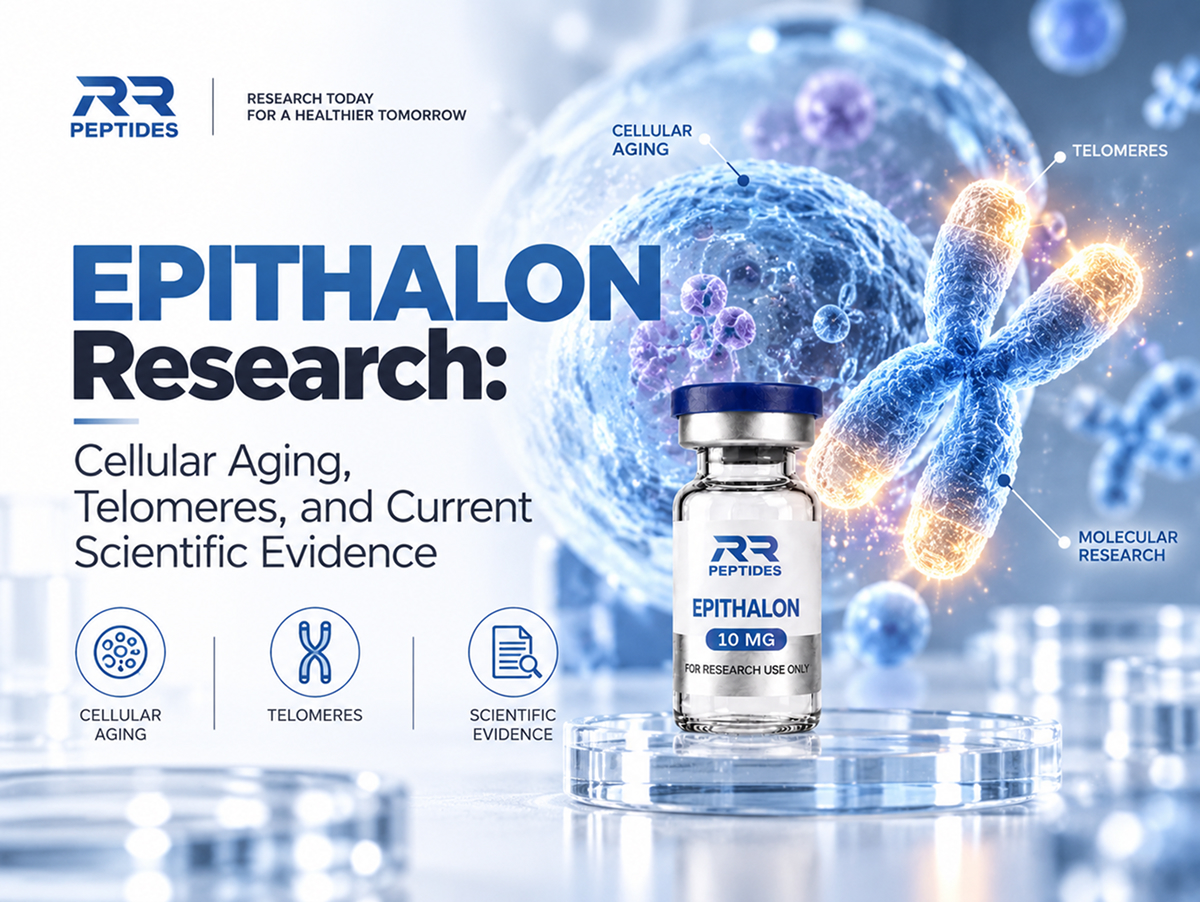
Why do some cells stop dividing while others continue? Researchers investigating cellular aging study chromosome protection, DNA damage, metabolism, and the molecular decisions that regulate growth. These processes are connected, yet none provides a complete explanation of human longevity.
Epithalon research examines a synthetic four-amino-acid peptide, also called epitalon, in experimental models of cellular regulation. Early studies reported changes in telomerase activity and telomere length. More recent work has examined additional telomere maintenance pathways. However, findings in cultured cells cannot establish that a compound reverses aging or improves human health.
For Canadian laboratories exploring this topic, RR Peptides provides research material listings and product information. Review the Epithalon listing and available quality documentation before planning an experiment. The RR Peptides collection can support material comparisons, but independent verification and applicable Canadian requirements remain essential.
These distinctions matter because interest often grows faster than the evidence needed to support reliable conclusions about complex biological processes.
Epithalon is a synthetic tetrapeptide with the amino-acid sequence alanine, glutamate, aspartate, and glycine, commonly abbreviated AEDG. The spelling epitalon also appears in scientific literature. Researchers should distinguish this defined synthetic sequence from epithalamin, a more complex preparation historically associated with pineal tissue research. Results involving one material cannot automatically be assigned to the other.
Epithalon research emerged from investigations of peptide bioregulation and age-associated cellular changes. Interest later concentrated on telomerase, an enzyme complex involved in maintaining repetitive DNA sequences at chromosome ends. The biological questions are legitimate, but commercial claims often extend far beyond the experimental evidence.
Why Telomeres Attract Attention
Telomeres contain repetitive DNA and protective proteins that help distinguish natural chromosome ends from broken DNA. They may shorten during repeated cell division, although shortening rates differ across tissues and circumstances. When chromosome ends become critically dysfunctional, cells can activate checkpoints that restrict further proliferation.
Telomerase can add telomeric repeats in certain cellular contexts. Its activity is regulated differently in stem cells, most mature somatic cells, and many cancers. Consequently, greater telomerase activity is not automatically equivalent to healthier aging.
Epithalon research examines whether experimental exposure changes telomerase-related measurements, but these observations must be separated from outcomes such as disease prevention or lifespan extension.
Important Terms for Readers
Term
Meaning in laboratory research
Common misunderstanding
Telomere
Protective chromosome-end structure
A universal aging clock
Telomerase
Enzyme involved in telomere maintenance
Always beneficial when activated
Senescence
Durable growth arrest in certain contexts
Every nondividing cell is damaged
Proliferation
Increase in cell numbers through division
Proof of rejuvenation
Healthspan
Years lived in relatively good health
Directly measurable in a cell dish
Epithalon research requires clear definitions because changes in cellular markers do not necessarily predict whole-body outcomes. A longer telomere in a particular culture is a measurement, not a clinical benefit.
Importantly, telomere measurements may differ among individual chromosomes and cell populations. Investigators should consider that variation when comparing treated cultures with untreated controls.
Explore cellular aging pathways and telomerase research with RR Peptides’ research-grade Epithalon 10mg.
Which Areas of Epithalon Research Are Most Established?
Early Telomerase Observations
A 2003 study by Khavinson and colleagues reported that Epithalon exposure in human fetal fibroblast cultures was associated with expression of the telomerase catalytic subunit, measurable enzyme activity, and telomere elongation. This was an experimental observation in a particular cell model, not a human longevity trial.
A related 2004 publication from the same research group described additional divisions in treated fetal fibroblast cultures compared with controls. These findings attracted attention because they connected chromosome-end biology with proliferative capacity. Nevertheless, studies originating from a small research group require careful independent replication.
Epithalon research should describe these reports as historical cell-culture findings rather than settled proof of an anti-aging mechanism.
What a More Recent Study Added
A 2025 study examined normal human fibroblast and epithelial cells alongside breast cancer cell lines. The investigators reported increased telomere length and changes in telomerase-related measurements in certain normal cells. In the cancer lines, telomere extension was associated with markers of alternative lengthening of telomeres, commonly called ALT, rather than a significant increase in measured telomerase enzyme activity.
This distinction matters. Telomere maintenance is not one pathway, and responses may depend strongly on the cell model. Results involving cancer cell lines are particularly unsuitable for promotional claims about rejuvenation.
Epithalon research now includes a broader mechanistic question: why might different cell populations show different chromosome-maintenance responses? The 2025 findings add experimental evidence, but they do not resolve clinical efficacy or long-term safety.
Comparing the Evidence
Research period
Main model
Reported observation
What remains unresolved
2003
Human fetal fibroblasts
Telomerase-related changes
Independent generalizability
2004
Aging fibroblast cultures
Additional cell divisions
Long-term genomic consequences
2025
Normal and cancer cell lines
Telomere and pathway changes
Mechanism across tissues
Current clinical context
Humans
No established anti-aging benefit
Efficacy and safety
Epithalon research has generated hypotheses worth testing, but a small collection of cellular studies cannot determine whether the compound changes aging in people.
Evidence Strength Is Not the Same as Popularity
Online discussions often treat repeated descriptions of the same early experiments as independent confirmation. They are not. A review, product page, and social media post may all trace back to one underlying experiment. Researchers should identify the original model, measured endpoints, independent replications, and limitations before assigning confidence.
Epithalon research benefits from distinguishing primary data from commentary and from separating biological plausibility from demonstrated outcomes.
A useful evidence review also asks whether investigators measured predefined outcomes, reported uncertainty, and considered alternative explanations for unexpected changes in cell behaviour.
How Is Epithalon Studied in Cellular and Preclinical Models?
Selecting a Model for the Question
Primary fibroblasts are useful for investigating replication-associated changes because they retain aspects of normal growth control. However, donor age, passage history, culture conditions, and individual variation influence results. Immortalized cells offer convenience but often contain altered pathways that complicate aging interpretations.
Epithalon research may also examine epithelial cells, established cell lines, or selected animal models. Each system answers a different question. Findings should not be generalized across species, tissues, or developmental stages without supporting evidence.
Model
Useful question
Major limitation
Primary fibroblasts
Replicative aging and telomeres
Donor variability
Primary epithelial cells
Tissue-specific regulation
Limited culture lifespan
Immortalized lines
Defined signalling responses
Altered cell-cycle control
Cancer cell lines
Telomere maintenance pathways
Abnormal growth biology
Animal models
Multisystem interactions
Species and design differences
Experimental Controls and Reproducibility
A credible experiment compares appropriately matched groups and identifies the primary outcome before collecting data. Researchers should document cell identity, culture history, analytical methods, material characteristics, and sampling times. Independent biological samples are more informative than repeated measurements of one culture alone.
Epithalon research needs controls that distinguish true changes in cellular biology from contamination, differences in cell survival, or analytical artifacts. A higher average telomere measurement could reflect changes in the mixture of surviving cells rather than elongation within every original cell.
A practical design checklist includes:
Define the biological hypothesis and primary endpoint.
Confirm cell identity and relevant culture history.
Document material identity and analytical specifications.
Include matched controls and independent biological replicates.
Measure viability alongside proliferation and molecular markers.
Report effect sizes, uncertainty, and negative findings.
Longitudinal Study Design
Measurements at one time point may capture a temporary response rather than a durable cellular change. Longitudinal observations can help determine whether altered gene expression precedes enzyme activity, whether telomere measurements persist, and whether cells retain normal growth regulation.
Epithalon research should distinguish repeated sampling of one culture from truly independent experiments. Researchers should also avoid interpreting a change in population composition as restoration of previously senescent cells.
Standardized reporting makes comparisons easier across laboratories. Without consistent descriptions of culture conditions and analytical methods, apparently conflicting findings may reflect differences in experimental design.
Material Quality in Canadian Laboratories
Material identity, purity, storage history, and batch differences can influence reproducibility. A certificate of analysis may describe selected measurements at a particular time, but it does not independently establish biological activity or suitability for every assay. Laboratories should apply institutional procurement and quality procedures.
Epithalon research is strengthened when the exact material, analytical verification, and chain of custody are documented. For laboratory supply comparisons, RR Peptides provides Epithalon research material information that teams can evaluate alongside their own requirements.
Explore cellular aging pathways and telomerase research with RR Peptides’ research-grade Epithalon 10mg.
What Biological Outcomes Are Measured in Epithalon Research?
Telomere Length and Telomerase Activity
Telomere length can be estimated using quantitative PCR or assessed through other complementary approaches. Different techniques provide different information about average length, distribution, or chromosome-specific features. A population average can conceal important variation between cells and chromosome ends.
Telomerase activity assays examine enzyme function, while measurements of hTERT expression examine a component associated with that function. These endpoints are related but not interchangeable. Higher hTERT expression does not necessarily mean that measured enzyme activity increases proportionally.
Epithalon research should report which endpoint changed, how it was measured, and whether independent methods support the result.
Senescence and Cell-Cycle Regulation
Cellular senescence involves durable proliferation arrest and changes in signalling. Investigators may evaluate DNA synthesis, population doublings, checkpoint proteins, DNA damage markers, and senescence-associated beta-galactosidase staining. No single measurement establishes the full state.
Epithalon research should interpret these results alongside viability and apoptosis measurements. Otherwise, a decline in cell division could reflect toxicity, while increased division could reflect selection of faster-growing cells.
Common endpoints include:
Population doublings and changes in cell counts.
DNA synthesis measured using validated incorporation assays.
p16, p21, and other context-dependent checkpoint markers.
Senescence-associated staining interpreted with functional data.
DNA damage indicators and chromosome stability measurements.
Secreted inflammatory factors when relevant to the model.
Telomere Maintenance Beyond Telomerase
Some cells maintain telomeres through ALT, a recombination-associated process that differs from conventional telomerase activity. The 2025 study reported ALT-related changes in the investigated cancer cell lines, highlighting why separate pathway assays matter. These results should not be interpreted as desirable effects in humans.
Epithalon research can compare telomerase and ALT measurements where scientifically appropriate, while recognizing that abnormal telomere maintenance is relevant to cancer biology.
Translating Measurements Into Meaning
Endpoint
What it can support
What it cannot establish
Telomere length
Chromosome-end measurement
Longer human lifespan
Telomerase activity
Enzymatic function
Clinical rejuvenation
hTERT expression
Gene regulation
Direct target binding
Cell divisions
Proliferative behaviour
Healthy tissue function
Senescence markers
Features of growth arrest
Reversed biological age
ALT markers
Alternative maintenance activity
Therapeutic safety
Epithalon research is most useful when authors state the limits of each endpoint. A statistically significant laboratory result can be biologically interesting without being clinically meaningful.
Results should be interpreted within their experimental timeframe. Short observations may reveal molecular responses without showing whether altered growth regulation remains stable over successive passages.
Explore cellular aging pathways and telomerase research with RR Peptides’ research-grade Epithalon 10mg.
What Are the Main Limitations of Current Epithalon Research?
Limited Human Evidence
Cell-culture studies cannot establish how a substance behaves across human organs, immune systems, or long periods. They also cannot determine appropriate clinical use, adverse-event frequency, or effects on lifespan. No robust clinical evidence establishes Epithalon as a treatment that reverses human aging.
Epithalon research should not convert laboratory observations into claims about disease prevention, better sleep, hormonal balance, or extended human life without direct supporting studies.
Mechanistic and Safety Uncertainty
Telomerase biology involves a central tradeoff: maintaining chromosome ends can support certain normal cells, while inappropriate growth maintenance is also relevant to cancer. The observation of ALT-associated changes in cancer cell models reinforces the need for careful mechanistic investigation rather than simplistic interpretations.
Epithalon research needs longer follow-up, genomic stability assessments, and independent replication before broad safety claims can be considered. An absence of reported harm in a small experiment is not evidence of safety in humans.
Canadian Regulatory Context
Health Canada has publicly identified epitalon among unauthorized injectable peptide drugs and warned Canadians about products marketed online for anti-aging or wellness. The agency has also explained that a research-use label does not automatically make a product legal or exempt from applicable requirements. Authorized prescription drugs in Canada carry an eight-digit Drug Identification Number.
Epithalon research conducted within legitimate institutions must remain distinct from consumer self-administration or unauthorized therapeutic marketing. Researchers should verify relevant laws, ethics requirements, and procurement procedures rather than assuming that laboratory terminology provides a regulatory exemption.
Priorities for Better Evidence
Future investigations should focus on clearly defined mechanisms, comparable assays, and independent reproducibility. Studies should report unsuccessful experiments, characterize unexpected cell growth, and distinguish short-term marker changes from sustained biological effects.
Evidence gap
Priority for future work
Limited replication
Independent laboratories and donors
Model-specific responses
Comparisons across cell types
Unclear direct mechanism
Target-focused experiments
Uncertain durability
Longitudinal follow-up
Growth-control concerns
Genomic stability assessments
Human relevance
Appropriate regulated clinical research
Epithalon research will become more informative through careful methods and transparent reporting, not stronger promotional language.
For Canadian readers, the distinction between experimental investigation and therapeutic marketing is important. Scientific discussion should never imply regulatory authorization that has not been demonstrated.
Epithalon is a synthetic four-amino-acid peptide, commonly represented as AEDG. Scientists have investigated it in selected models involving telomeres, cellular regulation, and proliferation.
Does Epithalon Extend Human Lifespan?
No reliable clinical evidence establishes lifespan extension in humans. Cell-culture observations cannot demonstrate improved human longevity or healthspan.
Is Epithalon the Same as Epithalamin?
No. Epithalon is a defined synthetic tetrapeptide, whereas epithalamin refers to a more complex historical preparation. Their findings should not be treated as interchangeable.
Why Do Researchers Measure Telomerase?
Telomerase participates in chromosome-end maintenance. Measuring its activity helps investigate cellular mechanisms, but increased activity alone does not demonstrate healthier aging.
Do Longer Telomeres Always Mean Healthier Cells?
No. Telomere length must be interpreted alongside genomic stability, cell identity, and growth regulation. Cancer-related pathways make simplistic conclusions inappropriate.
Are the Results Consistent Across Cell Types?
Not necessarily. Experimental findings differ across normal and cancer cell models, and the available literature does not establish one universal response.
Is Epithalon Approved for Human Use in Canada?
Health Canada has warned about unauthorized injectable products containing epitalon. A research label does not establish authorization for human administration.
What Should Researchers Prioritize?
Epithalon research should prioritize independent replication, validated endpoints, material verification, and transparent reporting of both positive and negative outcomes.
Independent confirmation matters more than popularity.
Conclusion
The scientific interest surrounding Epithalon comes primarily from experimental observations involving telomere maintenance, telomerase-related activity, and cellular proliferation. Newer studies broaden the discussion by identifying different responses in normal and cancer cell models. Nevertheless, these findings remain distinct from demonstrated human anti-aging benefits.
Epithalon research should be evaluated through the quality of its models, controls, measurements, and independent replication. Strong evidence requires more than a compelling mechanism or repeated summaries of a small literature.
Canadian laboratory teams can review Epithalon material information throughRR Peptides and explore the RR Peptides research collection when comparing documented supplies. Independently verify product specifications and comply with applicable institutional and Canadian regulatory requirements.
Disclaimer: All products and compounds discussed are intended strictly for laboratory and research purposes. This article is provided for educational and informational purposes only. This article is not medical advice, therapeutic guidance, or instructions for human administration.
×
Subscribe & Get 10% Off!
Enter your email address below to subscribe to our newsletter and receive an instant 10% OFF discount coupon code sent directly to your inbox!
Thank you for subscribing! Your 10% discount coupon has been sent to your email. Please check your inbox!