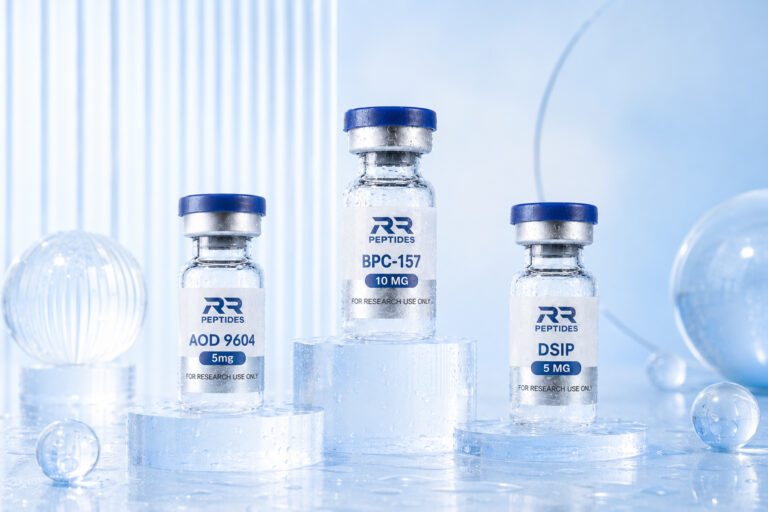
A research peptide can retain its original appearance while its chemical composition changes. For laboratories studying Epithalon, that possibility makes storage history, sample handling, and analytical verification essential to reproducible experiments. A vial that looks normal does not necessarily contain material identical to its initial condition.
Epithalon storage and stability concerns a synthetic tetrapeptide also called epitalon, with the amino acid sequence alanine, glutamate, aspartate, and glycine (AEDG). Its short sequence does not guarantee resistance to environmental stress. Formulation, packaging, moisture, and laboratory procedures may influence sample quality, while publicly available formulation-specific stability data remain limited.
Canadian research teams can explore the Epithalon research material listing at RR Peptides and review available specifications before planning experiments. The RR Peptides collection provides a starting point for comparing laboratory supplies; independent quality assessment and institutional requirements remain essential.
Epithalon is a defined four-residue peptide, but a defined sequence is not the same as a validated shelf life. The form supplied, its counterions, residual moisture, excipients, and container materials can influence how it behaves over time. Results from one formulation cannot automatically be applied to another, even when both labels identify AEDG.
Epithalon storage and stability must therefore be considered in relation to the actual batch and preparation. A dry powder and a prepared solution present different environmental conditions. Researchers should first establish what material they received, rather than selecting storage conditions from a generic peptide chart.
Chemical and Physical Changes
Chemical degradation changes molecular composition. Depending on formulation and conditions, peptide samples may undergo reactions such as hydrolysis or oxidation. Physical changes include precipitation, aggregation, or adsorption to container surfaces. These phenomena have different causes, yet all can affect measured recovery or experimental consistency.
Epithalon storage and stability assessments should distinguish disappearance of intact peptide from losses caused by handling. A reduced assay signal might reflect adsorption rather than chemical breakdown. Conversely, an apparently unchanged concentration may conceal new impurities if the analytical method lacks adequate separation.
Factor
Potential concern
Relevant evidence
Formulation
Different chemical environment
Composition and batch records
Residual moisture
Changes in dry-state behaviour
Moisture testing and packaging data
Container
Surface adsorption or interaction
Compatibility and recovery studies
Oxygen exposure
Possible oxidative reactions
Stability-indicating analysis
Repeated access
Contamination or handling losses
Opening and transfer records
Stability Claims Versus Measurements
A supplier certificate of analysis may report identity and purity when a batch was tested. It does not automatically prove that the same purity persists throughout shipping or storage. An expiration date requires supporting evidence under defined conditions; a suggested retest date is a prompt to evaluate quality, not proof of continued suitability.
Epithalon storage and stability should be documented with measurable acceptance criteria wherever feasible. When evidence is missing, laboratories should record that uncertainty instead of assigning an unsupported number of months or years.
The distinction between purity and potency also matters. Chromatographic purity describes measured components under particular test conditions, while biological activity depends on the experimental system. Neither should be inferred solely from the other.
Epithalon storage and stability also benefits from documenting analytical uncertainty. Laboratories should specify which changes their methods can detect and which quality attributes remain untested.
Explore cellular aging pathways and telomerase research with RR Peptides’ research-grade Epithalon 10mg.
Lyophilization removes water through a controlled freeze-drying process and may improve the storage characteristics of some formulations. However, dry appearance does not establish complete dryness or indefinite chemical stability. Residual moisture, protective ingredients, vial closure, and storage history still matter.
Epithalon storage and stability decisions for lyophilized material should begin with formulation-specific documentation. Many laboratories use controlled, dry, protected storage for peptide powders, but a universally validated temperature or shelf life for every Epithalon product cannot be assumed.
Packaging and Environmental Control
A properly sealed container helps limit moisture exchange and accidental contamination. Laboratories should inspect packaging at receipt, record damaged seals, and identify whether shipping conditions matched documented requirements. Opening a container repeatedly can introduce additional variability, particularly in humid environments.
Epithalon storage and stability benefits from clearly assigned storage locations and continuous or appropriately frequent environmental monitoring. The temperature displayed on a refrigerator or freezer is not a complete record of what the sample experienced during transport, door openings, or equipment faults.
Sample condition
Primary concern
Documentation priority
Unopened dry vial
Seal integrity and environmental exposure
Receipt and storage log
Opened dry vial
Humidity and repeated handling
Access history
Transferred dry material
Contamination and recovery loss
Container and transfer record
Prepared solution
Solvent, pH, and physical changes
Preparation and analytical log
Shipped sample
Temperature excursions
Shipping and receipt observations
Reconstitution Changes the Question
When a dry peptide is dissolved for legitimate laboratory analysis, the solvent environment introduces additional variables. Solution pH, concentration, dissolved oxygen, and container compatibility can affect measurements. Storage guidance for unopened dry material should not be treated as guidance for a prepared solution.
Epithalon storage and stability protocols should identify whether the sample is dry or dissolved at each stage. Researchers should document preparation details and avoid inventing a universal post-preparation expiration period without suitable data.
Retesting After Deviations
A sample exposed to conditions outside its documented limits should be flagged for review. A deviation does not prove degradation, but neither should it be ignored. A quality reviewer can assess exposure history and determine whether stability-indicating testing is needed before the material enters a sensitive experiment.
Epithalon storage and stability records become particularly valuable when several laboratories share batches, because consistent documentation allows investigators to compare results without guessing about earlier handling.
Epithalon storage and stability records should include who approved each deviation assessment. Clear responsibility prevents affected samples from returning to routine use without documented review.
How Can Temperature, Light, and Moisture Affect Epithalon?
Temperature and Reaction Rates
Temperature can influence chemical reaction rates and physical behaviour. Higher temperatures often accelerate certain reactions, while cooling may slow them. Yet freezing does not guarantee stability for every formulation, particularly when a solution undergoes phase separation, concentration changes, or interactions with its container.
Epithalon storage and stability should be assessed through recorded exposure conditions and actual analytical results. Researchers should avoid presenting a single freezer temperature as scientifically proven for every batch without formulation-specific evidence.
Temperature excursions also differ in duration. A brief interruption and a prolonged failure may have different consequences. Meaningful investigation records both time and temperature rather than simply noting that a sample was once warm.
Light Exposure
Light can trigger chemical reactions in susceptible compounds or formulations. However, the extent of light sensitivity for a particular Epithalon preparation should be demonstrated rather than presumed. Protective packaging may be reasonable as a general quality precaution, but darkness alone cannot verify integrity.
Epithalon storage and stability studies can compare samples exposed to controlled illumination with protected controls, provided other conditions remain comparable. A light-exposed sample may also become warmer, creating a confounding variable if temperature is not monitored.
Moisture and Condensation
Moisture can change the environment surrounding dry material. Damaged closures, humid handling spaces, or condensation may introduce water unexpectedly. Visible clumping can prompt investigation, but powder that still looks free flowing may also have experienced chemical changes.
Epithalon storage and stability procedures should minimize unnecessary exposure and record relevant humidity events. The appropriate response to suspected moisture intrusion is assessment, not an assumption that appearance proves either safety or degradation.
Exposure
Possible effect
What researchers should record
Elevated temperature
Faster chemical change
Maximum temperature and duration
Freeze-thaw cycling
Physical or recovery differences
Number of cycles and sample state
Light
Potential photochemical reactions
Intensity and exposure duration
Humidity
Changed dry-state conditions
Packaging and handling observations
Condensation
Unplanned moisture contact
Event history and analytical findings
Interacting Stressors
Environmental factors rarely operate in isolation. Heat and moisture may occur together during shipping; repeated opening may combine temperature cycling with contamination risk. A controlled stability study should isolate variables where possible and identify combined exposures when separation is impractical.
Epithalon storage and stability findings are more useful when the tested conditions resemble actual laboratory handling rather than artificial assumptions about ideal storage.
Explore cellular aging pathways and telomerase research with RR Peptides’ research-grade Epithalon 10mg.
What Handling Practices Help Preserve Sample Integrity?
Establish a Traceable Workflow
Sample integrity depends on what happens between receipt and measurement. Researchers should verify labels, check packaging, review available documentation, and assign unique identifiers before experimental work. Every transfer should preserve a clear connection to the original batch.
Epithalon storage and stability improves as a research practice when teams use written procedures rather than individual habits. A consistent workflow helps separate true biological differences from preventable variation in sample preparation.
A practical quality checklist includes:
Confirm the sample identity against procurement records.
Inspect the closure and document visible abnormalities.
Record receipt conditions and assigned storage location.
Follow the laboratory’s approved handling procedures.
Document transfers, preparation details, and container changes.
Flag deviations before the sample enters an experiment.
Retain analytical results alongside the complete batch history.
Containers and Adsorption
Peptides may interact with laboratory surfaces. The degree of adsorption depends on the specific material, concentration, solvent, and contact time. A loss of measured peptide during transfer can resemble degradation unless researchers include appropriate recovery controls.
Epithalon storage and stability evaluations should consider container compatibility when quantitative assays are sensitive to small losses. Selecting a container described as low binding may be useful, but performance should be checked in the actual analytical system.
Reduce Avoidable Variation
Unnecessary transfers, inconsistent preparation records, and repeated access to shared material can increase uncertainty. Researchers should design workflows that limit such variability while following validated institutional methods. Handling decisions should be driven by analytical requirements, not informal assumptions about peptide robustness.
Epithalon storage and stability also depends on staff training. When different researchers handle the same batch, agreed procedures and clear logs help make their findings comparable.
Canadian Laboratory Accountability
Canadian research institutions may have additional internal rules covering procurement, chemical hygiene, documentation, and ethics. Requirements depend on the setting and intended activity. Research-use wording on a supplier label does not automatically establish regulatory authorization or suitability for human administration.
Epithalon storage and stability should remain a laboratory quality topic. RR Peptides offers Epithalon product information that researchers can evaluate alongside independent verification and their institution’s requirements.
Explore cellular aging pathways and telomerase research with RR Peptides’ research-grade Epithalon 10mg.
How Can Researchers Monitor Epithalon Sample Quality?
Start With a Baseline
The strongest stability comparison begins with a well-characterized initial sample. Without baseline data, a later measurement may reveal an impurity but cannot establish when it appeared. Researchers should preserve relevant batch records and select methods capable of detecting meaningful change.
Epithalon storage and stability monitoring may include identity testing, chromatographic purity, measured recovery, and physical observations. No single measurement establishes every aspect of sample quality.
Chromatography and Mass Spectrometry
High-performance liquid chromatography can separate the main peptide signal from some related impurities when the method is suitable. Mass spectrometry can support identity assessment and help investigate molecular changes. Their usefulness depends on validation, detection limits, and the specific questions being asked.
Epithalon storage and stability should not be judged from a chromatogram showing one prominent peak alone. Coeluting components, weak detection, or sample preparation losses may obscure relevant changes. Complementary methods can strengthen interpretation.
Observation
Possible explanation
Appropriate next question
New chromatographic peak
Impurity or degradation product
Can its identity be confirmed?
Reduced peptide recovery
Adsorption or chemical change
Do recovery controls explain the loss?
Unexpected mass signal
Modification or interference
Is the result reproducible?
Cloudiness in solution
Physical instability
Does composition or pH explain it?
Unchanged appearance
No obvious visible difference
Has chemical integrity been tested?
Interpreting Results Responsibly
Analytical findings should be compared with predefined acceptance criteria. If results fall outside those limits, laboratories should investigate instrument performance, preparation records, storage history, and potential contamination. Repeating a test may clarify uncertainty, but repeated testing should not be used to dismiss an inconvenient result without justification.
Epithalon storage and stability assessments benefit from reporting negative findings and method limitations. If a laboratory lacks suitable testing, it should not claim that a sample remains unchanged merely because no problem was observed.
Linking Quality to Experimental Reliability
Degraded or poorly documented material can distort biological research. A weak experimental response might reflect reduced intact peptide, while unexpected effects could arise from impurities or formulation differences. Proper controls help investigators avoid assigning such variation to the peptide’s proposed biology.
Epithalon storage and stability is therefore part of reproducibility, not simply inventory management. Reliable conclusions depend on knowing what was tested and how its condition was established.
Epithalon storage and stability monitoring is most valuable when sampling plans are established beforehand. Consistent intervals help researchers compare changes without selecting only favourable results.
Does Lyophilization Guarantee Long-Term Stability?
No. Freeze-drying may improve the characteristics of certain formulations, but residual moisture, packaging, and environmental conditions remain relevant. Epithalon storage and stability requires evidence specific to the preparation rather than assumptions based on powder appearance.
Not automatically. Appropriate conditions depend on the formulation and available stability documentation. Laboratories should follow validated procedures and evaluate unsupported recommendations critically.
Can a Clear Solution Contain Degraded Material?
Yes. Chemical changes may occur without visible cloudiness, colour shifts, or precipitation. Analytical methods are needed when chemical integrity matters.
Does a Certificate of Analysis Prove Shelf Life?
No. A certificate usually describes selected quality attributes at a particular testing point. A supported shelf life requires appropriate stability evidence under defined conditions.
Why Record Freeze-Thaw Cycles?
Repeated cycling can introduce physical or handling variability in some preparations. Recording the number and circumstances of cycles helps researchers investigate unexpected results.
How Can Researchers Detect Degradation?
Suitable chromatography, identity testing, recovery controls, and comparisons with baseline material may reveal changes. Method suitability determines what can reasonably be concluded.
Is Epithalon Authorized for Human Use in Canada?
Health Canada has warned about unauthorized injectable peptide products, including epitalon. Research-use descriptions do not establish authorization for human administration.
What Is the Most Important Storage Record?
A complete history connecting batch identity, conditions, transfers, deviations, and analytical results is essential. Epithalon storage and stability cannot be assessed confidently when critical handling information is missing.
Conclusion
Preserving a research sample requires more than placing a vial in cold storage. Formulation, moisture, light, temperature history, container interactions, and handling practices can all affect how reliably laboratories interpret analytical results. Evidence should guide each storage decision, especially when published formulation-specific data are limited.
Epithalon storage and stability is best evaluated through documented procedures, appropriate controls, and qualified analytical methods. Unsupported expiration claims or visual inspection alone cannot establish sample integrity.
Canadian research teams can review the Epithalon research listing at RR Peptides and explore the broader RR Peptides collection when comparing laboratory supplies. Independently verify specifications, assess available quality documents, and follow institutional procedures and Canadian requirements.
Disclaimer: All products and compounds discussed are intended strictly for laboratory and research purposes. This article is provided for educational and informational purposes only. This article is not medical advice, therapeutic guidance, or instructions for human administration.
×
Subscribe & Get 10% Off!
Enter your email address below to subscribe to our newsletter and receive an instant 10% OFF discount coupon code sent directly to your inbox!
Thank you for subscribing! Your 10% discount coupon has been sent to your email. Please check your inbox!