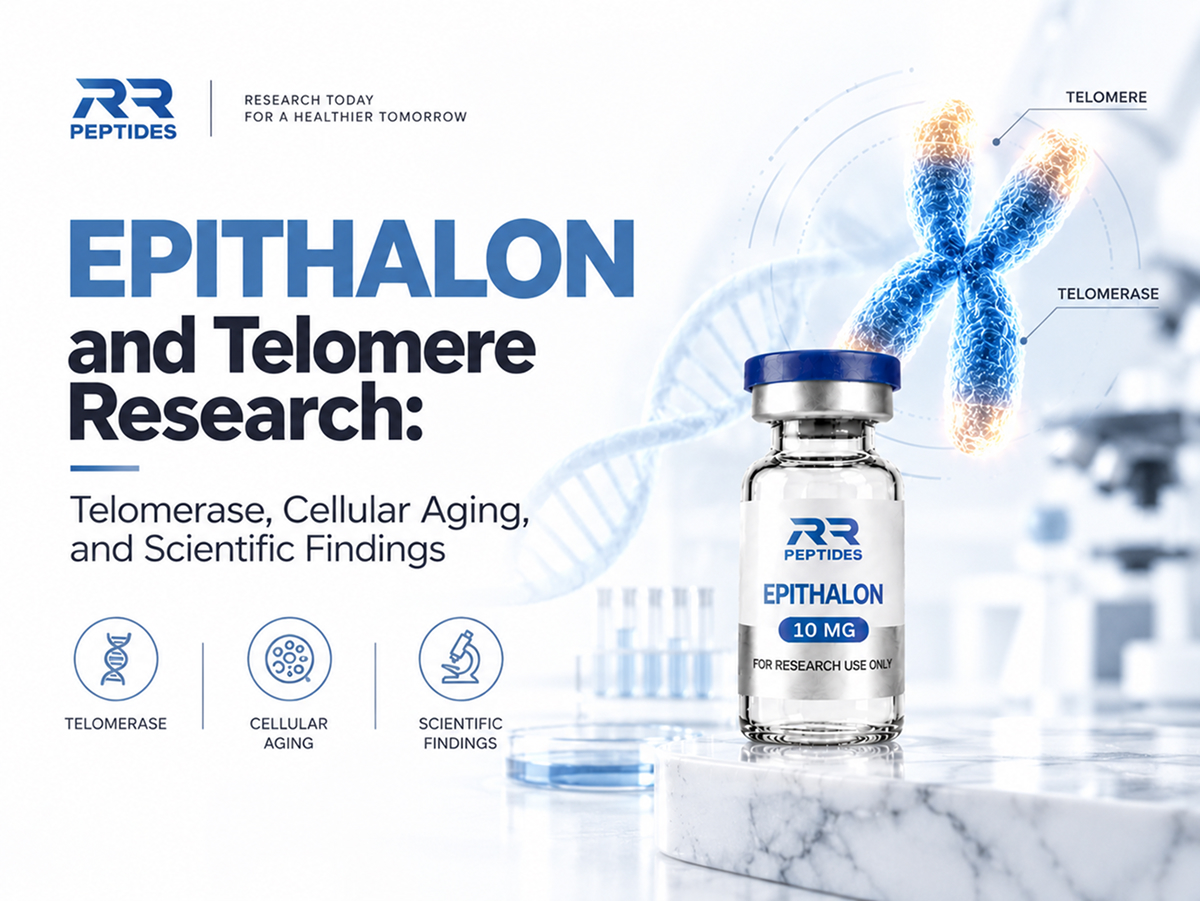
Telomeres are protective structures at chromosome ends that help preserve genomic stability during cell division. Yet telomere length alone cannot describe an organism’s biological age or predict how long someone will live.
Epithalon and telomere research explores whether a synthetic four amino acid peptide, also called epitalon, influences telomerase activity or related cellular processes. Interest stems partly from laboratory reports involving cultured human cells, although the available evidence remains limited and requires independent confirmation.
For Canadian laboratories reviewing experimental compounds, RR Peptides offers research focused product information and available specifications for Epithalon 10mg. Researchers should assess analytical documentation, laboratory controls, and applicable institutional requirements before designing experiments.
This guide explains the biological foundations, proposed mechanisms, measurement techniques, and major uncertainties surrounding Epithalon and telomere research without confusing experimental observations with demonstrated clinical benefits.
What Are Telomeres and Why Are They Studied in Aging Research?
Chromosome Ends and Cellular Protection
Telomeres consist of repeated DNA sequences and associated proteins at the ends of linear chromosomes. In humans, the repeated sequence is TTAGGG. A specialized protein assembly known as shelterin helps distinguish natural chromosome ends from damaged DNA, reducing inappropriate repair reactions and chromosome fusion.
Telomeres can shorten over successive divisions, although the rate varies among cell types and is influenced by cellular history, oxidative damage, and other biological factors. Short telomeres may eventually contribute to a persistent DNA damage response.
Epithalon and telomere research is therefore situated within a larger field studying how chromosome end maintenance affects cell proliferation and stress responses.
Telomere Shortening and Replicative Senescence
Replicative senescence describes a durable state in which cells stop dividing despite remaining metabolically active. Critically short or dysfunctional telomeres can trigger this response, but senescence also arises through oncogene activation, mitochondrial dysfunction, and other stressors.
Several biological processes are relevant to telomere shortening:
DNA replication: Repeated cell division can gradually reduce telomeric DNA.
Oxidative stress: Reactive oxygen species may contribute to telomeric DNA damage.
DNA damage signaling: Dysfunctional telomeres can activate cellular checkpoint pathways.
Cellular senescence: Persistent damage responses may limit further cell division.
Telomerase regulation: Enzyme activity influences telomere maintenance in selected cells.
Senescent cells can change tissue environments through inflammatory signaling and altered protein secretion. However, senescence is not uniformly harmful; it also contributes to wound responses and suppression of potentially dangerous cell growth.
In Epithalon and telomere research, measuring cell division alongside telomere status is more informative than examining chromosome length in isolation.
Why Telomere Length Is Not a Biological Clock
Blood samples, for example, contain changing proportions of immune cell types with different telomere distributions.
Research concept
What it can indicate
What it cannot establish
Mean telomere length
Average chromosome end repeat content
Individual lifespan
Shortest telomeres
Potentially vulnerable chromosome ends
Overall health status
Cellular senescence
Reduced proliferative capacity
A single underlying cause
Telomerase activity
Enzyme activity under assay conditions
Guaranteed telomere extension
Shelterin function
Chromosome end protection
Absence of other DNA damage
Epithalon and telomere research depends on these distinctions and helps prevent overinterpretation of preliminary laboratory results.
Explore cellular aging pathways and telomerase research with RR Peptides’ research-grade Epithalon 10mg.
Epithalon is a synthetic tetrapeptide commonly described by the sequence Ala–Glu–Asp–Gly. Early investigations associated with this peptide attracted attention because some reports described altered telomerase activity and cellular proliferative behavior.
Epithalon and telomere research should not be conflated with evidence that the compound reliably lengthens telomeres in humans or extends human lifespan.
Experimental Questions Researchers Ask
Epithalon and telomere research objectives include:
Comparing treated and untreated cell populations under matched culture conditions.
Measuring telomerase enzyme activity with validated assays.
Examining telomere length distributions across multiple passages.
Monitoring cellular viability, proliferation, and senescence markers.
Testing whether reported responses persist after treatment ends.
Replicating findings in distinct cell types and independent laboratories.
These priorities make Epithalon and telomere research more rigorous by separating observable outcomes from speculative mechanisms.
Cell Models and Their Limitations
However, growth medium, oxygen tension, passage number, donor characteristics, and culture stress all influence outcomes.
Model
Potential advantage
Important limitation
Primary human fibroblasts
Relevant replicative behavior
Donor and passage variability
Immortalized cell lines
Consistent laboratory availability
Abnormal proliferation pathways
Stem or progenitor cells
Active chromosome maintenance
Specialized telomerase regulation
Animal tissues
Multicellular biological context
Species specific telomere biology
Epithalon and telomere research requires models chosen for the precise hypothesis being tested, not merely because they are convenient to culture.
Research Material Quality
Laboratories should examine available analytical documentation and avoid assuming that a product label alone verifies molecular composition or suitability for a specific protocol.
Before beginning laboratory investigations, researchers should consider:
Compound identity: Confirm that analytical documentation corresponds to the intended material.
Purity assessment: Review available information about impurities and analytical methods.
Batch consistency: Consider whether different production batches may influence results.
Storage conditions: Evaluate potential effects of handling and storage on material stability.
Experimental controls: Include appropriate comparison groups and validated procedures.
Its Epithalon 10mg listing can serve as a starting point for reviewing specifications, while independent verification and institutional oversight remain essential.
What Is the Proposed Relationship Between Epithalon and Telomerase?
How Telomerase Functions
Telomerase is a ribonucleoprotein enzyme complex that can add telomeric DNA repeats to chromosome ends. Its core machinery includes telomerase reverse transcriptase, commonly abbreviated TERT, and an RNA component, TERC, that supplies the template for repeat synthesis.
Telomerase activity differs substantially among cell populations. Many adult somatic cells show limited activity, while certain stem cells, germline cells, and numerous cancers maintain greater telomere extension capacity.
The telomerase system involves several important components:
TERT: The catalytic protein responsible for reverse transcriptase activity.
TERC: The RNA component providing a template for telomeric repeat synthesis.
Associated proteins: Factors contributing to enzyme assembly, stability, and localization.
Telomere accessibility: Chromosome end conditions that influence enzyme interactions.
Cellular regulation: Biological mechanisms controlling telomerase expression and activity.
Thus, activating telomerase is not automatically desirable in every biological context.
Epithalon and telomere research examines possible associations with this machinery but does not establish a universally accepted direct binding target for the peptide.
What Early Laboratory Reports Suggested
Some early cell culture publications reported increased telomerase activity and changes in proliferative behavior following experimental Epithalon exposure. However, relatively limited replication, heterogeneous methods, and incomplete mechanistic characterization constrain the strength of conclusions.
An observed increase in an enzyme assay should not be interpreted as proof of sustained chromosome extension.
For Epithalon and telomere research, evidence becomes more persuasive when activity measurements agree with independently obtained telomere length and cellular function data.
Distinguishing Activity From Lengthening
Researchers should distinguish four related but separate endpoints:
TERT expression: The amount of messenger RNA or protein associated with a catalytic component.
Telomerase activity: Enzymatic repeat addition measured under defined assay conditions.
Telomere length: The distribution or average quantity of telomeric DNA in a cell population.
Cellular behavior: Changes in division, senescence, viability, or genomic stability.
None of these measurements can automatically substitute for the others. For example, altered TERT expression may not produce a corresponding change in functional enzyme activity.
Epithalon and telomere research must therefore use precise terminology when describing what an experiment actually measured.
Telomerase and Cancer Biology
Telomerase supports chromosome maintenance in many cancers, although cancer development involves numerous additional genetic and regulatory changes.
This creates an important scientific distinction: a mechanism potentially relevant to replicative senescence may have different implications in a cell with abnormal growth control.
Experiments should monitor:
Cell proliferation and population doubling patterns.
DNA damage responses and chromosome stability.
Changes in cell cycle regulatory pathways.
Potential differences between normal and transformed cells.
These considerations remain central to Epithalon and telomere research, particularly when interpreting claims about cellular rejuvenation.
Explore cellular aging pathways and telomerase research with RR Peptides’ research-grade Epithalon 10mg.
How Are Telomere Changes Measured in Epithalon Studies?
Choosing the Right Measurement
No single method captures every feature of telomere biology. Techniques differ in whether they estimate average repeat content, measure chromosome specific ends, identify short telomeres, or quantify enzymatic activity.
Epithalon and telomere research benefits from combining complementary methods instead of treating a single measurement as definitive.
Method
Main measurement
Key consideration
Quantitative PCR
Relative telomere repeat content
Sensitive to normalization and assay variation
Terminal restriction fragment analysis
Distribution of telomere associated fragment lengths
Includes subtelomeric DNA
Quantitative FISH
Fluorescent telomere signals
Requires careful calibration
Flow FISH
Telomere fluorescence in cell populations
Cell composition affects results
STELA or related approaches
Selected individual telomere lengths
Limited chromosome end coverage
TRAP assay
Telomerase activity
Does not directly measure length
Measuring Telomerase Activity
The telomeric repeat amplification protocol, or TRAP assay, is a commonly used method for detecting telomerase activity. It relies on extension of a substrate followed by amplification and detection. Appropriate positive controls, negative controls, and checks for reaction inhibition are important.
Researchers should evaluate several analytical considerations:
Sample preparation: Enzyme stability may depend on extraction and handling conditions.
Reaction inhibition: Certain sample components can interfere with amplification.
Positive controls: Reference samples help establish assay performance.
Negative controls: Appropriate comparisons help identify background signals.
Reproducibility: Repeated measurements can reveal technical variability.
Epithalon and telomere research should report activity and length outcomes separately, even when both are measured in the same experiment.
Tracking Changes Over Time
Investigators may collect samples at several culture passages and compare changes against untreated controls, accounting for growth rates and differences in population composition.
For Epithalon and telomere research, studies should consider:
Baseline telomere distributions before exposure.
Passage number and cumulative population doublings.
Replicate cultures and independent biological samples.
Consistent assay processing and reference materials.
Short telomere frequency, not only population averages.
Cell survival and selection effects that may alter the population.
Epithalon and telomere research becomes more interpretable when apparent length changes can be distinguished from shifts in which cells survived or expanded.
Statistical and Reporting Considerations
Biological replicates represent independent samples or experimental units, while technical replicates primarily estimate measurement variability. Confusing the two can exaggerate statistical confidence.
Researchers should report effect sizes, uncertainty, sample numbers, and methods used to handle multiple comparisons. Transparent reporting of unsuccessful experiments is equally important because publication bias can distort the apparent consistency of findings.
For Epithalon and telomere research, reproducibility depends on complete methods and independently verifiable results.
Explore cellular aging pathways and telomerase research with RR Peptides’ research-grade Epithalon 10mg.
What Are the Limitations of Current Telomere Research?
The available Epithalon literature does not provide a robust, independently replicated body of human clinical evidence demonstrating reliable telomere extension, slower biological aging, or increased lifespan.
Epithalon and telomere research should therefore describe proposed effects as investigational rather than established therapeutic outcomes.
Association Does Not Establish Causation
Cells with different telomere lengths can also differ in proliferation, stress exposure, differentiation, and survival. An association between peptide exposure and a measured endpoint does not prove that the peptide directly changed chromosome maintenance machinery.
Researchers need experiments that isolate plausible mechanisms and rule out alternative explanations, including:
Cell selection during repeated culture passages.
Differences in baseline telomere distributions.
Assay interference or analytical variability.
Changes in cell proliferation and survival.
Culture related stress and environmental conditions.
Epithalon and telomere research remains particularly sensitive to these confounding factors because small changes may be difficult to distinguish from measurement noise.
Translating Cell Findings to Human Biology
Human tissues contain multiple interacting cell populations, immune signals, and regulatory environments that cannot be reproduced fully in simple cultures. Even convincing changes in cultured cells would not demonstrate improvements in human health or longevity.
Telomere biology also varies across tissues, and interventions affecting cell division may introduce tradeoffs involving cancer surveillance and genomic stability. Translational claims require human studies with clinically meaningful endpoints.
Epithalon and telomere research cannot bypass these requirements through appealing laboratory imagery or isolated molecular results.
Canadian Regulatory Context
In Canada, a laboratory research designation is not equivalent to authorization as a prescription medicine. Health Canada requirements depend on the substance, intended use, study design, and applicable regulatory pathway.
Product descriptions should not imply authorization for human administration merely because a compound is commercially available for laboratory investigation. Epithalon and telomere research belongs within responsible Canadian scientific practice.
Priorities for Better Studies
Studies should also examine whether any measured changes persist and whether they coincide with altered genome stability or unexpected cell growth.
Research priority
Why it matters
Independent replication
Tests whether observations are reproducible
Mechanistic experiments
Separates direct and indirect effects
Longitudinal sampling
Evaluates persistent versus temporary changes
Multiple telomere assays
Reduces dependence on one measurement
Genomic stability monitoring
Identifies potentially important tradeoffs
Transparent negative results
Limits selective reporting bias
These priorities would make Epithalon and telomere research more informative for laboratory scientists and readers evaluating scientific claims.
Discover the latest findings on cellular aging, telomeres, and scientific evidence in Epithalon Research: Cellular Aging, Telomeres, and Current Scientific Evidence.
Epithalon is a synthetic tetrapeptide composed of four amino acids. Researchers have investigated it in experimental contexts involving cellular regulation, telomerase, and aging related biology.
Does Epithalon Increase Telomere Length?
Some early laboratory reports suggest changes in telomerase related endpoints, but there is insufficient robust evidence to conclude that Epithalon reliably lengthens human telomeres. Epithalon and telomere research requires independent replication and direct measurements.
Is Telomerase the Same as Telomere Length?
No. Telomerase is an enzyme complex that can add telomeric repeats, whereas telomere length describes chromosome end DNA. Enzyme activity and measured length may not change together.
Can Longer Telomeres Prove Slower Aging?
No. Telomere length reflects only part of a complicated biological system. Aging also involves epigenetic changes, metabolic processes, cellular damage, and tissue specific responses.
How Do Researchers Measure Telomeres?
Common methods include quantitative PCR, terminal restriction fragment analysis, and fluorescence based techniques.
Why Are Control Groups Important?
Controls help distinguish treatment associated observations from normal culture changes, assay artifacts, and shifts in cell populations.
Is Epithalon Approved for Human Use in Canada?
A research product listing does not establish Health Canada authorization. Researchers should independently verify the current regulatory status of any proposed human use or clinical investigation.
What Remains Uncertain?
Epithalon and telomere research has not established a universally accepted direct mechanism, reliable human telomere extension, or clinically meaningful longevity benefits. Stronger independent evidence is needed.
Conclusion
Epithalon and telomere research has generated scientific questions about peptide associated changes in telomerase activity and chromosome maintenance. However, the current evidence does not justify claims that the compound reverses aging, guarantees longer telomeres, or improves human lifespan.
Canadian laboratories can explore research focused information and available Epithalon 10mg specifications through RR Peptides while independently verifying compound documentation, assay suitability, and institutional requirements. Explore the RR Peptides research collection to compare available material information before planning controlled experiments.
Ultimately, Epithalon and telomere research will advance through transparent methods, multiple complementary measurements, and reproducible studies that distinguish molecular observations from clinical outcomes.
Disclaimer: All products and compounds discussed are intended strictly for laboratory and research purposes. This article is provided for educational and informational purposes only. This article is not medical advice, therapeutic guidance, or instructions for human administration.
×
Subscribe & Get 10% Off!
Enter your email address below to subscribe to our newsletter and receive an instant 10% OFF discount coupon code sent directly to your inbox!
Thank you for subscribing! Your 10% discount coupon has been sent to your email. Please check your inbox!