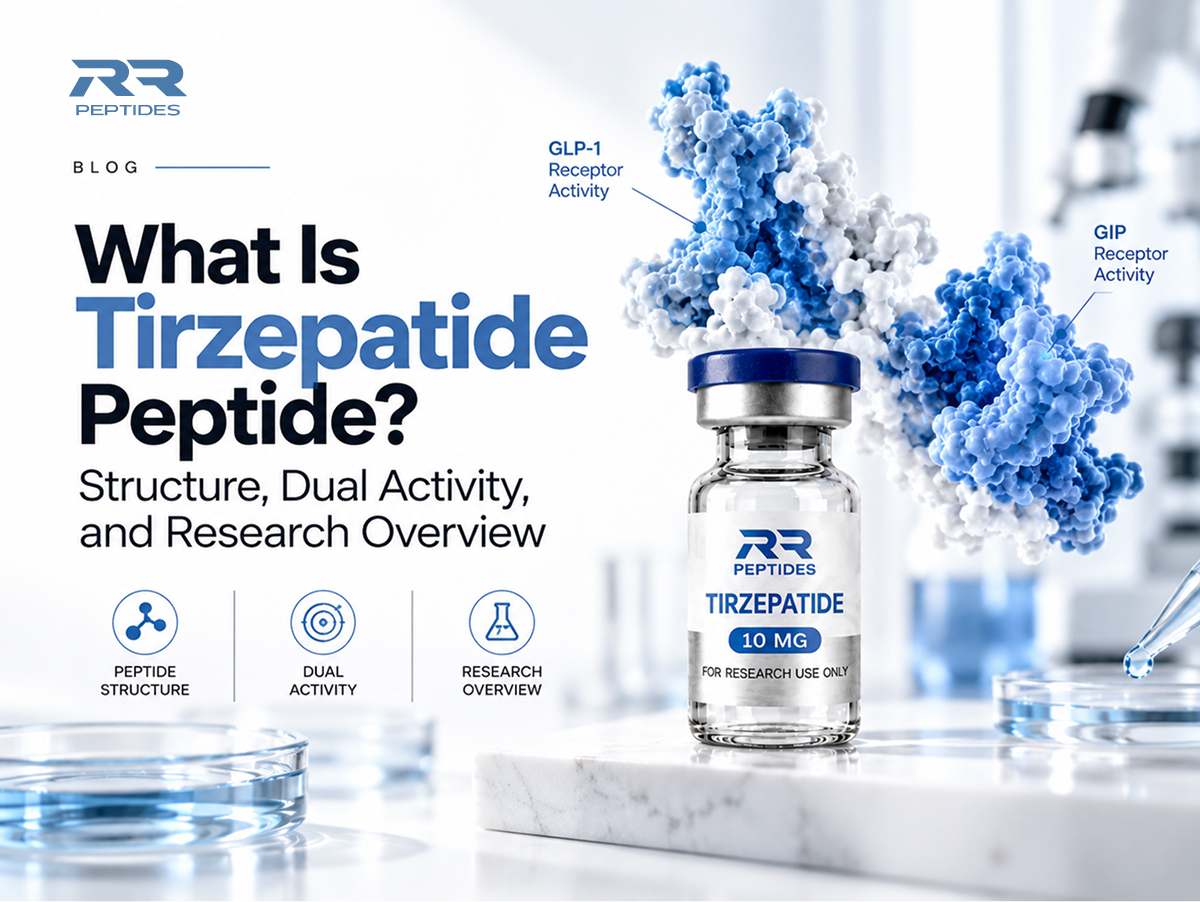
When researchers begin asking what is Tirzepatide peptide, the answer should start with molecular identity rather than marketing terminology. Tirzepatide is a synthetic peptide-based molecule designed to interact with two class B G protein-coupled receptors: the glucose-dependent insulinotropic polypeptide receptor, or GIPR, and the glucagon-like peptide-1 receptor, or GLP-1R. This dual activity gives the molecule a distinctive research profile.
The question what is Tirzepatide peptide also involves structure, receptor activity, analytical quality, experimental models, and evidence interpretation. A material can have a defined molecular identity while producing different observations in different laboratory systems. Receptor expression, assay conditions, exposure period, controls, sample quality, and selected endpoints can all influence experimental findings.
RR Peptides provides research-focused information about peptide materials, laboratory models, analytical characterization, and scientific study areas. Researchers exploring what is Tirzepatide peptide can use this information alongside primary literature, supplier documentation, validated analytical methods, and appropriate laboratory procedures.
For Canadian laboratories, research planning should also consider institutional requirements, laboratory safety procedures, procurement records, sample traceability, and applicable Canadian regulatory frameworks. Research-use material should not be interpreted as an authorized therapeutic product simply because it is commercially available.
What is Tirzepatide peptide? Tirzepatide is a synthetic peptide-based molecule engineered to activate both GIPR and GLP-1R. This dual receptor profile distinguishes it from molecules designed primarily around one incretin receptor and provides researchers with a model for examining signaling through two related but distinct receptor systems.
Understanding what is Tirzepatide peptide in a laboratory setting requires more than a short chemical definition. Researchers should consider molecular identity, structural characteristics, receptor targets, analytical quality, experimental model, and study endpoints. Each factor affects how a finding should be interpreted and whether it can reasonably be compared with findings from another experiment.
The molecule is structurally related to incretin hormone systems but contains modifications that distinguish it from naturally occurring GIP and GLP-1. These modifications are relevant to its stability, biological behavior, and interaction with receptors. Consequently, research questions can range from molecular pharmacology to cellular signaling and broader metabolic models.
Key research characteristics
Researchers examining what is Tirzepatide peptide may document:
molecular identity and available sequence information;
receptor targets and activity profile;
purity and batch information;
formulation and storage history;
analytical characterization;
experimental model and selected endpoints.
Characteristic
Research relevance
Peptide-based structure
Defines molecular identity and analytical requirements
Dual receptor activity
Enables GIPR and GLP-1R research
Structural modifications
May influence stability and biological behavior
Albumin association
Relevant to exposure characteristics
Analytical quality
Supports reproducibility
A useful definition should separate chemical identity from biological interpretation. What is Tirzepatide peptide can describe the material itself, but it cannot by itself explain every biological response observed in a cell, tissue, or animal model.
Researchers should also distinguish receptor activity from downstream outcomes. A measurable signaling response can support a mechanistic hypothesis, while a broader metabolic response may involve several interacting pathways. Careful experimental design helps determine which interpretation is supported by the data.
Explore the research specifications and laboratory information available from RR Peptides for Tirzepatide 10mg.
Structure and Biological Characteristics of Tirzepatide
A structural perspective on what is Tirzepatide peptide begins with its modified peptide architecture and dual receptor activity. Tirzepatide is designed to interact with both GIPR and GLP-1R while incorporating structural features intended to influence its biological characteristics, including resistance to enzymatic degradation and association with albumin.
Tirzepatide research can examine how these molecular characteristics relate to receptor engagement and downstream responses. Researchers may investigate receptor activity, intracellular signaling, cellular effects, and metabolic markers. However, observations should always be interpreted according to the experimental conditions in which they were produced.
The dual-receptor profile is particularly important because GIPR and GLP-1R are distinct receptors even though both belong to the class B GPCR family. Their expression patterns, cellular environments, regulatory processes, and downstream responses can differ. A result associated with one receptor should therefore not automatically be assigned to the other.
Molecular variables relevant to research
Important variables can include peptide identity, purity, formulation, degradation status, sample history, receptor expression, and assay conditions. Chromatographic and mass spectrometric methods may contribute to analytical characterization when appropriately validated.
For researchers asking what is Tirzepatide peptide, the condition of the material entering an experiment is therefore part of the research question. An incompletely characterized sample can introduce uncertainty that is unrelated to the biological hypothesis.
Biological characteristic
Why it matters
Dual receptor activity
Supports comparative receptor studies
Modified peptide structure
Influences molecular behavior
Albumin association
Relevant to exposure characteristics
Receptor expression
Influences cellular response
Experimental environment
Can affect measured signaling
Researchers should avoid assuming that every tirzepatide preparation is experimentally equivalent. Differences in formulation, concentration, purity, storage, and analytical characterization may affect study interpretation. Clear records can help separate material-related variation from biological or methodological variation.
Another useful consideration in what is Tirzepatide peptide research is the relationship between structure and experimental endpoints. A study focused on receptor signaling may require molecular measurements, whereas a study examining metabolic responses may require cellular, tissue, or integrated physiological endpoints. The structure provides the starting point, while the experimental design determines what can be concluded.
Understanding GLP-1 and GIP Receptor Activity
A central part of what is Tirzepatide peptide is its dual activity at GLP-1R and GIPR. Both receptors are class B GPCRs, but they are separate biological targets with different expression patterns and signaling contexts. Tirzepatide research can therefore examine their activity individually or in combination.
GLP-1R activation can engage intracellular signaling involving G proteins and second messengers such as cyclic AMP. Depending on the experimental system, researchers may examine phosphorylation, gene expression, calcium-related responses, receptor trafficking, and functional cellular changes.
GIPR can also engage signaling pathways involving cyclic AMP and downstream regulatory processes. The observed response can vary according to cell type, receptor abundance, experimental conditions, and endpoint selection. A response observed in one GIPR model should not automatically be generalized to every biological system.
Comparing receptor activity
Researchers studying what is Tirzepatide peptide may compare receptor-associated responses using appropriate experimental controls.
Receptor
Research focus
Potential endpoints
GLP-1R
Receptor signaling
cAMP, phosphorylation, gene expression
GIPR
Incretin-associated signaling
cAMP, metabolic markers, cellular responses
Both
Dual receptor activity
Integrated signaling and functional endpoints
A dual-receptor experiment may compare GIPR, GLP-1R, or combined activity. Appropriate controls become especially important because an observed response may involve multiple signaling inputs. Researchers can use receptor-specific approaches when the study design requires clearer attribution.
Timing is another important variable. Receptor-proximal signaling can occur earlier than transcriptional or metabolic changes. Multiple observation points can therefore provide more information than a single measurement and may help distinguish transient signaling from sustained cellular responses.
The presence of a signaling response does not automatically demonstrate a complete biological mechanism. Researchers should connect molecular measurements with appropriate controls and functional endpoints while recognizing that each experimental model represents only part of a larger biological system.
For what is Tirzepatide peptide studies, analytical purity should also be separated from biological activity. A highly characterized material can still produce different responses in different models because receptor expression, cell state, assay conditions, and experimental environment influence biological observations.
Understanding what is Tirzepatide peptide becomes more useful when researchers examine how the material is studied experimentally. Laboratory research can occur at several levels, including receptor assays, cell-based models, tissue systems, and animal studies. Each model answers different questions and introduces different limitations.
Molecular assays may investigate receptor interaction and signaling. Cell-based models can examine cyclic AMP, phosphorylation, gene expression, cellular metabolism, and other responses. Pancreatic beta-cell models may be used to investigate glucose-associated signaling, while broader metabolic systems can examine lipid-related and energy-balance endpoints.
Common research models
Researchers may consider:
receptor and molecular assays;
pancreatic and other cell-based models;
tissue or ex vivo systems;
animal metabolic models;
integrated experimental approaches.
Model
Typical research question
Main limitation
Receptor assay
How does receptor activity change?
Limited biological complexity
Cell model
What cellular pathways respond?
Does not reproduce whole-organism physiology
Tissue model
How do multiple cell types interact?
Greater experimental variability
Animal model
What integrated metabolic responses occur?
Species-specific differences
Potential endpoints can include cAMP, phosphorylation, gene expression, insulin-associated markers, glucose-related responses, lipid biomarkers, and other metabolic measurements. Endpoint selection should follow the hypothesis rather than simply increasing the number of measurements. In what is Tirzepatide peptide research, a focused endpoint can provide clearer interpretation than a large collection of unrelated measurements.
Researchers investigating what is Tirzepatide peptide should document cell type, receptor expression, culture conditions, sample characteristics, exposure period, assay method, controls, and observation timing. Such records make findings easier to interpret and compare.
Animal models provide greater physiological complexity but also introduce variables absent from isolated systems. Species differences can affect receptor expression, metabolism, and biological responses. Findings from animal experiments should therefore remain within their appropriate preclinical context.
For Canadian laboratories, studies involving animals, human-derived materials, or other regulated activities may require specific institutional oversight. Researchers should establish applicable procedures before beginning the work and maintain records supporting traceability, safety, and reproducibility.
Laboratory research should also distinguish an experimental observation from a therapeutic conclusion. A cellular response can help explain a pathway, but it does not independently establish human efficacy or safety. What is Tirzepatide peptide should therefore be considered together with the evidence level supporting each conclusion.
Explore the research specifications and laboratory information available from RR Peptides for Tirzepatide 10mg.
Purity, Quality, and Research Considerations
A complete understanding of what is Tirzepatide peptide includes the quality of the material entering an experiment. Molecular identity alone does not establish that a research sample is appropriate for every study. Purity, batch consistency, formulation, storage, preparation, and analytical characterization can all affect interpretation.
Researchers may review certificates of analysis, chromatographic data, mass spectrometry, batch records, and relevant supplier documentation when available. These records can help establish identity and provide context when findings differ between experiments or laboratories.
Research quality checklist
Before beginning an experiment, researchers can review:
material identity;
purity and analytical characterization;
batch or lot information;
formulation and storage history;
preparation records;
experimental controls;
selected endpoints.
Quality documentation does not establish biological efficacy or safety. Instead, it helps researchers determine whether the material is sufficiently characterized for the research question. What is Tirzepatide peptide should therefore be interpreted together with how the material was tested, stored, prepared, and documented.
When comparing studies, researchers should consider whether materials were prepared and stored under comparable conditions. Differences in sample history may contribute to different observations even when research questions appear similar.
For Canadian research environments, laboratories should align sample management with institutional quality systems, safety procedures, procurement requirements, and applicable regulatory frameworks. Requirements may vary according to the type of research, material, facility, and experimental model.
RR Peptides provides research-focused information about peptide materials, laboratory applications, analytical considerations, and scientific evidence. Researchers should combine supplier information with primary literature, validated analytical evidence, institutional procedures, and appropriate scientific oversight.
What is Tirzepatide peptide? It is a synthetic peptide-based molecule designed to interact with both GIPR and GLP-1R. Its dual receptor activity is the defining feature most relevant to laboratory research.
Is tirzepatide a GLP-1-only peptide?
No. Tirzepatide has activity at both GLP-1R and GIPR. Describing it only as a GLP-1 receptor agonist does not fully represent its dual-receptor pharmacological profile. Researchers asking what is Tirzepatide peptide should therefore consider both receptor systems.
Why is tirzepatide studied in metabolic research?
Researchers study tirzepatide because its dual receptor activity provides a model for investigating incretin signaling, glucose-related pathways, cellular responses, and broader metabolic processes. What is Tirzepatide peptide in this context refers to both the material and the biological questions it can support.
Which laboratory models can be used?
Research may include receptor assays, cell cultures, pancreatic models, tissue systems, and animal models. Each model provides different information and has specific limitations.
What analytical information is useful?
Researchers may review identity, purity, batch information, chromatography, mass spectrometry, storage history, formulation, and certificates of analysis when available. These records help place experimental findings in context.
Does laboratory research establish human effects?
No. Findings from molecular, cellular, tissue, or animal models do not automatically establish human efficacy or safety. Human conclusions require appropriate clinical evidence.
What should Canadian researchers consider?
Canadian laboratories should follow institutional procedures, relevant safety requirements, procurement policies, research oversight, and applicable regulatory frameworks. Requirements can differ according to the study type and materials involved.
Why can different studies produce different results?
Differences in material preparation, model selection, receptor expression, concentration, assay design, observation period, controls, and endpoints can influence findings. Results should therefore be interpreted in relation to the methods used.
Final Research Perspective
Understanding what is Tirzepatide peptide requires more than identifying the molecule. Researchers should consider its modified peptide structure, dual activity at GIPR and GLP-1R, analytical characteristics, experimental model, selected endpoints, and evidence limitations.
The most useful research approach connects molecular identity with a clearly defined scientific question. Receptor assays can provide mechanistic information, cellular models can explore signaling and metabolism, and more complex models can provide additional biological context. None should be interpreted beyond what the model can demonstrate.
Material characterization and documentation are equally important. Identity, purity, batch information, storage, preparation, controls, and analytical methods can support reproducibility and make differences between studies easier to evaluate.
For Canadian laboratories, what is Tirzepatide peptide should be considered within appropriate institutional procedures, safety requirements, traceability practices, and applicable oversight. Commercial availability should not be treated as evidence of therapeutic authorization.
RR Peptides provides research-oriented information for researchers evaluating peptide materials, laboratory models, analytical quality, and scientific evidence. Readers researching what is Tirzepatide peptide can combine this information with primary literature and appropriate laboratory documentation.
The research value of tirzepatide comes from its ability to connect dual receptor pharmacology with broader metabolic research. For readers asking what is Tirzepatide peptide, this connection helps explain why molecular identity, receptor signaling, model selection, and evidence quality should be considered together. Careful model selection, appropriate controls, analytical characterization, and transparent reporting can help researchers generate findings that are easier to interpret and reproduce.
A careful research framework should also recognize that biological evidence develops across different experimental levels. Molecular findings can clarify receptor behavior, while cellular studies can identify downstream responses. Tissue and animal models add biological complexity, but they also introduce additional variables that may affect interpretation. Comparing these levels requires attention to study design rather than assuming that every observation represents the same biological process.
Researchers can improve reproducibility by documenting the conditions surrounding each experiment. Sample identity, batch information, analytical results, storage history, preparation procedures, controls, assay methods, observation periods, and selected endpoints provide useful context when results are reviewed later. This approach is valuable when findings are compared across laboratories using different systems or analytical platforms.
In Canada, institutional procedures and applicable requirements should be considered alongside scientific literature and supplier documentation.
Disclaimer: All products and compounds discussed are intended strictly for laboratory and research purposes. This article is provided for educational and informational purposes only. This article is not medical advice, therapeutic guidance, or instructions for human administration.
3 Comments
This article provides a clear introduction to tirzepatide and its peptide structure. I found the explanation of its interaction with GLP-1 and GIP receptors particularly useful for understanding why this compound has become an interesting subject in metabolic research.
I liked the straightforward explanation of what tirzepatide is and how its molecular characteristics distinguish it from other peptides. Starting with the basic structure and receptor activity makes the more advanced research easier to follow.
A useful starting point for readers who are new to tirzepatide research. I appreciate the focus on its molecular properties and dual receptor activity, which provides helpful context for understanding how researchers investigate this peptide.
Comments are closed.
×
Subscribe & Get 10% Off!
Enter your email address below to subscribe to our newsletter and receive an instant 10% OFF discount coupon code sent directly to your inbox!
Thank you for subscribing! Your 10% discount coupon has been sent to your email. Please check your inbox!





This article provides a clear introduction to tirzepatide and its peptide structure. I found the explanation of its interaction with GLP-1 and GIP receptors particularly useful for understanding why this compound has become an interesting subject in metabolic research.
I liked the straightforward explanation of what tirzepatide is and how its molecular characteristics distinguish it from other peptides. Starting with the basic structure and receptor activity makes the more advanced research easier to follow.
A useful starting point for readers who are new to tirzepatide research. I appreciate the focus on its molecular properties and dual receptor activity, which provides helpful context for understanding how researchers investigate this peptide.