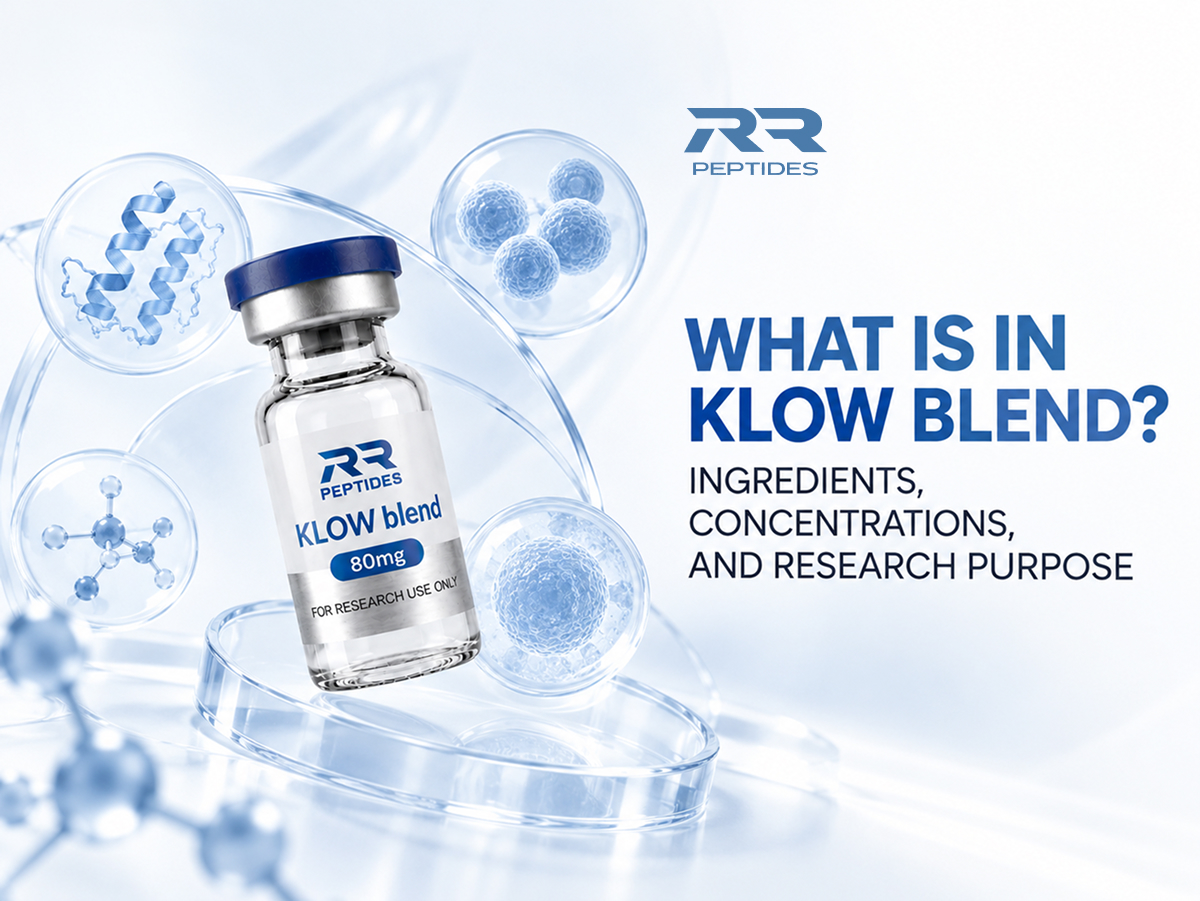
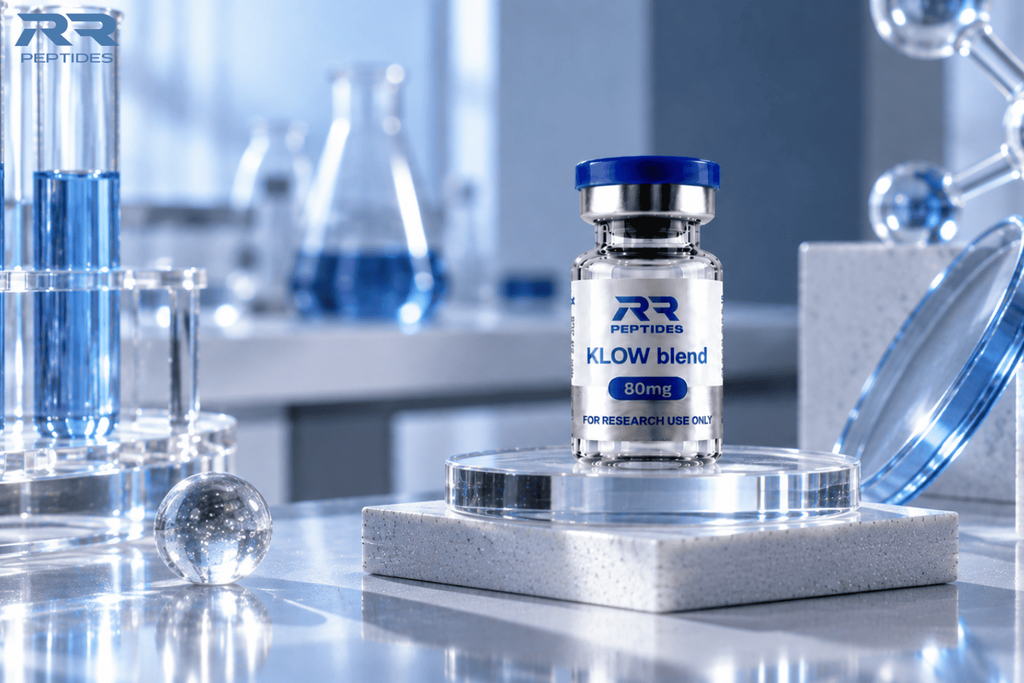
Understanding what is in KLOW blend starts with the formulation itself. KLOW is commonly presented in the Canadian research market as a four-component lyophilized blend containing GHK-Cu, BPC-157, TB-500, and KPV. The widely listed 80 mg format uses a nominal composition of 50 mg GHK-Cu, 10 mg BPC-157, 10 mg TB-500, and 10 mg KPV.
For researchers asking what is in KLOW blend, the important point is that these four compounds are chemically distinct. The blend is not one 80 mg molecular entity, and the role of each ingredient should be considered separately before conclusions are made about the formulation as a whole. The 50/10/10/10 mg label describes nominal mass, not an equal molecular ratio.
At RR Peptides, researchers can explore research-focused peptide materials and educational information covering composition, analytical testing, batch verification, storage, and laboratory quality. A clear understanding of what is in KLOW blend helps laboratories interpret the formulation more accurately before it enters a controlled experimental workflow.
What Is in KLOW Blend?
The direct answer to what is in KLOW blend is four listed components: GHK-Cu, BPC-157, TB-500, and KPV. In the 80 mg formulation commonly listed by Canadian research suppliers, those components are distributed in a 50/10/10/10 mg ratio.
This table answers the label-level question, but understanding what is in KLOW blend requires another distinction: nominal formulation and measured batch content are not automatically identical. The label states the intended composition, while analytical testing can report the quantity actually measured in a particular batch.
Why the 80 mg Total Can Be Misunderstood
The 80 mg designation refers to the combined nominal mass of all four components. It does not mean that KLOW is one peptide with a molecular mass or concentration of 80 mg.
This matters because a researcher evaluating what is in KLOW blend needs to think at the component level. GHK-Cu represents most of the nominal mass, while BPC-157, TB-500, and KPV are present at smaller but equal listed masses.
A second source of confusion is the difference between mass ratio and molar ratio. Because the four compounds have different molecular weights, 50/10/10/10 mg does not correspond to an equal or directly proportional number of molecules.
Explore research composition and quality with KLOW 80mg.
Understanding the Listed Peptide Components
A complete explanation of what is in KLOW blend requires examining each listed component independently. The four compounds differ in structure, research history, analytical behavior, and potential role in experimental design.
GHK-Cu
GHK-Cu is a copper-binding complex of the tripeptide glycyl-L-histidyl-L-lysine. It is commonly listed at 50 mg in the 80 mg KLOW formulation, making it the largest component by nominal mass.
Research literature involving GHK-Cu has examined extracellular matrix biology, fibroblast responses, collagen-related processes, gene expression, and peptide–metal interactions. Its copper association also makes it chemically distinct from the other three components.
When researchers examine what is in KLOW blend, GHK-Cu therefore deserves attention both because of its research background and because it represents 62.5% of the nominal formulation by mass.
The comparatively high mass does not prove that GHK-Cu is the most important component in every biological model. Experimental importance depends on concentration, molecular behavior, assay design, and the endpoint being measured.
BPC-157
BPC-157 is a synthetic 15-amino-acid peptide that appears mainly in preclinical research literature. Experimental studies have explored cellular signaling, tissue-related models, vascular processes, gastrointestinal research, and migration-related observations.
For researchers asking what is in KLOW blend, BPC-157 introduces a longer peptide structure than short tripeptide components such as KPV. This difference can influence molecular weight, analytical separation, concentration calculations, and interpretation of a fixed-mass blend.
Findings from isolated BPC-157 should remain separate from findings generated using the complete KLOW formulation. The presence of other components creates a different experimental system.
TB-500
TB-500 is commonly listed at 10 mg and is associated in research-product contexts with thymosin beta-related material. Laboratory discussions frequently connect this component with actin-associated processes, cytoskeletal organization, and cell migration.
One reason what is in KLOW blend should be reviewed through batch documentation is that commercial terminology around TB-500 can vary. Product naming does not always provide the same level of precision as analytical identity data.
Researchers should therefore look for clear material identification where available, especially when comparing results across suppliers, batches, or published models.
KPV
KPV is the tripeptide Lys-Pro-Val. It has been examined in experimental research involving inflammatory signaling, epithelial models, and molecular interaction pathways.
KPV is commonly listed at 10 mg in the 80 mg formulation. Its inclusion also distinguishes KLOW from related three-component formulations that contain GHK-Cu, BPC-157, and TB-500 without KPV.
For researchers investigating what is in KLOW blend, KPV is therefore both a separate research compound and an important compositional marker that helps define the four-component formulation.
The Research Role of Each Ingredient
Knowing what is in KLOW blend does not establish what the complete blend will do. The research role of each ingredient comes primarily from studies of the individual compounds, and those findings should not automatically be converted into blend-level claims.
GHK-Cu and Matrix-Related Research
GHK-Cu provides much of the extracellular matrix and fibroblast-related research context associated with KLOW. Experimental work has explored collagen-associated processes, tissue remodeling, cellular signaling, and gene-expression patterns.
These areas can inform hypotheses for KLOW studies. However, a finding produced by isolated GHK-Cu remains evidence about GHK-Cu under the conditions tested.
This distinction is important when explaining what is in KLOW blend because the complete formulation contains three additional components that may alter concentration, analytical behavior, or experimental response.
BPC-157 and Preclinical Models
BPC-157 has a research history dominated by preclinical models. It has been explored in areas involving tissue biology, vascular responses, gastrointestinal systems, and cellular migration.
Within KLOW, BPC-157 contributes a separate research context rather than a guaranteed function of the full blend. A properly controlled experiment would need to compare BPC-157 alone with the complete formulation to determine whether an observed result changes when the other components are present.
TB-500 and Cytoskeletal Research
Thymosin-related research has examined cytoskeletal organization, actin-associated processes, and cell movement. These areas provide a rationale for investigating TB-500-related material in cellular research systems.
When interpreting what is in KLOW blend, researchers should avoid assuming that TB-500 and BPC-157 automatically produce a combined migration-related effect simply because their individual research areas overlap.
Overlapping pathways create a research question, not proof of synergy.
How the Components May Be Studied Together
Multi-component formulations are most useful scientifically when the research design can distinguish the blend from its individual ingredients. Understanding what is in KLOW blend is therefore closely connected to control selection and concentration planning.
Comparing the Blend With Individual Components
A straightforward experimental approach is to compare the complete KLOW formulation with individual component controls.
A study might include untreated controls, isolated GHK-Cu, BPC-157, TB-500, KPV, selected combinations, and the full four-component blend. The exact design depends on the scientific question and laboratory model.
Experimental Group
Main Purpose
Untreated control
Establish a baseline
GHK-Cu alone
Evaluate GHK-Cu-associated observations
BPC-157 alone
Evaluate BPC-157-associated observations
TB-500 alone
Evaluate TB-500-associated observations
KPV alone
Evaluate KPV-associated observations
Selected combination
Examine specific component interactions
Full KLOW blend
Evaluate the complete fixed-ratio formulation
This structure can help identify whether an observed difference is associated with one ingredient, several ingredients, or the complete formulation.
Fixed Mass Ratios Influence Concentration
The commonly listed 50/10/10/10 mg ratio means that all four ingredients change together when researchers change the amount of blend used.
Researchers cannot increase KPV independently while keeping GHK-Cu, BPC-157, and TB-500 constant unless they use separate materials or a differently formulated preparation.
This is a major experimental implication of what is in KLOW blend. The product is useful when the fixed formulation itself is the variable of interest, but it is less flexible when a study requires independent control of each ingredient.
Mass Ratio Versus Molar Concentration
Researchers should also convert mass into molar terms when the experiment depends on molecular concentration.
Equal milligrams do not mean equal molecule counts. BPC-157, TB-500-related material, GHK-Cu, and KPV have different molecular weights, so their molar concentrations can differ substantially even when two components are present at the same mass.
For what is in KLOW blend, this means the 50/10/10/10 mg label provides a mass-based formulation description, not a complete description of molecular exposure in an assay.
Synergy Must Be Demonstrated
The fact that the four ingredients have different or partially overlapping research backgrounds does not prove that they act synergistically when combined.
A synergy claim requires experimental comparison against the expected responses of the individual compounds and relevant combinations. Appropriate controls and statistical analysis are necessary to determine whether an interaction is additive, synergistic, antagonistic, or neutral.
A responsible explanation of what is in KLOW blend should therefore describe the composition and possible research questions without presenting synergy as an established feature.
Explore research composition and quality with KLOW 80mg.
Confirming Ingredients Through Product and COA Data
A product description explains what the formulation is intended to contain. Analytical documentation helps researchers evaluate what was measured in a particular batch.
For laboratories asking what is in KLOW blend, both types of information are useful, but they should not be confused.
Product Label Versus Analytical Verification
The product label generally provides the nominal ingredient list and intended component amounts. In the common 80 mg formulation, this means GHK-Cu 50 mg, BPC-157 10 mg, TB-500 10 mg, and KPV 10 mg.
Analytical testing addresses separate questions. HPLC or UPLC can provide chromatographic and purity-related information. Mass spectrometry can support molecular identity. Quantitative analysis can report measured component content. Canadian product listings currently describe KLOW batches using HPLC and mass-spectrometry verification, although the scope of testing varies by supplier and batch.
This is why what is in KLOW blend cannot be verified fully by a single purity percentage.
Identity, Purity, and Quantity
Researchers should keep these three terms separate.
Identity asks whether the expected molecular species is present. Purity evaluates the analytical cleanliness of a sample under a defined method. Quantity evaluates how much of the material is measured.
A vial can have high chromatographic purity without containing exactly the nominal mass. Likewise, a total mass close to 80 mg does not independently prove that each expected component has the correct identity.
For researchers reviewing what is in KLOW blend, the most useful analytical documentation clearly identifies which of these questions were actually tested.
How to Review a COA
A Certificate of Analysis should be connected to the batch being used in the experiment. Researchers should confirm that the lot or batch number on the material matches the analytical report.
Useful COA fields can include:
Product or sample identification
Batch or lot number
Testing date
Analytical laboratory
HPLC or UPLC results
Mass spectrometry or identity results
Measured component quantities
Specifications or acceptance criteria where relevant
These details help researchers determine whether the analytical record supports the stated what is in KLOW blend composition for the actual batch under study.
Batch-Level Variation
Measured batch content does not always match nominal label values exactly. Differences can arise from manufacturing variation, sampling, analytical uncertainty, and method-specific factors.
The significance of a difference should be interpreted against the stated specification and analytical context rather than judged solely by whether a result equals an exact round number.
When determining what is in KLOW blend, researchers should therefore view the nominal formula as the intended composition and batch testing as evidence describing the specific material analyzed.
The commonly marketed 80 mg formulation contains GHK-Cu, BPC-157, TB-500, and KPV. The nominal amounts are generally listed as 50 mg GHK-Cu and 10 mg each of BPC-157, TB-500, and KPV.
Is KLOW one peptide?
No. KLOW is a multi-component research formulation containing four distinct compounds. The 80 mg designation refers to their combined nominal mass.
Which ingredient makes up most of the blend?
GHK-Cu represents the largest share by nominal mass at 50 mg, or 62.5% of the commonly listed 80 mg formulation.
Are BPC-157, TB-500, and KPV present at equal amounts?
They are commonly listed at equal nominal masses of 10 mg each. However, equal mass does not mean equal molecular concentration because the compounds have different molecular weights.
Why is KPV included in KLOW?
KPV contributes a distinct research background involving inflammatory and epithelial signaling models. It also differentiates the four-component KLOW formulation from related three-component blends.
Is the 50/10/10/10 ratio a molar ratio?
No. It is a mass-based ratio. Researchers asking what is in KLOW blend should account for molecular weight when calculating molar concentrations for laboratory experiments.
Does KLOW have proven synergy?
The composition itself does not prove synergy. Demonstrating synergy requires direct experimental comparison between individual ingredients, combinations, and the complete blend.
Can a COA confirm the ingredients?
A suitable batch-specific COA can provide evidence about identity, chromatographic purity, and measured content depending on the tests performed. Researchers should review the methods rather than assuming every COA contains the same information.
Does 99% purity mean the vial contains exactly 80 mg?
No. Purity and quantity are different analytical measurements. High chromatographic purity does not independently confirm exact component amounts.
Why should the batch number match the COA?
The analytical report describes the sample or lot that was tested. If the identifiers do not match, the report may not directly characterize the material being used in the study.
Is the KLOW formulation standardized by Health Canada?
No. KLOW should be treated as a research-market formulation rather than a Health Canada-approved therapeutic standard. One current Canadian listing explicitly describes the product as not authorized by Health Canada for therapeutic, clinical, or human use.
Final Thoughts
The clearest answer to what is in KLOW blend is a four-component formulation containing GHK-Cu, BPC-157, TB-500, and KPV. In the commonly marketed Canadian 80 mg version, the nominal composition is 50 mg GHK-Cu with 10 mg each of BPC-157, TB-500, and KPV.
Those numbers are only the starting point. Researchers should understand the distinct molecular identities, component-level research backgrounds, fixed mass ratio, and difference between nominal formulation and measured batch content.
Understanding what is in KLOW blend also helps improve experimental design. Appropriate component controls, concentration calculations, and separation of ingredient-level evidence from blend-level observations reduce the risk of drawing conclusions that the available data do not support.
For Canadian researchers, product labels should be considered alongside batch-specific analytical documentation. HPLC, mass spectrometry, quantitative testing, and a matching COA can provide a stronger picture of the material than a blend name or purity percentage alone.
At RR Peptides, researchers can explore research-focused peptide materials and educational information covering composition, analytical quality, batch verification, storage, and laboratory practices. A careful understanding of what is in KLOW blend provides a stronger foundation for reproducible multi-component peptide research.
Disclaimer: All products and compounds discussed are intended strictly for laboratory and research purposes. This content is provided for educational and informational use and is not medical advice or guidance for human administration.
3 Comments
I found the breakdown of the KLOW Blend quite useful, especially for understanding why the individual components are discussed together in research contexts. Having the composition explained clearly makes it easier to evaluate the available information without relying on assumptions about the blend.
The article provides a helpful starting point for understanding what is included in the KLOW Blend and how its components are described. I appreciate the focus on the individual compounds, since looking at each component separately can provide more useful context when reviewing emerging research.
I liked the straightforward explanation of the KLOW Blend composition. For research compounds involving multiple components, clearly identifying what is included is an important first step before looking more closely at mechanisms, experimental findings, and the limitations of the available evidence.





I found the breakdown of the KLOW Blend quite useful, especially for understanding why the individual components are discussed together in research contexts. Having the composition explained clearly makes it easier to evaluate the available information without relying on assumptions about the blend.
The article provides a helpful starting point for understanding what is included in the KLOW Blend and how its components are described. I appreciate the focus on the individual compounds, since looking at each component separately can provide more useful context when reviewing emerging research.
I liked the straightforward explanation of the KLOW Blend composition. For research compounds involving multiple components, clearly identifying what is included is an important first step before looking more closely at mechanisms, experimental findings, and the limitations of the available evidence.