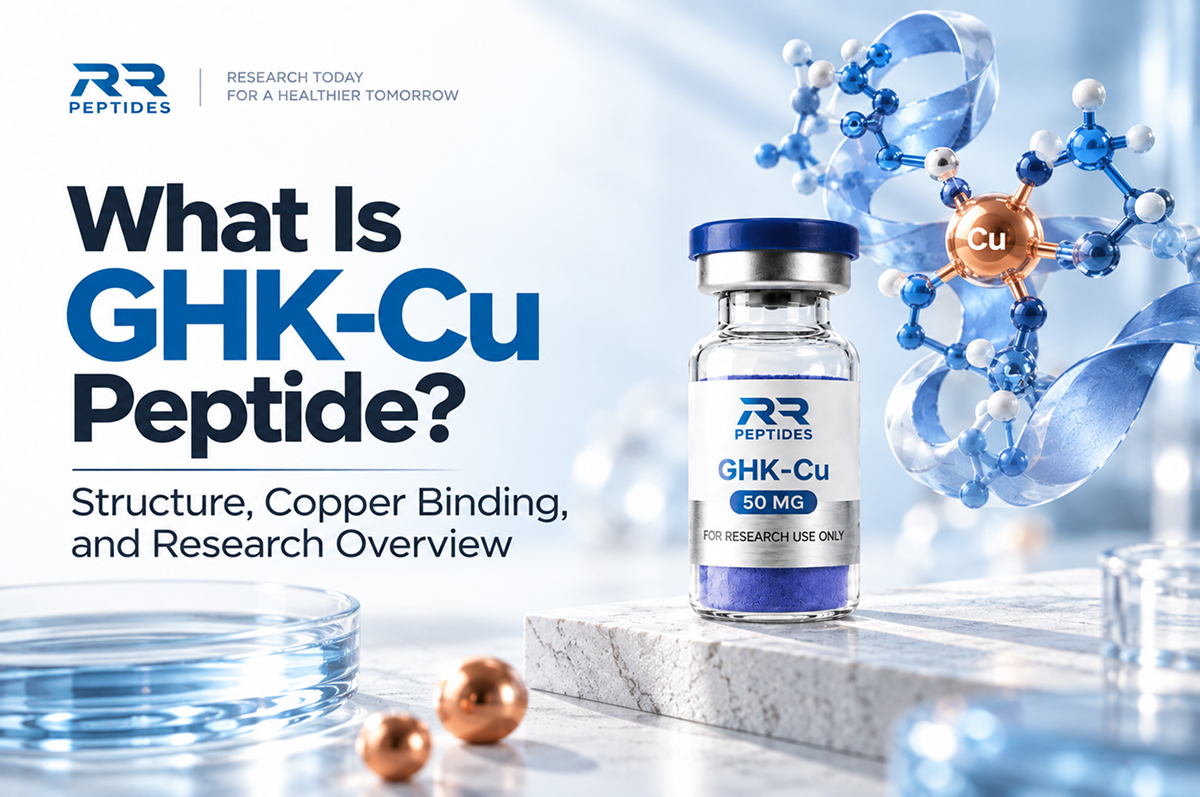
If you are evaluating GHK-Cu for laboratory research, the first question should be what the material actually is, how its copper association is understood, and what current research can demonstrate. What is GHK-Cu peptide is therefore both a chemistry and research-design question.
GHK-Cu has been investigated in biochemical, cellular, skin, and tissue-related research, particularly in connection with copper binding, extracellular matrix biology, cellular signaling, and tissue-associated processes. However, findings depend on material characterization, experimental models, controls, analytical methods, and study endpoints.
RR Peptides provides research-focused information about peptide materials, laboratory models, analytical quality, and scientific evidence. For Canadian researchers, laboratory work should follow institutional procedures, supplier documentation, applicable safety requirements, and relevant Canadian regulatory frameworks. Research-use material should not be interpreted as an approved therapeutic product simply because it is commercially available.
What is GHK-Cu peptide? GHK-Cu is commonly described as a copper-associated complex involving glycyl-L-histidyl-L-lysine (GHK) and copper. GHK is a small tripeptide consisting of glycine, histidine, and lysine.
Understanding what is GHK-Cu peptide requires separating chemical identity from biological interpretation. Researchers should first establish the material’s identity and then examine its behavior under defined experimental conditions. GHK-Cu may also be referred to as copper tripeptide-1, but exact identity, composition, formulation, and analytical information should be verified for the specific research material.
Understanding the material
What is GHK-Cu peptide can be approached through four basic elements: the GHK tripeptide, copper association, molecular identity, and experimental context. None of these elements alone establishes therapeutic efficacy or human safety.
A research project may investigate the chemical characteristics of the complex, its stability, interaction with a biological system, or changes in selected cellular markers. The appropriate methodology depends on the research question.
Key points to identify in a GHK-Cu research material
Researchers evaluating a GHK-Cu material should establish:
Material identity: Confirm that the sample is identified as the intended GHK-Cu material.
Composition: Review the stated peptide and copper-related composition where available.
Batch information: Record the batch or lot number for traceability.
Analytical documentation: Review available certificates of analysis and characterization data.
Formulation: Determine whether the material is isolated or supplied with additional components.
Research purpose: Define the experimental question before selecting a model or endpoint.
Characteristic
Research relevance
GHK tripeptide
Defines the peptide component
Copper association
Defines the copper-containing complex
Molecular identity
Supports material verification
Formulation
Can influence experimental behavior
Purity
Helps control material variability
Experimental model
Determines biological interpretation
A well-designed study should make clear whether it evaluates isolated GHK-Cu, a formulation containing the complex, or another copper-containing material. Without this distinction, comparisons between studies can become difficult.
What is GHK-Cu peptide should therefore be answered in relation to the exact research material being examined. Chemical identity provides the foundation for interpreting later biological observations.
Explore the research specifications and laboratory information available from RR Peptides for GHK-Cu 50mg.
Structure and Copper-Binding Properties
Understanding what is GHK-Cu peptide begins with the structure of GHK and its relationship with copper. This helps clarify what is GHK-Cu peptide from a structural perspective. GHK consists of glycine, histidine, and lysine, with the histidine residue contributing to metal coordination. Copper association can be influenced by factors such as pH, competing ligands, concentration, solvent conditions, and formulation.
The structure also matters when comparing GHK with GHK-Cu. This distinction is important when evaluating what is GHK-Cu peptide in laboratory research. The uncomplexed tripeptide and copper-associated complex should not automatically be considered interchangeable research materials. Likewise, free copper salts are not necessarily substitutes for a peptide-associated copper complex.
Copper coordination in research
What is GHK-Cu peptide can therefore involve both structural and analytical questions. Researchers may investigate whether the intended peptide is present, whether copper association can be demonstrated, and whether the material maintains expected characteristics under defined conditions.
Analytical characterization may involve chromatographic, spectroscopic, mass-based, or other validated approaches depending on the research objective. No single technique necessarily answers every question about identity, purity, composition, and stability.
Factors that can influence copper-binding research
When studying the copper-associated properties of GHK, researchers may consider:
Chemical environment: pH and surrounding compounds can influence metal coordination.
Copper availability: The amount and chemical form of copper can affect the experimental system.
Competing molecules: Other ligands may interact with copper and influence observations.
Sample composition: Additional formulation components can affect analytical measurements.
Analytical method: Different techniques provide different types of information.
Structural factor
Why researchers may examine it
Amino acid sequence
Confirms peptide identity
Copper association
Characterizes the complex
pH
May influence coordination
Competing ligands
Can affect copper availability
Concentration
Defines experimental conditions
Formulation
May alter sample behavior
For what is GHK-Cu peptide comparisons, formulation is particularly important. A research material may contain additional components that influence solubility, stability, exposure, or assay behavior.
Material characterization is also important when comparing results from different laboratories. If identity, purity, copper association, or formulation is poorly described, differences between studies may be difficult to interpret.
Canadian laboratories can strengthen traceability by retaining batch information, supplier documentation, certificates of analysis, storage records, and relevant analytical results. Such documentation supports reproducibility but does not itself establish regulatory authorization.
Understanding what is GHK-Cu peptide at the molecular level provides a foundation for investigating biological behavior. It does not predict every response that may occur in a cellular or tissue model.
What is GHK-Cu peptide can also be examined through its biological context. GHK has been described as a naturally occurring tripeptide, while copper is an essential trace element involved in numerous biological processes. These observations provide context for studying their interaction.
Natural occurrence should not be confused with proof of a particular therapeutic effect. Biological activity depends on concentration, molecular form, tissue environment, and experimental conditions.
Research involving GHK-Cu has examined extracellular matrix biology, cellular responses, oxidative processes, inflammatory markers, and tissue-associated observations. These findings also help explain what is GHK-Cu peptide in different research contexts.
Extracellular matrix research
Researchers have shown interest in extracellular matrix biology because matrix components contribute to tissue structure, organization, and cellular communication. Experimental studies may examine collagen-associated markers, fibroblast behavior, matrix-related gene expression, or other structural indicators.
A change in a collagen-associated marker does not automatically establish improved tissue function. Researchers should distinguish molecular measurements from functional outcomes and interpret each endpoint within the study design.
What is GHK-Cu peptide in this context refers to a research material being investigated in relation to defined biological processes rather than a conclusion about human treatment.
Biological observations researchers may evaluate
Depending on the research question, studies may examine:
Extracellular matrix markers associated with structural organization.
Fibroblast responses including morphology or cellular behavior.
Oxidative-stress indicators under defined experimental conditions.
Inflammatory markers associated with selected signaling pathways.
Cellular migration or morphology as measurable biological endpoints.
Tissue-associated observations in reconstructed, ex vivo, or animal models.
Biological area
Example research focus
Extracellular matrix
Matrix-associated markers
Fibroblast biology
Cellular behavior
Oxidative processes
Stress-related measurements
Inflammatory signaling
Cytokine or pathway markers
Tissue models
Structural observations
These endpoints should be interpreted independently and within the limitations of the experimental model. A change in one marker does not automatically demonstrate a broader biological outcome.
Copper itself participates in biological processes including enzyme activity and redox-related chemistry. Researchers should therefore distinguish observations associated with GHK-Cu from findings generated using free copper or unrelated copper compounds.
The biological context is useful for developing research hypotheses, but evidence should remain tied to the model in which it was generated. This context is important when interpreting what is GHK-Cu peptide across different experimental models. A cellular observation does not automatically establish a tissue-level response, and an animal observation does not automatically establish a human effect.
For laboratories building a research workflow, understanding what is GHK-Cu peptide is only the first step. The next step is defining the material, model, endpoint, controls, and analytical strategy.
How GHK-Cu Is Studied in Laboratory Research
Understanding what is GHK-Cu peptide in a laboratory requires more than reading a product description. Researchers may approach the material through chemical characterization, cell-based experiments, tissue models, ex vivo systems, or animal research.
Each model answers a different question and provides additional context for understanding what is GHK-Cu peptide in laboratory research. Biochemical experiments can focus on material characteristics or molecular interactions. Cell models allow researchers to investigate specific biological responses under controlled conditions. Tissue models provide greater structural complexity, while animal models introduce organism-level interactions.
Common research models
Cell culture can examine cellular behavior such as morphology, migration, viability, gene expression, protein abundance, and extracellular matrix markers, but it does not reproduce every feature of a living organism. Reconstructed skin and tissue models add structural context for studying cellular organization and tissue responses under defined conditions.
Ex vivo tissues preserve more of the original tissue environment but may be limited by tissue viability and study duration. Animal models provide greater biological complexity, although species-specific differences can affect interpretation.
Research model
Potential value
Main limitation
Biochemical assay
Examines molecular properties
Limited biological context
Cell culture
Controlled cellular investigation
Simplified environment
Reconstructed tissue
Adds structural context
Limited systemic factors
Ex vivo tissue
Preserves tissue characteristics
Limited experimental duration
Animal model
Adds organism-level complexity
Species differences
Researchers may combine several approaches to strengthen interpretation. Analytical characterization can establish material identity, a cellular model can investigate a proposed mechanism, and a tissue model can determine whether related observations occur in a more complex system.
A practical research workflow
A laboratory investigation may progress through:
Define the research question and determine what needs to be examined.
Characterize the material using appropriate identity and purity information.
Select the experimental model according to the biological question.
Establish controls and endpoints before beginning the experiment.
Record experimental conditions including batch, preparation, and analytical methods.
Interpret findings within the model without extending preclinical observations beyond available evidence.
Selecting meaningful endpoints
Potential endpoints include gene expression, protein levels, cell morphology, migration, extracellular matrix markers, oxidative-stress indicators, and inflammatory measurements. Researchers should select endpoints based on the research hypothesis and use appropriate controls to interpret observed responses. Replication is also important because reproducible findings under controlled conditions provide stronger evidence.
What is GHK-Cu peptide should therefore be considered in relation to the specific research question, whether it involves chemistry, cellular signaling, or tissue biology. For Canadian laboratories, study planning should consider institutional procedures, sample traceability, laboratory safety, applicable requirements, and appropriate oversight for human or animal research.
Explore the research specifications and laboratory information available from RR Peptides for GHK-Cu 50mg.
Purity and Quality Considerations
Understanding what is GHK-Cu peptide also means confirming the material entering the experiment. Identity, purity, copper association, formulation, batch consistency, storage history, and analytical characterization can influence how results are interpreted, especially when comparing laboratories or production batches.
Researchers may review certificates of analysis and relevant analytical data from chromatographic, mass spectrometric, spectroscopic, or other validated methods. GHK is the tripeptide, while GHK-Cu refers to the copper-associated complex, so the exact material should be verified before interpreting research findings.
Key quality variables
Quality factor
Research purpose
Identity
Confirms intended material
Purity
Helps assess composition
Copper association
Supports complex characterization
Batch information
Enables traceability
Storage history
Provides sample context
Analytical testing
Supports reproducibility
Research quality checklist
Before using a GHK-Cu material, researchers can review:
Identity and composition
Batch or lot information
Certificate of analysis
Purity and analytical characterization
Copper association information
Storage and handling history
Preparation procedure
Experimental controls
Relevant study endpoints
This checklist improves traceability and reduces experimental variability, but it does not establish biological efficacy or safety. Purity is not the same as biological activity, and results can vary with the experimental model, formulation, exposure conditions, endpoint, and storage conditions.
A biological response does not independently confirm chemical purity. When comparing publications, researchers should consider material characterization and experimental conditions, as differences in formulation, purity, copper association, or analytical characterization may mean that what is GHK-Cu peptide in one study does not represent the same preparation in another.
Building a reproducible quality record
A laboratory record can include material identity, batch number, storage history, preparation method, analytical information, experimental conditions, controls, and study endpoints. This documentation helps researchers review unexpected results alongside experimental data.
For Canadian research environments, documentation should align with institutional quality systems and applicable requirements, which may vary by research setting and study type.
RR Peptides provides research-oriented information on peptide materials and laboratory considerations. Researchers should combine this information with primary literature, supplier documentation, institutional procedures, and appropriate analytical evidence.
Explore the mechanisms, biological properties, and research findings of GHK-Cu in GHK-Cu Research: Mechanisms, Scientific Findings, and Laboratory Applications.
What is GHK-Cu peptide made of? It is commonly described as a copper-associated complex involving glycyl-L-histidyl-L-lysine and copper. Researchers should verify the exact identity and formulation of the material used in a specific experiment.
Is GHK-Cu the same as GHK?
No. GHK is the tripeptide, while GHK-Cu refers to the copper-associated complex. This distinction is central to understanding what is GHK-Cu peptide.
Why does copper binding matter?
Copper association is central to the chemical identity of the complex. The behavior of peptide-associated copper can differ from that of free copper compounds, so researchers should use the material actually specified in the study.
What is GHK-Cu studied for?
GHK-Cu has been investigated in biochemical, cellular, skin, and tissue-related models. Research areas include extracellular matrix biology, cellular responses, oxidative processes, inflammatory markers, and tissue-associated observations.
Can cell studies prove human effects?
No. Cell studies can provide mechanistic information and generate hypotheses, but they cannot independently establish human efficacy, safety, or clinical relevance.
Why is purity important?
Purity and identity help researchers establish what material was actually tested. Without adequate characterization, differences between experimental findings may be difficult to interpret.
What analytical methods may be relevant?
Depending on the research question, laboratories may use chromatographic methods, mass spectrometry, spectroscopic approaches, or other validated analytical techniques. Method selection should match the property being investigated.
What should Canadian researchers consider?
Canadian researchers should follow institutional procedures, supplier documentation, applicable laboratory safety requirements, and relevant Canadian regulatory frameworks. Research-use materials should not be interpreted as approved therapeutic products solely because they are commercially available.
Does natural occurrence prove a therapeutic effect?
No. Natural occurrence provides biological context for scientific investigation but does not establish that a particular preparation is safe, effective, or suitable for human use.
Final Research Perspective
A complete understanding of what is GHK-Cu peptide combines molecular identity, copper coordination, biological context, laboratory models, and evidence quality. Research has examined GHK-Cu across biochemical, cellular, skin, and tissue-related models, with each model providing different information.
A reliable research approach begins with clearly characterized material and a defined scientific question. Researchers should connect material identity with the selected model, controls, endpoints, analytical methods, and experimental conditions. Documentation of identity, purity, copper association, batch information, and storage can further support reproducibility.
Researchers should also distinguish mechanistic observations from broader biological conclusions and preclinical findings from evidence directly applicable to humans. RR Peptides provides research-focused information on peptide materials, laboratory applications, analytical considerations, and scientific evidence for researchers evaluating GHK-Cu.
Disclaimer: All products and compounds discussed are intended strictly for laboratory and research purposes. This article is provided for educational and informational purposes only. This article is not medical advice, therapeutic guidance, or instructions for human administration.
3 Comments
This article is a useful introduction to GHK-Cu for anyone who wants to understand the compound before looking into more detailed research. I particularly liked the explanation of how the peptide is associated with copper and why this complex has attracted scientific interest.
I found the basic explanation of GHK-Cu clear and easy to follow. Understanding its composition and biological background provides useful context before exploring the proposed mechanisms and research applications associated with this peptide complex.
The article provides a helpful starting point for understanding what makes GHK-Cu different from a standalone peptide. I appreciate the research-oriented explanation and the focus on understanding the compound’s properties before considering its broader scientific applications.
Comments are closed.
×
Subscribe & Get 10% Off!
Enter your email address below to subscribe to our newsletter and receive an instant 10% OFF discount coupon code sent directly to your inbox!
Thank you for subscribing! Your 10% discount coupon has been sent to your email. Please check your inbox!




This article is a useful introduction to GHK-Cu for anyone who wants to understand the compound before looking into more detailed research. I particularly liked the explanation of how the peptide is associated with copper and why this complex has attracted scientific interest.
I found the basic explanation of GHK-Cu clear and easy to follow. Understanding its composition and biological background provides useful context before exploring the proposed mechanisms and research applications associated with this peptide complex.
The article provides a helpful starting point for understanding what makes GHK-Cu different from a standalone peptide. I appreciate the research-oriented explanation and the focus on understanding the compound’s properties before considering its broader scientific applications.