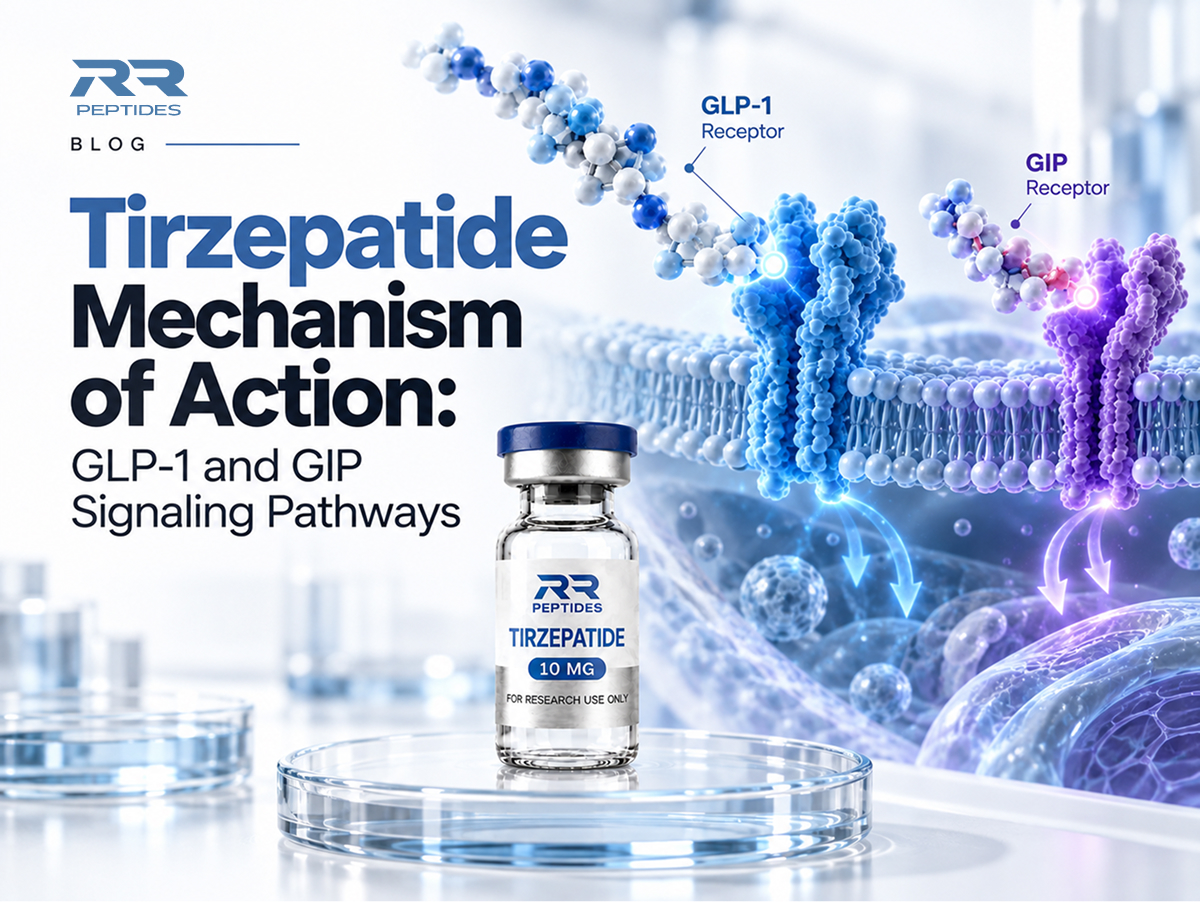
Understanding the Tirzepatide mechanism of action starts with its unusual dual-receptor profile. Tirzepatide is a synthetic peptide-based molecule designed to interact with two class B G protein-coupled receptors, the glucagon-like peptide-1 receptor (GLP-1R) and the glucose-dependent insulinotropic polypeptide receptor (GIPR). This combination provides a useful research model for examining how related incretin signaling systems can influence intracellular pathways.
For laboratory researchers, the Tirzepatide mechanism of action is more than a description of receptor binding. Researchers need to consider which receptor is being studied, what downstream pathway is measured, which model is used, and whether the observed response is reproducible. Molecular assays, cell-based systems, tissue models, and animal studies can each provide different levels of mechanistic information.
RR Peptides provides research-focused information on peptide materials, laboratory models, analytical characterization, and scientific applications. Researchers evaluating the Tirzepatide mechanism of action can combine this information with primary literature, appropriate controls, validated analytical methods, and institutional procedures.
For Canadian laboratories, research planning should also consider institutional requirements, laboratory safety, sample traceability, procurement records, and applicable Canadian regulatory frameworks. Research-use material should not be interpreted as an authorized therapeutic product simply because it is commercially available.
The Tirzepatide mechanism of action is based on activity at both GLP-1R and GIPR. These receptors are members of the class B GPCR family, but they are distinct biological targets with different expression patterns and signaling environments. Tirzepatide can therefore be studied as a dual-receptor ligand rather than as a conventional single-pathway compound.
At the molecular level, receptor activation can initiate G protein coupling and intracellular second-messenger signaling. Cyclic AMP is an important signaling molecule in both receptor systems, although the magnitude and downstream consequences of signaling can vary according to cell type, receptor expression, experimental conditions, and assay design.
A useful Tirzepatide mechanism of action framework separates receptor-proximal events from later cellular responses. Receptor engagement may be followed by changes in cAMP, kinase activity, phosphorylation, ion handling, gene expression, and functional cellular behavior. Measuring several levels can provide stronger mechanistic context than relying on one endpoint.
Core mechanistic variables
Researchers may examine:
receptor activation;
cAMP generation;
phosphorylation;
gene expression;
receptor trafficking;
cellular responses;
metabolic endpoints.
Research level
Example question
Potential endpoint
Molecular
Is the receptor activated?
Receptor-response measurement
Signaling
Which pathway changes?
cAMP or phosphorylation
Cellular
What changes inside the cell?
Gene expression or morphology
Functional
What cellular response follows?
Metabolic or hormone-associated marker
The Tirzepatide mechanism of action should not be interpreted as a single linear pathway. Signaling networks can interact, and downstream responses can depend on receptor abundance, cellular state, assay timing, and experimental conditions. A mechanistic result is therefore strongest when the study clearly connects the measured endpoint to the original hypothesis.
Another important distinction is between mechanistic evidence and therapeutic interpretation. A receptor-associated response in an experimental system can support a biological hypothesis, but it does not independently establish human efficacy or safety. Researchers should keep conclusions proportional to the evidence generated.
Explore the research specifications and laboratory information available from RR Peptides for Tirzepatide 10mg.
GLP-1R is a class B GPCR expressed in several tissues and is particularly relevant to research involving pancreatic beta-cell signaling and metabolic regulation. Tirzepatide can activate GLP-1R, allowing researchers to investigate intracellular responses associated with this receptor system.
The Tirzepatide mechanism of action at GLP-1R can involve G protein coupling and increased intracellular cAMP. Depending on the experimental model, this signaling may influence protein phosphorylation, calcium-related processes, gene expression, and cellular metabolic activity. The exact response depends on the biological environment.
GLP-1R signaling sequence
A simplified experimental framework can include:
Tirzepatide interacts with GLP-1R.
Receptor conformation changes.
G protein signaling is engaged.
Intracellular second-messenger activity changes.
Downstream signaling proteins respond.
Cellular endpoints are measured.
This sequence is a conceptual research framework rather than a complete description of every molecular event. GPCR signaling can involve receptor phosphorylation, regulatory proteins, internalization, recycling, and pathway-specific feedback.
Researchers investigating the Tirzepatide mechanism of action through GLP-1R should therefore define the stage of signaling being measured. A cAMP response provides different information from a later gene-expression change, while a functional cellular endpoint may integrate several upstream pathways.
GLP-1R research area
Potential measurement
Receptor activation
Receptor-response assay
Second messenger
cAMP
Intracellular signaling
Phosphorylation
Transcriptional response
Gene expression
Cellular function
Metabolic or hormone-associated endpoint
Pancreatic beta-cell models can be useful for investigating GLP-1R-associated signaling under controlled conditions. Researchers may compare responses at different glucose environments or examine how signaling changes over time. Such experiments can provide mechanistic information while remaining limited to the selected cellular model.
The Tirzepatide mechanism of action should also be interpreted carefully in relation to receptor expression. The Tirzepatide mechanism of action can also be compared across models using standardized endpoints. A model with high receptor expression may produce a different response from a system with lower expression. Differences in cell state, culture conditions, assay sensitivity, and observation period can further influence results.
Researchers should avoid treating a GLP-1R-associated observation as proof of every downstream physiological effect. Mechanistic interpretation becomes stronger when receptor activity, intracellular signaling, and functional endpoints are evaluated with suitable controls.
GIPR is another class B GPCR and a central component of the dual-receptor profile of tirzepatide. Studying GIPR allows researchers to examine signaling that is distinct from, but related to, GLP-1R activity.
The Tirzepatide mechanism of action through GIPR can involve intracellular cAMP and downstream regulatory pathways. As with GLP-1R, the response is influenced by receptor expression, cell type, experimental conditions, and selected endpoints. Researchers should therefore avoid assuming that both receptors produce identical responses simply because they belong to the same receptor family.
GIPR-associated research variables
Researchers may investigate:
GIPR activation;
cAMP production;
kinase signaling;
transcriptional responses;
metabolic markers;
receptor regulation.
GIPR research question
Possible endpoint
Is GIPR activated?
Receptor-response measurement
Does intracellular signaling change?
cAMP
Are downstream proteins affected?
Phosphorylation
Are transcriptional responses observed?
Gene expression
Does cellular metabolism change?
Metabolic markers
The Tirzepatide mechanism of action cannot be fully understood by studying GIPR in isolation if the experimental question concerns the molecule’s dual activity. Comparative experiments can help researchers determine whether an observed response is associated primarily with GIPR, GLP-1R, or combined receptor signaling.
Appropriate controls are particularly important. Receptor-specific experimental approaches may help identify the contribution of individual pathways, while vehicle and untreated controls can help distinguish material-related effects from background variation.
Researchers should also consider temporal behavior. Early receptor signaling may differ from later transcriptional or metabolic responses. Measuring multiple time points can help identify whether a response is transient, sustained, or associated with later cellular adaptation.
A useful Tirzepatide mechanism of action study should therefore document receptor expression, experimental conditions, timing, controls, and analytical methods. This information allows researchers to compare findings more carefully across studies.
The GIPR pathway may also be studied in relation to glucose and metabolic biology. However, a change in a metabolic marker does not automatically demonstrate a direct receptor mechanism. Several signaling pathways can converge on the same endpoint, so mechanistic claims should be supported by appropriate experimental evidence.
Combined Effects on Metabolic Signaling
The dual activity of Tirzepatide creates an opportunity to examine how GLP-1R and GIPR signaling may contribute to overlapping or complementary biological responses. The Tirzepatide mechanism of action is therefore especially relevant when researchers compare individual receptor pathways with responses generated by the combined molecular profile.
Both receptors can engage cAMP-related signaling, but receptor distribution, cellular context, and downstream regulation differ. A shared second messenger does not mean that the receptors are biologically interchangeable. Their signals can interact with different intracellular networks and produce different functional consequences.
Areas commonly investigated
Researchers may examine:
glucose-associated signaling;
insulin-related cellular responses;
metabolic gene expression;
lipid-associated markers;
energy-balance pathways;
receptor regulation.
Research area
GLP-1R contribution
GIPR contribution
cAMP signaling
Can increase intracellular cAMP
Can increase intracellular cAMP
Pancreatic research
Relevant to beta-cell signaling
Relevant to incretin-associated responses
Gene expression
May alter downstream transcription
May alter metabolic transcription
Metabolic endpoints
Can influence measured metabolic markers
Can contribute to metabolic responses
Receptor regulation
Subject to GPCR regulation
Subject to GPCR regulation
A combined analysis of the Tirzepatide mechanism of action should distinguish receptor activity from downstream physiological outcomes. For example, an increase in cAMP is a signaling observation, whereas a change in glucose-associated behavior may reflect multiple biological processes.
Researchers can strengthen interpretation by comparing several endpoints within the same experimental model. Molecular measurements can be evaluated alongside cellular responses, allowing researchers to determine whether observations support a coherent pathway hypothesis.
Experimental timing is also important. Receptor-proximal signaling may occur quickly, while gene expression, protein abundance, and metabolic responses can develop over longer periods. A single time point may therefore provide incomplete mechanistic information.
The Tirzepatide mechanism of action may also vary between experimental systems. Cell cultures provide controlled environments but lack whole-organism interactions. Tissue and animal models provide greater biological complexity but introduce additional variables, including species-specific differences and systemic regulation.
Researchers should therefore avoid combining findings from different models without examining their methodological context. The Tirzepatide mechanism of action can also be evaluated using multiple complementary experimental endpoints. A response observed in a pancreatic cell model cannot automatically be interpreted as equivalent to an integrated metabolic response in an animal model.
For Canadian laboratories, studies involving animals or human-derived materials may require specific institutional oversight. Researchers should establish appropriate procedures and documentation before beginning such work.
Explore the research specifications and laboratory information available from RR Peptides for Tirzepatide 10mg.
Current Mechanistic Evidence and Limitations
Current evidence supports extensive investigation of tirzepatide as a dual GIPR and GLP-1R agonist, particularly in molecular, cellular, metabolic, and physiological research. However, the strength of a mechanistic conclusion depends on the level of evidence and the quality of the experimental design.
The Tirzepatide mechanism of action can be examined at several evidence levels. Molecular assays provide information about receptor interaction and signaling. Cellular models can investigate intracellular pathways and functional responses. Tissue and animal models provide greater biological complexity but also introduce more variables.
Evidence hierarchy for mechanistic research
A practical framework includes:
receptor and molecular studies;
cellular signaling experiments;
tissue or ex vivo models;
animal studies;
human evidence where applicable.
These evidence levels should not be treated as interchangeable. A molecular response can support a receptor hypothesis without establishing a broader physiological outcome. Similarly, an animal observation may provide useful preclinical information without predicting the magnitude of a response in humans.
A strong Tirzepatide mechanism of action analysis should also consider experimental heterogeneity. Different laboratories may use different cell types, receptor expression levels, sample preparations, assay methods, concentrations, exposure periods, controls, and endpoints. Such differences can produce apparently inconsistent results.
Material characterization is another important consideration. Researchers should document identity, purity, batch information, formulation, storage conditions, preparation history, and analytical testing. These records help distinguish material-related variability from biological or methodological differences.
Important limitations
Researchers should consider:
model-specific responses;
receptor-expression differences;
assay variability;
limited endpoint selection;
differences in experimental timing;
incomplete mechanistic evidence;
challenges in translating preclinical findings.
The Tirzepatide mechanism of action should therefore be interpreted within the model that generated the observation. Mechanistic confidence generally increases when findings are reproducible, supported by multiple experimental approaches, and consistent with appropriate controls.
For Canadian laboratories, research documentation should align with institutional quality systems, laboratory safety procedures, research oversight, and applicable requirements. Commercial availability does not by itself establish therapeutic authorization. The Tirzepatide mechanism of action requires careful comparison of signaling patterns across models.
RR Peptides provides research-focused information on peptide materials, laboratory applications, analytical considerations, and scientific evidence. Researchers should combine this information with primary literature, supplier documentation, validated analytical methods, and institutional procedures.
The Tirzepatide mechanism of action involves activity at both GLP-1R and GIPR, two class B GPCRs. Research can examine receptor activation, intracellular signaling, cAMP, phosphorylation, gene expression, and downstream metabolic endpoints.
Does tirzepatide activate GLP-1R?
Yes. Tirzepatide has activity at GLP-1R, and laboratory studies can examine associated signaling responses. However, GLP-1R activity represents only one part of the molecule’s dual-receptor profile.
Does tirzepatide activate GIPR?
Yes. GIPR is the second major receptor target of tirzepatide. Researchers can investigate GIPR-associated cAMP signaling, downstream pathways, receptor regulation, and metabolic endpoints.
Why are both receptors important?
The dual receptor profile allows researchers to examine how GIPR and GLP-1R pathways may contribute separately or together to biological responses. This makes the molecule useful for studying interactions between related incretin signaling systems.
Which signaling molecule is commonly studied?
Cyclic AMP is an important second messenger associated with both receptor systems. Researchers may also examine phosphorylation, gene expression, receptor trafficking, and functional cellular responses.
Can receptor signaling prove clinical efficacy?
No. Receptor or cellular findings provide mechanistic evidence within a defined experimental system. They do not independently establish clinical efficacy or safety in humans.
Why can studies produce different mechanistic findings?
Differences in receptor expression, cell type, sample preparation, assay methods, experimental timing, controls, and endpoints can influence observations. Results should therefore be interpreted in relation to study design.
What should researchers document?
Useful records can include material identity, purity, batch or lot information, storage history, preparation conditions, receptor expression, assay methods, controls, observation periods, and selected endpoints.
What should Canadian researchers consider?
Canadian researchers should follow institutional procedures, applicable laboratory safety requirements, research oversight frameworks, and relevant regulatory requirements. Animal and human research may require additional approvals depending on the study.
Final Research Perspective
The Tirzepatide mechanism of action provides a useful framework for studying dual incretin receptor pharmacology. By examining GLP-1R and GIPR activity separately and together, researchers can investigate how receptor engagement connects with intracellular signaling and broader metabolic responses.
A rigorous research approach begins with a clearly defined hypothesis and an appropriate experimental model. Receptor assays can clarify molecular activity, cellular systems can examine downstream pathways, and more complex models can provide additional biological context. Each level has specific strengths and limitations.
The Tirzepatide mechanism of action should also be interpreted alongside analytical quality and experimental documentation. Identity, purity, batch consistency, formulation, storage, preparation, controls, and assay conditions can influence reproducibility and should be considered when comparing findings.
For Canadian laboratories, appropriate institutional procedures, safety requirements, sample traceability, and research oversight should form part of study planning. Researchers should distinguish research-use materials from authorized therapeutic products and avoid extending experimental findings beyond the evidence available.
RR Peptides provides research-oriented information on peptide materials, laboratory applications, analytical characterization, and scientific research. Researchers can use these resources alongside primary literature and appropriate laboratory documentation when evaluating tirzepatide-related research questions.
The most reliable interpretation comes from connecting receptor-level findings with cellular and functional endpoints while recognizing the limitations of each experimental model. Transparent reporting, appropriate controls, reproducible methods, and careful evidence interpretation can make mechanistic findings more useful for future research.
Disclaimer: All products and compounds discussed are intended strictly for laboratory and research purposes. This article is provided for educational and informational purposes only and is not medical advice, therapeutic guidance, or instructions for human administration.
3 Comments
The explanation of tirzepatide’s mechanism of action is quite easy to follow. I found the discussion of its activity at both GIP and GLP-1 receptors particularly useful for understanding the biological pathways being investigated.
I appreciate the research-focused approach to explaining how tirzepatide interacts with its target receptors. Breaking the mechanism down into individual signalling pathways makes the molecular activity much easier to understand.
This is a useful reference for anyone trying to understand the science behind tirzepatide. The focus on receptor interactions and downstream signalling provides helpful context for interpreting research on this dual-action peptide.
Comments are closed.
×
Subscribe & Get 10% Off!
Enter your email address below to subscribe to our newsletter and receive an instant 10% OFF discount coupon code sent directly to your inbox!
Thank you for subscribing! Your 10% discount coupon has been sent to your email. Please check your inbox!





The explanation of tirzepatide’s mechanism of action is quite easy to follow. I found the discussion of its activity at both GIP and GLP-1 receptors particularly useful for understanding the biological pathways being investigated.
I appreciate the research-focused approach to explaining how tirzepatide interacts with its target receptors. Breaking the mechanism down into individual signalling pathways makes the molecular activity much easier to understand.
This is a useful reference for anyone trying to understand the science behind tirzepatide. The focus on receptor interactions and downstream signalling provides helpful context for interpreting research on this dual-action peptide.