Third-party peptide testing provides an independent way to evaluate measurable characteristics of research peptides, including chromatographic purity, molecular identity, and other quality attributes. Rather than relying only on a s upplier’s internal quality-control data, samples can be submitted to an external laboratory for separate analytical evaluation.
However, the phrase “third-party tested” should not be treated as a quality guarantee on its own. The value of independent testing depends on the laboratory, analytical method, sample handling, batch traceability, and the quality of the supporting documentation.
For researchers reviewing peptide quality and analytical data, RR Peptides provides additional research-focused peptide information and resources.
What Is Third-Party Peptide Testing?
Third-party peptide testing refers to analysis performed by a laboratory that is independent of the peptide manufacturer or supplier.
When third-party peptide testing results align with supplier specifications, they provide an additional layer of analytical evidence.
The goal is to generate independent analytical data that can be compared with product specifications or internal quality-control results.
Third-Party vs In-House Testing
In-house and independent testing can serve complementary purposes.
Internal laboratories may monitor manufacturing consistency and routine batch specifications. Meanwhile, third-party peptide testing provides analytical evidence outside the supplier’s own testing system.
A research quality framework may therefore include:
In-house testing → routine process and batch monitoring
Still, independence does not automatically guarantee reliable results. Laboratory competence, suitable analytical methods, proper sample handling, and clear documentation remain important.
Explore quality research peptides in Canada at RR Peptides
Why Independent Laboratory Testing Matters
The primary value of third-party peptide testing is independent verification.
For example, when a supplier reports a particular peptide purity, an external laboratory can perform HPLC or UPLC analysis on a submitted sample. Likewise, mass spectrometry can provide molecular-mass data that researchers compare with the expected peptide.
When independent findings align with supplier specifications, they provide an additional layer of analytical evidence. Significant differences, on the other hand, may indicate a need for further investigation.
Purity and Identity Answer Different Questions
An important principle in third-party peptide testing is that purity and identity are not interchangeable.
A high HPLC purity result indicates that a principal chromatographic peak accounts for a large proportion of the relevant detector response under defined analytical conditions. However, the percentage alone does not independently establish that the peak represents the intended peptide.
Mass spectrometry addresses a different question by evaluating whether detected molecular-mass information is consistent with the expected molecule.
In simple terms:
HPLC → evaluates relative chromatographic purity
Mass spectrometry → supports molecular identity
Using complementary analytical methods can therefore provide a more informative picture than relying on one result alone.
Common Tests Performed on Research Peptides
Third-party peptide testing uses different analytical techniques to answer different research questions. Therefore, the appropriate testing panel depends on the peptide and the characteristics being evaluated.
Test
Primary Purpose
Main Limitation
HPLC / UPLC
Relative chromatographic purity
Does not independently confirm molecular identity
Mass spectrometry
Molecular-mass verification
Does not directly establish HPLC purity
LC-MS
Separation plus mass analysis
Interpretation depends on method and instrument
MS/MS
Additional structural information
May not resolve every structural question
Water analysis
Moisture determination
Separate from peptide purity
Residual solvent testing
Detects selected solvents
Only evaluates compounds targeted by the method
HPLC for Peptide Purity
HPLC is widely used in third-party peptide testing to evaluate chromatographic purity.
During analysis, sample components interact differently with the stationary and mobile phases and may therefore elute at different retention times. A detector records the separated components as peaks on a chromatogram.
A laboratory may then calculate relative purity using the principal peak area compared with the total relevant integrated peak area.
For example: HPLC purity: 98.7%
This typically represents chromatographic area purity under the conditions of that specific analysis.
Importantly, a 98.7% HPLC result does not necessarily mean that 98.7% of the total vial mass consists of the desired peptide. Water, counterions, residual solvents, salts, or other components may not be represented in the same way by the chromatographic measurement.
What to Look for in an HPLC Report
A useful third-party peptide testing report provides more information than a single purity percentage.
Researchers may look for the sample or batch identifier, analytical method, test date, retention time, chromatogram, integrated peak areas, and reported purity.
The chromatogram is particularly valuable because it shows the underlying separation from which the reported result was calculated.
Mass Spectrometry for Peptide Identity
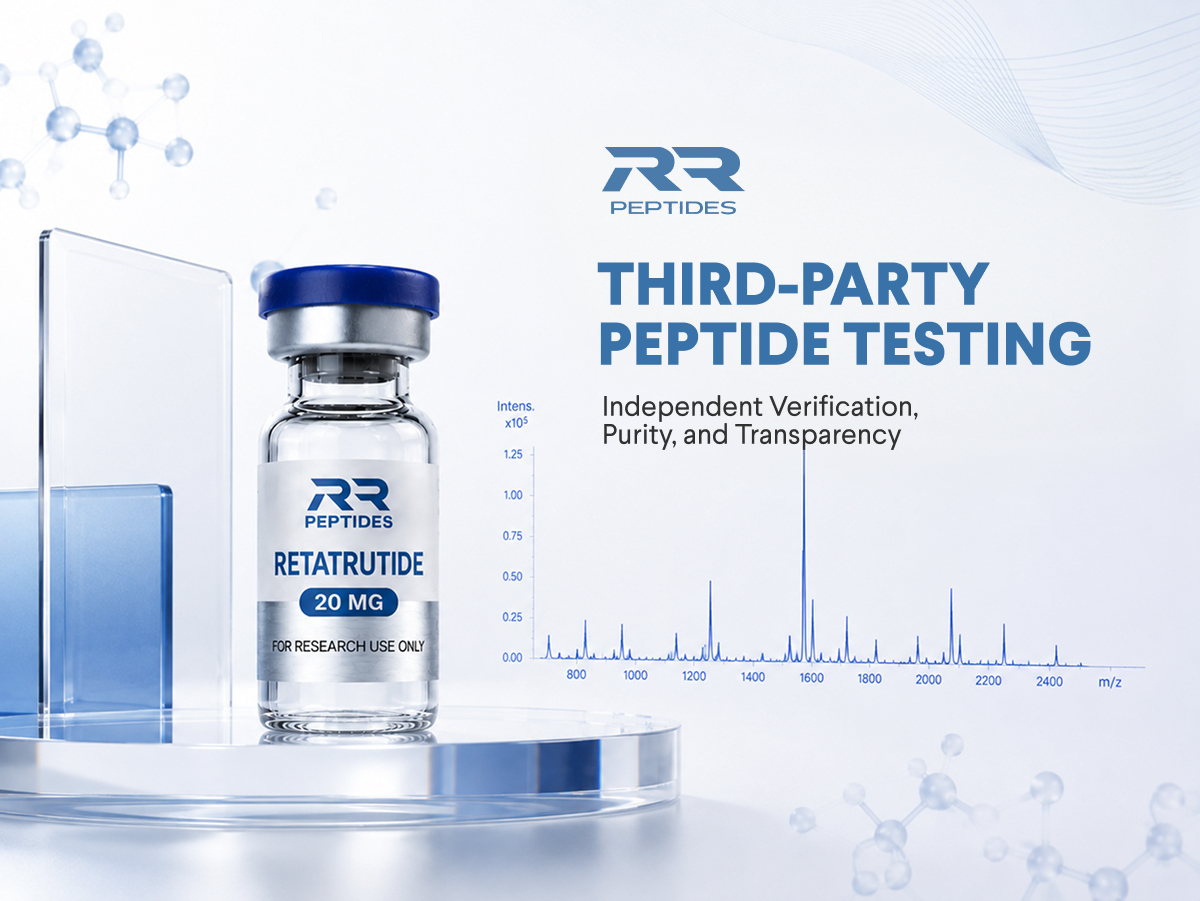
In third-party peptide testing, mass spectrometry (MS) analyzes ionized molecules according to their mass-to-charge ratio (m/z).
Researchers can compare the observed molecular information with the theoretical molecular mass expected from the peptide sequence. Agreement within an appropriate analytical tolerance can support molecular identity.
Mass spectrometry therefore complements HPLC rather than replacing it.
LC-MS and MS/MS
Liquid chromatography-mass spectrometry combines two analytical techniques. LC first separates sample components, while MS provides molecular information about those components.
Tandem mass spectrometry, or MS/MS, goes further by selecting an ion, fragmenting it, and analyzing the resulting product ions. Fragmentation data can provide additional structural evidence when more detailed characterization is required.
Researchers should interpret third-party peptide testing findings within the capabilities and limitations of the specific analytical method.
Additional Analytical Tests
Third-party peptide testing with HPLC and MS does not measure every characteristic of a peptide sample.
For example, water content may require a separate moisture determination method. Residual solvents may also require dedicated analytical testing when relevant to the manufacturing process.
Therefore, a high chromatographic purity percentage should not be interpreted as a complete measurement of every component in the sample.
How to Evaluate Third-Party Laboratory Reports
A professional-looking Certificate of Analysis (COA) does not automatically provide sufficient analytical evidence. Researchers should determine what was tested, how it was tested, and whether the results clearly correspond to the material being evaluated.
Confirm the Laboratory and Sample
The report should identify the laboratory responsible for testing and provide enough information to trace the analyzed sample.
Useful information may include:
laboratory name;
sample identification;
batch or lot number;
report identifier;
analytical method; and
testing date.
Ideally, the documentation should establish a clear connection:
Product → Batch/Lot → Laboratory Sample → Test Result
Without this connection, it may be difficult to determine whether a laboratory report applies to the current material.
Identify the Analytical Method
The analytical method provides context for interpreting a result.
For example: Purity: 99% is less informative than: HPLC purity: 99.0%
Similarly, “identity confirmed” provides less analytical context than a mass spectrometry report showing theoretical and observed molecular-mass information.
Researchers should therefore ask not only what the result is, but also how the laboratory obtained it.
Review Supporting Analytical Data
Where available, researchers should review the chromatogram or spectrum associated with the reported result.
For HPLC, relevant information may include the principal peak, minor peaks, retention time, and integration data.
For MS, researchers may examine expected and observed molecular mass, relevant m/z signals, and the supporting spectrum.
Underlying analytical data provides more context than a summary statement alone.
How Sampling Can Affect Third-Party Test Results
A laboratory can only analyze the sample it actually receives. Therefore, sampling is an important part of third-party peptide testing.
If the submitted material does not adequately represent the corresponding batch, even a technically reliable test may have limited value when researchers attempt to generalize the result.
Storage and handling before analysis can also influence sample condition. Factors such as moisture exposure, temperature, prolonged storage, or contamination may alter material before testing begins.
Researchers should therefore consider whether the submitted sample can be linked clearly to the batch and whether appropriate handling conditions were maintained before laboratory analysis.
Sampling also matters when comparing reports from different laboratories. Differences between results may reflect genuine sample variation, but they can also arise from preparation, storage, sampling, instrumentation, or analytical-method differences.
Consequently, independent testing should be viewed as a chain that includes sample selection, identification, handling, preparation, analysis, and reporting.
What a Strong Third-Party Report Should Show
Researchers reviewing third-party peptide testing reports can use the following framework to evaluate laboratory documentation:
Report Element
Why It Matters
Laboratory identity
Shows who performed the analysis
Sample identification
Connects results to submitted material
Batch or lot number
Supports batch-level traceability
Test date
Shows when analysis occurred
Analytical method
Explains how the result was obtained
Numerical result
Provides measurable analytical data
Chromatogram or spectrum
Shows supporting evidence
Report identifier
Supports document traceability
Not every report requires every element. However, clearly connecting the sample, batch, analytical method, and result makes laboratory documentation substantially more useful.
Explore quality research peptides in Canada at RR Peptides
Batch Testing, Traceability, and Quality Transparency
One important consideration in third-party peptide testing is whether the report corresponds to the specific batch under evaluation.
Testing one batch does not automatically characterize future production lots. Differences in synthesis, purification, raw materials, handling, or storage can produce variation between batches.
Researchers should therefore distinguish between: Product-level statement: “This peptide has been independently tested.” and: Batch-level evidence: “This specific lot has a corresponding independent laboratory report.”
The second provides stronger traceability because it connects analytical findings to the actual material being evaluated.
Why Batch Numbers and Dates Matter
A batch or lot number creates a link between physical material and analytical documentation.
Ideally, the identifier shown on the product should correspond with the batch information on its COA or laboratory report.
The testing date also provides useful context. An older report may represent a historical batch rather than current material, particularly if manufacturing sources or analytical procedures have changed.
Why Repeated Batch Testing Adds Value
A single independent report describes one submitted sample at a particular point in time. Repeated third-party peptide testing across production batches can provide additional information about consistency.
Researchers reviewing multiple reports may compare chromatographic purity, molecular-mass verification, impurity patterns, and consistency with stated specifications.
Repeated testing can also make changes easier to identify. If analytical characteristics shift between batches, researchers can investigate whether synthesis, purification, handling, storage, or another factor has changed.
Small differences between results do not necessarily indicate a quality problem because analytical and batch variation can occur. Instead, repeated batch testing provides a broader view than relying on one historical report.
What Transparency Actually Means
Quality transparency is not simply publishing the highest purity percentage.
Useful transparency allows researchers to understand:
what was tested, which batch was tested, who performed the analysis, which method was used, and what the result demonstrates.
A traceable HPLC result supported by a chromatogram and batch number may provide more useful analytical information than a higher percentage presented without supporting documentation.
Why HPLC and Mass Spectrometry Are Often Used Together
HPLC and mass spectrometry are frequently discussed together because they provide complementary information.
Suppose HPLC shows that a principal component accounts for a high proportion of the chromatographic response. This supports relative chromatographic purity.
If mass spectrometry also identifies molecular-mass information consistent with the expected peptide, researchers gain additional evidence supporting identity.
Together, these methods address:
Chromatographic composition + Molecular identity
This provides a stronger analytical picture than assuming that either method independently answers both questions.
For researchers reviewing peptide documentation, a more useful question than “Does this product have a COA?” is:
What analytical evidence does the COA contain, and what does each test actually demonstrate?
Common Mistakes When Reviewing Third-Party Peptide Testing
Even legitimate third-party peptide testing results can be misinterpreted without proper analytical context.
Treating HPLC Purity as Total Peptide Content
HPLC area purity represents relative chromatographic response under specific analytical conditions. It does not automatically equal peptide content by total sample mass.
Treating Molecular Mass as Proof of Purity
A molecular mass consistent with the expected peptide can support identity, but it does not independently establish a particular HPLC purity percentage.
Ignoring Batch Information
A report from a different or unidentified batch provides weaker evidence for the material currently being evaluated.
Focusing Only on the Highest Percentage
The analytical method, laboratory, sample identification, and supporting data matter alongside the final percentage.
Assuming “Third-Party Tested” Means Comprehensive Testing
A laboratory may have performed only one assay. Researchers should check exactly which attributes were evaluated rather than assuming that purity, identity, water, residual solvents, and other characteristics were all tested.
Third-Party Peptide Testing in Canada
For Canadian researchers, established laboratory-quality principles provide a useful framework for evaluating third-party peptide testing documentation.
In regulated product categories, Health Canada emphasizes appropriate analytical procedures, laboratory competence, sample and batch identification, numerical test results, and quality documentation. In certain contexts, laboratory accreditation frameworks such as ISO/IEC 17025 may also help demonstrate technical competence.
These requirements should not automatically be applied to every research peptide. However, they illustrate broader analytical principles that remain useful when evaluating laboratory evidence.
Most importantly, analytical testing and regulatory authorization are separate matters. A high chromatographic purity result or molecular mass consistent with an expected peptide does not independently establish clinical safety, efficacy, or authorization for human use.
Third-party peptide testing is analytical testing performed by an independent laboratory rather than solely by the manufacturer or supplier. It can provide separate data about purity, identity, or other specified characteristics.
Why is independent testing important?
Third-party peptide testing provides additional analytical evidence that researchers can compare with supplier specifications and internal quality-control data.
What tests are commonly used for research peptides?
HPLC or UPLC commonly evaluates chromatographic purity, while mass spectrometry provides molecular-mass information supporting identity. Other tests may evaluate water or residual solvents when relevant.
Can HPLC confirm peptide identity?
HPLC provides chromatographic information but does not independently establish molecular identity. Mass spectrometry can provide complementary molecular-mass evidence.
Is 99% HPLC purity the same as 99% peptide content?
Not necessarily. HPLC purity generally represents relative chromatographic peak area under defined conditions rather than total peptide content by mass.
What should a third-party laboratory report include?
Useful documentation may include laboratory identity, sample name, batch number, analytical method, testing date, numerical results, and supporting chromatograms or spectra.
Why is batch-specific testing important?
Different production batches may have different analytical characteristics. Batch-specific documentation links the laboratory findings to the particular material being evaluated.
Does third-party testing guarantee peptide quality?
No. Its value depends on laboratory competence, sampling, analytical methods, traceability, and the scope of testing performed.
Is a Certificate of Analysis enough?
A COA can provide useful information, but researchers should examine which tests were performed, whether the report corresponds to the current batch, and whether supporting analytical evidence is available.
Final Thoughts
Third-party peptide testing provides an independent layer of analytical verification for research peptides, but its value depends on the quality and traceability of the underlying evidence.
HPLC can evaluate relative chromatographic purity, while mass spectrometry can support molecular identity. Additional methods may address water, residual solvents, or other characteristics when relevant. Sampling and batch identification also matter because laboratory results apply most directly to the material that was actually tested.
When evaluating third-party peptide testing, researchers should focus on batch-specific documentation, analytical methods, numerical results, and supporting chromatograms or spectra.
Ultimately, meaningful transparency allows researchers to understand what was tested, how it was tested, which batch the result represents, and what the analytical findings actually support.
For additional research-focused peptide information and analytical resources, explore RR Peptides.
Disclaimer: All products and compounds referenced are intended strictly for laboratory and research purposes only. This content is provided for informational and educational purposes and is not intended as medical advice or to diagnose, treat, cure, or prevent any disease.
3 Comments
Really useful overview of third-party peptide testing. I like that the article explains why independent analysis can provide additional context beyond a supplier’s own specifications. It would be interesting to see a practical example of how researchers compare third-party results with a certificate of analysis.
I found the discussion of independent quality verification particularly helpful. Having an outside laboratory evaluate a research material seems like an important consideration when assessing purity and identity. A follow-up explaining which analytical techniques are commonly used in third-party testing would be very informative.
Appreciate the research-focused approach to third-party testing. It’s easy to rely on a stated purity figure, so understanding how independent verification works adds useful context when evaluating research materials. I’d be interested in seeing a checklist of what researchers should look for in an independent testing report.




Really useful overview of third-party peptide testing. I like that the article explains why independent analysis can provide additional context beyond a supplier’s own specifications. It would be interesting to see a practical example of how researchers compare third-party results with a certificate of analysis.
I found the discussion of independent quality verification particularly helpful. Having an outside laboratory evaluate a research material seems like an important consideration when assessing purity and identity. A follow-up explaining which analytical techniques are commonly used in third-party testing would be very informative.
Appreciate the research-focused approach to third-party testing. It’s easy to rely on a stated purity figure, so understanding how independent verification works adds useful context when evaluating research materials. I’d be interested in seeing a checklist of what researchers should look for in an independent testing report.