FREE SHIPPING for orders over $250 Canada-wide Xpresspost FREE SHIPPING for orders over $250 Canada-wide Xpresspost

Retatrutide vs Tirzepatide: What’s the Difference in metabolic peptide research?

Metabolic peptide research continues to advance rapidly, with increasing scientific attention focused on multi-receptor agonists and their potential role in metabolic signaling pathways.
Among the most widely discussed investigational compounds are Retatrutide and Tirzepatide. Both peptides are being studied for their interaction with incretin-related pathways, yet they differ significantly in their receptor activity and overall research design.
As interest in next-generation metabolic peptides grows, researchers continue examining how these compounds compare across various metabolic and signaling systems.
Understanding the Difference
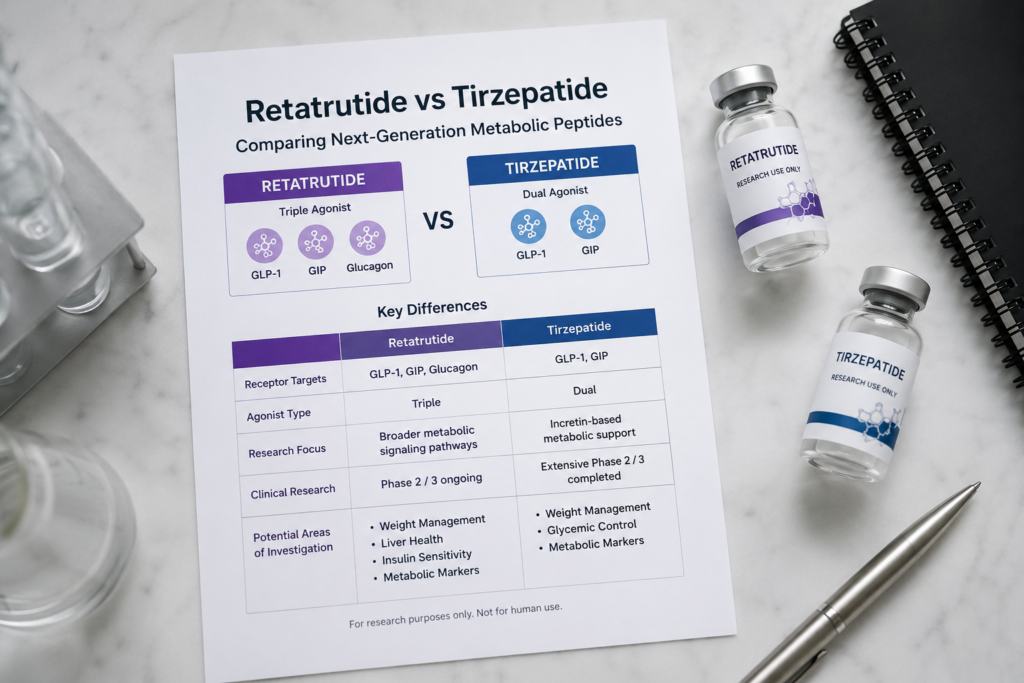
One of the primary distinctions between those two is the number of receptor pathways each compound targets.
Tirzepatide
Is classified as a dual agonist and is being studied for its interaction with:
- GLP-1 receptors
- GIP receptors
Researchers have investigated Tirzepatide extensively due to its dual-pathway mechanism and its ability to influence multiple metabolic signaling systems simultaneously.
Researchers interested in this product can explore our research peptide library.
Retatrutide
Represents a newer generation of investigational peptide research and is classified as a triple agonist.
It is designed to interact with:
- GLP-1 receptors
- GIP receptors
- Glucagon receptors
The addition of glucagon receptor activity distinguishes Retatrutide from Tirzepatide and has generated significant scientific interest regarding potential differences in metabolic signaling and energy regulation pathways.
Researchers interested in this product can explore our research peptide library.
Comparing Receptor Activity
The table below summarizes the primary receptor targets currently being studied:
| Receptor | Tirzepatide | Retatrutide |
|---|---|---|
| GLP-1 | Yes | Yes |
| GIP | Yes | Yes |
| Glucagon | No | Yes |
Because Retatrutide engages an additional receptor pathway, researchers are investigating whether triple agonist activity may influence metabolic outcomes differently than dual agonist approaches.
Published Research Findings
Tirzepatide has been evaluated in multiple large-scale clinical studies and has become one of the most extensively researched dual agonist peptides.
Retatrutide, while newer, has attracted substantial scientific attention following the publication of phase 2 clinical trial data demonstrating significant dose-dependent reductions in body weight and improvements in metabolic markers.
Researchers continue studying both compounds to better understand:
- Metabolic regulation
- Energy balance pathways
- Glucose-related signaling mechanisms
- Cardiometabolic markers
- Advanced incretin biology
As additional clinical data becomes available, comparisons between dual and triple agonist approaches are expected to remain an important area of investigation.
Why Researchers Are Paying Attention
The comparison between Retatrutide and Tirzepatide highlights the broader evolution occurring within metabolic peptide science.
While Tirzepatide helped establish interest in dual incretin receptor agonism, Retatrutide represents a newer investigational approach that expands receptor targeting through additional glucagon pathway activity.
Researchers continue evaluating both compounds to better understand how multi-pathway receptor engagement may influence complex metabolic signaling systems.
As scientific knowledge advances, these investigational peptides remain among the most discussed compounds within modern metabolic research.
Related Research Products
These products are supplied exclusively for laboratory and research applications.
Read the Published Research
Researchers interested in reviewing published literature may explore peer-reviewed studies available through PubMed and other scientific journals discussing Tirzepatide, Retatrutide, incretin biology, and multi-receptor agonist research.
- Triple–Hormone-Receptor Agonist Retatrutide for Obesity (NEJM/PubMed)
- Tirzepatide Once Weekly for the Treatment of Obesity (NEJM/PubMed)
- Retatrutide Reduces Liver Fat in Adults With Obesity (PubMed)
- Retatrutide: A Novel Triple Agonist for Metabolic Research (PubMed Review)
Disclaimer: All compounds referenced are intended strictly for laboratory and research purposes only. This content is provided for informational and educational purposes and is not intended as medical advice or to diagnose, treat, cure, or prevent any disease.