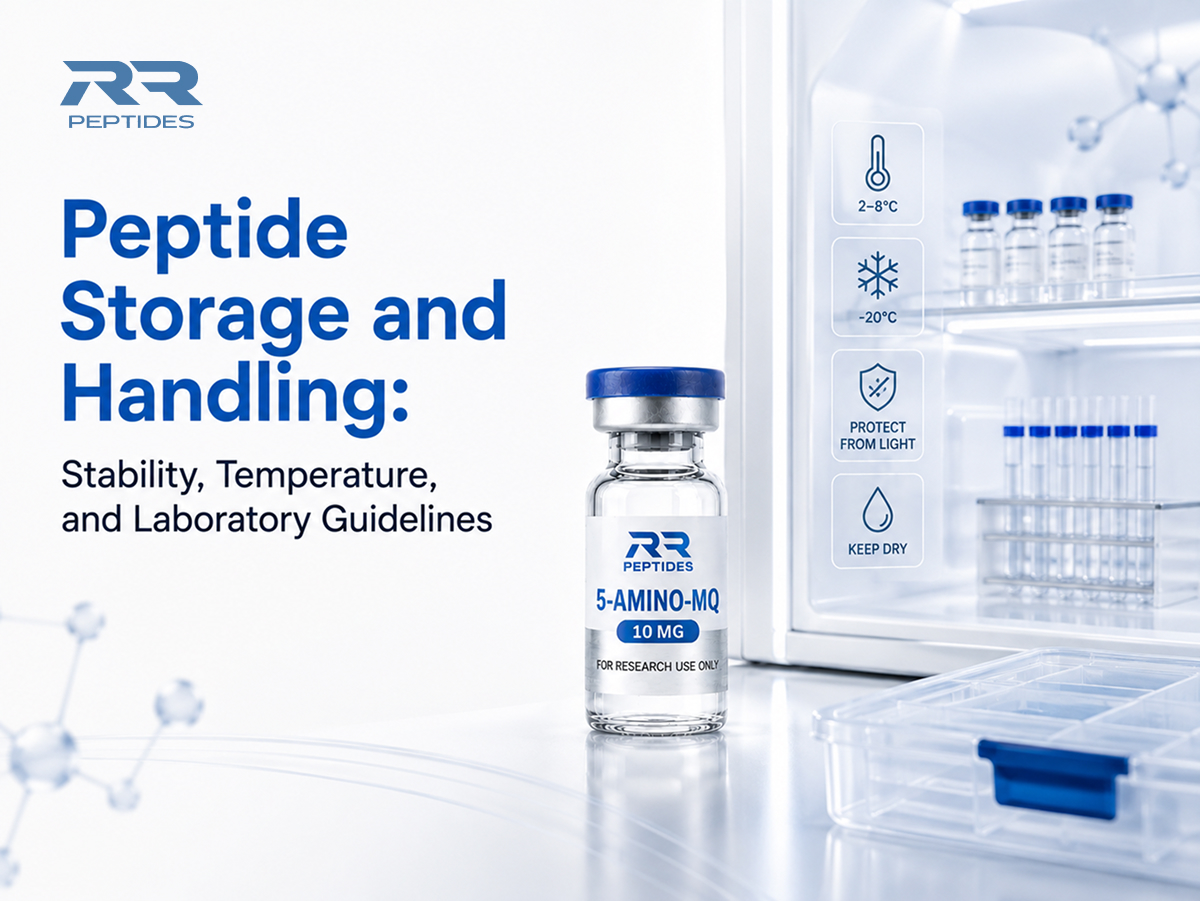
Peptide quality does not depend only on synthesis, purity testing, or Certificate of Analysis results. Proper peptide storage and handling can influence the integrity of research material throughout its laboratory lifecycle.
Temperature, moisture, light, oxygen exposure, contamination, and repeated manipulation may introduce variables into experimental workflows. Therefore, peptide storage and handling should form part of laboratory quality control from the moment material arrives until researchers use it in an experiment.
There is no single storage condition appropriate for every peptide. Sequence, formulation, physical state, container system, storage duration, and available stability data can all influence suitable conditions. For this reason, researchers should prioritize compound-specific documentation over generalized storage recommendations.
For more educational resources on peptide quality, analytical testing, COAs, and batch verification, explore RR Peptides.
Why Peptide Storage and Handling Matter
A peptide may meet analytical specifications when initially tested but undergo chemical or physical changes during subsequent storage.
Depending on the compound and formulation, potential degradation pathways include oxidation, hydrolysis, deamidation, aggregation, and other structural changes. Their importance varies considerably between peptides.
Peptide storage and handling history can therefore become an important experimental variable. Two laboratories may start with material from the same batch but obtain different material histories if one maintains controlled conditions while the other repeatedly exposes the sample to changing environments.
Clear peptide storage and handling documentation can support experimental traceability and reproducibility.
Purity and Stability Answer Different Questions
Researchers evaluating peptide storage and handling should distinguish initial analytical purity from stability over time.
HPLC Purity: 99.2%
This result describes the analyzed sample at a particular time. It does not establish that the peptide will maintain the same analytical profile indefinitely.
Purity asks what the analytical sample looked like when tested. Stability asks whether relevant characteristics remain acceptable during storage under defined conditions.
For this reason, a high initial purity result does not eliminate the need for appropriate peptide storage and handling.
Explore quality research peptides in Canada at RR Peptides
Storage Guidelines for Lyophilized Peptides
Many research peptides are supplied as lyophilized, or freeze-dried, powders. Lyophilization removes substantial amounts of water and may improve practical stability for certain compounds.
In peptide storage and handling, lyophilized material should not be assumed stable under every condition.
Researchers should avoid universal peptide storage and handling rules such as assuming all peptides require refrigeration or freezing. A better approach is to prioritize compound-specific stability data and validated documentation.
Key Storage Considerations
Factor
Why It Matters
Temperature
Can influence chemical degradation and physical stability
Moisture
May affect dry material and promote certain degradation pathways
Light
Can affect photosensitive compounds
Oxygen
May contribute to oxidation in susceptible sequences
Container integrity
Helps limit environmental exposure
Storage duration
Influences the relevance of stability data
Physical state
Lyophilized and dissolved peptides can behave differently
Peptide sequence
Influences susceptibility to degradation
These variables should be considered together rather than treating temperature as the only factor.
Container Integrity
In peptide storage and handling, the vial and closure form an important part of the storage system. Researchers should maintain container integrity and limit unnecessary opening or transfer.
This is particularly relevant for lyophilized materials because repeated exposure to humid laboratory air may introduce moisture. The significance of an exposure, however, depends on the compound, duration, environmental conditions, and available stability evidence.
Lyophilized vs Dissolved Peptides
One of the most important distinctions in peptide storage and handling is whether the material remains dry or has entered solution.
Researchers should not automatically apply storage information for a lyophilized peptide to the same compound after dissolution.
Factor
Lyophilized Material
Peptide in Solution
Water availability
Low
High
Hydrolysis
Generally reduced
May become more relevant
pH effects
Limited
Potentially significant
Buffer effects
Usually limited
Can influence stability
Concentration effects
Limited
May affect physical stability
Freeze–thaw effects
Different considerations
May affect some formulations
After dissolution, peptide storage and handling must account for additional variables such as pH, buffer composition, concentration, dissolved oxygen, and container interactions.
Consequently, a statement such as “stable for 30 days after reconstitution” has limited scientific value unless the underlying data specify the conditions under which researchers established that stability.
A meaningful stability statement should identify the relevant formulation, temperature, concentration, container, duration, and analytical criteria.
Handling Peptides in Laboratory Environments
Effective peptide storage and handling requires both appropriate storage conditions and consistent laboratory practices.
A practical peptide storage and handling workflow should maintain sample identity, limit unnecessary environmental exposure, and reduce contamination risks.
Maintain Sample Traceability
Researchers should maintain clear identification throughout the material’s laboratory lifecycle. Useful records may include the compound name, batch number, laboratory sample ID, preparation date, concentration where relevant, and specified storage conditions.
Traceability strengthens peptide storage and handling when multiple research samples have similar appearances.
If researchers later observe unexpected analytical or experimental results, these records help determine whether sample identity or handling history could have contributed.
Use a Consistent Handling Workflow
A straightforward process may follow:
Prepare workspace → Verify sample identity → Retrieve material → Perform procedure → Secure container → Return to storage → Record relevant information
Researchers should also avoid unnecessary opening, transferring, warming, cooling, or relabelling. Each additional manipulation can increase opportunities for contamination, sample loss, environmental exposure, or identification errors.
Protecting Peptides from Heat, Light, and Moisture
Environmental protection is a central part of peptide storage and handling, although the level of control required depends on the specific compound.
Temperature and Heat
Temperature can influence chemical reaction rates and physical stability. Nevertheless, a brief excursion outside a specified range does not automatically demonstrate peptide degradation.
When an excursion occurs, researchers should consider its duration and severity alongside the peptide’s physical state, formulation, container condition, and available stability information.
This evidence-based assessment is more useful than assuming that every temperature deviation makes the material unusable.
Light
Some compounds can undergo photochemical changes. Where stability information identifies light sensitivity, laboratories should use appropriate storage conditions and containers.
Researchers should not, however, assume identical photosensitivity across all peptides.
Moisture and Oxygen
Moisture may be particularly relevant for lyophilized material, while certain peptide sequences may be susceptible to oxidative changes.
Maintaining suitable container integrity can help limit both exposures. The actual risk depends on the peptide and its formulation rather than on a universal rule.
Explore quality research peptides in Canada at RR Peptides
Factors That Can Affect Peptide Stability
Several variables can influence peptide storage and handling outcomes by affecting how a peptide changes over time.
Peptide Sequence
Amino acid composition affects chemical behaviour. Certain sequences may show greater susceptibility to oxidation, hydrolysis, deamidation, or other modifications.
As a result, two peptides exposed to the same environment may not have the same stability profile.
pH and Formulation
For dissolved peptides, pH can influence degradation pathways. Buffer composition, salts, ionic strength, solvents, and excipients may also alter peptide behaviour.
Therefore, researchers should be cautious when applying stability data from one formulation to another.
Concentration and Container Interactions
Concentration may influence aggregation, adsorption, or other physical interactions in some peptide systems. Peptides can also interact with container surfaces depending on their molecular characteristics and formulation.
These factors become particularly relevant when researchers compare stability data generated under different experimental conditions.
Freeze–Thaw Cycling
Repeated freeze–thaw cycling may affect certain peptide solutions through aggregation, precipitation, adsorption, or related physical changes.
The effect is compound-specific. Researchers should therefore minimize unnecessary cycling instead of relying on a universal number of acceptable freeze–thaw cycles.
Temperature Monitoring, Transport, and Storage Records
Maintaining appropriate peptide storage and handling requires more than assigning a sample to a refrigerator or freezer. Laboratories also need sufficient records to understand the material’s storage history.
If temperature forms part of the specified storage condition, researchers should have a reasonable method for monitoring it.
Recording Temperature Excursions
When an unexpected temperature change occurs, useful information may include:
Information
Why It Matters
Maximum temperature
Indicates excursion severity
Duration
Defines the exposure period
Material identity
Identifies affected samples
Physical state
Distinguishes dry and dissolved material
Container condition
Identifies additional exposure concerns
Stability information
Supports assessment
Laboratory action
Records the response
These records allow researchers to evaluate an excursion rather than making an unsupported assumption.
Moving Peptides Between Laboratory Locations
Storage controls should also extend to transport between storage areas, laboratory rooms, or research facilities.
Researchers should consider the expected transfer time and relevant storage requirements before moving temperature-sensitive material. During transport, labels and batch identifiers should remain connected to the sample.
For longer transfers, recording departure and arrival times or significant environmental deviations can provide additional traceability.
This does not mean every short transfer compromises peptide stability. The goal is to prevent transportation from becoming an undocumented variable.
Why Storage Records Matter for Reproducibility
Detailed storage records strengthen peptide storage and handling by allowing researchers to reconstruct the environmental history of a sample. This becomes particularly useful when the same peptide batch supports multiple experiments over several weeks or months.
Researchers may document when a vial first entered storage, when they removed it for preparation, whether temperature excursions occurred, and when they transferred the material between storage locations. Together, these records create a timeline that researchers can compare with subsequent analytical or experimental results.
If a later experiment produces findings that differ from an earlier study, the storage history can help researchers determine whether the samples experienced different conditions before use. Such records do not prove that storage caused the difference, but they prevent handling history from remaining an unknown variable.
Consistent documentation also improves communication when multiple researchers share the same material. Team members can determine when a sample moved, whether significant deviations occurred, and which storage conditions applied during a particular period.
In this way, peptide storage and handling documentation contributes to both material control and experimental reproducibility.
Creating a Consistent Peptide Storage Workflow
Laboratories can reduce variability by establishing a standardized process for receiving, storing, handling, and documenting research peptides.
A simple workflow might look like this:
Receive material → Verify identity and batch → Review storage information → Assign storage location → Record handling events → Document significant deviations
A consistent process becomes particularly valuable when multiple researchers share the same materials.
It can reduce accidental storage in incorrect locations, incomplete records, unnecessary environmental exposure, and confusion between similar samples.
More importantly, it creates a traceable history that researchers can review if unexpected experimental results occur.
Stability Data Should Support Storage Claims
Peptide storage and handling recommendations become more meaningful when researchers can connect them to appropriate stability evidence.
For example, a claim that a peptide remains stable for six months provides little context on its own. Researchers would also need to know whether the material was lyophilized or dissolved, its storage temperature, formulation, container, and how stability was evaluated.
Short-Term vs Long-Term Peptide Storage
Storage duration is another important consideration in peptide storage and handling. Conditions suitable for short experimental periods may not necessarily provide the same level of stability over several months. As storage time increases, gradual chemical or physical changes may become more relevant, particularly for materials susceptible to moisture, oxidation, or temperature-related degradation.
Researchers should therefore interpret any storage recommendation together with its intended duration. Conditions supported for short-term laboratory storage should not automatically be assumed appropriate for long-term storage unless relevant stability evidence supports that conclusion.
Long-term storage can also make container integrity and environmental consistency more important. Repeated access to the same material may introduce additional exposure to laboratory air, moisture, or temperature changes. Consequently, the material’s handling history becomes increasingly useful when researchers use one batch across multiple experiments.
The physical state also matters. Stability information generated for a lyophilized peptide does not necessarily describe how the same compound behaves after dissolution. Likewise, data generated under one formulation or storage environment may not apply to another.
Considering storage duration alongside storage conditions gives researchers a more complete basis for interpreting stability information and controlling variability throughout the experimental lifecycle.
Visual Appearance Cannot Confirm Stability
A sample can undergo chemical changes without developing obvious visual differences.
Therefore, colour, clarity, or physical appearance alone cannot confirm that a peptide remains analytically unchanged.
Depending on the research question, appropriate techniques such as chromatography or mass spectrometry may provide more meaningful information about changes during storage.
In simple terms:
No visible change does not necessarily mean no analytical change.
Peptide Storage and Handling in the Canadian Research Context
Canada does not establish one universal storage temperature for every research peptide.
Health Canada’s regulated-product frameworks instead demonstrate a broader quality principle: storage conditions should reflect material characteristics and available stability evidence, while relevant environmental variables require appropriate control.
These requirements apply within specific regulated categories and should not automatically be interpreted as legal requirements for research-only peptides.
Nevertheless, they provide useful principles for Canadian research environments: Use evidence-supported conditions, control relevant environmental variables, and document meaningful deviations.
For peptide storage and handling, this evidence-based approach is more defensible than applying identical refrigeration or freezing rules to unrelated peptides.
Researchers should follow compound-specific storage information supported by appropriate stability data or laboratory documentation. Suitable conditions can vary according to sequence, formulation, physical state, container, and storage duration.
Do all lyophilized peptides need refrigeration?
No. There is no universal storage temperature for every lyophilized peptide. Researchers should use conditions appropriate to the specific material.
Are lyophilized peptides more stable than dissolved peptides?
Lyophilization can improve stability for many materials by reducing water availability. However, actual stability remains compound-specific, and dissolution introduces additional variables such as pH and formulation.
Does a temperature excursion mean a peptide has degraded?
Not automatically. Researchers should assess the temperature reached, duration, material state, formulation, and available stability information.
Should researchers protect peptides from light?
Some peptides or formulations may require light protection. Compound-specific stability information should determine the appropriate precaution.
Can researchers repeatedly freeze and thaw peptide solutions?
The effects vary between peptides and formulations. Minimizing unnecessary cycling is preferable to assuming a universal number of acceptable cycles.
Does HPLC purity prove peptide stability?
No. HPLC purity represents an analytical measurement at a particular point in time. Stability evaluates how relevant characteristics behave over time under defined conditions.
Can researchers judge peptide stability by appearance?
Not reliably. Chemical changes may occur without visible differences, so analytical testing provides stronger evidence when stability requires verification.
What storage information should laboratories record?
Useful records can include compound identity, batch number, specified storage conditions, physical state, preparation dates, significant temperature excursions, and relevant transport or handling information.
Final Thoughts
Effective peptide storage and handling requires researchers to consider both the material and its laboratory history.
Peptide sequence, physical state, formulation, temperature, moisture, light, oxygen, pH, concentration, container interactions, and storage duration can influence stability. The difference between lyophilized and dissolved material is especially important because dissolution introduces additional chemical variables.
At the laboratory level, clear sample identification, controlled handling, appropriate environmental monitoring, and documentation of meaningful deviations can reduce avoidable experimental uncertainty. Maintaining a clear storage history can also help researchers compare experiments and investigate unexpected results without leaving sample handling as an unknown variable.
Rather than applying one universal rule to every peptide, researchers should rely on compound-specific evidence and maintain traceable storage records.
Strong peptide storage and handling practices ultimately support sample integrity, reproducibility, and more reliable interpretation of laboratory results.
For more educational resources covering peptide stability, purity testing, COAs, batch verification, and laboratory quality, visit RR Peptides.
Disclaimer: All products and compounds referenced are intended strictly for laboratory and research purposes only. This content is provided for informational and educational purposes and is not intended as medical advice or to diagnose, treat, cure, or prevent any disease.
3 Comments
Really useful guide to peptide storage and handling. I liked the practical focus on factors such as temperature, moisture and repeated handling, since these details can easily be overlooked when working with research materials. A comparison of storage considerations for different peptide formats would be an interesting addition.
I found the handling recommendations particularly helpful. Maintaining consistent storage conditions seems important for preserving the integrity of research samples, especially when materials may be stored for extended periods. I’d be interested in seeing a checklist of common storage and handling mistakes to avoid.
Appreciate how straightforward this article makes peptide storage and handling. It’s easy to focus on the quality of a research material when it arrives and overlook how subsequent handling can affect sample integrity. A follow-up on documenting storage conditions and handling history would be very useful.




Really useful guide to peptide storage and handling. I liked the practical focus on factors such as temperature, moisture and repeated handling, since these details can easily be overlooked when working with research materials. A comparison of storage considerations for different peptide formats would be an interesting addition.
I found the handling recommendations particularly helpful. Maintaining consistent storage conditions seems important for preserving the integrity of research samples, especially when materials may be stored for extended periods. I’d be interested in seeing a checklist of common storage and handling mistakes to avoid.
Appreciate how straightforward this article makes peptide storage and handling. It’s easy to focus on the quality of a research material when it arrives and overlook how subsequent handling can affect sample integrity. A follow-up on documenting storage conditions and handling history would be very useful.