When evaluating a multi-peptide research material, identifying the ingredients listed on a product specification is only the first step. Researchers also need to determine whether those ingredients are supported by appropriate documentation and analytical evidence. This makes KLOW blend ingredient verification an important part of reviewing a research formulation.
A product label describes the intended formulation, but it does not independently establish chemical identity, purity, quantity, or batch consistency. These aspects require a structured review of product specifications, lot information, Certificates of Analysis (COAs), and relevant analytical methods.
For Canadian researchers, research materials should also be distinguished from products authorized for therapeutic use. Analytical documentation can support laboratory material evaluation, but it should not be interpreted as evidence of therapeutic approval or clinical effectiveness.
At RR Peptides, researchers can explore research-focused peptide materials and educational information related to formulation, analytical quality, and batch documentation. Understanding the principles behind KLOW blend ingredient verification can help researchers evaluate technical information more systematically.
Why KLOW Blend Ingredient Verification Matters
KLOW blend ingredient verification focuses on determining whether the declared ingredients in a multi-peptide formulation can be supported by appropriate documentation and analytical evidence.
A useful verification process separates several questions:
Verification area
What it evaluates
Typical evidence
Ingredient identity
Whether the expected compound is present
Mass spectrometry
Purity
Chromatographic quality of a specified analyte
HPLC or UPLC
Quantity
Amount of a specified component
Quantitative testing
Batch traceability
Which production lot was tested
Lot number and COA
Formulation
Declared components and quantities
Product specification
Identity and purity are different
Identity asks whether a detected compound corresponds to the expected material. Purity describes the measured proportion of a specified analyte under a particular analytical method.
A high purity result for one peptide therefore does not automatically confirm the identity or quantity of every component in a multi-peptide formulation. This distinction is central to KLOW blend ingredient verification because different analytical results answer different questions.
Composition requires supporting evidence
Composition describes which components are included in a formulation and, where disclosed, their relative quantities. Product specifications can establish the declared formulation, while laboratory testing may provide additional evidence about individual components.
Researchers should avoid treating a single laboratory result as proof of the complete formulation. Instead, KLOW blend ingredient verification should consider product information and analytical evidence together.
Why batch information matters
Batch-level information provides traceability. A lot number connects a physical sample with a specific production batch and its associated documentation.
This connection is important because a general product specification may describe an intended formulation, while a COA may provide analytical information about a particular lot. KLOW blend ingredient verification is therefore stronger when the documentation can be clearly connected to the material being evaluated.
Canadian research context
Canadian researchers should distinguish laboratory research materials from products authorized for therapeutic use. Requirements can vary depending on the institution, laboratory, and intended research activity.
Accordingly, KLOW blend ingredient verification should be understood as an analytical and documentation assessment rather than a statement about human use, therapeutic approval, or clinical efficacy.
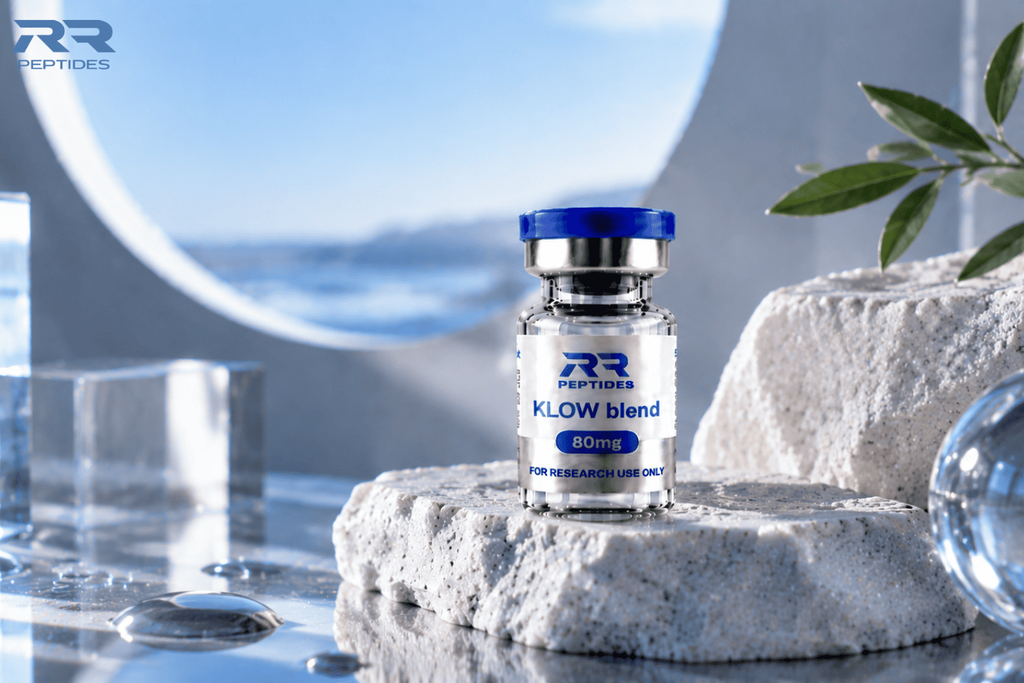
Explore research composition and quality with KLOW 80mg.
Matching Product Labels with Batch Documentation
Product documentation provides the foundation for KLOW blend ingredient verification. A product specification describes the intended formulation, while batch documentation can provide information about a specific production lot.
What researchers should record
Before reviewing analytical results, researchers should record the key information associated with the material.
Information
Purpose
Product name
Identifies the material
Declared ingredients
Defines the stated formulation
Declared quantity
Establishes the stated amount
Lot number
Provides batch traceability
COA
Documents reported testing
Test date
Shows when testing occurred
Analytical method
Explains how testing was performed
This information creates a reference point for KLOW blend ingredient verification.
Match the lot number
A COA is most useful when its lot number corresponds to the material being evaluated. Without batch identification, researchers may not be able to establish whether the reported findings apply to the specific material received.
A generic certificate can provide background information, but it should not automatically be treated as batch-specific evidence.
Compare declared and analytical information
Researchers should compare the product specification with the available analytical documentation.
Key questions include:
Are the same ingredients identified?
Are stated quantities consistent?
Which analytical methods were used?
Were individual components tested?
Does the COA report general purity or individual results?
Are there unexplained discrepancies?
During KLOW blend ingredient verification, discrepancies should be documented and investigated rather than ignored.
Do not estimate missing information
If individual quantities are not disclosed, researchers should not estimate them using another supplier’s formulation or an unrelated online source.
A missing value should remain identified as unavailable. This prevents an assumed formulation from being presented as an established specification.
Documentation and reproducibility
Clear documentation makes later comparison easier. Records of the product, lot, stated formulation, and analytical documentation can help researchers determine whether comparable material was used in a subsequent experiment.
For this reason, KLOW blend ingredient verification can also contribute to better material traceability and research documentation.
Using HPLC to Evaluate Blend Purity
High-performance liquid chromatography (HPLC) is widely used to separate compounds within a sample. In peptide analysis, it can provide information about chromatographic purity, additional peaks, and analytical profiles.
For KLOW blend ingredient verification, HPLC can help researchers examine how components behave under defined chromatographic conditions.
How HPLC works
HPLC separates compounds according to their interactions with the chromatographic system. Different compounds can elute at different times, producing peaks on a chromatogram.
HPLC element
Function
Sample
Material being analyzed
Mobile phase
Carries compounds through the system
Column
Separates components
Retention time
Indicates elution behavior
Peak area
Can support quantitative analysis
Chromatogram
Shows the analytical profile
What HPLC can reveal
HPLC may help researchers assess chromatographic purity, observe additional peaks, and compare analytical profiles between samples.
However, retention time alone does not necessarily provide definitive molecular identification. Different compounds can sometimes exhibit similar chromatographic behavior.
Therefore, KLOW blend ingredient verification should not rely on retention time alone when definitive identity confirmation is required.
Purity is method-dependent
A reported purity percentage should always be interpreted according to the analytical method used.
A high chromatographic purity result may describe one specific analyte. It does not necessarily demonstrate that all expected components of a blend are present at their stated amounts.
Researchers should determine exactly what the reported purity value represents before using it to assess the entire formulation.
HPLC in multi-peptide analysis
Multi-peptide samples can be more challenging to analyze because individual peptides may differ in molecular weight, charge, solubility, hydrophobicity, and stability.
These characteristics can influence separation and sample preparation. The analytical method should therefore be appropriate for the components and research objective.
A well-designed KLOW blend ingredient verification process interprets chromatographic findings alongside other analytical and documentary evidence.
Comparing analytical profiles
When comparable methods are applied across multiple lots, chromatographic profiles can provide useful information for comparison.
Researchers may examine retention behavior, peak patterns, and reported purity values. However, differences can also result from sample preparation, storage conditions, degradation, instrument conditions, or analytical variability.
HPLC should therefore be considered one component of the overall verification process.
Using Mass Spectrometry to Confirm Ingredient Identity
Mass spectrometry provides information based on the mass-to-charge ratio of detected ions. When combined with liquid chromatography, LC-MS can provide both chromatographic separation and mass-based information.
For KLOW blend ingredient verification, this additional information can support the assessment of whether a detected component has molecular characteristics consistent with the expected peptide.
Why mass spectrometry is useful
HPLC provides information about chromatographic behavior, while mass spectrometry adds molecular-mass information.
When both forms of evidence are available, researchers can compare retention behavior with expected molecular characteristics.
However, mass spectrometry should still be interpreted within the limitations of the analytical method.
HPLC and LC-MS comparison
Feature
HPLC
LC-MS
Chromatographic separation
Yes
Yes
Retention information
Yes
Yes
Mass-to-charge information
No
Yes
Purity assessment
Often useful
Possible with suitable method
Identity evidence
Limited by retention alone
Additional mass-based evidence
Quantification
Possible with suitable method
Requires appropriate calibration
These methods can therefore complement one another during KLOW blend ingredient verification.
Interpreting mass data
Peptides may produce multiple charged ions during mass spectrometric analysis. Related compounds, degradation products, adducts, and other analytical factors can also affect interpretation.
Researchers should consider expected molecular characteristics, charge states, reference information, and method performance rather than relying on a simple visual mass match.
Identity does not prove quantity
Confirming that a peptide is present does not automatically establish how much is present.
Quantitative measurement may require suitable reference standards, calibration procedures, and appropriate analytical controls. Consequently, KLOW blend ingredient verification should treat identity and quantity as separate analytical questions.
Combining analytical evidence
A stronger analytical review may combine chromatographic and mass-based information. When complementary techniques produce consistent findings, the overall evidence can be more informative than a single measurement.
For multi-component materials, this approach makes KLOW blend ingredient verification more comprehensive without treating any single test as definitive for every characteristic.
Explore research composition and quality with KLOW 80mg.
Common Red Flags in Blend Testing Documents
Analytical documentation should be reviewed critically. A report can contain numerical results while still providing insufficient information about what was tested or what those results demonstrate.
Researchers should look for the following issues during KLOW blend ingredient verification.
Missing lot number
A COA without a clear lot number provides limited evidence about the specific material received.
Unspecified analytical method
A purity percentage without an identified analytical method gives limited technical context. Researchers should know how the result was generated and what the method was designed to measure.
One purity value for multiple ingredients
A single purity value may apply to one analyte rather than the entire formulation. Researchers should determine whether individual components were separately evaluated.
Retention time used as sole identity evidence
Retention time can support chromatographic identification, but it may not be sufficient for definitive molecular confirmation.
Missing test date
The test date provides useful context when comparing documentation and understanding when a sample was analyzed.
Unclear laboratory information
Where laboratory details are provided, researchers should check whether the testing organization, sample, method, and results are clearly connected.
Conflicting documentation
Differences between product specifications and COAs should be investigated rather than automatically ignored.
Red flag
Why it matters
Recommended action
Missing lot number
Weak traceability
Seek batch-specific documentation
No analytical method
Limited context
Identify the testing method
Generic purity result
Unclear scope
Determine the analyte tested
Retention time only
Limited identity evidence
Review complementary evidence
Missing test date
Unclear timing
Check testing records
Unclear laboratory
Limited provenance
Review available information
Conflicting specifications
Possible discrepancy
Investigate the difference
A practical verification checklist
A concise checklist can make KLOW blend ingredient verification easier to apply:
Identify the exact product.
Record the lot number.
Record the declared ingredients.
Record stated quantities.
Review the COA.
Identify the analytical methods.
Determine whether identity was assessed.
Determine whether purity was assessed.
Compare results with the product specification.
Record unresolved discrepancies.
The objective is not to find the most favorable result. It is to understand what the available evidence actually supports.
KLOW blend ingredient verification is the process of reviewing product specifications, batch documentation, and analytical evidence to assess the identity and documented characteristics of ingredients in a multi-peptide research formulation.
Why is KLOW blend ingredient verification important?
A product name or label does not independently establish chemical identity, purity, or quantity. Verification helps researchers distinguish declared information from analytical evidence.
Can HPLC confirm peptide identity?
HPLC can provide useful chromatographic information, but retention time alone may not definitively establish molecular identity. Additional analytical evidence may be appropriate.
What does mass spectrometry confirm?
Mass spectrometry can provide mass-based evidence that supports the identification of a detected compound. The result must be interpreted according to the analytical method and sample characteristics.
Does high purity prove the complete formulation?
No. A purity result may apply to a specific analyte under a defined method. It does not automatically establish the identity or quantity of every component.
What should be checked on a COA?
Researchers should review the product identifier, lot number, test date, analytical method, reported results, specifications, and laboratory information where available.
Why does the lot number matter?
The lot number connects the physical material to a specific production batch and its documentation. This improves traceability when conducting KLOW blend ingredient verification.
Can missing ingredient quantities be estimated?
They should not be estimated from another supplier or unrelated online source. If an amount is not documented, it should be treated as unavailable.
Does mass spectrometry prove quantity?
Not automatically. Identity and quantity are different analytical questions, and quantitative measurement may require appropriate calibration, standards, and controls.
What should Canadian researchers consider?
Canadian researchers should distinguish research-use materials from products authorized for therapeutic use and consider applicable institutional, laboratory, and regulatory requirements.
What is the strongest verification approach?
A strong approach combines the product specification, batch-specific documentation, and analytical testing appropriate to the research question. KLOW blend ingredient verification is most informative when these sources are assessed together.
How to Interpret COA Results During Verification
A Certificate of Analysis (COA) can provide useful supporting information, but researchers should evaluate the document based on what it actually reports. During KLOW blend ingredient verification, the first step is to confirm that the product name and lot number correspond to the material being reviewed. The next step is to examine the reported test method, specification limits, analytical results, and testing date.
Researchers should also distinguish between a reported value and an interpretation of that value. For example, a purity percentage may describe the chromatographic purity of a particular analyte rather than the overall quality of every ingredient in a blend. Similarly, an identity result can indicate that a compound is consistent with the expected material without establishing its exact concentration.
A careful COA review therefore considers the complete set of available information rather than focusing on one numerical result. This approach makes KLOW blend ingredient verification more transparent and helps researchers identify information that may require further clarification.
Final Thoughts
KLOW blend ingredient verification is ultimately an evidence-based process. The goal is not simply to confirm that a product has a particular name or that a document contains a high purity percentage. Researchers need to determine whether the available evidence supports specific questions about identity, purity, quantity, and traceability.
Product specifications establish the declared formulation. Batch documentation connects that formulation to a particular lot. HPLC or UPLC can provide chromatographic information, while LC-MS can add mass-based evidence that may support ingredient identification.
Each analytical technique has a defined scope. A chromatographic result should not automatically be interpreted as complete molecular identification, and mass-based identification should not automatically be interpreted as quantitative confirmation.
For Canadian researchers, this documentation-first approach is particularly useful when distinguishing research-oriented materials from therapeutically authorized products. Analytical verification should be understood as part of laboratory material assessment rather than evidence of therapeutic approval or clinical efficacy.
At RR Peptides, researchers can explore research-focused peptide materials and educational information related to formulation, analytical quality, and batch documentation. Reviewing available specifications and supporting records can help establish a clearer basis for laboratory material evaluation.
Disclaimer: All products and compounds discussed are intended strictly for laboratory and research purposes. This content is provided for educational and informational use and is not medical advice or guidance for human administration.
3 Comments
I found the focus on ingredient verification particularly useful when evaluating a multi-component research blend. Having clear documentation for each component can provide a stronger basis for assessing sample consistency and understanding exactly what is being studied.
The emphasis on verifying individual ingredients adds an important layer to the discussion around KLOW Blend. I appreciate the research-oriented approach, since analytical documentation and testing can provide more meaningful information than relying solely on a listed composition.
Ingredient verification is an important consideration for any research material, particularly when several components are involved. I liked the practical focus on documentation and analytical evidence, as these details can help researchers evaluate the identity and consistency of the material more carefully.
Comments are closed.
×
Subscribe & Get 10% Off!
Enter your email address below to subscribe to our newsletter and receive an instant 10% OFF discount coupon code sent directly to your inbox!
Thank you for subscribing! Your 10% discount coupon has been sent to your email. Please check your inbox!





I found the focus on ingredient verification particularly useful when evaluating a multi-component research blend. Having clear documentation for each component can provide a stronger basis for assessing sample consistency and understanding exactly what is being studied.
The emphasis on verifying individual ingredients adds an important layer to the discussion around KLOW Blend. I appreciate the research-oriented approach, since analytical documentation and testing can provide more meaningful information than relying solely on a listed composition.
Ingredient verification is an important consideration for any research material, particularly when several components are involved. I liked the practical focus on documentation and analytical evidence, as these details can help researchers evaluate the identity and consistency of the material more carefully.