Understanding KLOW blend composition requires more than identifying the name of a peptide blend. Researchers need to determine which peptide components are included, how their quantities are reported, how ratios are calculated, and what analytical evidence is available to verify the material.
A blend name does not necessarily represent one universal formulation across every supplier. The most reliable starting point is the specific product specification, followed by batch-level documentation and appropriate laboratory testing where required.
For Canadian researchers, this distinction is particularly important when evaluating research peptide materials. Research products should be considered according to their documented specifications and intended research use rather than being interpreted as approved therapeutic products.
At RR Peptides, researchers can explore research-focused peptide materials and educational information covering composition, analytical testing, batch verification, and laboratory quality. A clear understanding of KLOW blend composition can help researchers evaluate a multi-peptide formulation and assess its documented characteristics more systematically.
Understanding KLOW Blend Composition
KLOW blend composition refers to the combination of peptide components contained in a specific formulation and the relative amount of each component. A well-documented blend should identify the individual peptides and provide enough quantitative information to understand how they are combined.
The name “KLOW” alone does not establish a standardized formulation. Unless a recognized scientific or regulatory standard defines the term, researchers should not assume that every product using the same name contains identical components or ratios.
A practical review should focus on four questions:
Which peptides are included?
How much of each component is declared?
Is the ratio based on mass or molar quantity?
Can the stated formulation be supported by analytical testing?
These questions help researchers evaluate KLOW blend composition more accurately and distinguish clearly documented research materials from product descriptions that provide only a general blend name.
Composition Versus Product Naming
A product name is primarily an identifier. It does not necessarily provide quantitative information about the formulation.
For example, if a product is described only as a peptide blend without individual amounts, researchers cannot reliably calculate the relative concentration of each component. The order in which ingredients appear on a label should also not be interpreted as a concentration ranking unless the supplier explicitly defines it that way.
When evaluating KLOW blend composition, the exact product specification should therefore take priority over secondary sources, forum discussions, and uncited online formulas.
Information Needed for a Reliable Composition Profile
Information
What It Establishes
Peptide name
Identity of each declared component
Amount per unit
Quantity of each component
Ratio
Relative representation of components
Lot number
Traceability to a specific batch
Purity specification
Defined analytical quality criterion
Analytical method
How identity or purity was assessed
COA
Batch-specific testing documentation
A complete specification also supports research reproducibility. When an experiment needs to be repeated later, knowing the exact product version, batch, stated quantity, and analytical criteria makes it easier to determine whether comparable research material was used.
The reliability of the information can also be evaluated by comparing different documentation layers. The product label describes the intended formulation, the COA provides batch-related analytical information, and independent laboratory testing can provide an additional verification layer. If these sources are consistent, confidence in the documented specification is stronger. If they differ, researchers should investigate the discrepancy rather than automatically selecting the most favorable result.
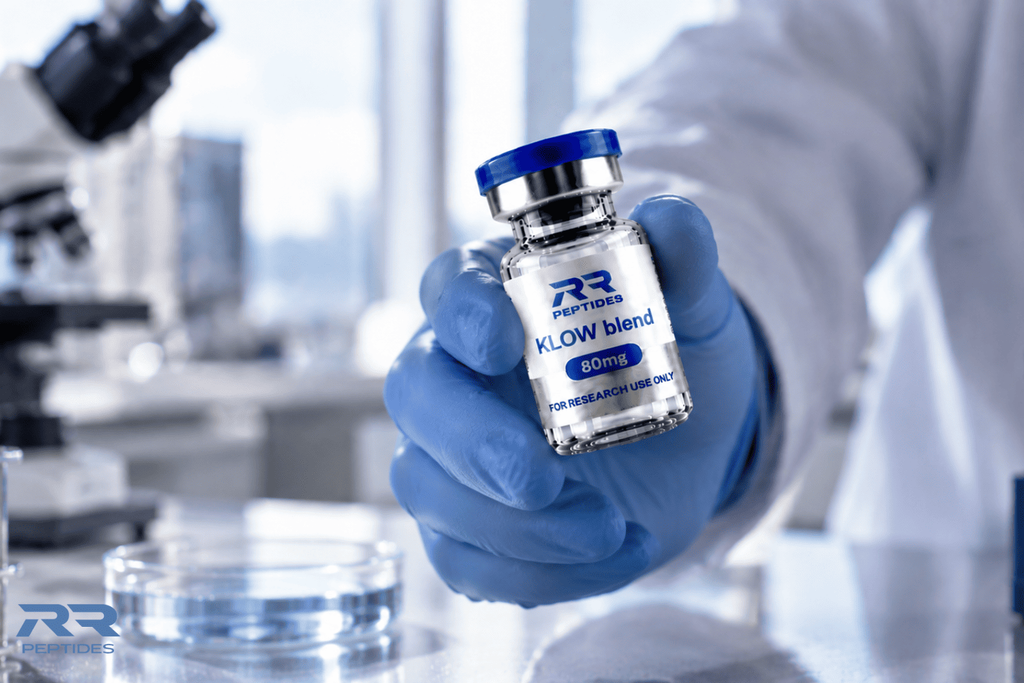
Explore research composition and quality with KLOW 80mg.
Peptides Commonly Listed in the KLOW Formula
KLOW blend composition can vary between documented formulations, so researchers should verify the specific product information before comparing ingredient profiles. Different suppliers may define their own formulations, so researchers should evaluate the exact product specification rather than rely on a generic ingredient list.
When researching KLOW blend composition, the first step is to identify the product and its declared components. If individual quantities are provided, those values can then be used to determine the stated mass ratio or other quantitative relationship.
When documenting KLOW blend composition, a useful composition record can include:
Component Information
What Researchers Should Verify
Peptide identity
Full name or accepted identifier
Sequence
Available sequence information, where relevant
Molecular weight
Expected molecular mass
Declared amount
Amount per vial or defined unit
Ratio
Mass or molar basis
Purity
Stated analytical purity
Lot number
Specific production batch
Test documentation
COA or laboratory report
Why Peptide Identity Matters
Clear identification of each component is essential when documenting KLOW blend composition, particularly when abbreviations or commercial names may create ambiguity.
Where appropriate, researchers can use additional identifiers such as amino-acid sequence, molecular weight, molecular formula, or other structural information to distinguish one peptide from another.
This becomes particularly important when assessing KLOW blend composition because several chemically distinct components may be present within the same sample. The analytical method needs a clearly defined target for each compound.
When Individual Quantities Are Not Disclosed
If a supplier identifies the peptides but does not disclose the amount of each component, the exact ratio cannot be calculated from the ingredient list alone.
In that situation, the correct description is that the individual ratio is not publicly specified.
Researchers should avoid using estimated percentages from another supplier or website to define KLOW blend composition when individual quantities have not been disclosed. Doing so could incorrectly present one formulation as the standard KLOW blend composition.
When comparing products, researchers should also record whether quantities are stated per vial, per unit of total material, per volume, or under another defined basis. These measurements cannot always be compared directly without appropriate conversion.
How Component Ratios Are Documented
Understanding KLOW blend composition also requires examining how individual components are distributed within the multi-peptide formulation. However, the word “ratio” can refer to different measurements, particularly mass ratio and molar ratio.
For example, a hypothetical formulation containing 2 mg of peptide A, 3 mg of peptide B, and 5 mg of peptide C has a mass ratio of 2:3:5.
The same formulation can be expressed as:
Peptide A: 20%
Peptide B: 30%
Peptide C: 50%
These percentages are based on mass. They should not automatically be interpreted as molar percentages because peptides can have different molecular weights.
Mass Ratio
A mass ratio compares the weight of each peptide.
This is often a straightforward way to document a formulation because the quantities can be reported directly in milligrams or another mass unit.
For KLOW blend composition, researchers should confirm whether the supplier’s stated amounts represent peptide mass or another measurement.
Molar Ratio
A molar ratio compares the number of molecules rather than their weight.
Because different peptides have different molecular weights, converting a mass-based formulation into molar quantities can change the relative proportions.
This distinction becomes important when researchers compare formulations or design experiments in which molecular concentration is the relevant variable.
How Ratios Should Be Reported
Field
Example
Component
Peptide A
Declared amount
2 mg
Total blend
10 mg
Mass percentage
20%
Ratio basis
Mass
Lot
Specific batch number
The values above are illustrative and do not represent a confirmed KLOW formulation.
A well-documented KLOW blend composition should make the ratio basis explicit. Without this information, apparently similar percentages may not be directly comparable.
Researchers should also distinguish between the nominal ratio stated by a supplier and a ratio calculated from measured analytical results. The first describes the intended formulation, while the second describes what was detected or quantified in a particular sample. Keeping these two concepts separate makes technical reporting more precise.
What Ingredient Order Does Not Tell You
The order of ingredients on a product page or label does not necessarily indicate their concentration.
The position of an ingredient on a label does not define KLOW blend composition or indicate that it is present at the highest concentration. Researchers should use disclosed quantities or analytical measurements rather than infer a ratio from presentation order.
Composition Considerations in Multi-Peptide Research
Multi-peptide blends require careful interpretation because individual peptides can differ in molecular weight, solubility, charge, hydrophobicity, and stability.
These differences are important when evaluating KLOW blend composition, as they can influence sample preparation, storage, chromatographic separation, and analytical measurement.
For this reason, KLOW blend composition should be evaluated separately from general product claims or a single reported purity percentage.
Composition and Purity Are Different
Composition answers:
What components are present, and in what amounts or ratios?
Purity answers:
How much of a measured material corresponds to the intended analyte under a defined analytical method?
These are related but different measurements.
A reported purity percentage does not automatically describe the complete formulation of a multi-peptide blend. It may refer to a specific analyte measured using a specific analytical method.
Researchers should therefore avoid using a single purity value as proof of the entire composition.
Stability and Degradation
Peptide samples can change during storage and handling. Temperature, moisture, repeated temperature changes, and preparation conditions may influence sample stability.
When analytical results differ from the expected specification, researchers should consider both the material and its storage history.
Useful records can include:
Product name
Lot number
Date received
Storage conditions
Preparation date
Preparation method
Date of analysis
These details provide useful context when investigating unexpected analytical results.
Batch-to-Batch Consistency
Comparing KLOW blend composition across production batches can help researchers evaluate whether the documented formulation remains consistent over time. Lot-level documentation allows researchers to determine whether material used in one experiment is consistent with material used in another.
For KLOW blend composition, the lot number connects the physical sample to its production batch and associated documentation.
Researchers comparing several batches should assess each lot against its own specification before comparing results between batches. This approach provides a clearer picture of material consistency and reduces the risk of attributing batch differences to the experimental system itself.
A useful quality-review approach is to examine three levels separately: the declared formulation, the batch documentation, and the analytical findings. Agreement across these levels provides stronger evidence than any one document alone. If the results do not align, researchers can then determine whether the difference may be related to sampling, storage, analytical uncertainty, or the material itself.
Explore research composition and quality with KLOW 80mg.
How Laboratory Testing Confirms Blend Composition
Laboratory testing can provide evidence that supports the declared KLOW blend composition and helps researchers assess whether the documented formulation is consistent with analytical findings.
Chromatography and mass spectrometry are commonly considered when evaluating peptide identity, purity, and composition. The appropriate analytical approach depends on the specific research question and the characteristics of the compounds being tested.
HPLC and UPLC
High-performance liquid chromatography (HPLC) and ultra-high-performance liquid chromatography (UPLC) separate compounds according to their interactions with the chromatographic system.
For peptide analysis, these techniques can help:
Separate different components
Assess chromatographic purity
Identify additional peaks
Compare analytical profiles between batches
However, a matching retention time alone may not provide definitive molecular identification. Additional analytical evidence may be appropriate when compounds have similar chromatographic behavior.
LC-MS
Liquid chromatography–mass spectrometry (LC-MS) combines chromatographic separation with mass-based detection.
For KLOW blend composition, LC-MS can provide additional evidence that an observed chromatographic component corresponds to the expected molecular characteristics of a target peptide.
Mass information should still be interpreted carefully. Related compounds or degradation products can complicate interpretation, while quantitative accuracy depends on calibration, matrix effects, ionization behavior, and method performance.
Using complementary analytical evidence can therefore provide a stronger assessment than relying on one measurement alone.
A Practical Verification Process
A straightforward verification workflow can include:
Identify the exact product and lot number.
Record all declared peptide components.
Record the stated quantities and ratio basis.
Review the applicable COA or laboratory report.
Select an analytical method appropriate to the research objective.
Compare analytical findings with the declared specification.
Investigate significant discrepancies.
For multi-component samples, researchers should also determine whether the selected method can adequately distinguish all relevant components. A method that performs well for a single peptide may not automatically provide sufficient separation or quantification when several peptides are present together.
The final interpretation should consider the limitations of the method. A test result is meaningful only within the scope of what the method was designed and validated or qualified to measure. This is particularly important when a blend contains multiple chemically distinct peptides and the objective is to quantify each component separately.
Understanding a COA
A Certificate of Analysis is most useful when it is connected to the exact batch being evaluated.
Researchers should check:
Product identification
Lot number
Test date
Analytical method
Reported result
Acceptance specification
Testing laboratory, where provided
Without clear batch identification, a generic certificate provides limited evidence for confirming the specific KLOW blend composition of the material received.
A COA should also be interpreted only within the scope of the tests it reports. If it provides a general purity result but does not individually identify every component, it may not establish the complete KLOW blend composition.
Not necessarily. The name alone does not establish a universal formulation. Researchers should refer to the exact supplier specification and batch documentation.
What information defines a peptide blend?
A reliable description of KLOW blend composition should identify the individual components, their quantities or concentrations, the ratio basis, and relevant batch information.
How Are Peptide Ratios Calculated?
Ratios can be expressed by mass or by molar quantity. The calculation method should always be stated because different peptide molecular weights can produce different mass and molar ratios.
Can Ingredient Order Be Used to Determine Concentration?
No. Ingredient order does not reliably indicate quantity unless the manufacturer explicitly defines it as a quantitative ordering system.
Does Purity Equal Composition?
No. Purity describes the measured quality of a specified analyte under a particular analytical method. Composition describes the components and their relative amounts.
Can HPLC Verify a Peptide Blend?
HPLC or UPLC can provide useful chromatographic information, including separation and purity assessment. However, retention time alone may not be sufficient for definitive molecular identification.
Why Is LC-MS Useful?
LC-MS adds mass-based information to chromatographic separation. It can provide additional evidence for identifying peptide components in a multi-component sample.
What Does a COA Confirm?
A COA confirms only the information and tests it actually reports. A batch-specific COA with individual analytical results provides stronger evidence than a generic document.
Why Does the Lot Number Matter?
The lot number connects the physical sample to a particular production batch and its associated documentation. This is important for traceability and reproducibility.
Can an Online Article Provide the Exact Formulation?
Only when the article is based on reliable, current documentation. A generic online formula should not automatically be assumed to represent every product using the same blend name.
What Should Canadian Researchers Consider?
Researchers in Canada should distinguish research materials from products authorized for therapeutic use and follow applicable institutional, laboratory, and regulatory requirements. Current Canadian guidance should be consulted for the specific research context.
What Is the Best Way to Verify a Blend?
The strongest approach combines a clear product specification, batch-specific documentation, and analytical testing appropriate to the question being investigated.
Final Thoughts
KLOW blend composition should be evaluated through documented evidence rather than assumptions based on a product name.
The essential information is straightforward: identify the peptide components, determine how their quantities are reported, establish whether ratios are mass-based or molar, and connect the formulation to appropriate batch documentation.
Laboratory techniques such as HPLC, UPLC, and LC-MS can provide additional evidence of composition, purity, and identity. However, each method answers a different analytical question, so a single result should not automatically be interpreted as proof of every aspect of a blend.
Batch-level verification is also important. When researchers compare multiple lots, each batch should be assessed against its own specification and analytical record. Comparing the declared formulation with the COA and analytical findings provides a more complete quality picture and supports better research reproducibility.
For researchers in Canada, accurate documentation is particularly important when distinguishing research-oriented materials from therapeutically authorized products.
At RR Peptides, researchers can explore research-focused peptide materials and educational information related to composition, analytical quality, and batch verification. Review the latest product specifications and available documentation before selecting a material for laboratory research.
Disclaimer: All products and compounds discussed are intended strictly for laboratory and research purposes. This content is provided for educational and informational use and is not medical advice or guidance for human administration.
3 Comments
I found the breakdown of the KLOW Blend composition useful, particularly the focus on identifying the individual components. Understanding how a multi-component blend is structured provides important context when reviewing the research and available information surrounding it.
The detailed composition makes it easier to understand the research context behind the KLOW Blend. I appreciate the straightforward approach to discussing the individual ingredients, since each component can have its own research background and evidence base.
A clear composition breakdown is a useful starting point when evaluating any research blend containing multiple compounds. Knowing exactly which components are included makes it easier to explore their individual characteristics while keeping the broader research context in perspective.






I found the breakdown of the KLOW Blend composition useful, particularly the focus on identifying the individual components. Understanding how a multi-component blend is structured provides important context when reviewing the research and available information surrounding it.
The detailed composition makes it easier to understand the research context behind the KLOW Blend. I appreciate the straightforward approach to discussing the individual ingredients, since each component can have its own research background and evidence base.
A clear composition breakdown is a useful starting point when evaluating any research blend containing multiple compounds. Knowing exactly which components are included makes it easier to explore their individual characteristics while keeping the broader research context in perspective.