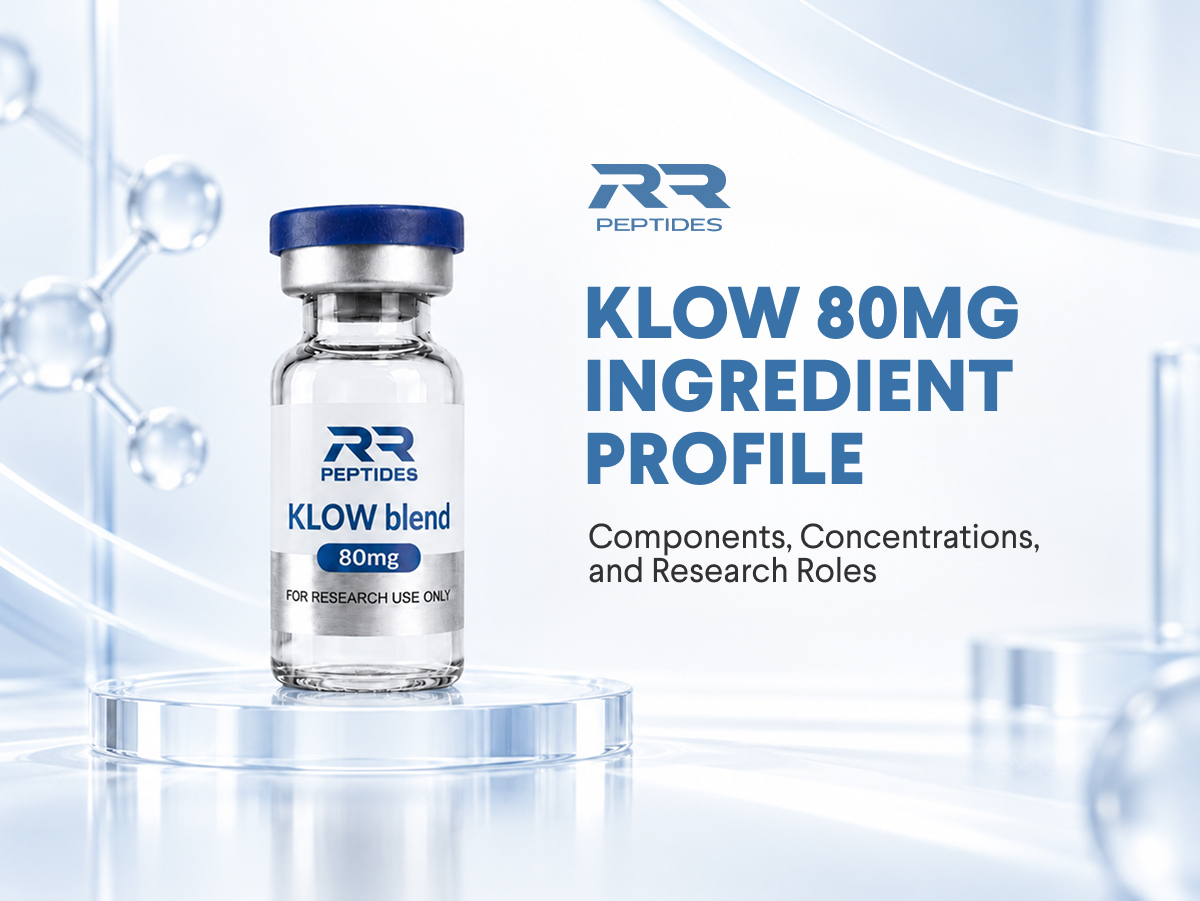
The KLOW 80mg ingredient profile describes a multi-peptide research formulation rather than a single peptide. It is commonly presented as a blend of GHK-Cu, BPC-157, TB-500, and KPV, with a frequently listed composition of 50 mg GHK-Cu and 10 mg each of BPC-157, TB-500, and KPV.
Understanding this formulation requires looking beyond the total 80 mg amount. Each component has a different molecular structure, concentration, and research background. The commonly listed 5:1:1:1 mass ratio also means that the four ingredients are not present in equal quantities.
For laboratory research, it is useful to distinguish between the stated formulation and analytical findings from a specific batch. A formulation specification describes the intended composition, while laboratory testing can provide information about the material that was actually analyzed.
This article provides a streamlined overview of the KLOW 80mg ingredient profile, including its composition, individual components, research areas, formulation relationships, and batch documentation.
Researchers looking for additional educational resources on peptide composition and laboratory characterization can explore RR Peptides for research-focused information.
Overview of the KLOW 80mg Ingredient Profile
The KLOW 80mg ingredient profile is commonly associated with four components: GHK-Cu, BPC-157, TB-500, and KPV. The commonly listed KLOW 80mg ingredient profile totals 80 mg.
Ingredient
Nominal Amount
Percentage of Total
General Research Area
GHK-Cu
50 mg
62.5%
Cellular signaling and extracellular matrix research
BPC-157
10 mg
12.5%
Preclinical cellular and tissue research
TB-500
10 mg
12.5%
Cytoskeletal and cell-migration research
KPV
10 mg
12.5%
Inflammatory and epithelial research
Total
80 mg
100%
Multi-peptide research formulation
The listed quantities create a 5:1:1:1 ratio by mass. GHK-Cu represents 62.5% of the total, while BPC-157, TB-500, and KPV each represent 12.5%.
This distribution describes the KLOW 80mg ingredient profile’s mass composition rather than the biological importance of each component. A larger mass contribution does not automatically mean that a compound has a greater influence in an experimental system.
Explore research composition and quality with KLOW 80mg.
Individual Components in the KLOW Blend
The four components differ in structure and research history. These differences are important when interpreting the KLOW 80mg ingredient profile.
Ingredient
Molecular Description
Amount
Main Research Context
GHK-Cu
Copper-associated tripeptide
50 mg
Cellular signaling and extracellular matrix
BPC-157
Synthetic pentadecapeptide
10 mg
Preclinical cellular and tissue models
TB-500
Thymosin beta-related research material
10 mg
Cytoskeletal and cell-migration research
KPV
Short tripeptide
10 mg
Inflammatory and epithelial models
Equal mass does not mean equal molecular quantity or equivalent research characteristics.
GHK-Cu
GHK-Cu is a copper-associated form of glycyl-L-histidyl-L-lysine. It represents the largest portion of the commonly listed KLOW 80mg ingredient profile.
Research involving GHK-Cu has examined cellular signaling, extracellular matrix biology, fibroblast-related models, collagen-associated processes, and peptide-copper interactions.
The 50 mg amount makes GHK-Cu the dominant component by mass. However, this does not establish that it determines the behavior of the complete formulation.
Researchers examining the KLOW 80mg ingredient profile should distinguish the documented amount of GHK-Cu from conclusions about the biological behavior of the blend.
BPC-157
BPC-157 is a synthetic pentadecapeptide that has been studied mainly in preclinical research.
Experimental studies have examined BPC-157 in areas including cellular responses, vascular models, gastrointestinal systems, and tissue-related research.
The available evidence should be interpreted according to the experimental model. Findings from cellular or animal studies should not automatically be presented as established human outcomes.
Within the KLOW 80mg ingredient profile, BPC-157 is commonly listed at 10 mg. Its identity and amount should be recorded independently when characterizing the material.
TB-500
TB-500 is commonly described in research-product contexts as a thymosin beta-related material. Research associated with thymosin beta biology has examined actin organization, cytoskeletal processes, cellular movement, and migration.
Commercial terminology can vary between materials, making analytical identity information particularly relevant when comparing samples.
TB-500 is commonly listed at 10 mg in the KLOW 80mg ingredient profile. Although this is the same nominal mass as BPC-157 and KPV, the compounds have different molecular characteristics.
KPV
KPV is a short tripeptide consisting of lysine, proline, and valine. It corresponds to the C-terminal sequence of alpha-melanocyte-stimulating hormone.
Research has investigated KPV in experimental inflammatory and epithelial models, including studies examining cellular signaling and inflammatory responses.
KPV is commonly listed at 10 mg in the KLOW 80mg ingredient profile. Its equal mass compared with BPC-157 and TB-500 should not be interpreted as equal molecular concentration.
Research Pathways Associated with Each Ingredient
The KLOW 80mg ingredient profile represents several different areas of laboratory research rather than one established biological pathway.
The major research areas associated with the individual components include:
Cellular signaling
Extracellular matrix biology
Peptide-copper interactions
Preclinical tissue research
Cytoskeletal organization
Cell migration
Inflammatory signaling
Epithelial biology
GHK-Cu research
Research involving GHK-Cu has explored extracellular matrix processes and cellular signaling. Experimental models have included fibroblast-related systems and collagen-associated biology.
These findings provide background for studying GHK-Cu independently. They do not establish how the compound behaves when combined with BPC-157, TB-500, and KPV.
BPC-157 research
BPC-157 has been investigated across multiple preclinical systems. Its research background includes cellular, vascular, gastrointestinal, and tissue-related models.
This literature can provide a basis for experimental questions, but the type of evidence remains important. Preclinical observations should not automatically be extended to human outcomes.
TB-500 research
Research involving thymosin beta-related biology has examined cytoskeletal organization, actin dynamics, and cellular movement.
These areas can be relevant to laboratory models investigating cell migration and structural changes. However, research involving thymosin beta biology should be distinguished from direct evidence concerning a particular TB-500 material.
How the Ingredients May Complement One Another
The term “complement” should be treated cautiously in a research context. The components cover different areas of investigation, but their presence in one formulation does not demonstrate synergy.
Component
Primary Research Area
Related Research Context
GHK-Cu
Extracellular matrix biology
Cellular signaling
BPC-157
Preclinical cellular and tissue models
Cellular responses
TB-500
Cytoskeletal processes
Cell migration
KPV
Inflammatory and epithelial models
Cellular signaling
The relationships shown above represent areas of conceptual overlap rather than a confirmed combined mechanism.
Individual peptide versus complete formulation
A study involving an isolated peptide answers a different research question from a study involving the complete KLOW 80mg ingredient profile.
For example, an experiment using GHK-Cu alone evaluates that compound under defined conditions. An experiment using the complete blend evaluates GHK-Cu together with BPC-157, TB-500, and KPV.
Consequently, findings from an isolated peptide study cannot automatically be used to explain the complete formulation.
Fixed-ratio considerations
The KLOW 80mg ingredient profile follows a commonly listed 50:10:10:10 mg distribution.
Changing the total amount of a fixed-ratio formulation changes all four components simultaneously. Researchers cannot independently increase one ingredient simply by adjusting the total blend.
This characteristic may be useful when the formulation itself is the research variable. Component-specific questions may instead require individual materials or suitable comparison groups.
Mass ratio versus molar ratio
The 5:1:1:1 relationship represents mass rather than molar concentration.
Because the four components have different molecular weights, equal milligram quantities do not contain equal numbers of molecules.
For quantitative work involving the KLOW 80mg ingredient profile, researchers should therefore specify whether concentrations are reported by mass, molarity, or another analytical basis.
Explore research composition and quality with KLOW 80mg.
Reviewing Ingredient Information and Batch Records
A reliable assessment of the KLOW 80mg ingredient profile should combine formulation information with batch-specific analytical documentation.
Researchers should review:
Formulation name
Individual peptide components
Nominal amount of each ingredient
Total formulation amount
Batch or lot number
Testing laboratory
Analytical methods
Testing date
Identity results
Purity information
Quantitative results, when available
Quality Check
What to Review
Research Value
Ingredient identity
Listed peptide names
Confirms expected components
Composition
Amount of each ingredient
Defines the intended formulation
Batch number
Lot identifier
Links results to a specific batch
Identity testing
Appropriate analytical methods
Supports molecular identification
Purity testing
HPLC, UPLC, or relevant method
Provides chromatographic information
Quantitative analysis
Measured content
Enables comparison with nominal values
Laboratory information
Testing organization
Improves traceability
Testing date
Date of analysis
Provides analytical context
Checking the stated composition
A basic consistency check is:
50 mg + 10 mg + 10 mg + 10 mg = 80 mg
This confirms that the listed amounts correspond with the stated total. It does not independently verify the contents of a particular batch.
Analytical testing is required to provide information about what was measured in a specific sample.
Matching batch information
The batch number connects laboratory results with a specific production lot.
Researchers should verify that the identifier on the analytical documentation corresponds with the material being evaluated. Documentation from another batch may demonstrate that testing occurred but does not necessarily characterize the current sample.
Identity and purity testing
Different analytical methods answer different questions.
HPLC or UPLC can provide chromatographic separation and purity-related information. Mass spectrometry can support molecular identity assessment. Quantitative methods may provide measured content when appropriately designed.
These techniques should not be treated as interchangeable because their analytical purposes differ.
Interpreting purity results
A reported purity percentage should always be considered alongside the method used to obtain it.
Researchers should determine whether the value refers to a particular peptide, chromatographic peak, overall analytical profile, or another defined measurement.
For a multi-component material, one overall purity value may not fully describe the identity and quantity of every individual ingredient.
Additional Considerations for Research Documentation
Good documentation is particularly important when several research compounds are present in one formulation.
Researchers should use consistent terminology for ingredient names, units, batch numbers, and analytical methods throughout their records. This makes comparisons between experiments easier and reduces ambiguity.
Sample preparation and testing conditions can also provide useful context. Recording the testing date, analytical technique, sample history, and relevant laboratory information can help researchers understand why results may differ between analyses.
When comparing batches, researchers should not assume that materials are identical simply because they have the same product name. Batch-specific analytical information provides a more reliable basis for comparison.
A structured record can connect:
Formulation → Batch → Analytical Method → Laboratory Result → Research Sample
This documentation chain makes it easier to trace experimental observations back to the material that was actually studied.
For laboratory teams, documenting the KLOW 80mg ingredient profile consistently can improve comparison across research sessions. Records should identify the formulation, batch number, stated quantities, analytical methods, and testing dates in a standardized format. Researchers may also record deviations between nominal and measured values when such data are available. Keeping these details together helps separate formulation specifications from observations generated during analysis.
Consistent documentation also helps researchers compare findings across different experiments. When recording the KLOW 80mg ingredient profile, details such as ingredient names, nominal concentrations, batch numbers, and analytical results should follow the same format throughout the research record.
Researchers can also note any differences between expected and measured values instead of combining them into a single figure. This approach creates a clearer distinction between formulation specifications and laboratory observations.
Over time, standardized records can make it easier to identify batch differences, review previous experiments, and determine whether changes in results may relate to the research material or experimental conditions.
Canadian Research Considerations
Canadian researchers should distinguish laboratory research materials from products authorized for human use.
Health Canada has issued warnings concerning unauthorized peptide products and has discussed substances including BPC-157, GHK-Cu, KPV, and TB-500 in its regulatory communications.
For this reason, the KLOW 80mg ingredient profile should be discussed in terms of composition, analytical characterization, and laboratory research rather than therapeutic approval or clinical efficacy.
A research designation does not independently establish regulatory authorization, safety, or effectiveness in humans.
The KLOW 80mg ingredient profile commonly refers to a four-component research formulation containing GHK-Cu, BPC-157, TB-500, and KPV.
What is the commonly listed composition?
The commonly referenced formulation contains 50 mg GHK-Cu, 10 mg BPC-157, 10 mg TB-500, and 10 mg KPV.
Which ingredient represents the largest portion?
GHK-Cu represents the largest nominal amount at 50 mg, or 62.5% of the listed formulation.
Are BPC-157, TB-500, and KPV present at equal amounts?
They are commonly listed at 10 mg each. Equal mass does not mean equal molecular quantity because their molecular weights differ.
What does the 5:1:1:1 ratio mean?
It represents the relative mass of the four components. It is not a molar ratio.
Does the higher GHK-Cu amount establish greater biological importance?
No. The amount of a compound by mass does not determine its biological influence in an experimental model.
Does research on individual peptides describe the complete blend?
Not necessarily. Research involving an isolated compound provides information about that compound under specific conditions. Direct blend research is needed to characterize the complete formulation.
Can one ingredient be changed independently?
Not by simply changing the total amount of a fixed-ratio blend. Adjusting the total changes all four components according to the formulation.
Why is molecular weight important?
Different molecular weights mean that equal masses contain different numbers of molecules. This distinction matters when comparing mass-based and molar concentrations.
How can researchers evaluate a batch?
Researchers can compare the stated formulation with batch-specific documentation and review identity, purity, quantitative results, analytical methods, and batch information.
What does HPLC contribute?
HPLC can provide chromatographic separation and purity-related information. It does not independently answer every identity or quantity question.
What does mass spectrometry contribute?
Mass spectrometry can provide molecular information that supports identity assessment. It should be interpreted alongside complementary analytical data.
Why is the batch number important?
The batch number connects analytical results with a particular production lot and improves traceability.
Does a COA guarantee complete quality?
No. A COA reports specific tests and results. Researchers should review the methods, laboratory information, batch identifier, and analytical scope.
Is KLOW approved for human use in Canada?
Research materials should not be represented as approved therapeutic products. Canadian regulatory requirements concerning unauthorized peptide products are separate from laboratory research characterization.
Final Thoughts
The KLOW 80mg ingredient profile commonly describes a formulation containing GHK-Cu, BPC-157, TB-500, and KPV. The frequently listed composition is 50 mg GHK-Cu and 10 mg each of BPC-157, TB-500, and KPV, creating an 80 mg nominal total. The 5:1:1:1 mass ratio defines the formulation structure but does not indicate the relative biological importance of each component.
Each ingredient has a different research background. GHK-Cu is associated with cellular signaling and extracellular matrix research, BPC-157 with preclinical models, TB-500 with thymosin beta-related cellular research, and KPV with inflammatory and epithelial models. These individual findings should not automatically be treated as evidence for the complete KLOW 80mg ingredient profile.
Researchers should evaluate the KLOW 80mg ingredient profile as its own research material when studying the combined formulation. Batch-specific documentation can provide additional information about identity, purity, quantitative results, analytical methods, and lot traceability, helping distinguish stated formulation data from measured findings.
For Canadian research settings, laboratory characterization should remain distinct from therapeutic authorization. A research formulation should be evaluated according to its documented composition and available analytical evidence without making unsupported clinical claims. RR Peptides provides research-focused information on peptide composition, testing, and laboratory documentation.
Disclaimer: All products and compounds discussed are intended strictly for laboratory and research purposes. This content is provided for educational and informational use and is not medical advice or guidance for human administration.
3 Comments
I found this ingredient profile useful for getting a clearer picture of what makes up the KLOW 80mg blend. Looking at each component individually provides helpful context when trying to understand the research background and proposed roles of the ingredients.
The breakdown of the individual ingredients makes the KLOW 80mg profile much easier to follow. I appreciate the research-focused presentation, especially the emphasis on understanding each component rather than making assumptions about the blend as a whole.
A detailed ingredient profile is a useful starting point for understanding any multi-component research blend. I liked the straightforward approach here, as knowing the individual components makes it easier to explore their separate research backgrounds and the evidence available for each one.





I found this ingredient profile useful for getting a clearer picture of what makes up the KLOW 80mg blend. Looking at each component individually provides helpful context when trying to understand the research background and proposed roles of the ingredients.
The breakdown of the individual ingredients makes the KLOW 80mg profile much easier to follow. I appreciate the research-focused presentation, especially the emphasis on understanding each component rather than making assumptions about the blend as a whole.
A detailed ingredient profile is a useful starting point for understanding any multi-component research blend. I liked the straightforward approach here, as knowing the individual components makes it easier to explore their separate research backgrounds and the evidence available for each one.