HPLC peptide purity testing is one of the most widely used analytical approaches for evaluating the relative purity of synthetic peptide samples. High-performance liquid chromatography (HPLC) separates components within a sample, allowing researchers to examine the principal peptide-related peak alongside other detectable components.
However, an HPLC purity percentage does not provide a complete picture of peptide quality or identity. Chromatography primarily evaluates separation and detector response under defined analytical conditions. Therefore, researchers often use complementary techniques, particularly mass spectrometry (MS), to obtain additional evidence about molecular identity.
For researchers evaluating peptide quality and laboratory documentation, explore RR Peptides for additional research-focused information and resources.
What Is HPLC Peptide Purity Testing?
HPLC peptide purity testing is an analytical process used to separate components within a peptide sample and estimate the relative proportion represented by the principal chromatographic peak.
Synthetic peptide production can generate the intended sequence alongside related substances. Depending on synthesis, purification, handling, and storage conditions, a sample may contain truncated sequences, deletion products, modified peptide species, degradation products, or other detectable components.
HPLC helps researchers distinguish these components because different molecules interact differently with the chromatographic system. For peptide analysis, reversed-phase HPLC (RP-HPLC) is commonly used because it can separate peptide-related components according to differences in their interactions with the stationary and mobile phases.
What Does HPLC Actually Measure?
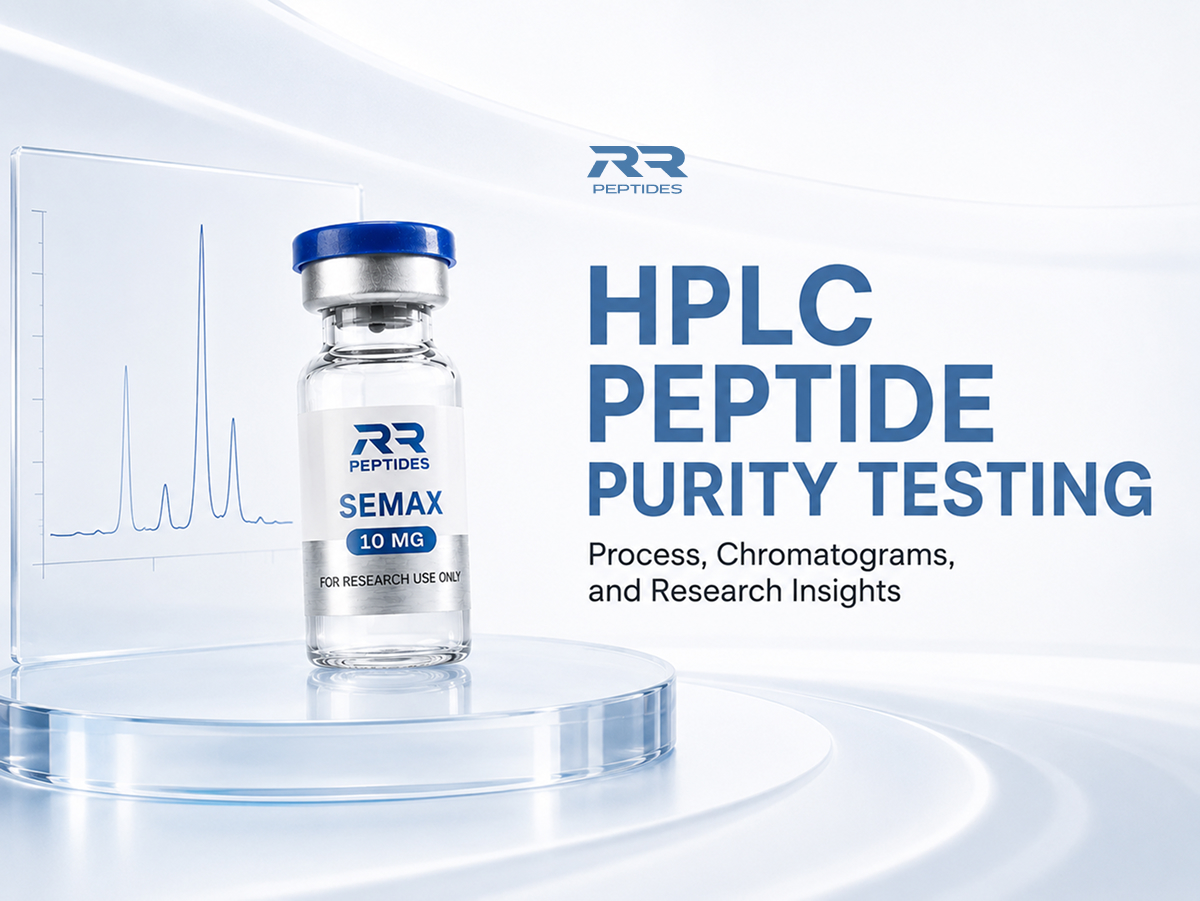
HPLC separates detectable sample components and records them as peaks on a chromatogram. Researchers can integrate these peaks to estimate the relative contribution of the principal component.
A simplified calculation is:
Relative main peak area (%) = Main peak area ÷ Total relevant integrated peak area × 100
For example, if the principal peak represents 98% of the relevant integrated detector response, a laboratory may report approximately 98% HPLC purity.
However, this percentage remains method-dependent. It does not necessarily mean that 98% of everything physically present in the sample is the intended peptide by mass.
Purity and Identity Are Different
This distinction is essential when interpreting HPLC peptide purity testing.
HPLC can demonstrate that one chromatographic component dominates a sample. Nevertheless, the largest peak does not independently prove that the component has the expected molecular identity.
Mass spectrometry provides complementary information by examining mass-to-charge characteristics and determining whether the observed molecular information is consistent with the expected peptide.
Researchers should therefore distinguish between two questions:
Purity: How much of the relevant chromatographic response corresponds to the principal component?
Identity: Is that component consistent with the expected peptide?
Strong analytical documentation addresses both questions rather than treating a high HPLC percentage as proof of overall peptide quality.
Explore quality research peptides in Canada at RR Peptides
How HPLC Separates Peptide Components
Understanding HPLC peptide purity testing requires a basic understanding of chromatographic separation.
First, researchers prepare the peptide sample using a solvent system suitable for both the peptide and analytical method. The HPLC system injects an aliquot and carries it through a column using a liquid mobile phase.
Inside the column is a stationary phase. Sample components interact differently with the stationary and mobile phases, causing them to travel through the system at different rates.
As separated components exit the column, a detector records their responses and produces a chromatogram.
Reversed-Phase HPLC
In HPLC peptide purity testing, RP-HPLC is commonly used to separate peptide-related components for analytical evaluation. In this approach, peptide components interact with a relatively hydrophobic stationary phase while the mobile-phase composition changes during the analytical run.
A gradient typically increases the proportion of organic solvent over time. Because different components interact differently with the chromatographic system, they can leave the column at different times.
Column chemistry, mobile-phase composition, gradient conditions, flow rate, temperature, and sample concentration can all affect separation. Therefore, chromatograms produced by different laboratories may not look identical even when similar peptide samples are analyzed.
Why Chromatographic Resolution Matters
The goal of chromatography is not simply to produce several peaks. An effective analytical method should sufficiently separate the principal peptide component from relevant detectable impurities.
When two components leave the column at similar times, their peaks may overlap. Poor resolution can make integration more difficult and potentially influence the calculated purity value.
Therefore, method suitability and chromatographic resolution are important for obtaining reliable HPLC peptide purity testing results. Analytical principles used in Canada similarly emphasize characteristics such as specificity, accuracy, precision, range, robustness, and system suitability when appropriate.
Understanding Retention Time and Peak Area
Two concepts frequently appear in HPLC peptide purity testing reports: retention time and peak area. Although related, they provide different information.
What Is Retention Time?
Retention time describes how long a component takes to pass through the chromatographic system and reach the detector after injection.
For example, if the principal component appears at 12.4 minutes, its retention time under that analytical method is approximately 12.4 minutes.
In HPLC peptide purity testing, retention time helps researchers compare chromatographic behaviour between samples and analytical runs. However, it depends heavily on the method.
Changes in column chemistry, mobile-phase composition, temperature, flow rate, or gradient conditions can shift retention times. Therefore, retention time alone should not be considered definitive evidence of peptide identity.
What Is Peak Area?
Peak area represents the integrated detector response associated with a chromatographic component.
For relative purity calculations, laboratories may compare the principal peak area with the total area of relevant integrated peaks.
For example:
Component
Relative Peak Area
Main peak
98.4%
Related peak A
0.8%
Related peak B
0.5%
Related peak C
0.3%
In this simplified example, the main component accounts for 98.4% of the relevant chromatographic response.
It is therefore more accurate to describe the result as approximately 98.4% HPLC area purity under the specified analytical conditions rather than assuming 98.4% absolute chemical purity by mass.
Why Peak Integration Matters
Chromatography software typically calculates peak areas, but integration parameters can influence the result.
Very small signals may fall below integration or reporting thresholds. In addition, baseline disturbances, overlapping peaks, solvent-related signals, and other analytical factors can complicate interpretation.
Researchers should therefore evaluate HPLC peptide purity testing results alongside the chromatogram and method information rather than relying only on the final percentage.
Explore quality research peptides in Canada at RR Peptides
How to Read a Peptide HPLC Chromatogram
Researchers can interpret an HPLC peptide purity testing chromatogram more effectively by examining several key features.
Start With the Chromatogram
The horizontal axis normally represents retention time, while the vertical axis represents detector response. Peaks appear as detectable components leave the chromatographic column.
Next, identify the principal peak. In a relatively high-purity sample, one peak may account for most of the integrated response.
However, researchers should evaluate peak area rather than visual peak height when interpreting relative purity.
Examine Minor Peaks
Minor peaks provide information about sample complexity.
They may represent peptide-related impurities, modified sequences, degradation products, or other detectable components. However, HPLC alone may not reveal the exact identity of every minor peak.
When identifying a particular impurity matters to the research question, researchers may need additional analytical techniques.
Review the Reported Purity
If a report lists an HPLC purity percentage, researchers should determine how the laboratory calculated it.
Important factors include whether the result uses area normalization, which peaks were included or excluded, the detection conditions, and whether the analysis corresponds to the specific batch.
A percentage without sufficient analytical context provides less information than a result supported by method and chromatographic data.
Connect Results to the Batch
A chromatogram becomes more useful when researchers can connect it to the actual material being evaluated.
Documentation may include a batch or lot number, sample identification, analysis date, reported purity, analytical method, and complementary identity information.
This traceability helps establish that the analytical result relates to the specific research material rather than a generic representative sample.
Compare HPLC With Mass Spectrometry
Researchers should also determine whether complementary identity testing is available.
HPLC provides information about chromatographic purity, while mass spectrometry provides evidence about molecular identity.
For example, HPLC may show that one component represents 99% of the relevant detector response. Mass spectrometry can then help determine whether the molecular characteristics of that material are consistent with the expected peptide.
Together, these techniques provide more meaningful analytical evidence than either result interpreted alone.
Why Baseline Quality Matters
The chromatographic baseline is another important factor when interpreting HPLC peptide purity testing results. Ideally, the baseline should remain sufficiently stable for researchers and analytical software to distinguish genuine peaks from background detector fluctuations.
Mobile-phase composition, solvent quality, temperature changes, detector conditions, column performance, and system equilibration can influence baseline behaviour. Excessive noise or baseline drift may make small peaks more difficult to identify and integrate.
This becomes particularly important when minor components represent only a small proportion of the total detector response. A stable baseline and appropriate peak separation provide stronger analytical context than a purity percentage presented alone.
How Sample Preparation Can Influence HPLC Results
Sample preparation can significantly influence the reliability of HPLC peptide purity testing. Before injection, researchers must prepare the peptide under conditions compatible with both the sample and chromatographic method.
Incomplete dissolution, inappropriate solvent selection, excessive sample concentration, or degradation during preparation can affect the resulting chromatogram.
Solubility is particularly important. If the peptide does not dissolve completely, the injected solution may not accurately represent the original sample. Particulate material can also interfere with the analytical system or affect column performance.
Sample concentration requires similar attention. An excessively concentrated solution may overload the column or detector, potentially changing peak shape and separation. Conversely, very low concentrations may make minor components more difficult to detect.
Researchers should also consider sample stability between preparation and analysis. Depending on the peptide and conditions, factors such as temperature, oxidation, light exposure, hydrolysis, and extended storage in solution may alter the sample before testing.
Therefore, reliable results depend not only on the HPLC instrument but also on appropriate sample handling and preparation.
Limitations of HPLC Purity Analysis
Despite its usefulness, HPLC peptide purity testing has important limitations. Understanding these limitations prevents researchers from assigning more meaning to a purity percentage than the method can support.
What HPLC Cannot Establish Alone
HPLC does not independently confirm that the principal peak is the intended peptide. In addition, chromatographic area percentage should not automatically be treated as exact mass percentage.
Some substances may respond weakly to the detector, co-elute with other components, or fall below detection thresholds.
Consequently, complementary methods such as mass spectrometry may be needed to strengthen peptide identity and characterization data.
Co-Elution Can Affect Results
Two substances may elute at similar times and appear as one incompletely resolved peak.
If an impurity co-elutes with the intended peptide, simple area normalization may not clearly distinguish the two components. Therefore, chromatographic specificity and resolution are important for reliable purity analysis.
HPLC Does Not Replace Other Quality Tests
Depending on the research material and analytical objective, researchers may require additional testing for molecular identity, water content, residual solvents, counterions, elemental impurities, or other attributes.
No single analytical method provides every piece of quality information. Researchers should therefore view HPLC as one component of a broader analytical characterization strategy.
A COA Requires Context
A Certificate of Analysis (COA) can summarize useful information, but the presence of a COA alone does not establish analytical quality.
Researchers should look for batch-specific identification, analytical methods, actual test results, and supporting chromatograms or spectra where available.
A reported purity percentage becomes considerably more informative when researchers can examine the analytical evidence supporting it.
HPLC Peptide Testing in the Canadian Research Context
For Canadian researchers, analytical testing and regulatory authorization should remain separate concepts.
An HPLC chromatogram or high purity percentage does not establish that a peptide is authorized as a drug, safe for human use, or approved for therapeutic purposes.
Health Canada distinguishes laboratory analytical information from regulatory authorization. In addition, Canadian implementation of ICH analytical guidance emphasizes developing and validating analytical procedures that are suitable for their intended purpose.
This distinction is particularly important when evaluating research materials. A laboratory result answers a specific analytical question: what did the analytical method detect under the conditions used?
It does not independently answer broader questions about clinical safety, therapeutic efficacy, or regulatory approval.
Therefore, Canadian researchers should interpret HPLC peptide purity testing according to the analytical evidence it actually provides rather than extending the result beyond its intended scope.
Why Method Quality Matters
A higher HPLC percentage is not automatically more informative if researchers know little about how the result was generated.
Reliable HPLC peptide purity testing depends on appropriate separation, resolution, detection, integration, sample preparation, and overall method suitability.
For example, a documented 98.5% result generated using an appropriate analytical method may provide more useful information than a claimed 99.9% result without a chromatogram, batch number, or method details.
Researchers should therefore evaluate the evidence behind the purity number rather than comparing samples solely according to percentages such as 98%, 99%, or 99.5%.
For more information about peptide testing, documentation, and research-focused products, explore RR Peptides.
HPLC peptide purity testing uses high-performance liquid chromatography to separate detectable components within a peptide sample. Researchers can compare the principal chromatographic peak with other integrated peaks to estimate relative purity under defined analytical conditions.
What does 99% HPLC peptide purity mean?
It generally means that the principal integrated peak represents approximately 99% of the relevant chromatographic detector response according to the analytical method. It should not automatically be interpreted as 99% absolute purity by mass.
Can HPLC confirm peptide identity?
HPLC provides useful chromatographic information but does not independently establish molecular identity. Researchers commonly use mass spectrometry as a complementary technique to evaluate whether molecular characteristics are consistent with the expected peptide.
What does retention time mean?
Retention time is the amount of time a component takes to travel through the chromatographic system and reach the detector. Because it depends on analytical conditions, it is not a universal value for a particular peptide.
What does HPLC peak area indicate?
Peak area represents the integrated detector response associated with a chromatographic component. Laboratories can compare the principal peak area with the total relevant integrated area when calculating relative purity.
Why can two HPLC chromatograms look different?
Different columns, mobile phases, gradients, flow rates, temperatures, sample conditions, and detector settings can change chromatographic behaviour. Therefore, two laboratories may generate different-looking chromatograms from similar materials.
Is the largest HPLC peak always the intended peptide?
Not necessarily. The largest peak represents the dominant detected chromatographic component. Complementary identity testing can help determine whether that component is consistent with the intended peptide.
Is HPLC enough to determine overall peptide quality?
No. HPLC provides valuable information about chromatographic purity, but researchers may need additional methods to evaluate identity and other quality attributes.
What should researchers look for on a peptide COA?
Useful documentation may include batch identification, analytical date, testing methods, purity results, chromatograms, mass spectra, and other batch-specific analytical information.
Final Thoughts
HPLC peptide purity testing is a valuable analytical method for separating peptide-related components and estimating the relative contribution of the principal chromatographic peak. Retention time, peak area, resolution, integration, baseline quality, and sample preparation all influence interpretation of the final result.
However, researchers should not treat a high HPLC percentage as a complete guarantee of peptide identity or overall quality. Chromatographic purity is method-dependent, some components may not be adequately separated or detected, and HPLC alone cannot definitively establish molecular identity.
Therefore, researchers should evaluate the chromatogram, analytical method, sample preparation, batch information, reported purity, and complementary identity data together rather than focusing exclusively on the highest percentage.
For additional research-focused peptide information and laboratory resources, explore RR Peptides.
Disclaimer: All products and compounds referenced are intended strictly for laboratory and research purposes only. This content is provided for informational and educational purposes and is not intended as medical advice or to diagnose, treat, cure, or prevent any disease.
3 Comments
Really useful explanation of HPLC peptide purity testing. I liked how the article breaks down why HPLC is used to evaluate peptide samples rather than simply focusing on the final purity number. It would be interesting to see a practical example of how researchers interpret an HPLC chromatogram.
I found the research-focused approach particularly helpful. Understanding how HPLC separates and measures components in a peptide sample gives much more context to reported purity percentages. A comparison between HPLC and mass spectrometry for peptide characterization would make a great follow-up.
Appreciate how clearly this article explains the role of HPLC in peptide quality testing. It’s easy to assume that a stated purity percentage tells the whole story, so learning how chromatographic results are generated is valuable. I’d be interested in reading more about the common limitations of HPLC when testing complex peptide samples.





Really useful explanation of HPLC peptide purity testing. I liked how the article breaks down why HPLC is used to evaluate peptide samples rather than simply focusing on the final purity number. It would be interesting to see a practical example of how researchers interpret an HPLC chromatogram.
I found the research-focused approach particularly helpful. Understanding how HPLC separates and measures components in a peptide sample gives much more context to reported purity percentages. A comparison between HPLC and mass spectrometry for peptide characterization would make a great follow-up.
Appreciate how clearly this article explains the role of HPLC in peptide quality testing. It’s easy to assume that a stated purity percentage tells the whole story, so learning how chromatographic results are generated is valuable. I’d be interested in reading more about the common limitations of HPLC when testing complex peptide samples.