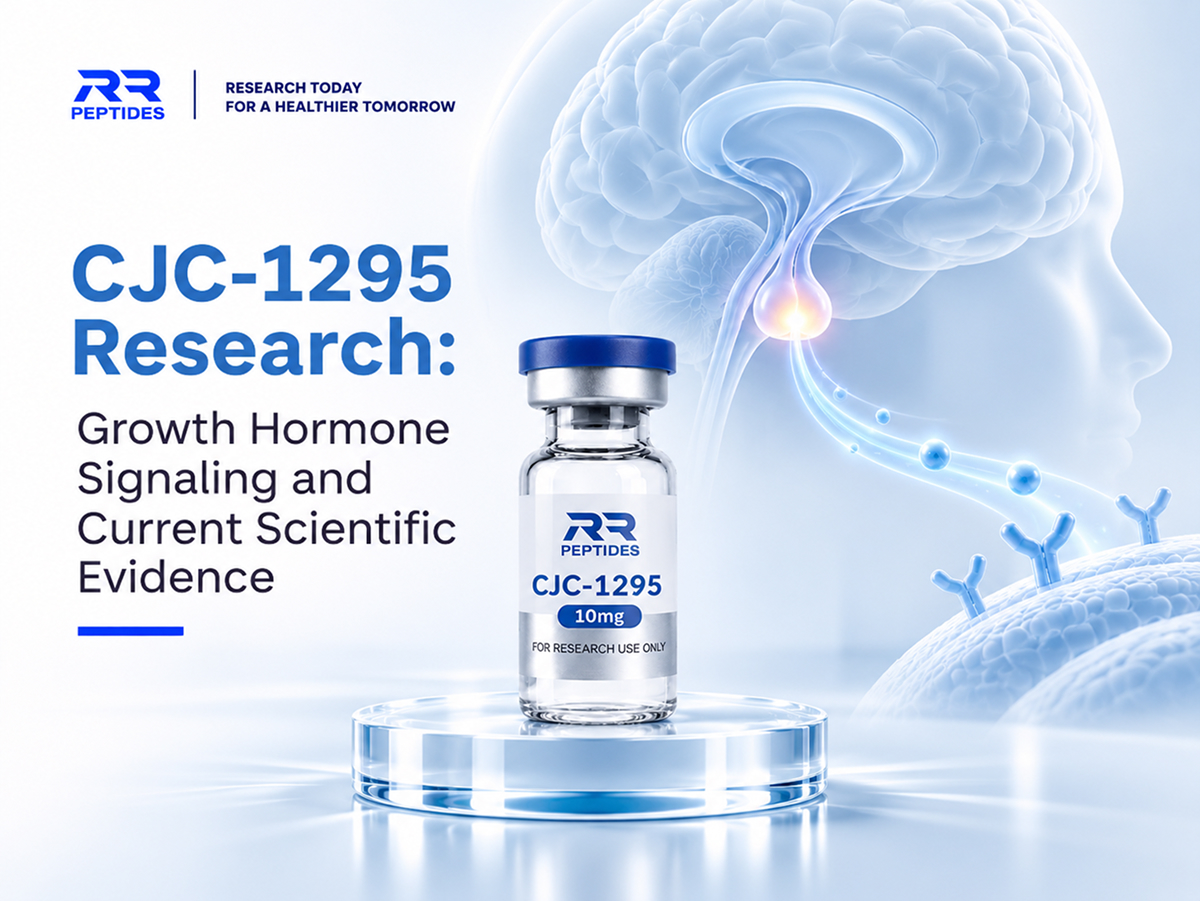
Growth hormone is released in pulses, not as a steady stream. Its rhythm reflects communication between the hypothalamus, pituitary gland, and peripheral tissues. A change in one hormone measurement can therefore reveal less than researchers expect. Understanding the timing, duration, and downstream consequences of endocrine signaling is essential.
CJC-1295 research investigates a synthetic growth hormone-releasing hormone analogue designed to produce prolonged biological exposure. Early controlled human studies reported changes in growth hormone and insulin-like growth factor 1, but those biochemical findings do not establish improvements in muscle growth, aging, recovery, or disease outcomes. The distinction between measurable endocrine activity and demonstrated clinical benefit guides this review.
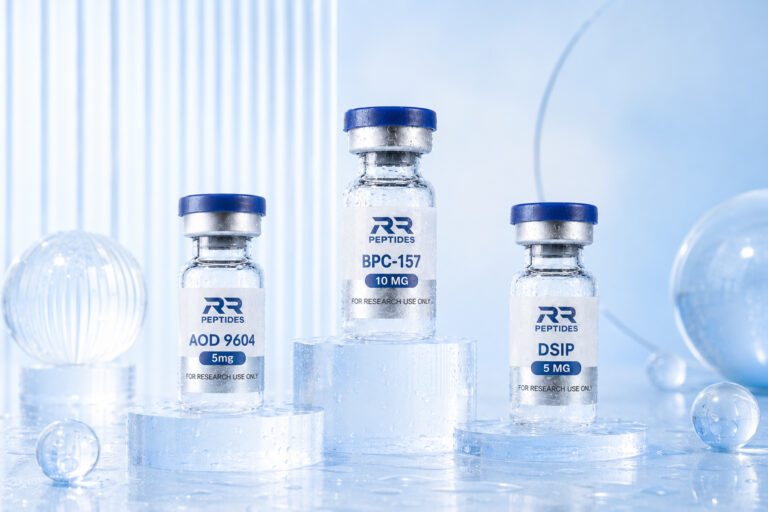
For Canadian readers exploring laboratory science, RR Peptides provides research-oriented product information and available documentation. Review those materials alongside primary publications and institutional requirements before making scientific or procurement decisions. CJC-1295 research is best approached as an investigation of endocrine mechanisms, not an endorsement of unapproved human use.
A Modified Growth Hormone-Releasing Hormone Analogue
Growth hormone-releasing hormone, or GHRH, is produced by hypothalamic neurons and signals to somatotroph cells in the anterior pituitary. These cells release growth hormone, abbreviated GH, into circulation. Researchers have developed synthetic GHRH analogues to examine how molecular changes influence receptor activity, persistence, and hormone secretion.
CJC-1295 was developed as a long-acting GHRH analogue incorporating a drug affinity complex, commonly abbreviated DAC. Its reactive component enables covalent attachment to circulating albumin, extending exposure compared with native GHRH. Albumin association does not mean the compound remains permanently active or that every preparation has identical pharmacokinetics.
An important terminology issue affects CJC-1295 research: commercial descriptions sometimes use the name for both DAC-containing material and a shorter-acting modified GHRH fragment marketed as “CJC-1295 without DAC.” These should not be treated as chemically interchangeable. A study involving the albumin-binding compound cannot automatically establish the behavior of another peptide sold under a similar name.
Understanding the Hormonal Pathway
The pathway is straightforward in outline but tightly regulated in practice:
Hypothalamus: Releases GHRH and somatostatin, which exert opposing influences on GH secretion.
Pituitary: Responds through GHRH receptors on somatotroph cells and releases GH.
Peripheral tissues: Respond to GH directly and contribute to production of IGF-I.
Feedback circuits: Adjust subsequent hormone release in response to changing signals.
CJC-1295 research focuses on this coordinated system because prolonged receptor stimulation offers a way to examine endocrine feedback over time. However, a higher hormone concentration is not inherently a beneficial biological outcome. Physiological meaning depends on context, duration, and downstream effects.
Why Albumin Binding Matters
Native GHRH is rapidly cleared, complicating prolonged exposure experiments. Albumin binding was intended to extend the period during which a GHRH analogue could influence signaling. In CJC-1295 research, that design makes pharmacokinetics particularly important: investigators must distinguish circulating peptide exposure from the hormonal response it produces.
Explore growth hormone signaling and IGF-1 regulation in endocrine research with CJC-1295 10mg.
The strongest published human evidence concerns endocrine biomarkers rather than clinical outcomes. Investigators have examined whether sustained exposure changes circulating GH, IGF-I, and the organization of hormone pulses. These measurements help characterize how a long-acting GHRH analogue interacts with a system that normally fluctuates throughout the day.
CJC-1295 research also raises questions about feedback regulation. GH and IGF-I participate in negative feedback networks, while somatostatin and other physiological signals influence pituitary responsiveness. A sustained rise in one marker cannot reveal the entire feedback response without repeated sampling and suitable controls.
Pharmacokinetics Versus Pharmacodynamics
Pharmacokinetics describes what happens to the investigational compound, including its distribution and disappearance from circulation. Pharmacodynamics describes what the compound does to measurable biological processes. Separating the two avoids confusing a long plasma half-life with a proven therapeutic effect.
Research area
Core question
Typical measurement
Pharmacokinetics
How long is the compound detectable?
Concentration over time, estimated half-life
Pharmacodynamics
How does endocrine signaling change?
GH and IGF-I profiles
Pulse analysis
Does GH retain a rhythmic pattern?
Frequent serial hormone samples
Molecular characterization
Is the intended analogue present?
Identity, purity, and analytical profiling
Safety observation
What unexpected effects occur?
Adverse events and clinical laboratory findings
CJC-1295 research requires careful attention to which category a result belongs to. A measurable rise in IGF-I is evidence of endocrine activity; it is not direct evidence of improved physical performance, reduced body fat, or longer life.
Early Human Studies and Their Scope
A 2006 publication by Teichman and colleagues described two randomized, placebo-controlled, double-blind, ascending-dose trials lasting 28 and 49 days. Healthy adults aged 21 to 61 participated. The investigators evaluated circulating GH, IGF-I, pharmacokinetics, and short-term tolerability.
After single exposure, mean GH concentrations increased approximately twofold to tenfold for at least six days, while mean IGF-I increased about 1.5-fold to threefold for nine to eleven days. The reported estimated half-life was 5.8 to 8.1 days. These results apply to the particular DAC-containing compound and study conditions.
For CJC-1295 research, those findings establish a useful starting point for mechanistic questions. They do not establish optimal use, long-term safety, or effectiveness for any proposed wellness indication.
Translational Questions
Scientists may investigate whether endocrine changes correspond to altered metabolic markers, tissue responses, or feedback patterns. Such questions require independently validated endpoints. They cannot be answered by extending conclusions from a short biomarker study into unrelated populations or conditions.
The GHRH receptor is a G protein-coupled receptor expressed on pituitary somatotrophs. Its activation typically engages cyclic AMP and protein kinase A-associated signaling, contributing to GH synthesis and release. The pathway also interacts with intracellular calcium dynamics and other regulatory mechanisms.
In CJC-1295 research, receptor-based experiments can help distinguish direct signaling effects from secondary endocrine responses. Nevertheless, observing increased circulating GH in a participant does not independently identify every intracellular event. Cell assays, receptor-specific controls, and functional measurements are needed for stronger mechanistic conclusions.
Animal Models and Human Sampling
Different experimental systems answer different questions. Cell cultures can isolate selected signaling components but lack intact endocrine feedback. Animal studies preserve more physiological interactions yet introduce species-specific differences. Controlled human studies provide direct biomarker observations, although small samples and short follow-up restrict interpretation.
Human pharmacokinetic studies characterizing exposure and variability.
Serial hormone sampling examining the timing and amplitude of GH pulses.
Independent analytical testing confirming that the experimental material matches its stated identity.
Each approach has limitations. Combining evidence across models is useful only when differences in compound identity, assay design, and species are explicitly considered.
Why Pulsatility Matters
GH secretion is episodic, with pulses shaped by sleep, age, sex, nutrition, and hypothalamic inputs. A single blood sample may miss a peak or exaggerate the apparent difference between participants. Frequent sampling and appropriate mathematical analysis are therefore important when investigators study secretion patterns.
A separate 2006 investigation examined GH pulsatility in healthy men before and after exposure to the long-acting analogue. Researchers collected blood samples at twenty-minute intervals during an overnight twelve-hour period. This design addressed whether prolonged stimulation alters the structure of GH secretion, rather than relying solely on an isolated concentration.
CJC-1295 research benefits from this distinction because pulse frequency, amplitude, and total secretion are not synonymous. Researchers should report which features were actually measured and avoid equating a higher average concentration with normal endocrine regulation.
Study Design Controls
Meaningful comparisons require placebo or appropriate reference groups, prespecified sampling schedules, validated assays, and careful handling of missing data. Circadian timing is particularly important. Food intake, physical activity, sleep, and concurrent illness may also influence hormone measurements.
For CJC-1295 research, transparent reporting of these variables improves reproducibility and helps readers distinguish genuine biological responses from ordinary endocrine variability.
Explore growth hormone signaling and IGF-1 regulation in endocrine research with CJC-1295 10mg.
The most directly supported outcomes are circulating GH and IGF-I concentrations. GH responds relatively quickly to pituitary stimulation, while IGF-I reflects downstream signaling over a different timescale. Both markers are informative, but neither is a standalone measure of health improvement.
Researchers may analyze peak concentration, time to peak, area under the concentration-time curve, and change from baseline. The choice matters because a compound could affect overall exposure without producing the same change in peak height or pulse timing.
Outcome
What it describes
Interpretation boundary
GH concentration
Circulating pituitary hormone
Varies substantially with sampling time
IGF-I concentration
Downstream endocrine response
Does not prove a clinical benefit
GH pulse characteristics
Rhythm, amplitude, or frequency
Requires frequent sampling and modeling
Peptide half-life
Estimated persistence in circulation
Not equivalent to duration of clinical benefit
Adverse-event reports
Observed short-term tolerability
Cannot establish long-term safety
CJC-1295 research should prioritize effect sizes, uncertainty intervals, and comparison with baseline rather than presenting an isolated percentage as a complete result.
What the Early Results Actually Show
In the initial controlled studies, the investigators observed sustained GH and IGF-I increases following exposure to the DAC-containing analogue. After repeated exposure, mean IGF-I remained above baseline for up to 28 days. No serious adverse reactions were reported in those particular trials, but their limited duration and participant numbers cannot exclude uncommon or delayed risks.
The distinction is crucial for CJC-1295 research. A biological signal demonstrated in healthy volunteers is not equivalent to evidence that the compound improves recovery, changes body composition, or treats a diagnosed endocrine condition.
Interpreting Hormone Measurements Responsibly
Readers can use several questions to evaluate a reported result:
Was the endpoint specified before the study began?
Were samples collected at comparable circadian times?
Did the investigators report baseline variability and placebo responses?
Were measurements repeated sufficiently to characterize GH pulses?
Was compound identity verified, particularly regarding DAC status?
Did follow-up extend long enough to investigate delayed effects?
In CJC-1295 research, these checks help separate convincing endocrine observations from promotional interpretations that exceed the evidence.
Beyond Hormone Concentrations
Clinical outcomes would require separate trials with validated measures, appropriate populations, and adequate follow-up. Changes in lean mass, metabolic health, functional capacity, or patient-reported outcomes cannot be assumed from IGF-I elevations alone. Moreover, hormonal systems can respond differently in healthy volunteers and individuals with underlying conditions.
CJC-1295 research therefore has an important evidence boundary: biochemical plausibility can justify further investigation, but it cannot replace controlled demonstrations of meaningful benefit.
Explore growth hormone signaling and IGF-1 regulation in endocrine research with CJC-1295 10mg.
What Are the Current Limitations of CJC-1295 Evidence?
Small Studies and Limited Follow-Up
The foundational controlled human trials were designed primarily to characterize pharmacokinetics, endocrine activity, and short-term tolerability. They were not large, long-duration efficacy trials. Small studies can detect pronounced biomarker changes while remaining poorly equipped to evaluate uncommon adverse events or long-term outcomes.
CJC-1295 research also faces an identity problem when discussions merge DAC-containing CJC-1295 with products described as lacking DAC. The compounds may differ in molecular structure, persistence, and study relevance. Conclusions must remain tied to the actual material investigated.
Safety Cannot Be Inferred From Hormone Elevation
GH and IGF-I participate in multiple physiological processes, including metabolism and tissue signaling. Their elevation does not automatically indicate safety or benefit. Any investigational compound affecting this axis requires appropriate evaluation of endocrine, cardiovascular, metabolic, and other potential risks.
Important evidence gaps include:
Long-term exposure: Limited controlled information on sustained outcomes.
Population differences: Uncertain generalizability beyond selected healthy adults.
Adverse-event detection: Insufficient scale for rare or delayed reactions.
Product variability: Differences in identity, purity, and formulation.
Clinical endpoints: Lack of convincing evidence for widely promoted performance or anti-aging claims.
CJC-1295 research should communicate these uncertainties without treating absence of reported harm in a small trial as proof of safety.
Canadian Regulatory Context
Canada has a direct historical connection to the compound: researchers affiliated with ConjuChem in Montréal contributed to the early published development work. That connection does not imply current Health Canada authorization.
Health Canada has explicitly listed CJC-1295 among unauthorized injectable peptide drugs in enforcement notices, including an April 2026 public advisory. The agency warns that unauthorized products have not undergone its assessment for safety, efficacy, and quality. A label stating “for research use only” does not automatically make sale, importation, or human use lawful.
For Canadian CJC-1295 research, institutions should independently confirm regulatory classification, procurement requirements, research approvals, and analytical documentation. Scientific interest and commercial availability are separate from legal authorization. For Canadian investigators, CJC-1295 research also demands clear separation between published experimental results, supplier descriptions, regulatory status, and widely circulated unsupported therapeutic claims.
What Stronger Evidence Would Require
Progress depends on independent replication, unambiguous compound characterization, validated assays, and sufficiently powered trials addressing specific questions. Future work should distinguish changes in hormone secretion from meaningful clinical outcomes and include transparent adverse-event reporting.
CJC-1295 research will be more informative when investigators publish negative findings, document study limitations, and avoid assuming that prolonged endocrine stimulation is necessarily desirable.
No. It is a synthetic analogue designed to alter properties such as persistence. Native GHRH and the DAC-containing compound should not be treated as pharmacokinetically identical.
What Does DAC Mean?
DAC stands for drug affinity complex. In the original long-acting compound, this feature supports covalent albumin binding and prolonged exposure.
Does Higher IGF-I Prove Muscle Growth?
No. IGF-I is a measurable endocrine biomarker. Changes in muscle mass or performance require direct clinical assessment and cannot be inferred from hormone levels alone.
Were Human Studies Conducted?
Yes. Small controlled studies in healthy adults reported sustained changes in GH and IGF-I. Those studies did not establish broad therapeutic efficacy or long-term safety.
Why Are GH Pulses Important?
GH secretion varies over time. Frequent measurements help distinguish changes in average concentration from changes in pulse amplitude, frequency, and timing.
Is CJC-1295 Authorized for Human Use in Canada?
Health Canada has identified unauthorized injectable CJC-1295 products and warns against their use. Researchers should verify current authorization and institutional requirements rather than relying on online claims.
What Is the Main Scientific Takeaway?
CJC-1295 research provides evidence of prolonged endocrine activity for the original DAC-containing analogue. It does not establish that marketed products are equivalent or that proposed wellness benefits are proven.
Conclusion
CJC-1295 research offers a focused example of how molecular design can change endocrine exposure. Early controlled studies demonstrated sustained GH and IGF-I responses, while pulse-sampling investigations examined the organization of hormone secretion. These findings are scientifically meaningful but narrower than many commercial claims suggest.
For Canadian laboratories, responsible interpretation starts with distinguishing DAC-containing material from similarly named alternatives, checking analytical identity, and understanding Health Canada requirements. RR Peptides provides research-oriented information that readers can examine alongside original publications and institutional guidance. Explore those resources with attention to documentation rather than unverified claims.
The next phase of CJC-1295 research requires stronger replication, longer observation, and outcomes that move beyond hormone concentrations. Until then, endocrine activity should be described accurately without presenting it as established treatment efficacy.
Disclaimer: All products and compounds discussed are intended strictly for laboratory and research purposes. This article is provided for educational and informational purposes only. This article is not medical advice, therapeutic guidance, or instructions for human administration.
×
Subscribe & Get 10% Off!
Enter your email address below to subscribe to our newsletter and receive an instant 10% OFF discount coupon code sent directly to your inbox!
Thank you for subscribing! Your 10% discount coupon has been sent to your email. Please check your inbox!