A molecule can disappear from circulation quickly, linger for days, or remain detectable without producing the same biological response throughout that period. These distinctions are central to peptide research, where a reported half-life is sometimes mistaken for a guaranteed duration of action in a particular experimental model.
CJC-1295 half-life and pharmacokinetics deserve particular scrutiny because the original compound was engineered to associate with serum albumin. That modification changes how researchers interpret circulating exposure, clearance, and downstream endocrine measurements. It also creates a naming problem: products marketed as CJC-1295 without DAC commonly refer to a different analogue.
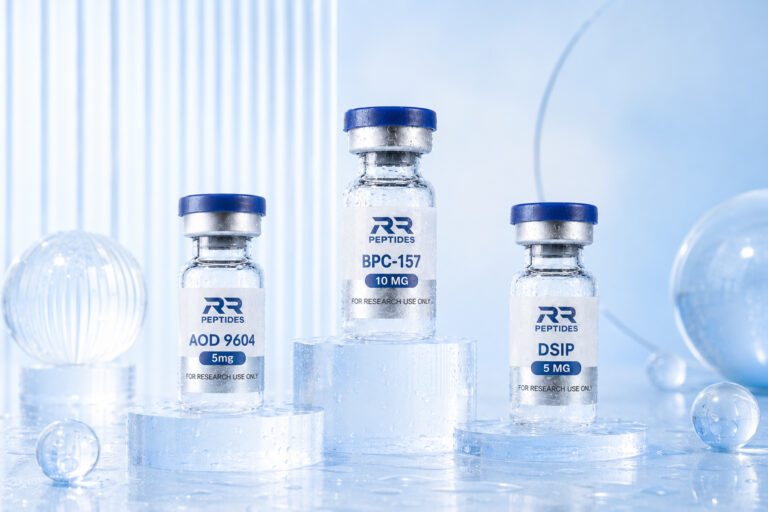
For Canadian laboratories, RR Peptides provides research-oriented product information that investigators can review alongside analytical documentation and published evidence. Explore its catalog to identify the precise material under consideration, then verify its identity and applicable institutional requirements. This guide examines CJC-1295 half-life and pharmacokinetics from a measurement perspective, without treating laboratory findings as established medical benefits.
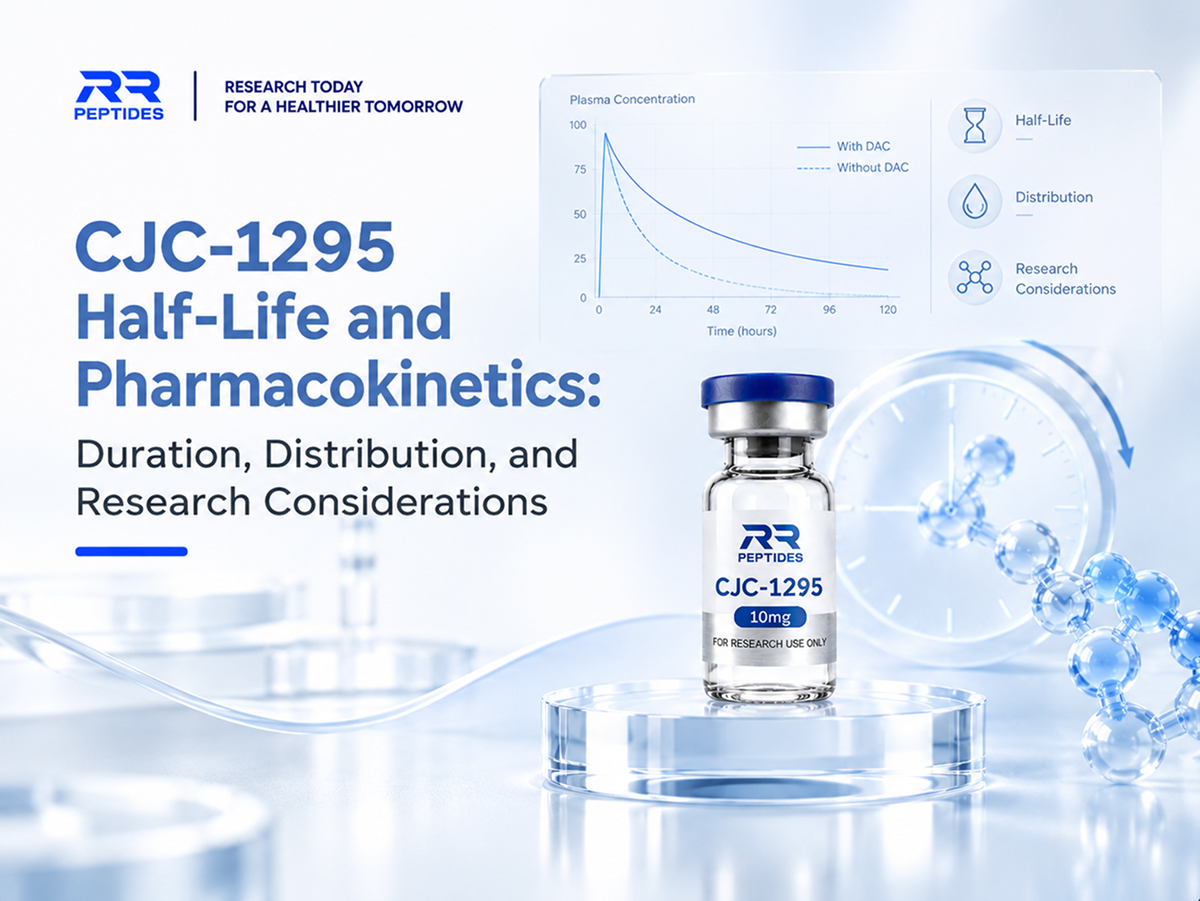
In pharmacokinetics, elimination half-life is the time required for a measured drug concentration to decrease by half during an appropriate elimination phase. It is not the time needed for complete removal, nor does it automatically describe how long a receptor remains activated. A concentration-time curve may contain several phases as a molecule enters circulation, distributes, and is cleared.
The central question in CJC-1295 half-life and pharmacokinetics is which phase an estimate describes. An early decline may reflect distribution between compartments rather than elimination. A later terminal slope may better represent the apparent elimination process, provided measurements extend long enough to characterize it.
For an idealized single exponential decline, successive half-lives leave progressively smaller fractions of the initial concentration:
Elapsed half-lives
Illustrative fraction remaining
Interpretation
Zero
100%
Reference concentration
One
50%
Half the reference remains
Two
25%
One quarter remains
Three
12.5%
Concentration continues declining
Four
6.25%
Detectability depends on the assay
This table is a mathematical illustration, not a prediction for a particular person, formulation, or experiment. Actual concentration profiles may not follow one simple exponential function throughout the observation period.
Elimination Is Different From Biological Duration
A peptide may be detectable while downstream hormone responses vary. Conversely, an endocrine biomarker can remain altered after the initiating concentration has fallen substantially. Growth hormone (GH) is secreted in pulses, and insulin-like growth factor I (IGF-I) follows a different time course. Neither biomarker is interchangeable with the concentration of CJC-1295 itself.
CJC-1295 half-life and pharmacokinetics therefore require three separate timelines: compound exposure, receptor-related activity, and downstream hormonal change. Reporting only the longest observed effect can obscure the distinction. Researchers should specify exactly what was measured and when.
What a Half-Life Cannot Tell You
A half-life estimate alone cannot establish safety, efficacy, storage stability, or a suitable administration schedule. In CJC-1295 half-life and pharmacokinetics, precision begins with resisting the temptation to turn one parameter into an entire biological explanation.
Explore growth hormone signaling and IGF-1 regulation in endocrine research with CJC-1295 10mg.
Which Structural Features Influence CJC-1295 Half-Life?
The Role of Peptide Structure
Peptides differ in susceptibility to enzymatic degradation, interaction with proteins, and movement between biological compartments. Sequence substitutions and terminal modifications can influence these properties, although their effects must be established experimentally. CJC-1295 half-life and pharmacokinetics do not establish receptor potency. Likewise, stability in a laboratory tube does not demonstrate persistence in circulation.
For CJC-1295 half-life and pharmacokinetics, the most important structural feature of the original compound is its drug affinity complex (DAC). This reactive modification was designed to enable covalent attachment to circulating albumin, a relatively abundant plasma protein. Albumin association changes the disposition of the attached peptide and helps explain its prolonged measured exposure.
Why Albumin Binding Changes the Question
Albumin is involved in the transport and distribution of many substances. Association with a large circulating protein can alter access to clearance pathways and modify how a peptide moves through the body. However, the exact effect depends on binding chemistry, biological environment, and the analytical method used to measure the compound.
CJC-1295 half-life and pharmacokinetics should distinguish the albumin-associated species from free material whenever the study design and assay allow. The amount detected as total peptide-related material may not be equivalent to the amount immediately available for receptor interaction.
Three structural considerations are particularly relevant:
Chemical identity: Verify the peptide sequence and modifications instead of relying on a commercial name.
Albumin association: Determine whether the DAC group is present and whether binding is demonstrated under relevant conditions.
Analytical specificity: Establish which molecular species the assay recognizes, including possible degradation products.
A Naming Problem With Scientific Consequences
The original long-acting CJC-1295 contains DAC. Products sold as “CJC-1295 without DAC” commonly refer to modified GRF(1-29), a related GHRH analogue rather than the identical molecule with a minor label change. Published human half-life findings for the DAC-containing compound should not automatically be applied to that non-DAC material.
This distinction is essential in CJC-1295 half-life and pharmacokinetics because a comparison is only meaningful when both test articles are chemically defined. Without identity confirmation, apparent differences in clearance might reflect mislabeling, formulation, or analytical interference rather than an intended structural modification.
A 2006 publication by Teichman and colleagues reported two randomized, placebo-controlled, double-blind studies of the original DAC-containing analogue in healthy adults aged 21 to 61. The studies lasted 28 and 49 days and examined pharmacokinetic parameters alongside GH and IGF-I responses. The reported elimination half-life after single administration was approximately 5.8 to 8.1 days.
These are among the clearest published human observations relevant to CJC-1295 half-life and pharmacokinetics. They describe the specific long-acting compound and study conditions, not a universal property of every product bearing the CJC-1295 name. The original research also involved contributors affiliated with ConjuChem in Montréal, Québec, providing a documented Canadian scientific connection.
Exposure and Hormone Response Are Separate Results
The same studies reported mean GH concentrations approximately twofold to tenfold above baseline for six days or longer, with mean IGF-I increases of roughly 1.5-fold to threefold for nine to eleven days after single administration. These findings demonstrate sustained endocrine responses in the studied population. They do not show that peptide concentrations, GH concentrations, and IGF-I concentrations declined at identical rates.
When reviewing CJC-1295 half-life and pharmacokinetics, separate the following observations:
Measured analogue concentration: The evidence used to estimate pharmacokinetic persistence.
GH response: A pulsatile pituitary output influenced by physiological regulation.
IGF-I response: A downstream endocrine marker with different production and turnover dynamics.
Clinical outcomes: Functional or health effects that were not established by these biomarker findings.
What About Material Without DAC?
Removing the albumin-binding design is expected to change systemic persistence, but an exact numerical half-life for every non-DAC product cannot be inferred from the DAC trials. Commercial sources sometimes circulate precise values without specifying a validated study, species, assay, or molecular identity. Such numbers should not be presented as established human evidence.
For CJC-1295 half-life and pharmacokinetics, this is an important evidence boundary. Shorter expected exposure is a mechanistic inference; a measured elimination half-life is an experimental result.
Prolonged Exposure Does Not Establish Superiority
Longer circulation can increase cumulative exposure, but it does not automatically imply greater clinical effectiveness, fewer adverse effects, or stronger receptor activity. Endocrine feedback and individual variability remain relevant. CJC-1295 half-life and pharmacokinetics should be evaluated for what the studies actually measured, not converted into unsupported performance or anti-aging claims.
Explore growth hormone signaling and IGF-1 regulation in endocrine research with CJC-1295 10mg.
Which Pharmacokinetic Parameters Are Commonly Measured?
Looking Beyond a Single Number
Half-life is only one component of a pharmacokinetic profile. Researchers often combine concentration-time data with measures of peak exposure, total exposure, distribution, and clearance. Each parameter addresses a different question, and each depends on adequate sampling and an appropriate analytical model.
In CJC-1295 half-life and pharmacokinetics, a complete report should identify whether the assay measured the original analogue, albumin-associated material, free material, or a broader group of peptide-related species. Without that distinction, apparently precise values may be difficult to interpret.
Parameter
Meaning
Important interpretation issue
Cmax
Highest observed concentration
Depends on sampling frequency
Tmax
Time of observed peak concentration
Can be missed with sparse early sampling
AUC
Integrated concentration-time exposure
Requires a defined interval and valid measurements
Terminal half-life
Rate of decline during the terminal phase
Requires enough late samples
Clearance
Relationship between elimination rate and exposure
Apparent estimates depend on route and bioavailability
Volume of distribution
Model-based extent of distribution
Not a literal anatomical volume
Bioavailability
Fraction reaching systemic circulation
Requires suitable comparative evidence
Protein binding
Association with circulating proteins
Total and free concentrations may differ
Understanding AUC Without Overclaiming
Area under the concentration-time curve, abbreviated AUC, summarizes exposure across a specified interval. A larger AUC indicates greater measured exposure under comparable conditions, but it does not by itself prove greater receptor activation or clinical benefit. For a compound associated with albumin, the definition of the measured analyte is particularly important.
CJC-1295 half-life and pharmacokinetics should report the integration interval and whether exposure beyond the last observed sample was estimated. Excessive extrapolation can make AUC estimates unstable, especially when late concentrations approach an assay’s detection limit.
Clearance, Distribution, and Assay Limitations
Clearance represents the relationship between the rate of elimination and circulating concentration. Volume of distribution is a model-based parameter describing the apparent relationship between the amount of compound and its concentration. Neither should be interpreted as a direct map of where molecules physically reside.
For CJC-1295 half-life and pharmacokinetics, researchers also need to distinguish systemic clearance from apparent clearance after non-intravenous exposure. Without independently established bioavailability, some parameters cannot be interpreted as absolute values. Matrix effects, assay cross-reactivity, and incomplete recovery of bound material can introduce additional uncertainty. When comparing datasets, researchers should report units consistently and describe whether concentrations were measured in plasma, serum, or another carefully validated biological matrix.
A practical reporting checklist includes:
State the identity and analytical form of the measured compound.
Describe the sampling interval and assay sensitivity.
Report variability and confidence intervals where possible.
Explain how terminal slopes and extrapolated values were calculated.
Keep pharmacokinetic results separate from hormone-response outcomes.
Why Reproducibility Depends on Methods
Two studies can report different half-lives because they examined different compounds, used different assays, or sampled different parts of the curve. CJC-1295 half-life and pharmacokinetics cannot be compared responsibly without reviewing these methodological details.
Explore growth hormone signaling and IGF-1 regulation in endocrine research with CJC-1295 10mg.
Why Does Half-Life Matter in Experimental Design?
Sampling Should Follow the Research Question
A study focused on early distribution requires different observations from one investigating terminal elimination. Similarly, a study of endocrine effects must account for the natural pulsatility of GH and the slower response of IGF-I. Sampling should be designed around the biological and analytical question rather than an assumed duration copied from another publication.
CJC-1295 half-life and pharmacokinetics influence whether a study can distinguish early exposure, prolonged persistence, and delayed biomarker changes. Sparse measurements can miss an early peak, while an observation period that ends too soon may not characterize the terminal decline. Neither limitation can be repaired simply by fitting a more complicated model.
Controls and Sources of Variation
Useful controls depend on the experimental model. Analytical blanks and reference materials support measurement quality, while appropriate biological controls help identify background changes. Independent verification of material identity is particularly valuable when commercial nomenclature is inconsistent.
Researchers planning CJC-1295 half-life and pharmacokinetics investigations should consider several potential confounders:
Biological matrix: Protein concentration and composition can affect measured species.
Sample handling: Delays or inappropriate processing may change analyte recovery.
Assay selectivity: A signal may reflect bound material or related fragments.
Population differences: Physiological conditions can influence exposure and endocrine responses.
Statistical assumptions: Model choice may alter reported terminal estimates.
Separating Research Questions From Medical Claims
A longer half-life may make a molecule useful for studying sustained exposure, but it cannot establish a suitable dosing regimen or predict long-term safety. Such decisions require an entirely different evidence base. CJC-1295 half-life and pharmacokinetics are scientific measurements, not instructions for self-administration or evidence of approved treatment.
Canadian Oversight and Research Integrity
Health Canada’s April 2026 advisory identified CJC-1295 among unauthorized injectable peptide drugs and warned that products marketed online have not undergone its assessment for safety, efficacy, and quality. The agency also stated that “research use only” labeling does not automatically make a product legal or exempt it from applicable requirements.
For Canadian CJC-1295 half-life and pharmacokinetics work, institutions should verify procurement, importation, ethics oversight where applicable, and laboratory controls. Historical involvement by Montréal researchers does not mean that a compound is currently authorized for human use in Canada.
The most defensible research plan is one that defines its analyte, endpoints, limitations, and regulatory context before interpreting results. CJC-1295 half-life and pharmacokinetics can then contribute meaningful evidence without blurring the boundary between laboratory observations and medical claims.
FAQs About CJC-1295 Half-Life and Pharmacokinetics
What Half-Life Was Reported for Original CJC-12955?
The 2006 controlled human studies estimated approximately 5.8 to 8.1 days for the original DAC-containing analogue after single administration. This value should not be assigned automatically to differently identified products.
Does DAC Change How the Peptide Circulates?
Yes. The drug affinity complex was designed to enable covalent association with serum albumin, influencing systemic persistence. The magnitude of that effect depends on the actual molecular structure and experimental conditions.
Is Half-Life the Same as Duration of GH Elevation?
No. Half-life concerns the measured compound’s concentration decline. GH and IGF-I are downstream endocrine biomarkers with their own regulation and time courses. CJC-1295 half-life and pharmacokinetics should not combine these timelines into one number.
Can the Non-DAC Form Use the Same Half-Life Estimate?
No. Products labeled without DAC commonly refer to modified GRF(1-29). A specific half-life requires compound-specific evidence from an appropriate study, not extrapolation from DAC-containing CJC-1295.
Why Are AUC and Cmax Reported Alongside Half-Life?
AUC summarizes integrated exposure, while Cmax identifies the highest observed concentration. Together with terminal half-life, they describe different features of a concentration-time profile.
Does a Longer Half-Life Mean a Better Research Compound?
Not universally. The preferred material depends on the hypothesis, model, analytical capabilities, and available evidence. Longer persistence does not establish stronger activity, superior safety, or clinical benefit.
What Should Canadian Researchers Verify?
They should confirm molecular identity, analytical documentation, institutional authorization, and applicable Health Canada requirements. CJC-1295 half-life and pharmacokinetics research does not create an exemption for unauthorized human use.
Conclusion
CJC-1295 half-life and pharmacokinetics are best understood through verified molecular identity, albumin association, concentration-time measurements, and carefully separated endocrine outcomes. The original DAC-containing analogue showed an estimated half-life of 5.8 to 8.1 days in controlled human research, but those results cannot be generalized to non-DAC material or converted into claims of clinical benefit.
Canadian investigators can explore RR Peptides‘ research catalog and available product information while reviewing primary evidence, analytical records, and institutional requirements. Choosing well-characterized material and asking precise questions are more valuable than relying on unsupported numerical comparisons.
Ultimately, CJC-1295 half-life and pharmacokinetics research advances when studies clearly identify what was measured, explain uncertainty, and distinguish exposure from biological response.
Disclaimer: All products and compounds discussed are intended strictly for laboratory and research purposes. This article is provided for educational and informational purposes only. This article is not medical advice, therapeutic guidance, or instructions for human administration.
×
Subscribe & Get 10% Off!
Enter your email address below to subscribe to our newsletter and receive an instant 10% OFF discount coupon code sent directly to your inbox!
Thank you for subscribing! Your 10% discount coupon has been sent to your email. Please check your inbox!