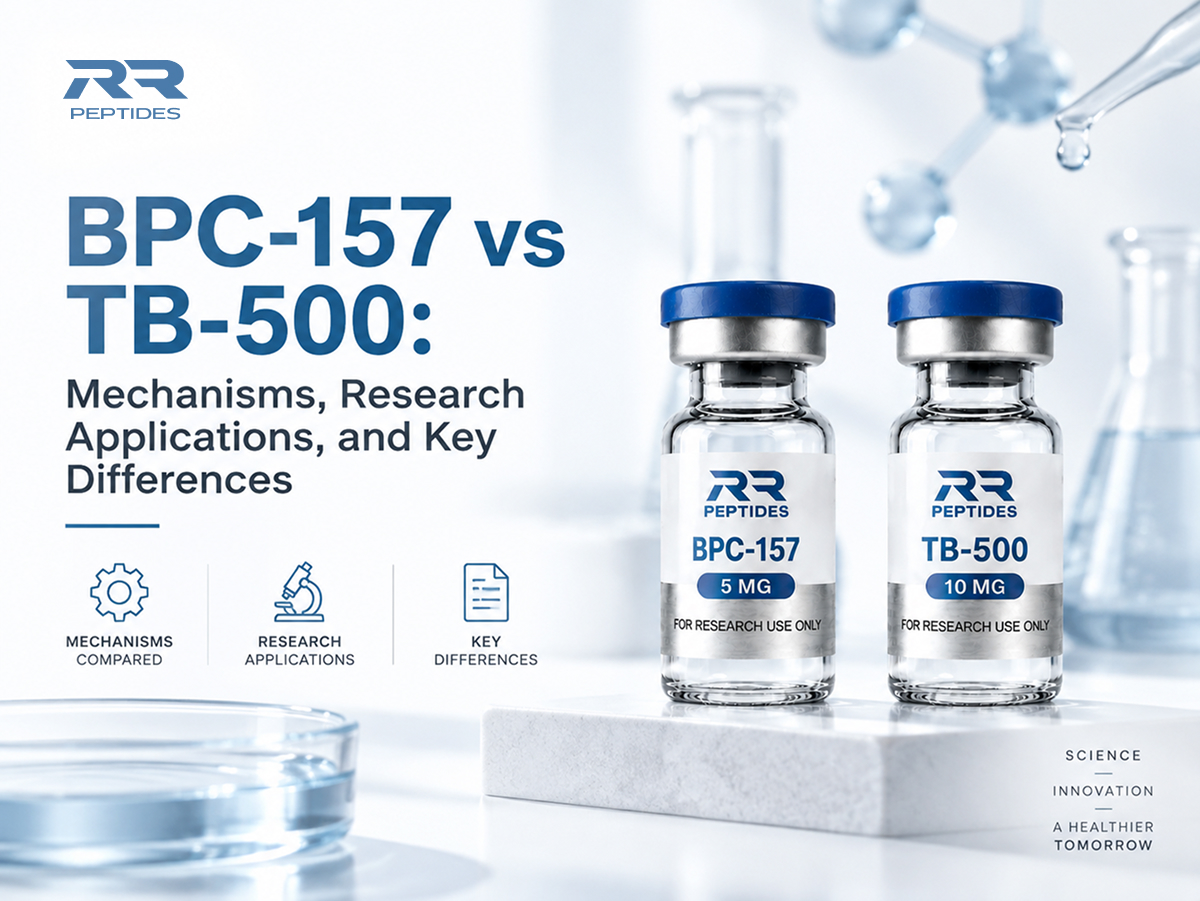
BPC-157 vs TB-500 is a common comparison in research peptide discussions, particularly when researchers examine cellular migration, vascular-associated processes, tissue models, and experimental recovery pathways. Although the two materials share several research themes, they are not the same peptide and should not be treated as interchangeable.
For readers exploring peptide science, RR Peptides provides research-focused information designed to distinguish experimental findings from broader commercial claims. A useful comparison begins with molecular identity, then moves through mechanisms, laboratory models, analytical quality, and study design.
This article examines BPC-157 vs TB-500 from a laboratory research perspective. The objective is to explain where their research areas overlap, where they differ, and why experimental context matters when interpreting findings.
Overview of BPC-157 and TB-500
BPC-157 and TB-500 are both discussed in preclinical peptide research, but they have different molecular identities and research backgrounds. BPC-157 is commonly described as a synthetic 15-amino-acid peptide represented by the sequence GEPPPGKPADDAGLV. Its experimental literature includes gastrointestinal, vascular, connective-tissue, inflammatory, and cellular models.
TB-500 is commonly described in research and commercial contexts as a synthetic peptide related to thymosin beta-4. However, the terms TB-500 and thymosin beta-4 should not automatically be treated as interchangeable. Exact sequence, formulation, source, and analytical characterization should be checked when evaluating a particular research material.
When examining BPC-157 vs TB-500, researchers should therefore begin with the exact material used in the underlying experiment. A product name alone does not establish molecular identity, purity, formulation, or comparability with a compound used in a published study.
Molecular identity
BPC-157 research has examined cellular responses, vascular-associated processes, gastrointestinal models, inflammatory signaling, and tissue-associated endpoints. The exact findings depend heavily on the experimental system, species, tissue type, and measured outcome.
TB-500-related research is frequently discussed around actin-associated biology, cellular movement, cytoskeletal organization, and tissue-associated processes. Much of this discussion is connected to the broader biological literature surrounding thymosin beta-4, which makes terminology particularly important.
Characteristic
BPC-157
TB-500
Research context
Experimental and preclinical
Experimental and preclinical
Molecular identity
Synthetic 15-amino-acid peptide
Synthetic peptide commonly described as related to thymosin beta-4
Research themes
Cellular, vascular, gastrointestinal, tissue and inflammatory models
Actin-associated, migration, vascular and tissue models
Evidence level
Model-dependent
Model-dependent
Established human therapeutic conclusion
Not established by preclinical evidence
Not established by preclinical evidence
The table illustrates why BPC-157 vs TB-500 should be viewed as a scientific comparison rather than a simple comparison of two equivalent products.
Why terminology matters
Scientific literature may use different terminology, sequences, formulations, or experimental materials. Researchers should verify the material actually tested before connecting findings from one publication to another.
This is especially important for TB-500 because references to thymosin beta-4 in scientific literature do not automatically demonstrate that the tested material was identical to a commercial material described as TB-500.
Explore the research specifications and product information from RR Peptides for BPC-157 5mg and TB-500 10mg.
The mechanistic literature surrounding BPC-157 vs TB-500 covers several overlapping areas, including cellular migration, vascular-associated responses, tissue remodeling, and inflammatory signaling. However, the biological questions investigated for each material are not identical.
BPC-157 has been studied through experimental models examining cellular behavior, vascular responses, gastrointestinal systems, and selected molecular markers. TB-500 is more commonly discussed in connection with actin-related processes and cellular movement, particularly because of its relationship in the literature to thymosin beta-4 biology.
Mechanistic findings must remain connected to the model in which they were observed. A change in a cellular marker does not independently establish a complete biological mechanism, and an animal observation cannot automatically be translated into an equivalent human outcome.
Experimental BPC-157 studies can investigate different cellular and molecular endpoints depending on the research question. Researchers may examine cellular migration, endothelial behavior, inflammatory markers, oxidative stress, vascular-associated signaling, or tissue structure.
These areas make BPC-157 vs TB-500 comparisons interesting, but they also demonstrate why individual findings should not be generalized across compounds.
Researchers may evaluate:
Cellular migration and adhesion
Endothelial or vascular-associated responses
Selected gene or protein markers
Inflammatory and oxidative stress indicators
Tissue-associated structural changes
Each endpoint provides a different type of information. A migration assay, for example, measures a defined cellular behavior, while a molecular assay may identify changes in selected signaling markers.
TB-500-associated research pathways
TB-500 is frequently discussed in relation to actin and cytoskeletal organization. Actin contributes to cell shape, adhesion, movement, and intracellular structure. Research involving related peptide biology has therefore examined processes associated with cellular migration and cytoskeletal behavior.
For BPC-157 vs TB-500 comparisons, this difference in mechanistic emphasis is important. BPC-157 research spans several tissue and signaling contexts, while TB-500 discussions often emphasize actin-associated cellular processes and migration-related biology.
Mechanistic area
BPC-157 research
TB-500 research
Cellular migration
Investigated
Frequently discussed
Cytoskeletal organization
Studied in selected models
Important research theme
Vascular-associated responses
Investigated
Investigated
Inflammatory signaling
Investigated in experimental models
Investigated in selected models
Tissue remodeling
Preclinical research area
Preclinical research area
The overlap should not be interpreted as proof of an identical mechanism. BPC-157 vs TB-500 represents partially overlapping research areas involving different materials.
Mechanism versus measured outcome
Researchers should distinguish a measured biological outcome from a proposed mechanism. Increased cellular movement may be observed directly, but identifying why that movement occurred requires additional experimentation.
Mechanistic studies can use pathway-specific interventions, molecular markers, controls, replication, and complementary assays. This approach helps researchers determine whether a proposed pathway is associated with an observation or actually contributes to the measured effect.
Comparing Their Research Applications
Research applications provide another way to understand BPC-157 vs TB-500. Both materials have appeared in experimental research involving cellular behavior and tissue-associated models, but the specific research questions can vary.
BPC-157 research includes experimental models involving gastrointestinal tissues, vascular systems, connective tissues, inflammatory responses, and cellular behavior. Depending on the hypothesis, investigators may use cell cultures, tissue preparations, molecular assays, or animal models.
TB-500-related research commonly focuses on cellular migration, actin-associated processes, tissue remodeling, and vascular-associated biology. The experimental approach may similarly include cellular systems, tissue models, molecular measurements, and animal studies.
Cell-based research
Cell-based models allow investigators to isolate specific biological processes under controlled conditions. In BPC-157 vs TB-500 research, researchers may measure cellular movement, morphology, adhesion, signaling markers, or responses to defined experimental conditions.
The strength of cell models is experimental control. Their limitation is biological complexity. Cultured cells do not reproduce every feature of intact tissue, including complete vascular interactions, immune responses, extracellular architecture, metabolism, and systemic regulation.
Tissue and organ-associated models
Tissue models provide greater structural context than isolated cells. Depending on the study, researchers may examine connective-tissue organization, vascular-associated behavior, gastrointestinal responses, or molecular changes within a defined tissue environment.
For BPC-157 vs TB-500 comparisons, tissue models can provide useful intermediate evidence. However, tissue source, species, preparation, experimental duration, and endpoint selection can substantially influence the results.
Animal models
Animal studies provide greater physiological complexity and may allow researchers to examine systemic responses. Experimental endpoints can include tissue-associated changes, vascular responses, inflammatory markers, or other predefined measurements.
Animal evidence remains preclinical. Differences between species in metabolism, anatomy, immune function, and molecular signaling mean that findings cannot automatically be interpreted as equivalent human outcomes.
Research model
Primary value
Main limitation
Cell culture
Controlled cellular investigation
Limited physiological complexity
Tissue model
Adds structural context
Preparation may alter biological conditions
Animal model
Provides systemic context
Species differences limit translation
Molecular assay
Measures defined molecular endpoints
Does not capture whole-system biology
A meaningful BPC-157 vs TB-500 comparison therefore depends on matching the research question, material, model, and endpoint rather than comparing isolated findings.
Similarities and Differences in Tissue Research
Tissue research is one of the areas where BPC-157 vs TB-500 can appear particularly similar. Both materials have been investigated in experimental contexts involving cellular movement, vascular-associated processes, and tissue-related responses.
However, similar research terminology does not establish identical biological activity. The experimental conditions and exact material remain critical.
Cellular migration
Cell migration is an important research theme for both materials. Researchers can evaluate migration through cell-based assays, changes in cellular distribution, adhesion-related behavior, or molecular markers associated with motility.
When comparing BPC-157 vs TB-500 studies, researchers should examine cell type, substrate, exposure conditions, controls, duration, and measurement method. These variables can significantly influence an observed migration response.
Vascular research
Vascular-associated studies can examine endothelial migration, proliferation, cellular organization, or expression of vascular markers. Such models provide information about selected cellular processes but cannot reproduce every component of vascular biology within a living organism.
Both BPC-157 and TB-500-related research has included vascular-associated questions, making this area relevant to BPC-157 vs TB-500 comparisons. Nevertheless, the same endpoint can result from different biological processes.
Tissue remodeling
Tissue remodeling involves coordinated changes involving cells, extracellular matrix, vascular structures, and inflammatory signaling. Experimental studies usually measure selected components rather than the entire remodeling process.
Researchers examining BPC-157 vs TB-500 should therefore identify precisely what was measured. A change in a molecular marker does not by itself demonstrate complete structural restoration or a fully resolved tissue process.
Tissue research area
BPC-157
TB-500
Cellular migration
Experimental research area
Experimental research area
Vascular-associated models
Investigated
Investigated
Connective-tissue models
Investigated
Investigated
Inflammatory markers
Investigated
Investigated in selected models
Tissue remodeling
Model-dependent
Model-dependent
Where comparisons become difficult
Direct comparison becomes difficult when studies use different materials, models, endpoints, or analytical methods. A BPC-157 experiment in an animal model cannot automatically be compared with a TB-500 experiment performed in cultured cells.
This is why BPC-157 vs TB-500 should be evaluated through study design first. Researchers should ask whether the studies are sufficiently similar to support the comparison being made.
Explore the research specifications and product information from RR Peptides for BPC-157 5mg and TB-500 10mg.
Quality and Study Design Considerations
A scientifically useful comparison begins with material quality. Researchers studying BPC-157 vs TB-500 should document the exact material, batch or lot, sequence or identity information where available, purity, formulation, storage conditions, and relevant analytical characterization.
A Certificate of Analysis can provide batch-specific information depending on the tests reported. Chromatographic methods such as HPLC may be used to assess analytical purity, while mass spectrometry can provide information relevant to molecular identity. These measurements answer different questions.
Material characterization
When reviewing BPC-157 vs TB-500, researchers should verify:
Exact material identity or sequence
Batch or lot information
Purity and analytical method
Physical state and formulation
Storage and handling history
Relevant analytical documentation
Analytical purity does not establish biological activity. Likewise, an observed biological response does not independently confirm the identity or purity of the tested material.
Experimental controls
Controls provide the reference needed to interpret experimental observations. Depending on the research question, investigators may use untreated controls, vehicle controls, positive controls, or other scientifically justified comparators.
Replication is also important. A single observation may generate a hypothesis, while repeated experiments can help determine whether an observation is consistent. Independent replication can provide additional evidence for reproducibility.
Evaluating study evidence
When evaluating BPC-157 vs TB-500 research, researchers can ask five questions:
What exact material was tested?
What experimental model was used?
What endpoint was measured?
What controls and replication were included?
How closely does the model address the research question?
These questions help prevent conclusions based solely on product descriptions or isolated experimental findings.
Canadian research context
For Canadian laboratories, research activities should follow applicable institutional procedures, laboratory safety requirements, ethical oversight where relevant, and other requirements associated with the specific research environment. Exact obligations can vary according to the institution and study design.
Commercial availability should not be interpreted as proof of therapeutic authorization. Researchers should distinguish research-use materials from products authorized for therapeutic purposes and consult appropriate Canadian and institutional sources when regulatory status is relevant.
No. They are different research materials with different molecular identities. Although BPC-157 vs TB-500 discussions often group them together because of overlapping research themes, they should not be treated as interchangeable.
Do BPC-157 and TB-500 have the same mechanism?
No single shared mechanism has been established. BPC-157 research covers several cellular, vascular, gastrointestinal, and tissue-associated areas, while TB-500 is commonly discussed around actin-associated processes and cellular migration.
What research models are used?
Both materials have been investigated in cellular, tissue, molecular, and animal models. The appropriate model depends on the hypothesis, research question, endpoint, and experimental methodology.
Can findings from one peptide be applied to the other?
No. Findings should remain connected to the material and experimental model in which they were generated. Similar endpoints do not establish equivalent biological activity.
Is one better for tissue research?
A general ranking is not scientifically appropriate because research questions, models, endpoints, and material specifications differ. Researchers should evaluate the material according to the specific hypothesis being investigated.
Why is material identity important?
Material identity establishes what was actually tested. This is particularly important when terminology differs between commercial descriptions and scientific literature. BPC-157 vs TB-500 comparisons require clear identification before evidence can be meaningfully compared.
Does purity prove biological activity?
No. Purity is an analytical characteristic, while biological activity requires an appropriately designed experimental assessment with defined endpoints and controls.
Are BPC-157 and TB-500 approved for human therapeutic use in Canada?
Research discussions should not be confused with therapeutic authorization. Canadian researchers should verify the regulatory status relevant to the specific product and intended activity through appropriate Canadian and institutional sources. Preclinical research does not itself establish therapeutic authorization.
What is the main lesson from comparing these peptides?
The main point is that overlapping research themes do not make two peptides equivalent. BPC-157 vs TB-500 should be evaluated through material identity, mechanisms, research models, endpoints, analytical quality, controls, and evidence limitations.
Final Research Perspective
BPC-157 vs TB-500 is a useful scientific comparison when it is framed around research questions rather than product preference. Both materials have been investigated in experimental settings involving cellular behavior, vascular-associated processes, and tissue research, but their molecular identities and mechanistic research backgrounds differ.
A careful comparison should begin with the exact material and batch, followed by the experimental model, endpoint, controls, analytical methods, and evidence level. This approach reduces the risk of combining findings generated under substantially different conditions.
RR Peptides provides research-oriented peptide information focused on molecular identity, laboratory applications, analytical considerations, and scientific limitations. Understanding these distinctions can help readers evaluate peptide literature without overstating what preclinical evidence demonstrates.
For Canadian research environments, institutional procedures and applicable requirements should remain part of study planning. Research-use materials should be evaluated within the appropriate laboratory framework, while commercial descriptions should not substitute for scientific characterization or regulatory verification.
Ultimately, BPC-157 vs TB-500 represents a comparison between two distinct research materials with overlapping areas and important differences. Careful characterization, appropriate controls, transparent methodology, and reproducibility remain essential for interpreting their scientific literature.
For additional research-focused information on peptide mechanisms, laboratory models, and analytical considerations, explore RR Peptides as part of your ongoing scientific research.
Disclaimer: All products and compounds discussed are intended strictly for laboratory and research purposes. This article is provided for educational and informational purposes only and is not medical advice, therapeutic guidance, or instructions for human administration.
3 Comments
The comparison between BPC-157 and TB-500 is useful because it highlights that these two research peptides should not simply be treated as interchangeable compounds. Looking at their proposed mechanisms and the evidence supporting each one provides a clearer scientific perspective.
I found the discussion of the differences between BPC-157 and TB-500 particularly interesting. Comparing their biological pathways while keeping the limitations of current research in mind makes the information much more useful for understanding where the evidence currently stands.
This is a helpful comparison for anyone exploring the research surrounding BPC-157 and TB-500. I appreciate the emphasis on proposed mechanisms and preclinical evidence rather than presenting research findings as established conclusions.






The comparison between BPC-157 and TB-500 is useful because it highlights that these two research peptides should not simply be treated as interchangeable compounds. Looking at their proposed mechanisms and the evidence supporting each one provides a clearer scientific perspective.
I found the discussion of the differences between BPC-157 and TB-500 particularly interesting. Comparing their biological pathways while keeping the limitations of current research in mind makes the information much more useful for understanding where the evidence currently stands.
This is a helpful comparison for anyone exploring the research surrounding BPC-157 and TB-500. I appreciate the emphasis on proposed mechanisms and preclinical evidence rather than presenting research findings as established conclusions.