Research involving peptide combinations requires more than examining the names of individual compounds. A blend creates a different experimental material, with its own composition, analytical requirements, storage considerations, and interpretation challenges. For laboratories studying BPC-157 and TB-500-related biology, understanding the formulation is therefore an essential first step.
The BPC-157 and TB-500 blend is discussed in research contexts because its components have appeared in different areas of preclinical peptide literature. BPC-157 is commonly described as a synthetic pentadecapeptide, while TB-500 is generally described as a synthetic peptide associated with thymosin beta-4-related biology. These descriptions should not be treated as evidence that the two materials have identical mechanisms or that combining them automatically produces a defined biological effect.
RR Peptides provides research-focused educational information for readers evaluating experimental peptides, material identity, analytical quality, and laboratory study design. This article examines the BPC-157 and TB-500 blend from a laboratory perspective, focusing on composition, proposed biological pathways, research applications, and quality considerations.
For Canadian researchers, study planning should account for institutional procedures, procurement, storage, analytical records, and applicable laboratory requirements. Commercial availability should not be interpreted as therapeutic authorization.
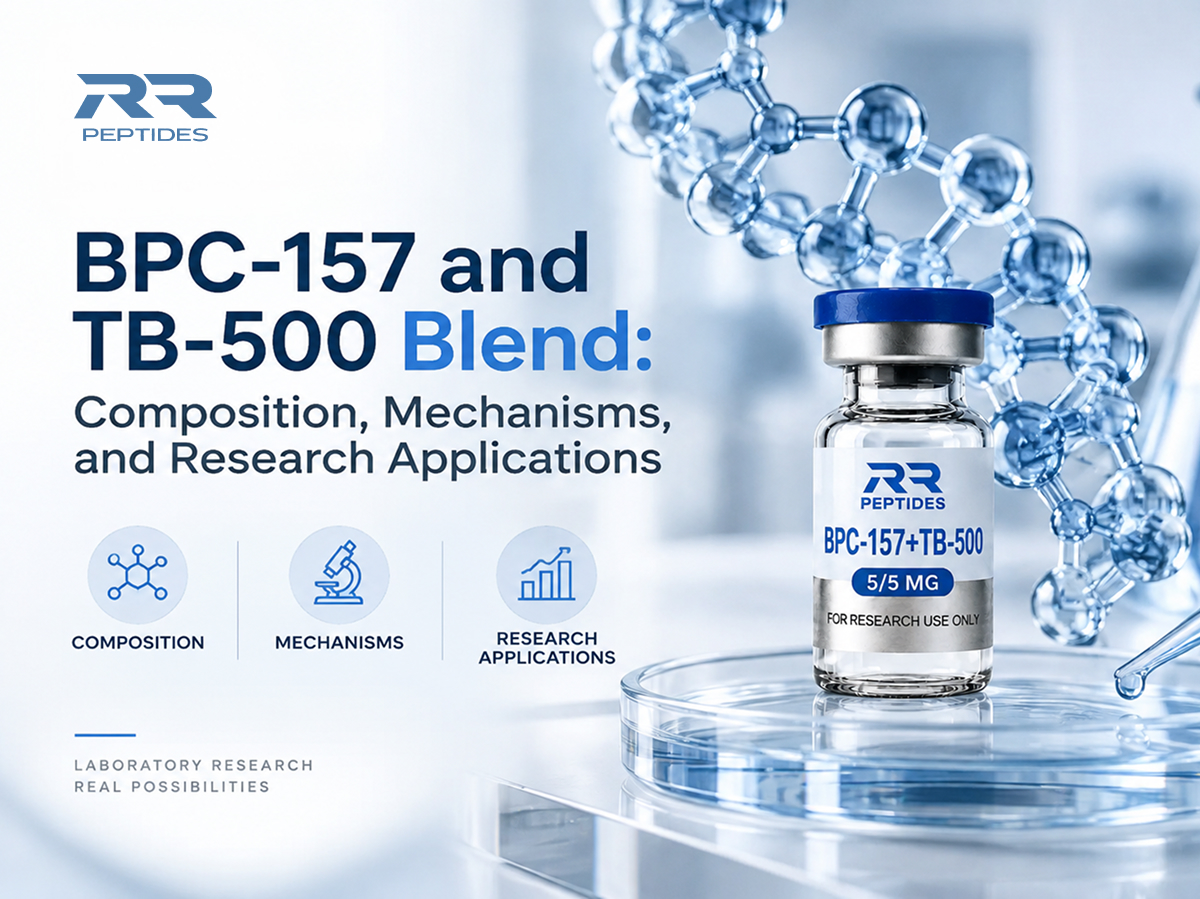
The BPC-157 and TB-500 blend refers to a research formulation containing both BPC-157 and a material identified as TB-500. The exact composition should always be established from product-specific documentation rather than inferred from the blend name.
BPC-157 is commonly described as a synthetic 15-amino-acid peptide. The sequence commonly reported in research literature is GEPPPGKPADDAGLV. Experimental research has examined BPC-157 in gastrointestinal, tissue-associated, cellular, vascular, inflammatory, and oxidative-stress models.
TB-500 is generally described in research and commercial literature as a synthetic peptide associated with thymosin beta-4-related biology. The terminology requires care because TB-500 should not automatically be considered identical to thymosin beta-4. A researcher should establish the identity and analytical characteristics of the actual material used in an experiment.
When evaluating the BPC-157 and TB-500 blend, researchers should distinguish nominal formulation from verified composition. Batch-specific testing can provide additional information about identity, purity, and measured characteristics.
Characteristic
BPC-157
TB-500-related material
General description
Synthetic pentadecapeptide
Synthetic peptide associated with thymosin beta-4-related biology
Common research areas
Gastrointestinal, tissue, cellular and vascular models
Actin-related, cellular movement, remodeling and vascular models
Main analytical questions
Identity, purity, batch characteristics
Identity, purity, terminology and batch characteristics
Evidence base
Primarily preclinical
Primarily preclinical
Blend interpretation
Component-level evidence
Component-level evidence
The BPC-157 and TB-500 blend should therefore be treated as a multi-component research material. Findings from individual components cannot automatically be presented as evidence for the complete blend.
Composition versus purity
Composition and purity answer different analytical questions. Composition concerns which components are present and their stated or measured amounts. Purity concerns the proportion of a specified analyte meeting an analytical criterion.
For the BPC-157 and TB-500 blend, both measurements can matter. A high purity result for one component does not independently verify the complete formulation. Researchers should review the methods used, sample identifiers, batch information, and the scope of the analytical report.
Why blend identity matters
A blend may introduce variables absent from single-component research. Researchers need to consider whether an observed response is associated with one component, several components, their relative amounts, or other variables.
This is why material documentation should be established before biological interpretation begins. Clear identity records can make later comparison between batches or laboratories more transparent.
Explore the research specifications and laboratory information available from RR Peptides for BPC-157 + TB-500 10mg.
Why BPC-157 and TB-500 Are Combined
The rationale for combining BPC-157 and TB-500 is usually based on overlapping but distinct research discussions. BPC-157 literature includes gastrointestinal, tissue-associated, cellular, vascular, inflammatory, and oxidative-stress models. TB-500-related literature often emphasizes actin-associated biology, cellular movement, remodeling, and vascular processes.
The BPC-157 and TB-500 blend therefore creates a research context in which multiple biological areas can be investigated within one formulation. However, the existence of overlapping research themes does not establish synergy.
Complementary research areas
BPC-157 and TB-500-related materials may be discussed in connection with cellular movement and tissue-associated observations, but the underlying experimental questions can differ. BPC-157 research may focus on gastrointestinal or tissue-associated models, while TB-500-related work often emphasizes actin and cellular movement.
For the BPC-157 and TB-500 blend, researchers should define whether the objective is to examine a combined material, compare the components separately, or investigate how component proportions affect an experimental response.
A combined formulation can be useful for a study question specifically designed around the formulation, but it also makes attribution more difficult. If a response is observed, a blend-only experiment cannot necessarily determine which component produced the effect.
Why synergy should not be assumed
Synergy is an experimental conclusion, not a property that can be established simply by placing two compounds in one formulation. Demonstrating synergy generally requires a study design that compares individual components, the combination, relevant controls, and defined endpoints.
Without these comparisons, researchers should use neutral terms such as combined response rather than claiming synergy.
Research question
Useful comparison
Component-specific response
BPC-157 versus TB-500-related material
Combined response
Individual components versus blend
Interaction hypothesis
Single components, combination, controls and multiple concentrations
Reproducibility
Independent batches and repeated experiments
Mechanistic interpretation
Molecular markers plus functional endpoints
The BPC-157 and TB-500 blend should therefore be evaluated according to the question being tested rather than assumed to have a predetermined combined mechanism.
Experimental design implications
A BPC-157 and TB-500 blend can simplify material handling but complicate interpretation. Researchers should decide whether the endpoint concerns the formulation as a whole or individual components.
Appropriate controls become especially important when a blend is compared with single compounds. Without component-level controls, it may be difficult to distinguish a formulation-specific observation from an effect associated with one constituent.
Biological Pathways Associated with the Blend
The BPC-157 and TB-500 blend does not have one established mechanism across all models. Its biological discussion combines processes investigated separately for its components.
BPC-157-related research has examined cellular signaling, migration-related observations, vascular-associated responses, inflammatory processes, oxidative stress, and tissue-associated changes. TB-500-related research is frequently connected with actin and cytoskeletal organization, cellular movement, adhesion, polarity, and remodeling-related processes.
BPC-157-associated pathways
BPC-157 research includes observations involving cellular behavior, tissue-associated signaling, gastrointestinal models, vascular processes, inflammatory markers, and oxidative-stress indicators. The specific pathways examined depend on the experimental model and endpoint.
A molecular change does not automatically prove direct pathway control. Researchers should consider whether the study measured an upstream signal, downstream marker, functional response, or multiple endpoints.
TB-500-associated pathways
TB-500-related discussions often emphasize actin because actin contributes to cellular shape, adhesion, polarity, organization, and movement. Cytoskeletal remodeling is connected with migration and other cellular behaviors.
However, cellular movement is not controlled by actin alone. It can involve signaling, adhesion, polarity, extracellular conditions, and interactions among multiple cellular systems.
Combined pathway interpretation
When studying the BPC-157 and TB-500 blend, researchers should avoid simply adding the proposed mechanisms associated with each component and describing the result as a confirmed blend mechanism.
A combined formulation may produce observations that are difficult to attribute without component-level controls. Interpretation should remain connected to the experimental design.
Biological area
BPC-157-related research
TB-500-related research
Cellular signaling
Investigated in experimental models
Investigated in selected contexts
Cellular movement
Reported in experimental studies
Frequently discussed with actin-related processes
Actin organization
Not the defining research theme
Frequently associated with research discussions
Vascular processes
Experimental research area
Experimental research area
Tissue remodeling
Frequently investigated
Frequently discussed
Inflammatory processes
Experimental research area
Requires model-specific interpretation
The BPC-157 and TB-500 blend should be discussed using formulation-specific evidence whenever available. Component-level literature can provide context but should not replace it.
Laboratory Research Applications
Research applications for the BPC-157 and TB-500 blend depend on the model, hypothesis, and endpoint. Cellular, tissue, and animal models support different conclusions.
Cell-based models
Cell-based research can examine migration, morphology, adhesion, cytoskeletal organization, signaling markers, inflammatory indicators, or other measurable responses. These models can isolate specific processes under controlled conditions.
For a blend study, researchers should document the cell type, conditions, controls, observation period, and analytical methods. Without these details, comparisons can become difficult.
Tissue-associated models
Tissue models can provide information about structural changes, tissue-associated signaling, cellular organization, or remodeling-related observations. They may offer more biological complexity than isolated cell systems but still cannot reproduce the complete physiology of an organism.
A blend-associated observation should therefore remain connected to the tissue model used. Researchers should avoid transferring conclusions from one tissue system to another without supporting evidence.
Animal models
Animal models can provide broader biological context because they include interactions among multiple tissues and physiological systems. However, species-specific differences remain an important limitation.
The BPC-157 and TB-500 blend should not be considered to have established human effects because of an animal observation. Preclinical findings can support hypotheses but do not independently establish human therapeutic effectiveness or safety.
Laboratory model
Potential research focus
Main limitation
Cell-based
Migration, signaling, morphology, adhesion
Limited systemic complexity
Tissue-based
Structure, remodeling, tissue-associated markers
Incomplete whole-organism context
Animal-based
Integrated biological responses
Species-specific differences
Analytical
Identity, purity, composition
Does not establish biological activity
Endpoint selection
Endpoint selection should follow the research question. Migration studies may measure movement and morphology, while tissue studies may focus on structural or biochemical observations.
Multiple endpoints can provide stronger context when studying the BPC-157 and TB-500 blend rather than relying on a single measurement.
Another consideration is the relationship between formulation evidence and experimental endpoints. Researchers may obtain stronger interpretive context when analytical characterization is reviewed alongside biological measurements. For example, a reported migration change can be examined together with morphology, adhesion, molecular markers, and appropriate controls. This does not prove a specific mechanism, but it can help determine whether several observations support the same hypothesis. Clear reporting also allows later studies to reproduce conditions and distinguish formulation-related findings from differences caused by experimental design or sample handling.
For the BPC-157 and TB-500 blend, researchers should distinguish formulation-level observations from component-level evidence. A blend response does not prove equal contribution from both components.
Explore the research specifications and laboratory information available from RR Peptides for BPC-157 + TB-500 10mg.
Purity, Testing, and Storage Considerations
Analytical quality is central to interpreting any experimental blend. The BPC-157 and TB-500 blend requires particular attention because the material contains more than one component and therefore creates additional identity and composition questions.
Identity and composition
Researchers should review the documented identity of each component where available. Relevant information may include sequence information, molecular characterization, batch or lot identifiers, and analytical methods.
For a multi-component formulation, researchers should also determine whether the stated composition has been analytically verified. A nominal mass ratio does not independently establish measured content.
Purity testing
HPLC or UPLC can provide information about chromatographic purity, while mass spectrometry can contribute to identity or molecular characterization. These methods answer different questions and should not be treated as interchangeable.
A Certificate of Analysis can provide useful batch-level information when it identifies the tested material and methods. However, a COA does not independently establish biological activity.
Researchers evaluating the BPC-157 and TB-500 blend should therefore consider:
Identity and sequence information where available
Component composition and measured content
Chromatographic purity
Mass spectrometry or other identity characterization
Batch or lot information
Storage and handling records
Storage and handling
Storage conditions can affect material stability and sample quality. Researchers should follow validated laboratory procedures and applicable documentation for the specific material and formulation.
Lyophilized materials can be sensitive to moisture, temperature, light, and repeated environmental exposure. Prepared samples may have different stability considerations from dry materials.
The BPC-157 and TB-500 blend should be managed according to documented storage requirements rather than assumptions based on another formulation.
Canadian research considerations
For Canadian laboratories, storage, handling, documentation, procurement, biosafety, and institutional oversight should follow the specific research setting and applicable requirements.
Commercial availability does not by itself establish therapeutic authorization. Researchers should distinguish research-use documentation from regulatory authorization for human therapeutic use.
SEE MORE:
What Is BPC-157 and TB-500 Blend? Components, Properties, and Research Overview
BPC-157 TB-500 Blend Research Applications: Laboratory Models and Study Areas
BPC-157 and TB-500 Blend Mechanism: Cellular Pathways and Research Insights
BPC-157 TB-500 Blend Composition: Ingredients, Ratios, and Quality Verification
BPC-157 and TB-500 Blend Storage: Stability and Laboratory Handling Guidelines
No. A blend is a formulation containing multiple components. BPC-157 and TB-500-related material have distinct molecular descriptions and should not be treated as one molecular entity.
Does combining BPC-157 and TB-500 prove synergy?
No. Synergy requires direct experimental evidence. Researchers would need appropriate comparisons involving individual components, the combined formulation, controls, and defined endpoints.
Can BPC-157 research be used as direct evidence for the blend?
Not automatically. Component-level research can provide background information, but the complete blend should be evaluated using formulation-specific evidence whenever possible.
Can TB-500 research be treated as thymosin beta-4 research?
Not automatically. Researchers should verify the identity and analytical characterization of the material used in the original study before transferring conclusions between different materials.
What models can be used to study the blend?
Potential models include cell-based, tissue-based, and animal systems. Each model provides different information and has distinct limitations.
What should researchers test in a blend?
Identity, composition, purity, batch characteristics, and appropriate biological endpoints may all be relevant. The exact analytical plan for the BPC-157 and TB-500 blend should follow the research question and laboratory requirements.
Does purity establish biological activity?
No. Purity is an analytical characteristic. It does not independently establish biological activity, mechanism, efficacy, or safety.
Why are controls important?
Controls help researchers determine whether an observed response is associated with the test material, experimental conditions, or other variables. Component-level controls can be particularly valuable when studying a blend.
What should Canadian researchers consider?
Canadian researchers should follow applicable institutional procedures and requirements for their specific laboratory setting. Documentation, procurement, storage, handling, biosafety, and research oversight may all be relevant.
Is the blend intended for human use?
The materials discussed in this article are addressed strictly from a laboratory and research perspective. Experimental findings should not be interpreted as instructions or evidence for human administration.
Final Research Perspective
The BPC-157 and TB-500 blend is best understood as a multi-component formulation rather than a single compound with one established mechanism. Its combination introduces questions about composition, attribution, analytical quality, and study design.
Research involving the BPC-157 and TB-500 blend can examine cellular, tissue-associated, vascular, remodeling, and other experimental endpoints, depending on the model and hypothesis. However, component-level literature should not automatically be presented as evidence for the complete formulation.
Strong research design depends on clear identity, documented composition, appropriate controls, relevant endpoints, analytical characterization, reproducible procedures, and careful interpretation of model limitations.
For Canadian researchers, institutional procedures, documentation, storage practices, laboratory requirements, and research oversight should remain part of study planning. Commercial availability should be distinguished from therapeutic authorization.
RR Peptides provides research-focused educational information for readers examining experimental peptide materials, analytical testing, laboratory models, and evidence interpretation. A careful approach to the BPC-157 and TB-500 blend can help researchers understand what a formulation-specific experiment can demonstrate while avoiding conclusions that extend beyond the available evidence.
The central principle is straightforward: a blend should be studied as the formulation it actually is, with its own analytical characteristics and evidence. Component-level research provides context, but formulation-specific testing remains important.
Disclaimer: All products and compounds discussed are intended strictly for laboratory and research purposes. This article is provided for educational and informational purposes only and is not medical advice, therapeutic guidance, or instructions for human administration.
3 Comments
The discussion of the BPC-157 and TB-500 blend is interesting, particularly because combining compounds requires understanding the properties of each individual component. I found the research-focused explanation useful for putting the blend into a clearer scientific context.
I appreciate that the article considers the individual research surrounding BPC-157 and TB-500 instead of assuming that a combination automatically produces a predictable effect. Looking at composition and available evidence is an important part of evaluating peptide blends.
This is a useful overview of the research considerations surrounding a BPC-157 and TB-500 combination. I especially liked the distinction between evidence on the individual peptides and evidence that directly evaluates the blend itself.






The discussion of the BPC-157 and TB-500 blend is interesting, particularly because combining compounds requires understanding the properties of each individual component. I found the research-focused explanation useful for putting the blend into a clearer scientific context.
I appreciate that the article considers the individual research surrounding BPC-157 and TB-500 instead of assuming that a combination automatically produces a predictable effect. Looking at composition and available evidence is an important part of evaluating peptide blends.
This is a useful overview of the research considerations surrounding a BPC-157 and TB-500 combination. I especially liked the distinction between evidence on the individual peptides and evidence that directly evaluates the blend itself.