A peptide sample may look unchanged after a delivery delay, an open freezer door, or several transfers between containers. Chemical modifications, moisture uptake, and changes in recovered concentration can develop without an obvious change in the powder or solution. That makes storage a question of evidence rather than visual reassurance.
CJC-1295 storage and stability is particularly relevant to laboratories that need consistent reference materials for analytical or endocrine experiments. The name CJC-1295 may describe the original drug affinity complex (DAC) analogue, while products marketed without DAC commonly refer to modified GRF(1-29). Their storage claims should not be treated as interchangeable without compound-specific data.
Explore RR Peptides‘ research catalog and available documentation before selecting appropriate laboratory materials. This guide explains CJC-1295 storage and stability through practical quality controls, with attention to Canadian shipping conditions and regulatory boundaries. It does not prescribe preparation for human administration or promise a universal shelf life.
Peptides contain chemical bonds and reactive groups that can change during storage. Depending on sequence, formulation, and environment, degradation pathways may include hydrolysis, oxidation, deamidation, or other chemical transformations. A general guideline for CJC-1295 storage and stability is therefore a starting hypothesis, not direct evidence about a particular CJC-1295 lot.
For CJC-1295 storage and stability, chemical identity matters from the beginning. The original DAC-containing analogue has a reactive albumin-binding design, whereas materials labeled without DAC may represent a different molecular structure. Stability testing should establish which entity is present, rather than assuming that similar product names imply identical degradation behavior.
Factor
Possible laboratory consequence
Evidence worth collecting
Elevated temperature
Faster chemical change under some conditions
Time-temperature record and assay trend
Atmospheric moisture
Water uptake in a dried preparation
Container integrity and residual moisture data
Light exposure
Photochemical change in susceptible sequences
Light-exposure history and comparative analysis
Solution pH
Changes in hydrolysis or other reaction rates
Measured pH and validated stability results
Container surfaces
Adsorption and reduced recovered concentration
Recovery tests across container materials
Repeated handling
More opportunities for contamination or variability
Handling log and sample comparison
Physical Stability Is a Separate Problem
A sample can retain much of its original chemical structure yet behave differently in an assay. Adsorption to plastic or glass, incomplete dissolution, and aggregation can alter measured recovery. A chromatogram showing a major peak does not necessarily prove that the expected quantity is available in solution.
CJC-1295 storage and stability should consequently be assessed using complementary measurements. Chemical purity, identity, recovered concentration, and physical appearance answer different questions. When a result changes, investigators need to know whether molecules degraded or whether less material reached the analytical instrument.
Sequence, Formulation, and Packaging
Counterions, excipients, residual water, container closure, and manufacturing history can affect the behavior of a dried peptide. Two lots with the same nominal sequence may have different impurity profiles or residual moisture.
An effective CJC-1295 storage and stability assessment records formulation and packaging details before comparing conditions. Without that context, apparent differences between storage temperatures may reflect different starting materials rather than the storage conditions themselves.
Explore growth hormone signaling and IGF-1 regulation in endocrine research with CJC-1295 10mg.
Lyophilization removes water through controlled freezing and drying. It often improves the storage characteristics of peptide preparations compared with aqueous solutions, but it does not make them immune to degradation. Residual water remains possible, and the dried material may absorb moisture if its packaging is compromised.
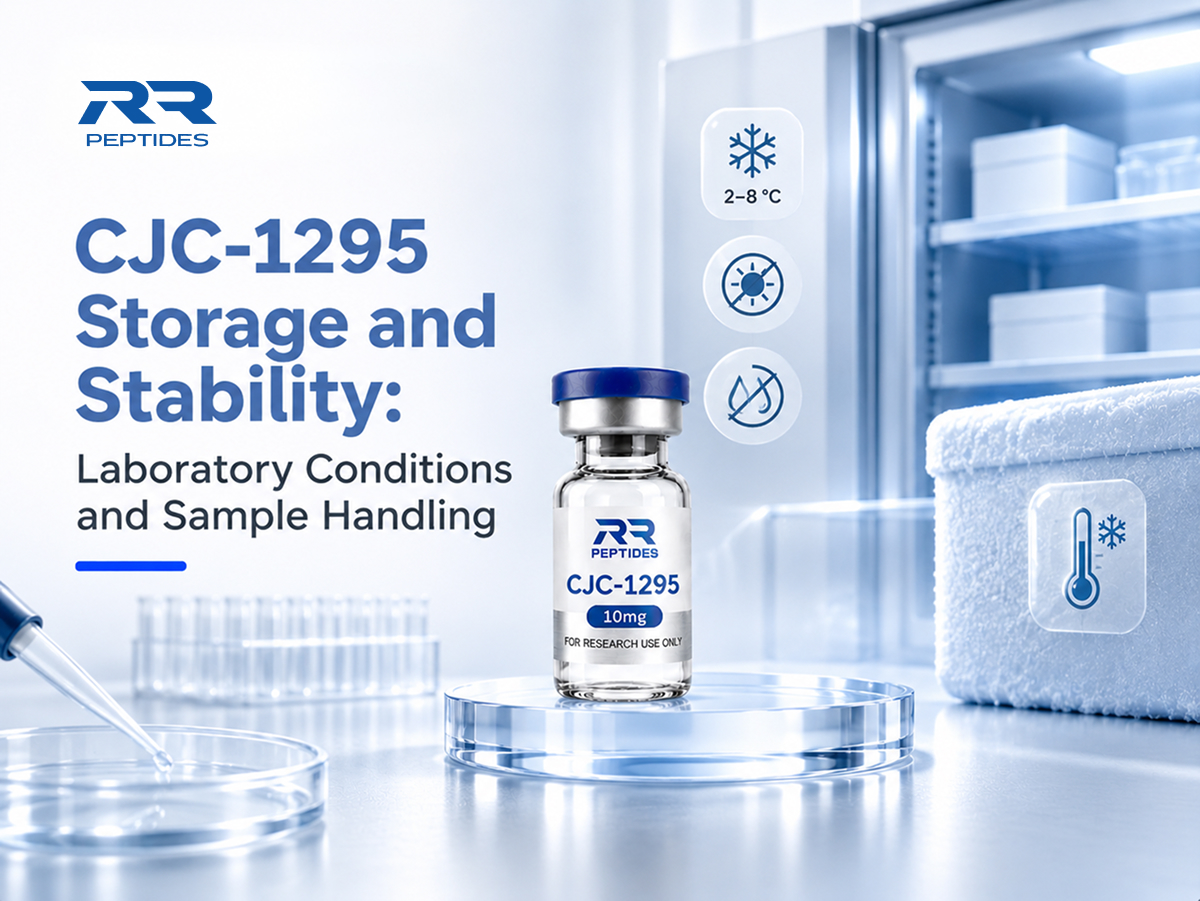
For CJC-1295 storage and stability, the first instruction should come from compound-specific, lot-specific documentation supported by actual testing. General laboratory references commonly describe sealed, dry, frozen storage for long-term peptide preservation, sometimes around minus twenty degrees Celsius or colder. Such practices are not a validated CJC-1295 shelf-life claim, and no single temperature should be presented as universally correct.
A Documentation-First Storage Workflow
For CJC-1295 storage and stability, a laboratory can organize its approach around verifiable controls:
At receipt: Record lot number, stated molecular identity, packaging condition, arrival time, and available shipping temperature evidence.
Before placement: Review the supplier’s specified conditions and internal acceptance criteria; flag missing or contradictory instructions.
During storage: Use a qualified storage unit with documented monitoring, controlled access, and an appropriate alarm response.
Before opening: Allow temperature equilibration while the container remains sealed when the validated procedure requires it, reducing the risk of condensation.
After use: Record exposure events, container openings, sample transfers, and remaining inventory.
This approach makes CJC-1295 storage and stability traceable. A temperature label alone cannot explain whether a vial experienced an excursion during transport or repeated warming during laboratory access.
Storage Conditions Are Not Expiry Dates
A certificate of analysis may establish identity or purity at a particular testing date. It does not automatically demonstrate how long the sample will meet specifications. An expiry or retest date requires an appropriate supporting stability program, including defined storage conditions and acceptance limits.
CJC-1295 storage and stability claims should distinguish a recommended handling condition from a verified duration of acceptable quality. If no validated stability period exists, researchers should avoid inventing one from general peptide guidance or a supplier’s marketing description.
Why Canadian Logistics Matter
Canadian shipments can experience winter freezing, summer heat, delays at distribution hubs, and repeated movement between indoor and outdoor environments. The relevant question is not whether the destination is cold, but whether the actual package remained within its specified conditions. Insulated packaging without temperature records does not prove an uninterrupted cold chain.
How Can Temperature and Moisture Affect Sample Integrity?
Temperature Changes Reaction Rates
Higher temperatures can accelerate many degradation reactions, although the rate and dominant pathway depend on the molecule and its environment. Freezing may slow certain reactions but does not prevent all changes. For aqueous samples, freezing can also alter local solute concentrations and expose material to interfaces during ice formation.
CJC-1295 storage and stability experiments should therefore compare defined conditions instead of relying on the vague labels “cold” and “room temperature.” Investigators need actual temperature ranges, exposure durations, container details, and a baseline measurement. A sample that passes one short excursion study may still lack evidence supporting months of storage.
Moisture Is Especially Relevant to Dried Samples
Residual moisture can influence chemical reactions and physical properties in lyophilized material. Water can enter through a damaged closure or during an opening event when the container is colder than the surrounding air. Visible droplets are an obvious warning, but small changes in water content may be invisible.
In CJC-1295 storage and stability studies, moisture testing can help determine whether changes in purity coincide with changes in the dried product’s water content. Karl Fischer analysis is one established method for quantifying water, provided the method is appropriate for the formulation and available sample amount.
Situation
What may happen
Practical research response
Warm delivery vehicle
Unrecorded thermal exposure
Review shipping evidence and quarantine if required
Cold vial opened immediately
Condensation enters the container
Follow validated sealed-equilibration procedures
Damaged closure
Moisture or contaminants enter
Inspect, document, and assess against rejection criteria
Repeated freezer access
Multiple temperature excursions
Monitor exposure history and minimize unnecessary retrieval
Aqueous sample repeatedly frozen
Concentration shifts or physical changes
Assess recovery and avoid unsupported reuse assumptions
Light and Oxygen Add Complexity
Light may promote changes in susceptible chemical groups, while oxygen exposure can contribute to oxidation in some peptides. The importance of either pathway depends on sequence, impurities, packaging, and formulation.
For CJC-1295 storage and stability, a controlled comparison should change one factor at a time whenever feasible. Otherwise, investigators cannot tell whether a decline followed heat, moisture, light, or an interaction between several stresses.
An Excursion Is a Question, Not a Verdict
In CJC-1295 storage and stability, a short temperature excursion does not prove that a sample is ruined. Equally, a vial that looks normal after warming cannot be presumed acceptable. Decisions should follow predefined limits and, when necessary, confirmatory analysis. This evidence-based distinction is especially important when shipping records are incomplete.
Explore growth hormone signaling and IGF-1 regulation in endocrine research with CJC-1295 10mg.
What Handling Practices Help Reduce Degradation?
Build a Repeatable Chain of Custody
In CJC-1295 storage and stability, quality can be lost through inconsistent handling. A sample may move from a receiving desk to temporary refrigeration, then to a freezer, then to an analytical bench. Each transfer creates opportunities for temperature exposure, labeling errors, or contamination. A concise standard operating procedure makes these events visible.
CJC-1295 storage and stability benefits from a chain-of-custody record identifying who received the material, where it was stored, and when it was accessed.
Separate Dry-Material Handling From Solution Handling
Dissolving a lyophilized peptide introduces a new chemical environment. Solvent composition, pH, concentration, container surfaces, and time in solution may change stability. A storage statement for dry material cannot simply be transferred to a prepared solution. Reconstitution procedures should be developed for legitimate analytical use and supported by method-specific evidence.
CJC-1295 storage and stability protocols should clearly identify whether each test refers to dry powder, a prepared analytical solution, or a reference standard.
Reduce Unnecessary Exposure
The following practices help laboratories maintain consistency without pretending to eliminate every risk:
Label each container with an unambiguous identifier, preparation date, and relevant storage conditions.
Use clean, compatible tools and containers appropriate to the analytical method.
Limit unnecessary openings and transfers, especially when moisture uptake is possible.
Consider single-use analytical aliquots when supported by validated recovery and stability data.
Record deviations immediately rather than reconstructing them from memory later.
Discard or quarantine questionable material according to laboratory procedures.
In CJC-1295 storage and stability work, aliquoting may reduce repeated handling of a parent sample, but it also creates new surfaces and transfer losses. Laboratories should verify that the process does not introduce more variability than it prevents.
Do Not Confuse Clean Appearance With Sterility
A clear solution or intact vial is not evidence of microbial safety. Analytical purity testing and sterility testing address different questions. Health Canada has warned about contamination and quality problems in unauthorized injectable peptides sold online. Laboratory material should never be represented as suitable for human or veterinary administration merely because it has a research label or an attractive certificate.
Explore growth hormone signaling and IGF-1 regulation in endocrine research with CJC-1295 10mg.
How Can Researchers Monitor CJC-1295 Sample Quality?
Start With a Baseline
Stability monitoring is meaningful only when investigators know what the material looked like analytically at the beginning. An initial sample can establish identity, purity profile, concentration, and other relevant characteristics. Later measurements can then be compared against that baseline using predefined criteria.
CJC-1295 storage and stability testing should employ methods that can detect meaningful change rather than simply reproduce the expected main peak.
Quality question
Possible analytical method
What the result does not prove
Is the expected molecule present?
Mass spectrometry with suitable reference data
That the entire sample is pure
Have related impurities increased?
Stability-indicating HPLC or UHPLC
That every impurity is identified
Has recovered concentration changed?
Validated quantitative assay
That all losses represent chemical degradation
Has dried material absorbed water?
Validated Karl Fischer moisture analysis
That the peptide is otherwise chemically intact
Are particles or aggregation present?
Suitable physical characterization
That invisible chemical changes are absent
Is microbial contamination present?
Appropriate microbiological methods
That chemical identity or potency is established
Read Certificates of Analysis Carefully
A certificate of analysis is useful when it identifies the batch, test method, specifications, results, and testing date. However, a single purity percentage may omit the impurity profile, assay uncertainty, and evidence of identity. It also cannot substitute for a time-course study performed under the intended storage conditions.
CJC-1295 storage and stability evaluation should treat a COA as one piece of evidence. Laboratories may need independent verification when the compound is central to a study, especially if DAC status, salt form, or sequence identity is unclear.
Design a Stability-Indicating Comparison
A defensible laboratory study includes an initial reference, defined storage conditions, scheduled observations, and acceptance limits established before results are examined. Testing should use sufficiently selective methods to distinguish the intact peptide from relevant degradation products. Replicate measurements and appropriate controls help separate analytical noise from genuine change.
For CJC-1295 storage and stability, the most useful output is not simply “stable” or “unstable.” It is a documented statement identifying the material, condition, observation period, method, and measured change.
Canadian Quality and Regulatory Boundaries
Health Canada has specifically identified CJC-1295 among unauthorized injectable peptide products and warned that “research use only” wording does not automatically make a product legal to sell or import. The agency has also reported contamination and mislabeling problems involving unauthorized peptides. These concerns reinforce the importance of traceable procurement and independent quality assessment.
Canadian CJC-1295 storage and stability research should follow applicable institutional and regulatory requirements. A laboratory quality result does not constitute Health Canada authorization, and a product marketed for research must not be assumed appropriate for clinical use.
Is Lyophilized CJC-1295 Automatically Stable for Years?
No. In CJC-1295 storage and stability, lyophilization can improve preservation, but a specific shelf life requires evidence for the actual compound, formulation, packaging, and storage condition. General peptide recommendations cannot establish a multi-year expiry date.
Is Minus Twenty Degrees Celsius Always Required?
Not necessarily. Frozen storage is common in peptide research, but a universal temperature cannot be assigned without validated product-specific information. Follow documented requirements and record actual conditions.
Can a Sample Be Used After a Shipping Delay?
A delay alone cannot establish acceptability. Review temperature records, packaging integrity, time outside specified conditions, and laboratory acceptance criteria. When uncertainty remains, quarantine or additional analysis may be appropriate.
Does a White Powder Mean the Peptide Is Intact?
No. Many chemical changes are invisible. CJC-1295 storage and stability assessments rely on suitable analytical measurements, not powder color or visual appearance alone.
Are Dry and Reconstituted Samples Equally Stable?
No assumption of equivalence is justified. Aqueous conditions introduce pH, solvent, concentration, microbial, and surface-interaction variables. Prepared analytical solutions need their own validated handling and stability procedures.
Can HPLC Purity Confirm Complete Sample Quality?
No. HPLC may detect relevant impurities, but identity, recovered concentration, moisture, and contamination require other evidence. The method must also be capable of separating expected degradation products.
Does a Research Label Remove Canadian Regulatory Requirements?
No. Health Canada states that research-use labeling does not automatically exempt peptide products from Canadian law. Laboratories should verify their specific activities and obligations before procurement or use.
Conclusion
CJC-1295 storage and stability is fundamentally a problem of traceability, chemical identity, environmental control, and measurement. Lyophilization, cold storage, and careful handling may support sample preservation, but none establishes a universal expiry date or guarantees that a material remains unchanged.
Researchers can explore the RR Peptides catalog and review available product documentation as part of a broader quality assessment. Before using any material in legitimate laboratory research, confirm its molecular identity, evaluate the supporting analytical evidence, and apply appropriate Canadian institutional and regulatory requirements.
The most reliable CJC-1295 storage and stability decisions come from documented conditions, validated methods, and clearly stated uncertainty, not visual inspection or unsupported storage claims.
Disclaimer: All products and compounds discussed are intended strictly for laboratory and research purposes. This article is provided for educational and informational purposes only. This article is not medical advice, therapeutic guidance, or instructions for human administration.
×
Subscribe & Get 10% Off!
Enter your email address below to subscribe to our newsletter and receive an instant 10% OFF discount coupon code sent directly to your inbox!
Thank you for subscribing! Your 10% discount coupon has been sent to your email. Please check your inbox!