A growth hormone result is only a snapshot of a moving biological system. Within the same day, circulating concentrations may rise sharply, fall toward baseline, and rise again. That variability complicates endocrine research.
CJC-1295 growth hormone signaling research examines how a synthetic growth hormone-releasing hormone (GHRH) analogue affects this dynamic network. Key questions concern timing, feedback, biomarkers, and physiological variation.
For Canadian investigators exploring these questions, RR Peptides offers research-focused product information to review alongside published studies and laboratory documentation. Explore its catalog while checking molecular identity and institutional requirements. This article approaches CJC-1295 growth hormone signaling research through endocrine models and measurement strategy, rather than repeating product comparisons or making unsupported claims about human benefits.
What Is the GHRH–Growth Hormone Signaling Axis?
Three Levels of Endocrine Communication
The growth hormone axis connects the hypothalamus, anterior pituitary, and peripheral tissues. Hypothalamic neurons release GHRH into portal circulation, delivering a stimulatory signal to pituitary somatotrophs. Those cells release growth hormone (GH), which reaches tissues through systemic circulation. The liver and other tissues subsequently produce insulin-like growth factor I (IGF-I) in response to GH signaling.
The process is not one-way. Somatostatin inhibits pituitary GH release, while circulating hormones participate in feedback that modifies future secretion. Sleep, nutritional status, age, sex, and metabolic conditions influence the resulting pattern. CJC-1295 growth hormone signaling research must therefore consider the axis as a regulated system rather than a continuously operating hormone pump.
Component
Principal role
Useful research observation
Hypothalamus
Coordinates GHRH and somatostatin signals
Timing and regulatory context
Pituitary somatotroph
Produces and releases GH
Secretory pulses and receptor responses
Circulating GH
Transmits endocrine signals to tissues
Serial concentrations and pulse characteristics
Liver and peripheral tissues
Generate IGF-I and other responses
Downstream biomarker patterns
Feedback networks
Modify further hormone release
Adaptation across observation periods
Why Pulsatility Changes Interpretation
GH secretion is episodic. Its concentration depends on the time since the previous pulse, the magnitude of that pulse, and the rate of hormone clearance. Consequently, samples minutes apart may differ without intervention.
In CJC-1295 growth hormone signaling research, sampling design becomes part of the scientific question. A single post-exposure result might reflect an ordinary pulse. Repeated samples, suitable controls, and prespecified analysis are needed to separate intervention-associated changes from background fluctuations. CJC-1295 growth hormone signaling research involving secretory dynamics needs frequent GH sampling.
Researchers commonly distinguish three concepts:
Pulse frequency: How often detectable secretory events occur.
Pulse amplitude: How large individual hormone excursions appear.
Integrated exposure: How much circulating hormone is observed across a defined interval.
These describe different properties. CJC-1295 growth hormone signaling research benefits when investigators state which property they intend to test before collecting samples.
Feedback Is Part of the Outcome
IGF-I is also regulatory. Alongside other signals, it contributes to regulatory feedback affecting the GH axis. A sustained change in one biomarker can coincide with compensatory changes elsewhere. Interpreting the axis requires attention to these interacting processes, not just the highest observed hormone concentration.
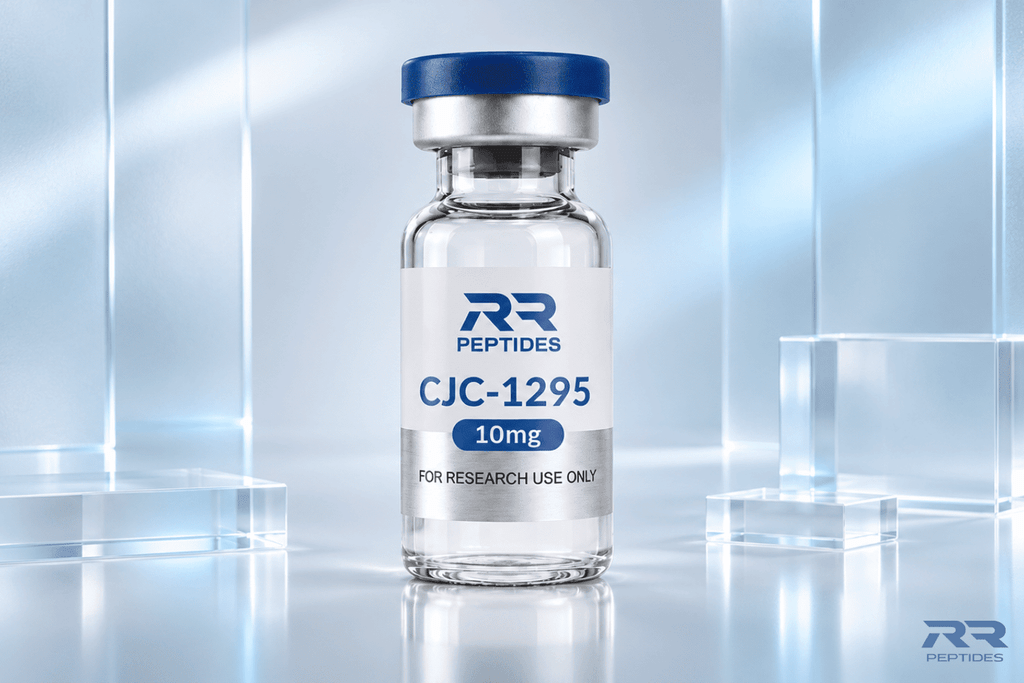
Explore growth hormone signaling and IGF-1 regulation in endocrine research with CJC-1295 10mg.
Why Is CJC-1295 Studied in Growth Hormone Research?
A Question About Sustained Stimulation
Native GHRH has a short circulating lifetime, limiting the duration of its systemic exposure. The original CJC-1295 was developed as a longer-acting GHRH analogue incorporating a drug affinity complex (DAC) designed to associate covalently with albumin. This property allowed investigators to examine whether prolonged analogue exposure could sustain GH and IGF-I responses.
CJC-1295 growth hormone signaling research is consequently relevant to a broader endocrine question: what happens to a naturally pulsatile system when an upstream stimulatory signal persists longer than usual? Answering requires average concentrations and secretion patterns.
What Early Human Studies Actually Measured
In 2006, Teichman and colleagues reported two randomized, double-blind, placebo-controlled studies involving healthy adults aged 21 to 61. The trials examined the original DAC-containing compound, with study durations of 28 and 49 days. Primary measurements included GH and IGF-I concentrations, exposure over time, and pharmacokinetic parameters.
After a single administration, investigators observed mean GH increases of approximately twofold to tenfold lasting at least six days, and mean IGF-I increases of roughly 1.5-fold to threefold lasting nine to eleven days. The estimated analogue half-life was 5.8 to 8.1 days. These group findings do not predict individual outcomes.
For CJC-1295 growth hormone signaling research, the significance lies in documented endocrine responses and their duration. The studies did not establish improved recovery, athletic performance, longevity, or treatment efficacy for a disease.
The Importance of a Separate Pulsatility Study
A later investigation examined whether GH secretion retained its pulsatile character during exposure to the long-acting analogue. Researchers collected samples every twenty minutes during overnight twelve-hour periods in healthy men, comparing patterns before and after exposure. They reported that pulsatile secretion persisted despite increased GH output.
This informs CJC-1295 growth hormone signaling research. Sustained stimulation need not eliminate episodic hormone release. Nevertheless, persistence of pulses does not prove that every feedback mechanism or physiological rhythm remains unchanged.
Avoiding an Identity Error
Commercial products labeled “CJC-1295 without DAC” often refer to modified GRF(1-29), which is chemically distinct from the original DAC-containing compound. Long-acting pharmacokinetic results cannot automatically transfer. CJC-1295 growth hormone signaling research must identify the actual molecule under investigation before comparing data across publications.
How Does GHRH Receptor Signaling Affect Growth Hormone Release?
From Receptor Activation to a Cellular Response
GHRH receptors are expressed on pituitary somatotrophs and belong to the class B family of G protein-coupled receptors. Receptor activation predominantly engages stimulatory G proteins, which activate adenylyl cyclase and increase intracellular cyclic adenosine monophosphate (cAMP). This second messenger supports signaling processes involved in GH synthesis and secretion.
These established features of GHRH biology provide a framework for CJC-1295 growth hormone signaling research. However, a pathway demonstrated for endogenous GHRH is not automatically direct evidence for every proposed action of a particular synthetic analogue. Detailed receptor claims need direct experiments.
Secretory Granules and Calcium Dynamics
Somatotrophs store GH in intracellular secretory granules. Signaling pathways influence electrical activity, calcium movement, and the machinery that releases these granules. Researchers may observe an early secretory response without proving that new GH molecules have been synthesized at the same rate.
CJC-1295 growth hormone signaling research can distinguish immediate secretion from longer-term regulation by measuring events at different timescales. Short experiments assess release; extended models assess transcription and feedback.
A useful experimental sequence is:
Confirm that the experimental cells express functional GHRH receptors.
Establish baseline cAMP signaling and spontaneous hormone release.
Compare the tested analogue against suitable vehicle and pathway controls.
Measure receptor-related responses before evaluating downstream GH secretion.
Repeat measurements to assess variability and potential adaptation.
The Difference Between Direct and Indirect Effects
An increase in GH following analogue exposure supports an upstream endocrine effect. It does not establish that the analogue directly binds GH receptors in the liver, stimulates IGF-I receptors, or acts on every downstream tissue. Those mechanisms require different assays.
For CJC-1295 growth hormone signaling research, keeping this distinction clear prevents a common interpretation error: assigning a downstream biological effect directly to the initiating compound. GH can activate receptor-associated JAK2-STAT5 signaling, while IGF-I activates its own receptor networks. Those processes are distinct receptor pathways.
Competing Signals Shape the Response
Somatostatin provides inhibitory control over pituitary secretion. Ghrelin-related pathways can also influence GH output, but they operate through different receptors. A GHRH analogue should not be described as a ghrelin receptor agonist without direct evidence.
CJC-1295 growth hormone signaling research is stronger when experiments account for these competing influences. A change in hormone concentration reflects the integrated state of the system, not merely the presence of one stimulatory molecule.
Explore growth hormone signaling and IGF-1 regulation in endocrine research with CJC-1295 10mg.
Which Biomarkers Are Measured in CJC-1295 Studies?
Choosing Biomarkers That Answer Different Questions
GH and IGF-I are complementary measurements. GH is released episodically from the pituitary and may change rapidly. Circulating IGF-I generally varies more slowly and reflects downstream endocrine activity, although it is influenced by additional physiological factors.
CJC-1295 growth hormone signaling research should select biomarkers according to the hypothesis. A study of longer-term endocrine response may emphasize serial IGF-I measurements, while still recognizing that neither marker directly proves clinical benefit.
Biomarker or measure
Main research question
Interpretation limitation
Serial GH
Does the pituitary response change over time?
Strongly affected by natural pulses
GH pulse frequency
Are secretory events occurring more often?
Requires dense sampling and modeling
GH pulse amplitude
Are individual bursts different?
Depends on analytical assumptions
GH area under the curve
Does integrated exposure change?
Does not identify the underlying mechanism
Circulating IGF-I
Is downstream endocrine activity altered?
Influenced by age, nutrition, and physiology
Analogue concentration
How does compound exposure evolve?
Exposure does not equal biological effectiveness
Why Timing Can Matter More Than One Number
Imagine a study collecting GH samples only at baseline and several hours later. If the later sample coincides with a natural pulse, the result could exaggerate an intervention-associated change. If it falls between pulses, a genuine change in overall secretion might be missed.
For CJC-1295 growth hormone signaling research, dense sampling can improve interpretation when pulse dynamics are central. The published overnight study used twenty-minute intervals, illustrating how investigators can examine secretory patterns rather than relying on isolated values. These are research protocols, not clinical recommendations. Preserving the full time series helps reveal delayed peaks, short excursions, and patterns hidden by summary statistics.
Assay Quality and Reference Context
Laboratories should document assay methods, detection limits, precision, sample handling, and possible interference. GH assays may differ in their recognition of circulating molecular forms. IGF-I results also require interpretation against appropriate reference populations because concentrations vary with age and other factors.
CJC-1295 growth hormone signaling research becomes difficult to reproduce when investigators report numerical changes without explaining measurement methods. An interpretability checklist includes:
Record the assay platform and relevant validation information.
Define baseline and follow-up sampling windows in advance.
Report variability rather than only group averages.
Account for biological factors that can influence endocrine measurements.
Separate exploratory findings from predefined primary outcomes.
Biomarkers Are Not Clinical Endpoints
A rise in IGF-I does not independently establish stronger muscles, faster recovery, or healthier aging. These outcomes require separate studies with validated functional measures and adequate follow-up. Similarly, an absence of serious events in a small short-term trial cannot establish long-term safety.
CJC-1295 growth hormone signaling research should therefore describe hormone changes as biochemical observations. This avoids turning measurements into untested claims.
Explore growth hormone signaling and IGF-1 regulation in endocrine research with CJC-1295 10mg.
What Are the Limitations of Current Growth Hormone Research?
Small Studies Cannot Resolve Every Question
The early human trials provided evidence of sustained GH and IGF-I responses to the original DAC-containing analogue. However, their limited size, short duration, and focus on healthy adults restrict conclusions about long-term outcomes, uncommon adverse effects, and people with different endocrine conditions.
CJC-1295 growth hormone signaling research also faces a translation problem. Findings from cultured cells, animal models, and healthy volunteers cannot be assumed to predict responses in clinical populations. Each model has distinct limitations.
Methodological Gaps Worth Addressing
Future investigations would benefit from standardized molecular characterization, independently validated assays, transparent statistical plans, and appropriate control groups. Hormone pulsatility introduces additional challenges because analytical choices can affect how secretory events are identified. Independent replication across laboratories helps determine whether observed differences depend on assay choice or material characteristics.
Researchers considering CJC-1295 growth hormone signaling research should prioritize questions such as:
Are the tested materials chemically identical across study groups?
Were GH samples frequent enough to characterize the stated outcome?
Were IGF-I changes evaluated against relevant baseline variability?
Did the study measure feedback or merely assume its behavior?
Are conclusions supported by direct measurements rather than analogy?
Canadian Scientific and Regulatory Context
Canadian involvement in the original scientific literature is documented through researchers affiliated with ConjuChem in Montréal, Québec. That historical connection should not be confused with Canadian authorization of the compound for medical use.
Health Canada has explicitly identified CJC-1295 among unauthorized injectable peptide drugs and warned about online marketing for anti-aging, bodybuilding, and wellness. Its April 2026 advisory emphasized that unauthorized products have not undergone the agency’s assessment of safety, efficacy, and quality. Research-oriented labeling does not automatically remove regulatory obligations.
For Canadian CJC-1295 growth hormone signaling research, laboratories should verify procurement, importation, institutional oversight, and any applicable regulatory requirements. Supplier documentation may assist scientific evaluation but does not substitute for authorization or independent analytical verification.
The Value of Negative Findings
Not every experiment will demonstrate a measurable endocrine change. A well-controlled negative result can identify limits of assay sensitivity, model responsiveness, or an initial hypothesis. Publishing them reduces selective reporting.
CJC-1295 growth hormone signaling research advances through reproducible measurements, not through assuming that every exposure produces a desired outcome.
No. CJC-1295 is a synthetic analogue associated with the GHRH pathway, which acts upstream of pituitary GH secretion. It is not GH itself. CJC-1295 growth hormone signaling research examines the resulting endocrine responses rather than direct replacement of circulating hormone.
Why Do Researchers Measure Both GH and IGF-I?
GH reflects pituitary secretion and fluctuates substantially. IGF-I is a downstream marker that generally changes more gradually. Together, they provide complementary information, although neither alone establishes clinical effectiveness.
Can One GH Test Establish a Response?
Usually not for questions about pulsatility. One concentration may reflect ordinary timing. Repeated measurements and suitable controls are more informative when the research question concerns hormone dynamics.
Does CJC-1295 Eliminate Normal GH Pulses?
A published investigation of the original long-acting analogue reported that GH pulsatility persisted during prolonged stimulation. This does not prove that all physiological regulation remained unchanged.
Do Findings for CJC-1295 Without DAC Match the Original Studies?
Not automatically. The non-DAC label often refers to modified GRF(1-29), a different molecular entity. CJC-1295 growth hormone signaling research should confirm compound identity before applying published pharmacokinetic findings.
Are Higher Hormone Levels Evidence of Better Health?
No. Hormone concentrations are research biomarkers. Claims about performance, recovery, longevity, or treatment require independent clinical evidence and appropriate safety assessment.
What Is the Main Canadian Consideration?
Health Canada has warned about unauthorized injectable peptide drugs, including CJC-1295. CJC-1295 growth hormone signaling research requires legitimate scientific oversight, not unauthorized medical marketing.
Conclusion
CJC-1295 growth hormone signaling research is most informative when it treats the GH axis as a dynamic network of pulses, receptor signals, downstream biomarkers, and feedback. The original DAC-containing analogue has demonstrated prolonged GH and IGF-I responses in limited human studies, but those biochemical findings do not establish broad therapeutic benefits.
For Canadian laboratories, RR Peptides provides research-focused product information that can be reviewed alongside primary publications, analytical documentation, and institutional procedures. Explore the RR Peptides catalog to identify relevant research materials while independently confirming molecular identity and applicable Canadian requirements.
Ultimately, CJC-1295 growth hormone signaling research benefits from precise questions, appropriate sampling, and transparent reporting. The strongest conclusions describe what investigators actually measured, acknowledge what remains uncertain, and keep scientific curiosity separate from unsupported health claims.
Disclaimer: All products and compounds discussed are intended strictly for laboratory and research purposes. This article is provided for educational and informational purposes only. This article is not medical advice, therapeutic guidance, or instructions for human administration.
×
Subscribe & Get 10% Off!
Enter your email address below to subscribe to our newsletter and receive an instant 10% OFF discount coupon code sent directly to your inbox!
Thank you for subscribing! Your 10% discount coupon has been sent to your email. Please check your inbox!