Two peptide products may share a familiar name while behaving very differently in an experiment. For growth hormone-releasing hormone analogues, a small structural modification can influence circulation time, sampling schedules, and the interpretation of hormone measurements.
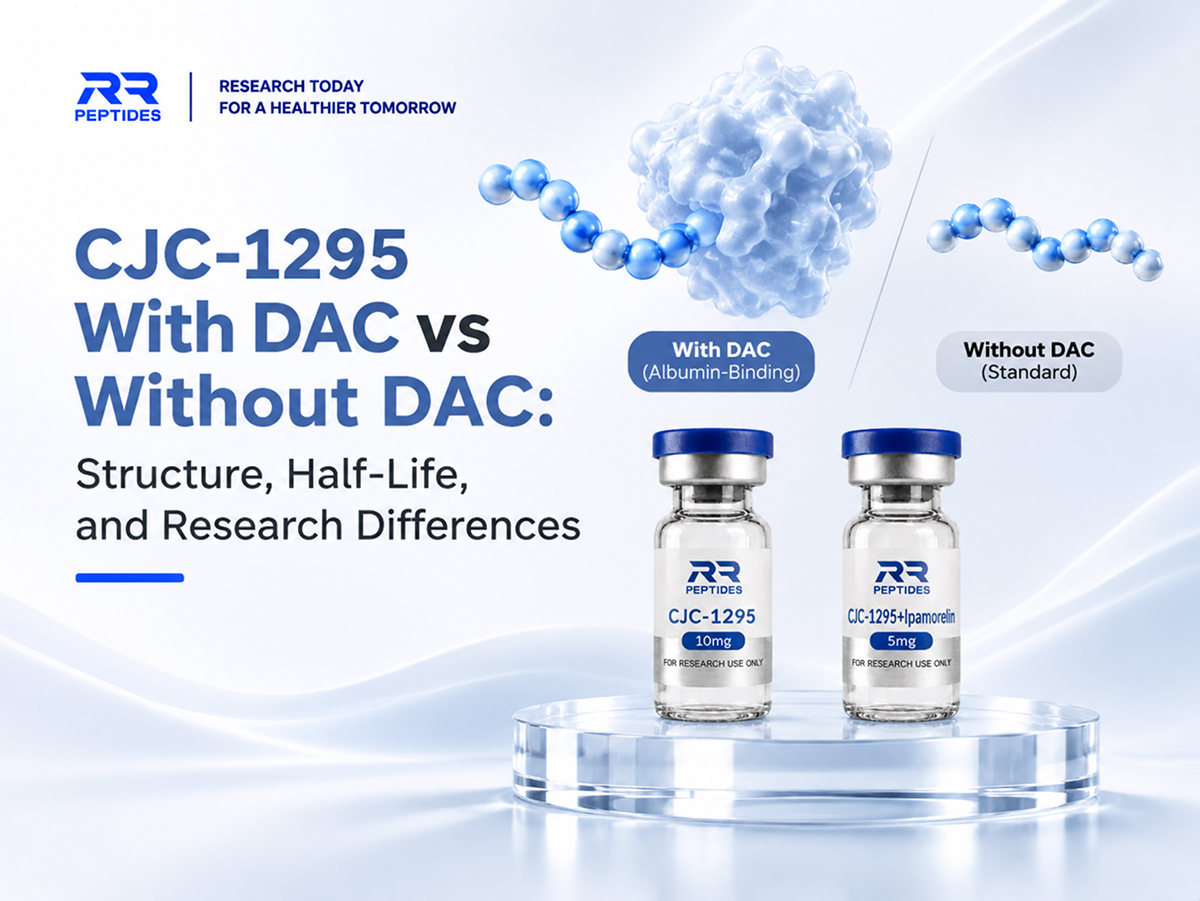
The comparison of CJC-1295 with DAC vs without DAC begins with molecular identity. The original CJC-1295 was developed with a drug affinity complex that enables binding to circulating albumin. Products described as “without DAC” generally refer to modified GRF(1-29), a related but distinct analogue. They should not be assumed to share pharmacokinetic findings.
For Canadian laboratories, RR Peptides provides a CJC-1295 (No DAC) 10mg research listing and product information to review alongside analytical records and institutional requirements. This guide explains CJC-1295 with DAC vs without DAC through published evidence, careful terminology, and practical study design rather than unsupported claims about human benefits.
DAC means drug affinity complex. In the original long-acting analogue, a reactive chemical group was incorporated to enable covalent attachment to serum albumin. Albumin is an abundant circulating protein that can influence the distribution and clearance of associated molecules. Binding was intended to prolong analogue exposure.
The chemistry matters when discussing CJC-1295 with DAC vs without DAC. The DAC-containing molecule is not simply a different brand name for the shorter peptide. Its additional functional group changes molecular identity and creates a different disposition pathway after exposure.
Albumin association is often described as extending half-life, but that description needs qualification. Covalent binding, clearance of albumin-associated material, and persistence of biological activity are related yet distinct processes. A measured concentration of compound does not prove uninterrupted receptor stimulation throughout the same interval.
Why GHRH Analogues Are Investigated
Growth hormone-releasing hormone, or GHRH, originates in the hypothalamus and acts on receptors in the anterior pituitary. Activation of these receptors contributes to growth hormone secretion. The system is regulated by somatostatin, metabolic conditions, sleep, and feedback from downstream hormones.
Both forms discussed in CJC-1295 with DAC vs without DAC are associated with research into this endocrine pathway. Neither form is growth hormone itself. Researchers therefore measure downstream pituitary responses rather than treating peptide exposure as equivalent to direct GH replacement.
Clarifying Names Before Comparing Results
Commercial terminology is inconsistent. “CJC-1295” in the foundational clinical literature refers to the long-acting DAC-containing analogue. “CJC-1295 without DAC” commonly denotes modified GRF(1-29), sometimes called Mod GRF(1-29). Researchers should confirm the actual sequence, terminal modifications, molecular mass, and analytical identity rather than relying on a catalogue title.
For CJC-1295 with DAC vs without DAC, three checks are particularly useful:
Identity: Does the analytical characterization match the stated molecular structure?
Modification: Is the albumin-binding DAC group present or absent?
Documentation: Are purity, lot information, and methods available for independent review?
These checks reveal whether studies actually compare related compounds.
Explore growth hormone signaling and IGF-1 regulation in endocrine research with CJC-1295 10mg.
How Does CJC-1295 With DAC Differ From Without DAC?
The two names are frequently placed together in product comparisons, yet the scientifically meaningful distinction is chemical structure. The DAC-containing compound includes a feature designed for albumin association. The non-DAC material commonly marketed under the same family name lacks that feature and is usually described as modified GRF(1-29).
In CJC-1295 with DAC vs without DAC, structural differences influence what can be inferred from published studies. Albumin-bound exposure cannot establish non-DAC clearance. Likewise, a receptor assay using modified GRF cannot demonstrate the clinical pharmacokinetics of the DAC compound.
Comparison point
With DAC
Without DAC
Common research identity
Original long-acting CJC-1295
Usually modified GRF(1-29)
Albumin-binding design
Present
Absent
Exposure profile
Prolonged in published human studies
Expected to be shorter; exact values require evidence
Strongest published evidence
Human GH, IGF-I, and pharmacokinetic measurements
Primarily mechanistic or analogue-specific information
Main interpretation risk
Assuming persistence guarantees benefit
Borrowing half-life results from DAC studies
Shared Signaling Does Not Mean Identical Behaviour
Both are discussed as GHRH receptor agonist analogues. The receptor belongs to the G protein-coupled receptor family and primarily engages stimulatory G proteins, cyclic AMP, and related pathways in pituitary somatotrophs. However, comparable pathway labels do not establish equal receptor affinity, potency, exposure, or endocrine responses.
CJC-1295 with DAC vs without DAC must therefore separate pharmacodynamics from pharmacokinetics. Pharmacodynamics concerns what the compound does to a biological system. Pharmacokinetics concerns what happens to the compound as it distributes and disappears. A longer circulating lifetime does not automatically mean a stronger immediate receptor response.
What the Evidence Can Support
The best-known controlled human findings concern the DAC-containing compound. A 2006 study by Teichman and colleagues evaluated healthy adults in randomized, placebo-controlled, double-blind trials. The investigators measured circulating GH, insulin-like growth factor I, and pharmacokinetic parameters. These findings cannot be assigned to a non-DAC product simply because its commercial name includes CJC-1295.
For CJC-1295 with DAC vs without DAC, an evidence table should distinguish directly measured outcomes from expectations based on chemistry. Without matched experiments, claims of superior safety or efficacy remain unsupported.
Avoiding a False Either-Or Choice
For CJC-1295 with DAC vs without DAC, the question is not which analogue is universally superior. A researcher interested in sustained systemic exposure may ask different questions from someone examining short-term receptor signaling in cultured cells. Material selection should follow the hypothesis, available evidence, and authorized laboratory procedures rather than a marketing comparison.
How Does DAC Influence Peptide Half-Life?
What Half-Life Actually Measures
Elimination half-life describes the time associated with a fifty percent decline in a measured concentration during an appropriate elimination phase. It does not mean the molecule stops functioning after that interval. It cannot establish storage life or clinical benefit.
In CJC-1295 with DAC vs without DAC, the half-life distinction is especially important because the original analogue was engineered for prolonged circulation. Its albumin-binding design changes exposure compared with peptides cleared rapidly through ordinary biological processes.
Findings From the Original Human Trials
The 2006 controlled studies reported an estimated elimination half-life of approximately 5.8 to 8.1 days for DAC-containing CJC-1295 after single administration. Investigators also reported mean GH increases of approximately twofold to tenfold for six days or longer, and mean IGF-I increases of approximately 1.5-fold to threefold for nine to eleven days. These figures describe particular study conditions and measured group responses.
They are not interchangeable measurements. Peptide half-life describes compound disposition; GH and IGF-I profiles describe downstream biology. In CJC-1295 with DAC vs without DAC, presenting all three as one continuous “effect duration” would misrepresent the research.
Why a Precise Non-DAC Number Is Difficult
Online comparisons often assign a short numerical half-life to the non-DAC analogue without identifying a validated human pharmacokinetic study of that exact material. It is reasonable to expect shorter systemic persistence without albumin binding, but a specific number should not be asserted as universally established.
Researchers evaluating CJC-1295 with DAC vs without DAC should ask whether a reported value was measured in humans, animals, plasma, buffer, or an in vitro degradation assay. Those settings cannot be treated as equivalent. Researchers should also distinguish the apparent terminal elimination phase from early distribution, because estimates depend on sampling density, assay sensitivity, statistical models, and the compound measured in circulation.
A reliable half-life comparison requires:
Confirmed molecular identity for each tested compound.
A validated analytical assay with adequate sensitivity.
Sampling that captures the relevant elimination phases.
Appropriate pharmacokinetic modeling and uncertainty estimates.
Comparable conditions and transparent reporting of variability.
Interpreting Exposure Without Oversimplification
In CJC-1295 with DAC vs without DAC, longer half-life can increase exposure without establishing greater benefit or lower risk. Endocrine feedback, receptor responsiveness, and individual biological variability influence the resulting hormone profile. Endocrine regulation still matters.
For CJC-1295 with DAC vs without DAC, exposure curves should be interpreted alongside GH pulsatility and IGF-I measurements whenever the research question concerns endocrine activity. A single concentration at one time point rarely captures the complete response.
Explore growth hormone signaling and IGF-1 regulation in endocrine research with CJC-1295 10mg.
How May the Two Forms Differ in Research Design?
Matching the Model to the Hypothesis
Study design should begin with the question being tested. A cell-based experiment might investigate receptor activation, cyclic AMP accumulation, or signaling kinetics. A preclinical endocrine model may assess hormone release and feedback. A human study, when appropriately authorized, may characterize exposure and serial biomarkers. Each approach answers different questions.
CJC-1295 with DAC vs without DAC requires especially careful design because albumin availability differs between experimental systems. A serum-free cell assay may not reproduce the same binding conditions encountered in circulation. Researchers should document albumin concentration and matrix composition rather than assuming that all models reflect the intended DAC behavior.
Choosing Meaningful Measurements
Research objective
Potential endpoint
Key design consideration
Confirm molecular identity
Mass spectrometry and chromatographic profile
Distinguish DAC and non-DAC structures
Examine receptor signaling
cAMP or functional receptor assay
Control for receptor expression and matrix
Investigate albumin association
Binding characterization
Specify albumin source and conditions
Study endocrine response
Serial GH and IGF-I measurements
Account for natural hormone fluctuations
Compare systemic exposure
Concentration-time profiles
Use validated, compound-specific assays
For CJC-1295 with DAC vs without DAC, a carefully selected endpoint matters more than collecting many unrelated measurements. Each assay should test a prediction arising from structural differences.
Controls That Prevent Misleading Conclusions
Relevant controls may include vehicle-only conditions, a known GHRH pathway reference, matched analytical blanks, and independent verification of compound identity. Where feasible, blinding and predefined exclusion criteria reduce interpretation bias. Replication across separate batches can reveal whether results depend on material quality.
In CJC-1295 with DAC vs without DAC experiments, researchers should also consider these confounders:
Albumin concentration: Changes the environment available for DAC association.
Sampling schedule: Can miss brief responses or exaggerate apparent persistence.
Assay cross-reactivity: May distort peptide or hormone measurements.
Species differences: Can alter clearance and endocrine regulation.
Product nomenclature: Can conceal differences between tested structures.
Comparing Hormonal Profiles Responsibly
GH secretion occurs in pulses influenced by sleep, age, sex, nutrition, and somatostatin. An isolated GH value may therefore be misleading. Serial sampling, prespecified analysis, and appropriate control groups are more informative than selecting the largest observed concentration.
CJC-1295 with DAC vs without DAC should be studied with comparable analytical standards even when the compounds require different sampling windows. Sampling windows should reflect differing exposure profiles.
Explore growth hormone signaling and IGF-1 regulation in endocrine research with CJC-1295 10mg.
What Should Researchers Consider When Comparing Both Forms?
Evidence Quality Before Product Claims
The central evidence gap is the lack of robust, directly comparable human studies establishing how the two specifically identified materials differ across matched conditions. The DAC-containing analogue has published controlled endocrine and pharmacokinetic observations. The non-DAC label, however, is used inconsistently, and claims about its exact half-life often lack clear primary documentation.
CJC-1295 with DAC vs without DAC should therefore be framed as a comparison of established structural features and unequal evidence bases, not as a proven ranking of therapeutic outcomes. Increased GH or IGF-I concentrations are biochemical findings, not proof of muscle growth, improved recovery, or anti-aging benefits.
Quality and Reproducibility
A study can fail even when its conceptual model is sound if the tested material is misidentified or inadequately characterized. Researchers should request lot-specific identity and purity information, review storage conditions, and document sample handling. Analytical documentation supports interpretation but does not substitute for independent verification when the experiment requires it.
Before beginning CJC-1295 with DAC vs without DAC work, a laboratory can review:
Scientific rationale: Does the hypothesis require prolonged albumin-associated exposure?
Material identity: Is the precise molecular structure confirmed?
Analytical suitability: Can the method distinguish each compound reliably?
Evidence boundaries: Are conclusions limited to the measured endpoints?
Regulatory review: Are procurement and experimental activities permitted?
Canadian Regulatory Context
Health Canada has named CJC-1295 among unauthorized injectable peptide products and has warned that unauthorized products have not undergone its assessment for safety, efficacy, and quality. In April 2026, the agency again cautioned Canadians about injectable peptides promoted online. The phrase “for research use only” does not automatically exempt products from Canadian regulatory requirements.
For Canadian CJC-1295 with DAC vs without DAC investigations, institutions should independently assess product classification, procurement, importation, research approvals, and permitted activities. Scientific interest does not establish authorization for human use. A supplier’s certificate of analysis also does not demonstrate Health Canada approval.
Questions Worth Pursuing Next
Future CJC-1295 with DAC vs without DAC research could test albumin-binding kinetics, compare receptor signaling with verified materials, and examine endocrine feedback. Independent replication would reduce uncertainty.
CJC-1295 with DAC vs without DAC remains a useful scientific comparison precisely because its unanswered questions are specific. Better studies will explain which differences arise from structure, which arise from experimental conditions, and which remain unsupported assumptions.
DAC refers to a drug affinity complex modification incorporated into the original long-acting analogue. It changes the molecular structure and enables albumin association. The designation should not be treated as a cosmetic naming difference.
Is the Non-DAC Version Identical to Original CJC-1295?
No. Products called “without DAC” commonly refer to modified GRF(1-29). Researchers should verify the actual molecular identity because commercial naming conventions are inconsistent.
What Half-Life Has Been Published for the DAC Form?
Controlled human studies reported approximately 5.8 to 8.1 days for the original DAC-containing compound. These findings should not be transferred to non-DAC material without direct evidence.
Does a Longer Half-Life Mean Better Results?
No. Prolonged circulation can change exposure, but it does not establish superior clinical outcomes, safety, or receptor potency. Those questions require separate controlled investigations.
Do Both Forms Act Through GHRH Signaling?
Both are discussed as GHRH analogues, but shared pathway classification does not establish identical pharmacokinetics or responses. Compound-specific functional evidence remains important.
Can Researchers Compare Them Using One Blood Sample?
Usually not meaningfully for dynamic endocrine questions. GH secretion is pulsatile, and exposure profiles may differ. Serial sampling and appropriate controls provide stronger evidence.
Are These Products Authorized for Human Use in Canada?
Health Canada has warned about unauthorized injectable CJC-1295 products. Researchers must verify current regulatory requirements; research labeling alone does not authorize sale or human administration.
For CJC-1295 with DAC vs without DAC, the strongest conclusion is that structure and evidence must be evaluated together. Neither a commercial name nor a single hormone measurement can resolve the comparison.
Conclusion
CJC-1295 with DAC vs without DAC describes a meaningful molecular distinction, not merely two labels for an interchangeable peptide. DAC enables albumin association and was associated with prolonged exposure in early human studies. The non-DAC material commonly marketed as modified GRF(1-29) should be evaluated on its own analytical and experimental evidence.
Canadian researchers can review RR Peptides‘ CJC-1295 (No DAC) 10mg product information and available documentation while confirming institutional and Health Canada requirements. Compare primary studies and verify the tested material.
Ultimately, CJC-1295 with DAC vs without DAC is most useful when investigators distinguish verified chemistry, measured pharmacokinetics, and unproven clinical claims. Transparent methods and carefully bounded conclusions make that distinction scientifically valuable.
Disclaimer: All products and compounds discussed are intended strictly for laboratory and research purposes. This article is provided for educational and informational purposes only. This article is not medical advice, therapeutic guidance, or instructions for human administration.
×
Subscribe & Get 10% Off!
Enter your email address below to subscribe to our newsletter and receive an instant 10% OFF discount coupon code sent directly to your inbox!
Thank you for subscribing! Your 10% discount coupon has been sent to your email. Please check your inbox!