Growth hormone does not flow through the bloodstream at a constant rate. Its release changes throughout the day as the brain, pituitary gland, and peripheral tissues exchange signals. That rhythmic regulation explains why a single hormone measurement rarely tells the whole story about endocrine activity.
The CJC-1295 mechanism of action is investigated through its relationship with growth hormone-releasing hormone (GHRH), a hypothalamic signal that stimulates pituitary growth hormone (GH) secretion. The original CJC-1295 molecule was designed to persist longer than native GHRH, allowing researchers to study prolonged endocrine stimulation. Importantly, measurable hormone changes are not proof of improved health, physical performance, or clinical effectiveness.
For Canadian laboratories exploring this pathway, RR Peptides provides research-focused product information and available material documentation. Researchers can review these resources alongside original publications, confirm the exact compound being considered, and follow institutional requirements. Understanding the CJC-1295 mechanism of action begins with distinguishing established receptor biology from findings demonstrated specifically for the peptide.
GHRH originates primarily from hypothalamic neurons and travels through the pituitary portal circulation to the anterior pituitary. There, it binds GHRH receptors on somatotroph cells, which synthesize and release GH. Somatostatin provides an opposing inhibitory influence, while sleep, nutrition, age, and metabolic signals modify the overall response.
The CJC-1295 mechanism of action is generally discussed within this established GHRH receptor pathway. CJC-1295 is a synthetic GHRH analogue, not growth hormone itself. Rather than supplying GH directly, the analogue is investigated for its ability to stimulate endogenous pituitary secretion. The distinction matters because an intact, responsive pituitary is part of the proposed biological process.
Why Molecular Identity Matters
The original long-acting CJC-1295 includes a drug affinity complex, or DAC, designed to form a covalent association with circulating albumin. Albumin binding can extend systemic exposure compared with native GHRH, which is cleared rapidly. This prolonged availability is central to interpreting the original human pharmacokinetic studies.
However, products advertised as “CJC-1295 without DAC” are often described as modified GRF(1-29). They are not chemically identical to the DAC-containing compound studied in the foundational trials. The CJC-1295 mechanism of action cannot be characterized accurately if results from these different materials are combined without qualification.
Research term
What it describes
Why the distinction matters
Native GHRH
Endogenous hypothalamic releasing hormone
Provides the physiological reference pathway
CJC-1295 with DAC
Long-acting synthetic GHRH analogue
Albumin association changes exposure duration
Modified GRF(1-29)
Shorter-acting analogue often marketed without DAC
Cannot inherit DAC-specific half-life findings
Growth hormone
Pituitary hormone released downstream
Not the same molecule as a GHRH analogue
A Pathway, Not a Guaranteed Outcome
The CJC-1295 mechanism of action concerns a sequence of possible events: analogue exposure, GHRH receptor stimulation, intracellular signaling, and GH release. Each event can be studied separately. A documented rise in circulating GH supports endocrine activity, but it does not establish every proposed intracellular step in humans or predict downstream clinical benefits. The CJC-1295 mechanism of action requires receptor specificity.
Explore growth hormone signaling and IGF-1 regulation in endocrine research with CJC-1295 10mg.
What Happens After GHRH Receptor Activation?
Receptor Binding and Cyclic AMP
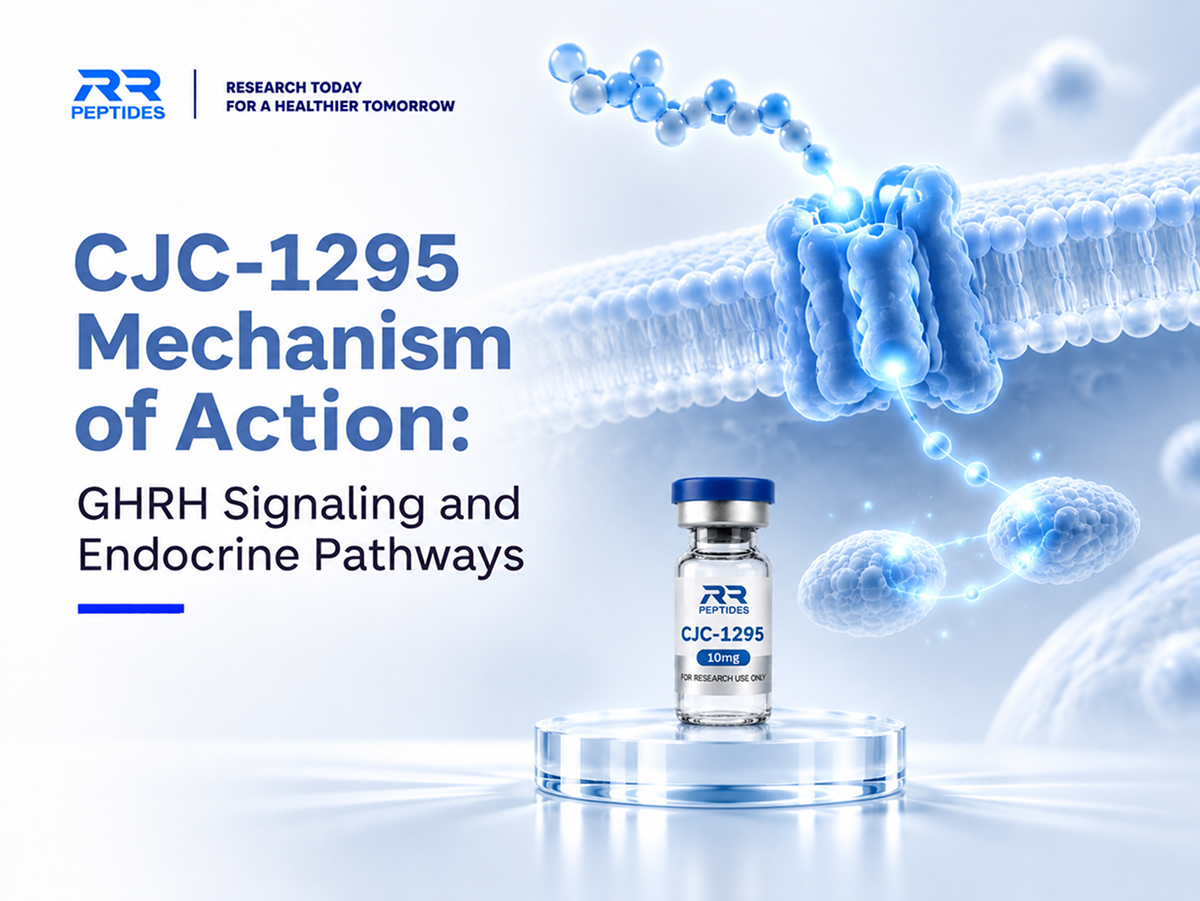
The GHRH receptor belongs to the class B family of G protein-coupled receptors. When activated in pituitary somatotrophs, it predominantly couples to stimulatory G proteins. This activates adenylyl cyclase, increasing intracellular cyclic adenosine monophosphate (cAMP). The second messenger engages protein kinase A and related signaling processes that influence GH production and secretion.
This receptor biology supplies the mechanistic framework for the CJC-1295 mechanism of action. Yet a framework is not equivalent to direct proof that every step has been measured following exposure to a particular CJC-1295 preparation. Receptor-specific assays remain necessary when making compound-specific molecular claims.
Calcium and Secretory Vesicles
GH is stored in secretory granules within somatotroph cells. Receptor signaling can influence membrane excitability, calcium entry, and the machinery that releases stored hormone. Calcium dynamics interact with cAMP signaling, creating a coordinated secretory response rather than a single linear switch.
Researchers may examine several linked events:
Receptor engagement: Determine whether signaling depends on functional GHRH receptors.
Second-messenger response: Measure cAMP accumulation and downstream kinase activity.
Cellular excitability: Evaluate calcium-related changes in somatotroph models.
Hormone secretion: Quantify GH released into experimental media or circulation.
Feedback adaptation: Test whether repeated stimulation changes subsequent responsiveness.
The CJC-1295 mechanism of action should be evaluated across these levels rather than inferred from one hormone assay. An increase in plasma GH does not reveal whether receptor abundance, signaling efficiency, or secretory reserve changed independently.
Synthesis Versus Release
An immediate increase in GH secretion can reflect release of existing hormone stores. Longer-term changes may also involve transcriptional regulation of GH synthesis. These processes operate on different timescales, so a study measuring blood GH over hours cannot automatically establish altered gene expression in pituitary cells.
The CJC-1295 mechanism of action is therefore better described as GHRH-pathway stimulation with downstream endocrine effects, while the exact contribution of synthesis, secretion, and adaptation depends on the experimental design. Strong studies distinguish acute cellular signaling from sustained hormonal responses. The CJC-1295 mechanism of action involves multiple steps.
Why Somatostatin Still Matters
Somatostatin inhibits GH secretion and helps shape physiological pulses. GHRH receptor stimulation occurs within this competing regulatory environment, not in isolation. Other signals, including ghrelin-related pathways, can also modify GH release. CJC-1295 should not be described as a ghrelin receptor agonist simply because both pathways affect the same hormone.
How May CJC-1295 Influence Growth Hormone Signaling?
Evidence From Controlled Human Studies
In 2006, Teichman and colleagues published two randomized, placebo-controlled, double-blind studies involving healthy adults aged 21 to 61. The trials lasted 28 and 49 days and evaluated the original long-acting analogue. Their main endpoints included circulating GH, insulin-like growth factor I (IGF-I), and pharmacokinetic measures.
After single administration in those studies, mean GH concentrations increased approximately twofold to tenfold for at least six days, while mean IGF-I increased about 1.5-fold to threefold for nine to eleven days. The estimated half-life ranged from 5.8 to 8.1 days. These findings are relevant to the CJC-1295 mechanism of action because they demonstrate prolonged endocrine responses under specific experimental conditions.
Crucially, these figures do not apply automatically to products without DAC, other formulations, or different populations. They also do not establish improvements in muscle mass, recovery, longevity, or disease outcomes.
Hormone Pulses and Sustained Exposure
GH secretion is naturally pulsatile. Researchers therefore asked whether prolonged stimulation would simply elevate average concentrations or also alter the pattern of release. A separate investigation collected blood every twenty minutes during overnight twelve-hour sampling periods in healthy men. It reported that pulsatile GH secretion persisted during exposure to the long-acting analogue.
The CJC-1295 mechanism of action must account for this distinction: higher overall GH exposure does not necessarily mean that normal pulse timing disappears. Conversely, the persistence of pulses does not establish that all aspects of endocrine feedback remain unchanged.
Measurement
What it helps answer
Important caution
Mean GH concentration
Is circulating GH higher overall?
Sensitive to sampling schedules
GH pulse amplitude
Are individual secretory bursts larger?
Requires frequent blood sampling
GH pulse frequency
Does the rhythm change?
Depends on analytical definitions
IGF-I concentration
Is downstream endocrine signaling altered?
Not a direct measure of clinical benefit
Analogue half-life
How long does compound exposure persist?
Not the same as duration of therapeutic effect
Interpreting Pharmacokinetics Carefully
A long half-life describes persistence of the studied compound in circulation. Pharmacodynamics describes the biological response produced during that exposure. The two are related but not interchangeable. Hormone concentrations can be shaped by receptor responsiveness, feedback signals, and tissue-level regulation even when analogue exposure remains measurable.
For CJC-1295 mechanism of action studies, reporting both compound concentrations and serial hormone profiles is more informative than quoting a single peak value. It also helps distinguish sustained stimulation from an isolated endocrine fluctuation. The CJC-1295 mechanism of action requires longitudinal measurements.
Explore growth hormone signaling and IGF-1 regulation in endocrine research with CJC-1295 10mg.
Which Downstream Endocrine Pathways Are Studied?
The GH and IGF-I Axis
Once secreted, GH binds growth hormone receptors in multiple tissues. This activates signaling pathways that include Janus kinase 2 (JAK2) and signal transducer and activator of transcription 5 (STAT5). The liver is an important source of circulating IGF-I, although other tissues also produce IGF-I locally. IGF-I then interacts with its own receptor and signaling networks.
The CJC-1295 mechanism of action is indirect at this stage. CJC-1295 is investigated as an upstream GHRH analogue; it is not established as a direct activator of GH receptors or IGF-I receptors. Observed IGF-I changes are downstream endocrine findings, not evidence that the peptide binds those peripheral receptors.
Downstream Signaling Is Not One Pathway
GH and IGF-I influence overlapping but distinct molecular systems. Researchers frequently discuss:
JAK2-STAT5: A major pathway associated with GH receptor signaling and transcriptional responses.
PI3K-AKT: A pathway involved in cellular growth, metabolism, and survival signals downstream of receptors including IGF-I receptors.
MAPK signaling: A network that can contribute to proliferation and other context-dependent cellular responses.
Negative feedback: GH and IGF-I participate in mechanisms that influence subsequent hypothalamic and pituitary activity.
These are established features of endocrine biology, not proof that CJC-1295 directly controls every listed pathway. The CJC-1295 mechanism of action should not be expanded into claims about specific tissue benefits without direct experimental evidence.
Metabolism and Physiological Context
GH participates in nutrient handling, lipolysis, and glucose regulation. IGF-I has important roles in growth-related signaling. However, changing a circulating biomarker does not determine the direction or magnitude of an individual’s overall metabolic response. Baseline endocrine status, age, and other physiological factors can modify results.
The CJC-1295 mechanism of action is therefore most responsibly investigated with carefully selected endpoints. Researchers should separate a demonstrated endocrine change from hypotheses about body composition, athletic performance, or healthy aging. Such outcomes require their own adequately controlled studies.
Feedback Prevents Simple Predictions
Elevated GH and IGF-I can participate in feedback mechanisms that modify hypothalamic and pituitary signaling. Somatostatin, endogenous GHRH, and metabolic factors remain relevant even during prolonged analogue exposure. The CJC-1295 mechanism of action should be viewed as an intervention within a regulated network rather than a permanent instruction to produce more hormone.
Explore growth hormone signaling and IGF-1 regulation in endocrine research with CJC-1295 10mg.
The most immediate challenge is ensuring that different studies examine the same molecular entity. DAC-containing CJC-1295 and materials marketed without DAC should not share pharmacokinetic conclusions by default. Researchers need accurate identity, purity, formulation, and analytical characterization before comparing results.
For the CJC-1295 mechanism of action, a product name is not sufficient experimental documentation. Independent identity testing and clearly reported methods help distinguish genuine biological differences from material variability.
Gaps Between Biomarkers and Outcomes
The foundational human studies were relatively small and short. They support prolonged changes in GH and IGF-I for the original analogue but cannot establish long-term safety, rare adverse effects, or broad clinical efficacy. An endocrine biomarker is useful precisely because it measures a defined response; it should not be treated as a substitute for clinical outcomes.
Important unanswered questions include:
Which receptor-specific effects have been directly demonstrated for each chemically distinct analogue?
How does prolonged exposure affect feedback regulation over longer periods?
Are responses consistent across sex, age, and baseline endocrine conditions?
What changes occur in glucose regulation and other safety-relevant markers?
Can independent laboratories reproduce findings using verified material?
Which outcomes, if any, translate beyond measurable hormone concentrations?
The CJC-1295 mechanism of action requires answers that connect molecular observations with validated endocrine measures. Longer studies alone will not resolve uncertainty if compound identity and analytical methods remain inconsistent.
Canadian Regulatory Context
Canada has a historical connection to early CJC-1295 development through Montréal-based research affiliations. However, scientific participation does not imply current authorization. Health Canada has identified CJC-1295 among unauthorized injectable peptide drugs and has warned Canadians about products marketed online for bodybuilding, anti-aging, or wellness.
For Canadian CJC-1295 mechanism of action investigations, research institutions should verify applicable procurement, importation, and oversight requirements. A “research use only” label does not automatically exempt a product from Canadian law or establish suitability for human administration. Supplier documentation is not equivalent to regulatory approval.
What Better Experiments Would Show
Future work would benefit from receptor-selective assays, matched pharmacokinetic comparisons, serial hormone measurements, independent replication, and transparent reporting of negative findings. Functional evidence should be distinguished from changes in gene expression or circulating biomarkers. Safety questions deserve the same methodological rigor as mechanistic questions.
The CJC-1295 mechanism of action remains a legitimate research topic, but conclusions should reflect the strength of the specific experiment rather than the popularity of the compound.
No. It is described as a synthetic analogue of GHRH, a signal that acts upstream of pituitary GH secretion. The original long-acting compound is chemically distinct from GH itself. The CJC-1295 mechanism of action remains investigational.
Is CJC-1295 With DAC Identical to CJC-1295 Without DAC?
No. The DAC-containing compound has an albumin-binding design. Products marketed without DAC generally refer to a different, shorter-acting analogue. Evidence for one should not be automatically assigned to the other.
Does CJC-1295 Act Through the Ghrelin Receptor?
The proposed primary pathway involves GHRH receptor signaling, not direct ghrelin receptor agonism. Ghrelin-related pathways can also influence GH release, but they are biologically distinct.
What Does cAMP Do in This Pathway?
Cyclic AMP is a second messenger produced after activation of stimulatory G proteins. It participates in intracellular signaling that supports GH synthesis and secretion in pituitary somatotrophs.
Do Higher IGF-I Levels Prove Better Recovery?
No. IGF-I is a downstream endocrine biomarker. Recovery, muscle growth, and other functional outcomes require direct, controlled assessment rather than inference from a hormone concentration.
Are the Early Human Results Relevant to Canadian Researchers?
Yes, as scientific evidence concerning the original DAC-containing analogue. Their interpretation still depends on study limitations, exact material identity, and compliance with applicable Canadian regulations.
What Is the Main Research Limitation?
The CJC-1295 mechanism of action is supported by established GHRH biology and limited human endocrine studies, but compound-specific molecular detail and long-term clinical outcomes remain incompletely characterized.
Conclusion
The CJC-1295 mechanism of action is best understood as an investigation of prolonged GHRH-pathway stimulation and its endocrine consequences. Receptor signaling can engage cAMP-related processes in pituitary somatotrophs, followed by GH release and downstream IGF-I responses. Early human studies documented sustained hormonal changes for the original DAC-containing compound, but those findings do not establish broad clinical benefits or long-term safety.
For Canadian laboratories, careful interpretation requires verified molecular identity, appropriate analytical methods, and awareness of Health Canada requirements. RR Peptides provides research-oriented product information and available documentation that investigators can review alongside primary studies and institutional guidance. Explore those resources to support evidence-based planning rather than unsupported therapeutic assumptions.
Future CJC-1295 mechanism of action studies should distinguish direct receptor effects from downstream responses, document feedback over time, and prioritize independent replication. Scientific clarity depends on asking precise questions and keeping every conclusion within the limits of the evidence.
Disclaimer: All products and compounds discussed are intended strictly for laboratory and research purposes. This article is provided for educational and informational purposes only. This article is not medical advice, therapeutic guidance, or instructions for human administration.
×
Subscribe & Get 10% Off!
Enter your email address below to subscribe to our newsletter and receive an instant 10% OFF discount coupon code sent directly to your inbox!
Thank you for subscribing! Your 10% discount coupon has been sent to your email. Please check your inbox!