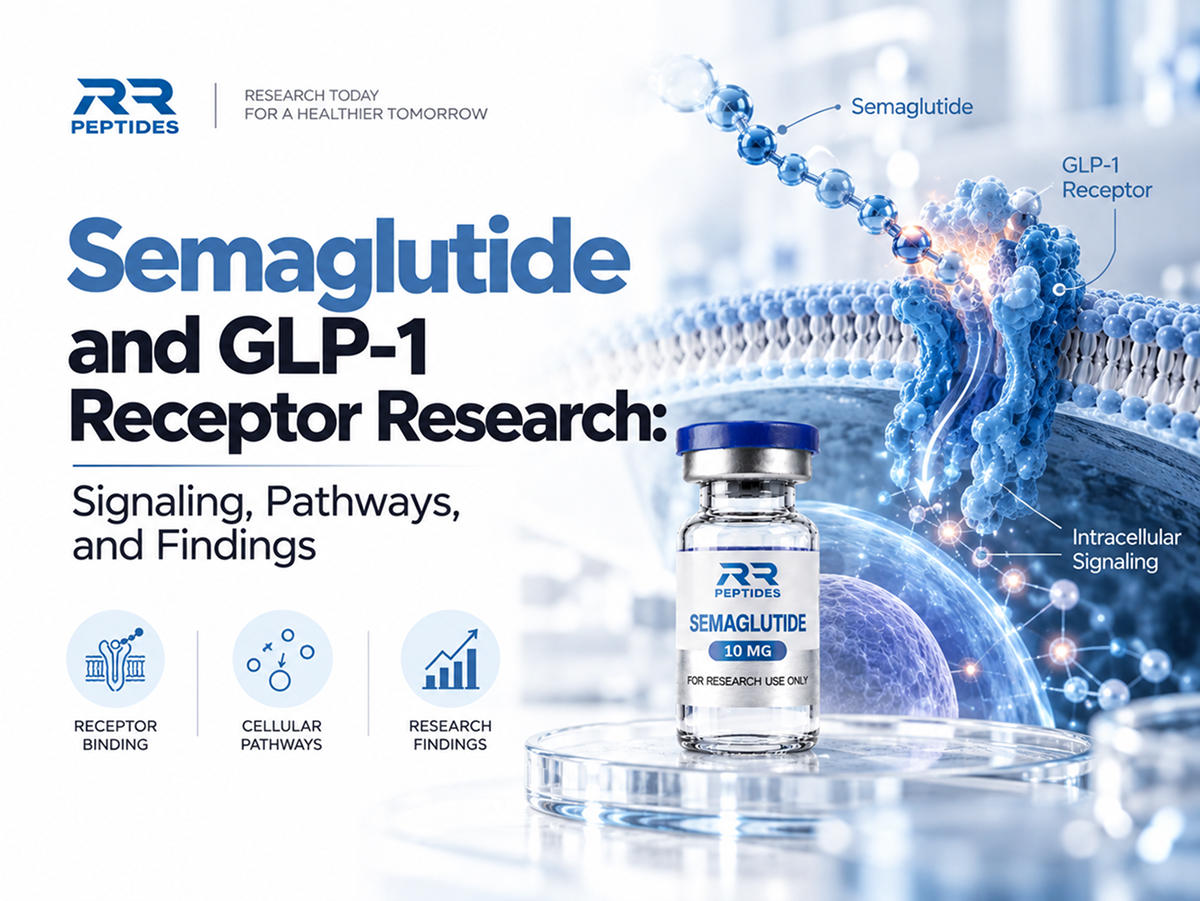
Semaglutide and GLP-1 receptor research has become an important area of molecular pharmacology because semaglutide provides a well-characterized example of a peptide-based GLP-1 receptor agonist. Researchers can use experimental models to examine receptor activation, intracellular signaling, second-messenger responses, downstream pathways, and metabolic outcomes.
The interesting part is that receptor activation is only the beginning. A measurable response does not automatically explain how that response occurred or whether the same observation would appear in another biological system. Researchers therefore examine multiple stages of the pathway, from receptor interaction and cAMP production to phosphorylation, gene expression, cellular behavior, and metabolic endpoints.
RR Peptides provides research-focused information on peptide materials, analytical characterization, and laboratory study areas. For researchers investigating Semaglutide and GLP-1 receptor research, combining supplier documentation with primary literature, appropriate controls, and validated analytical methods can provide a stronger foundation for experimental interpretation.
For Canadian laboratories, research planning should also consider institutional procedures, laboratory safety requirements, sample traceability, procurement documentation, and applicable Canadian regulatory frameworks. Research-use material should not be interpreted as an authorized therapeutic product simply because it is commercially available.
Introduction to Semaglutide and GLP-1 Receptor Research
Semaglutide and GLP-1 receptor research examines the relationship between semaglutide and the glucagon-like peptide-1 receptor, commonly abbreviated as GLP-1R. GLP-1R belongs to the class B family of G protein-coupled receptors and is associated with signaling processes relevant to metabolic biology.
Researchers can study this receptor at several levels. Molecular experiments may investigate receptor interaction, while cellular models can examine intracellular signaling. Tissue and organismal models introduce additional biological complexity and allow researchers to investigate broader metabolic responses.
In Semaglutide and GLP-1 receptor research, the key is to avoid treating these models as interchangeable. A receptor assay can answer whether a receptor-associated response occurs, while a pancreatic cell model can provide information about cellular signaling. An animal model introduces integrated physiological processes that cannot be reproduced completely in an isolated cell system.
What researchers investigate
Common research questions include:
How does semaglutide interact with GLP-1R?
Which intracellular signals follow receptor activation?
How does cAMP signaling change under defined conditions?
Which downstream proteins or genes are affected?
How do different models respond to receptor activation?
Which metabolic endpoints can be measured reproducibly?
These questions make Semaglutide and GLP-1 receptor research broader than a single receptor assay. A well-designed study connects the research question to the model, endpoint, control strategy, and analytical method.
Research level
Main focus
Example endpoints
Molecular
Receptor interaction
Binding or receptor activation
Cellular
Signal transduction
cAMP, phosphorylation
Tissue
Metabolic response
Hormonal or metabolic markers
Organismal
Integrated physiology
Glucose, appetite, energy balance
A useful Semaglutide and GLP-1 receptor research framework begins with the scientific question rather than the expected result. This helps researchers decide whether a receptor assay, cellular system, tissue model, or integrated model is appropriate.
Semaglutide and GLP-1 receptor research also requires careful terminology. Semaglutide is a GLP-1 receptor agonist, while GLP-1 is an endogenous peptide hormone. They interact with the same receptor system but are not chemically identical molecules. Experimental comparisons should therefore clearly identify the material and conditions being evaluated.
Explore the research specifications and laboratory information available from RR Peptides for Semaglutide 10 mg.
Structure and Function of the GLP-1 Receptor
Understanding receptor structure provides the foundation for Semaglutide and GLP-1 receptor research. GLP-1R is a class B GPCR with an extracellular domain, seven-transmembrane region, and intracellular regions involved in signaling and receptor regulation.
The extracellular domain contributes to ligand recognition, while the transmembrane region participates in receptor activation and conformational changes. Intracellular regions can interact with signaling proteins and regulatory components involved in receptor activity, trafficking, and desensitization.
This structure creates several possible research questions. Researchers can examine ligand recognition, receptor activation, intracellular coupling, second-messenger production, and receptor regulation as separate experimental events.
Receptor features relevant to laboratory studies
Researchers may evaluate:
extracellular ligand-recognition regions;
transmembrane receptor architecture;
intracellular G protein coupling;
receptor phosphorylation;
receptor internalization;
receptor recycling and localization.
Receptor feature
Research relevance
Extracellular domain
Ligand recognition
Transmembrane region
Activation and conformational change
Intracellular loops
Signaling interactions
C-terminal region
Regulation and trafficking
Cellular localization
Response interpretation
A Semaglutide and GLP-1 receptor research experiment using an engineered receptor system can help isolate receptor-level activity. Native cells provide additional biological context but also introduce more variables. Differences in receptor expression, signaling proteins, and cellular state can influence the observed response.
Researchers in Semaglutide and GLP-1 receptor research should also distinguish receptor binding from downstream signaling. signaling. A binding result demonstrates an interaction, whereas a change in cAMP or phosphorylation provides information about downstream activity. These measurements answer different questions.
Semaglutide and GLP-1 receptor research can also examine how receptor activity changes over time. GPCRs may undergo phosphorylation, internalization, recycling, or altered signaling efficiency. Consequently, the duration of an experiment can affect the observed response.
Semaglutide is a long-acting GLP-1 receptor agonist. When it interacts with GLP-1R, receptor activation can promote intracellular signaling through G protein-associated pathways. In suitable experimental systems, this can increase intracellular cyclic adenosine monophosphate, or cAMP.
Semaglutide and GLP-1 receptor research often examines signaling as a sequence rather than a single event. The sequence may involve ligand recognition, receptor conformational change, intracellular coupling, cAMP production, downstream kinase activity, and cellular responses.
This approach helps researchers in Semaglutide and GLP-1 receptor research determine where an observed change occurs within the pathway. A proximal signaling event can provide different information from a downstream transcriptional or functional response.
Receptor-level observations can be especially useful when researchers need to distinguish direct signaling events from later cellular responses. Examining several stages of the pathway can provide a clearer picture of how an experimental response develops. This also allows researchers to identify whether different endpoints support the same mechanistic interpretation under controlled conditions.
Common signaling endpoints
Laboratories may measure:
intracellular cAMP;
phosphorylation of signaling proteins;
kinase activity;
gene expression;
protein abundance;
receptor localization;
secretion-related markers.
Signaling stage
Example endpoint
Receptor activation
Receptor-response assay
Second messenger
cAMP concentration
Protein signaling
Phosphorylation
Gene regulation
RNA or protein expression
Functional response
Cellular endpoint
Semaglutide and GLP-1 receptor research becomes more informative when several signaling levels are measured within the same model. For example, a reproducible cAMP response combined with downstream phosphorylation can provide more context than a single isolated measurement.
However, multiple endpoints do not automatically prove a complete mechanism. Signaling pathways are interconnected, and one molecular change can result from several upstream processes. Researchers should therefore connect each endpoint to the original hypothesis.
Receptor regulation is another important consideration. GPCR signaling can change through phosphorylation, internalization, recycling, and regulatory-protein interactions. Short experiments may capture early signaling events, whereas longer experiments can provide information about downstream adaptation.
Experimental comparisons with other GLP-1 receptor agonists can also be useful. However, these comparisons require consistent assay conditions, receptor expression, material characterization, observation periods, and endpoint definitions.
Downstream Metabolic Research Pathways
GLP-1 receptor signaling extends beyond the initial receptor event. Downstream research can involve pancreatic beta-cell signaling, glucose regulation, glucagon-associated processes, appetite-related pathways, lipid metabolism, and energy balance.
Semaglutide and GLP-1 receptor research can investigate these pathways using different biological systems. Cell models can isolate specific signaling events, while tissue and animal models introduce additional physiological interactions.
Glucose regulation research
Pancreatic beta-cell models are commonly relevant to studies of GLP-1-associated signaling. Researchers may examine cAMP, calcium-associated signaling, insulin-related markers, gene expression, and cellular responses under controlled glucose conditions.
Potential research endpoints include:
glucose-responsive signaling;
insulin-related markers;
cAMP activity;
calcium-associated responses;
beta-cell gene expression;
cellular metabolic markers.
The experimental glucose environment matters because cellular responses can change according to metabolic conditions. A response observed under one condition should not automatically be generalized to another.
Appetite and energy-balance pathways
Appetite and energy-balance research generally requires more complex models. Researchers may examine food intake, metabolic biomarkers, behavioral endpoints, central signaling markers, or interactions between metabolic tissues.
A molecular marker associated with appetite does not independently demonstrate a complete behavioral mechanism. Similarly, an animal response can involve multiple organs and regulatory systems that cannot be reproduced in an isolated cell assay.
Researchers should also consider how metabolic signals interact across different biological systems. Changes observed in isolated cells may represent only one component of a larger pathway. Comparing cellular findings with tissue or organismal observations can provide additional context, while still requiring careful attention to model-specific limitations, controls, and experimental conditions.
Pathway
Possible model
Example endpoint
Beta-cell signaling
Pancreatic cells
cAMP, insulin-related markers
Glucose regulation
Cell or animal models
Glucose-associated measurements
Appetite
Integrated models
Food intake or signaling markers
Lipid metabolism
Cell or animal models
Lipid-associated biomarkers
Energy balance
Organismal models
Energy intake and metabolic measures
Semaglutide and GLP-1 receptor research can also include cardiovascular-associated pathways. These systems involve interactions among vascular cells, cardiac tissues, metabolic status, neural regulation, and other signaling pathways. A single molecular marker should therefore not be treated as a complete cardiovascular outcome.
Canadian research environments may have additional institutional requirements depending on whether studies involve animals, human-derived materials, or other regulated research activities. Documentation and appropriate oversight should be established before experimentation begins.
Explore the research specifications and laboratory information available from RR Peptides for Semaglutide 10 mg.
Current Findings and Scientific Limitations
Current Semaglutide and GLP-1 receptor research supports the observation that semaglutide can activate GLP-1R-associated signaling in appropriate experimental systems. Molecular, cellular, tissue, animal, and clinical research can each contribute different forms of evidence.
In Semaglutide and GLP-1 receptor research, the strongest mechanistic interpretation usually comes from studies that connect receptor activation with reproducible intracellular signaling and clearly defined downstream endpoints. A study measuring only one marker may still provide useful information, but it offers less context than a study connecting multiple stages of the pathway.
Evidence should remain model-specific
A practical evidence framework separates:
molecular studies of receptor interaction;
cellular studies of intracellular signaling;
tissue studies that add structural context;
animal studies that evaluate integrated physiology;
clinical studies addressing human outcomes.
Semaglutide and GLP-1 receptor research should not collapse these evidence levels into one category. A cellular response can support a mechanistic hypothesis without establishing a human effect. Animal findings can provide broader biological information while still being affected by species-specific differences.
Another major limitation is experimental heterogeneity. Different laboratories may use different cell lines, receptor expression levels, sample preparations, assay methods, concentrations, observation periods, and controls. These variables can make apparently conflicting findings difficult to interpret without reviewing the underlying methodology.
Time and assay design
Another useful consideration is assay sensitivity and temporal resolution. Receptor signaling can change rapidly after ligand exposure, while transcriptional or metabolic responses may appear later. Researchers should match the sampling schedule to the biological process being investigated.
Early time points may capture second-messenger responses, whereas later measurements can provide information about gene expression, protein abundance, cellular adaptation, or functional outputs. Several time points can help distinguish transient signaling from sustained responses.
This approach is especially relevant when interpreting different experimental models because a response observed at one time point may not represent the full biological pattern. Careful documentation of sampling intervals, assay conditions, and endpoint definitions also makes studies easier to reproduce.
In Semaglutide and GLP-1 receptor research, temporal design can strengthen interpretation without implying that one experimental pattern represents every biological context. A clear timeline helps researchers connect receptor activation with downstream observations.
Material quality and reproducibility
Material characterization is equally important. Researchers should document identity, purity, batch information, formulation, storage conditions, preparation procedures, and analytical results where available.
Semaglutide and GLP-1 receptor research depends on knowing what material entered the experiment and whether it remained suitable for the intended analytical workflow. Differences in preparation or storage can introduce variability that may otherwise be attributed incorrectly to biological mechanisms.
Controls are also essential in Semaglutide and GLP-1 receptor research. Vehicle controls can help identify effects associated with the experimental matrix, while receptor-specific approaches can help evaluate whether a response depends on GLP-1R. Independent replication provides additional support when findings are variable.
Repeated experiments can help determine whether an observed response is consistent under similar conditions. Researchers may also compare results across batches, experimental days, or analytical runs to identify unexpected variability. Maintaining detailed records of these factors makes it easier to investigate discrepancies and evaluate whether differences are biological, methodological, or material-related.
Semaglutide and GLP-1 receptor research also has interpretive limitations because signaling pathways are interconnected. A change in one marker cannot automatically be interpreted as proof of an entire biological mechanism.
For Canadian laboratories, documentation should align with institutional quality systems and applicable requirements. Researchers should distinguish research-use materials from authorized medicines and should not translate experimental findings into human-use recommendations.
What does Semaglutide and GLP-1 receptor research study?
It examines how semaglutide interacts with GLP-1R and how receptor activation is associated with intracellular and downstream biological responses. Depending on the model, researchers may investigate cAMP, phosphorylation, gene expression, pancreatic signaling, glucose regulation, appetite-associated pathways, or metabolic outcomes.
Is semaglutide the same as GLP-1?
No. GLP-1 is an endogenous peptide hormone, whereas semaglutide is a modified GLP-1 receptor agonist. They interact with the same receptor system but are chemically distinct molecules.
Why is cAMP important?
cAMP is an important intracellular second messenger associated with GLP-1R signaling. Measuring cAMP can provide evidence of receptor-associated intracellular activity, although cAMP alone does not describe every downstream biological response.
Which research models can be used?
Researchers may use engineered receptor systems, cell cultures, pancreatic beta-cell models, tissue preparations, animal models, and clinical datasets. Each model provides different information and has specific limitations.
Can receptor signaling establish a therapeutic effect?
No. Receptor and cellular findings provide mechanistic information within defined experimental conditions. They do not independently establish therapeutic efficacy in humans.
Why does material characterization matter?
Identity, purity, formulation, batch consistency, storage history, and analytical characterization can influence experimental results. Documentation helps researchers determine whether differences between studies may be biological or material-related.
What should Canadian researchers consider?
Canadian laboratories should follow institutional procedures, laboratory safety requirements, applicable oversight frameworks, and relevant regulatory requirements. Animal and human research may require additional approvals depending on the study.
How can reproducibility be improved?
Researchers can improve reproducibility by defining the research question, using characterized material, selecting appropriate assays, establishing controls, documenting experimental conditions, and clearly reporting endpoints.
Why can different studies produce different results?
Differences can arise from cell type, receptor expression, material preparation, concentration, assay format, observation period, analytical sensitivity, or endpoint selection. Findings should therefore be interpreted alongside the methods used.
Final Research Perspective
Semaglutide and GLP-1 receptor research provides a useful framework for understanding how peptide-receptor interaction can connect with intracellular signaling and broader metabolic biology. The strongest interpretation comes from studies that clearly define the receptor system, model, analytical method, controls, and endpoints.
Researchers in Semaglutide and GLP-1 receptor research should separate molecular observations from cellular responses, tissue findings, animal data, and clinical evidence. This makes it easier to identify what a study actually demonstrates and prevents mechanistic observations from being presented as broader conclusions.
A reliable laboratory workflow should also consider material identity, purity, batch information, storage, preparation, assay validation, and documentation. These factors support reproducibility and help researchers determine whether differences between experiments arise from biological variables or methodological differences.
For research-focused information on peptide materials, analytical considerations, and laboratory applications, RR Peptides provides resources designed for researchers evaluating experimental peptide materials. Researchers should combine supplier information with primary scientific literature, institutional procedures, and appropriate analytical evidence.
Disclaimer:All products and compounds discussed are intended strictly for laboratory and research purposes. This article is provided for educational and informational purposes only. This article is not medical advice, therapeutic guidance, or instructions for human administration.
3 Comments
This article provides a useful explanation of the relationship between semaglutide and GLP-1 receptor signaling. I found the discussion of receptor activation particularly helpful for understanding the molecular basis being investigated in current research.
I liked the mechanism-focused approach to semaglutide and GLP-1 research. Breaking down how receptor interactions are studied makes the topic much easier to follow, especially for readers who are not familiar with peptide research.
The article offers a helpful perspective on how semaglutide is studied in relation to GLP-1 receptors. I appreciate the focus on molecular mechanisms and research evidence rather than making conclusions that go beyond what the available studies can support.
Comments are closed.
×
Subscribe & Get 10% Off!
Enter your email address below to subscribe to our newsletter and receive an instant 10% OFF discount coupon code sent directly to your inbox!
Thank you for subscribing! Your 10% discount coupon has been sent to your email. Please check your inbox!







This article provides a useful explanation of the relationship between semaglutide and GLP-1 receptor signaling. I found the discussion of receptor activation particularly helpful for understanding the molecular basis being investigated in current research.
I liked the mechanism-focused approach to semaglutide and GLP-1 research. Breaking down how receptor interactions are studied makes the topic much easier to follow, especially for readers who are not familiar with peptide research.
The article offers a helpful perspective on how semaglutide is studied in relation to GLP-1 receptors. I appreciate the focus on molecular mechanisms and research evidence rather than making conclusions that go beyond what the available studies can support.