Research into tissue recovery involves multiple biological processes, including cellular migration, extracellular matrix remodeling, vascular signaling, inflammation, and changes in tissue organization. TB-500 has attracted laboratory interest in these areas because it is commonly discussed in relation to biological processes associated with thymosin beta-4 research. However, experimental findings must be interpreted according to the specific peptide material, model, endpoint, and study conditions.
For researchers and readers exploring TB-500 tissue recovery research, the distinction between laboratory observation and therapeutic evidence is essential. A cellular response observed in vitro does not automatically demonstrate tissue recovery in an animal or human model. Instead, laboratory studies can help researchers investigate individual mechanisms and determine whether specific biological changes are reproducible.
RR Peptides approaches peptide research from a laboratory-focused perspective, emphasizing material characterization, experimental context, and responsible interpretation. This article examines the major areas relevant to TB-500 tissue recovery research, including cellular migration, angiogenesis, tissue remodeling, muscle and connective tissue models, and the limitations that should be considered when evaluating existing evidence.
Introduction to TB-500 Tissue Recovery Research
TB-500 tissue recovery research is best understood as an investigation into biological processes that may be relevant to tissue remodeling rather than as evidence of an established treatment. TB-500 tissue recovery research considers tissue recovery as a complex biological process rather than a single event. It involves coordinated interactions between cells, extracellular structures, signaling molecules, blood vessels, and immune responses.
One area of interest is cellular movement. During tissue remodeling, different cell populations can migrate toward or away from specific regions in response to biochemical and physical signals. Researchers can examine this behavior using controlled cell-based assays and compare experimental groups with appropriate controls.
Another important area of TB-500 tissue recovery research involves the extracellular matrix and its role in tissue organization. The matrix provides structural support for cells and can change during tissue remodeling. Researchers may therefore evaluate matrix-associated proteins, gene expression, cellular morphology, and other molecular markers to understand how experimental conditions influence tissue-associated processes.
From biological observation to research question
A useful study does not begin with the assumption that a peptide produces tissue recovery. Instead, researchers can formulate a narrower question: does a defined experimental material correspond with a measurable change in a particular biological process?
For TB-500 tissue recovery research, relevant questions may include:
Does the experimental material alter cellular migration under defined conditions?
Are changes in cytoskeletal organization measurable?
Are tissue-remodeling markers altered in the selected model?
Do vascular-associated endpoints change?
Can the observation be reproduced across independent experiments?
This approach keeps the research question measurable and prevents laboratory observations from being presented as clinical conclusions.
The terminology surrounding TB-500 also deserves attention. TB-500 is commonly described as a synthetic peptide related to thymosin beta-4, but researchers should not automatically treat the two terms as interchangeable. The exact material identity, sequence, formulation, purity, and experimental conditions should be established before findings from different studies are compared.
Cellular migration is a major subject within TB-500 tissue recovery research because movement is an important component of many biological remodeling processes. Cells can respond to chemical gradients, extracellular structures, mechanical signals, and interactions with neighboring cells.
Laboratory migration assays allow researchers to examine cellular movement within TB-500 tissue recovery research under controlled conditions. Depending on the experimental design, investigators may compare untreated and experimental groups and measure changes in migration distance, migration rate, cell morphology, or adhesion.
Migration-associated endpoints
Different experimental endpoints can provide different types of information. Researchers may examine:
Migration distance or migration velocity.
Cell spreading and morphology.
Adhesion to an extracellular surface.
Cytoskeletal organization.
Expression of selected migration-related markers.
These measurements should be interpreted together rather than individually. An increase in migration does not automatically demonstrate improved tissue recovery, because migration is only one component of a much larger biological process.
Cell type is another important variable. Fibroblasts, endothelial cells, epithelial cells, and immune cells have different biological characteristics and can respond differently under experimental conditions. Consequently, results from one cell population should not automatically be generalized to another.
Actin and cytoskeletal behavior
Actin is an important component studied in TB-500 tissue recovery research because it contributes to cell shape, adhesion, and movement. Because cellular migration requires coordinated cytoskeletal changes, researchers may examine actin organization alongside migration measurements.
Microscopy can provide information about cellular morphology and spatial organization. Biochemical or molecular methods can provide complementary information about associated proteins or signaling markers.
Within TB-500 tissue recovery research, these experiments can help researchers investigate whether observed changes in cellular movement are accompanied by changes in cytoskeletal organization. However, correlation between two measurements does not necessarily prove that one directly causes the other.
Experimental controls are therefore important. Researchers should consider the baseline behavior of the selected cell population, assay conditions, exposure conditions, and appropriate controls before interpreting differences between groups.
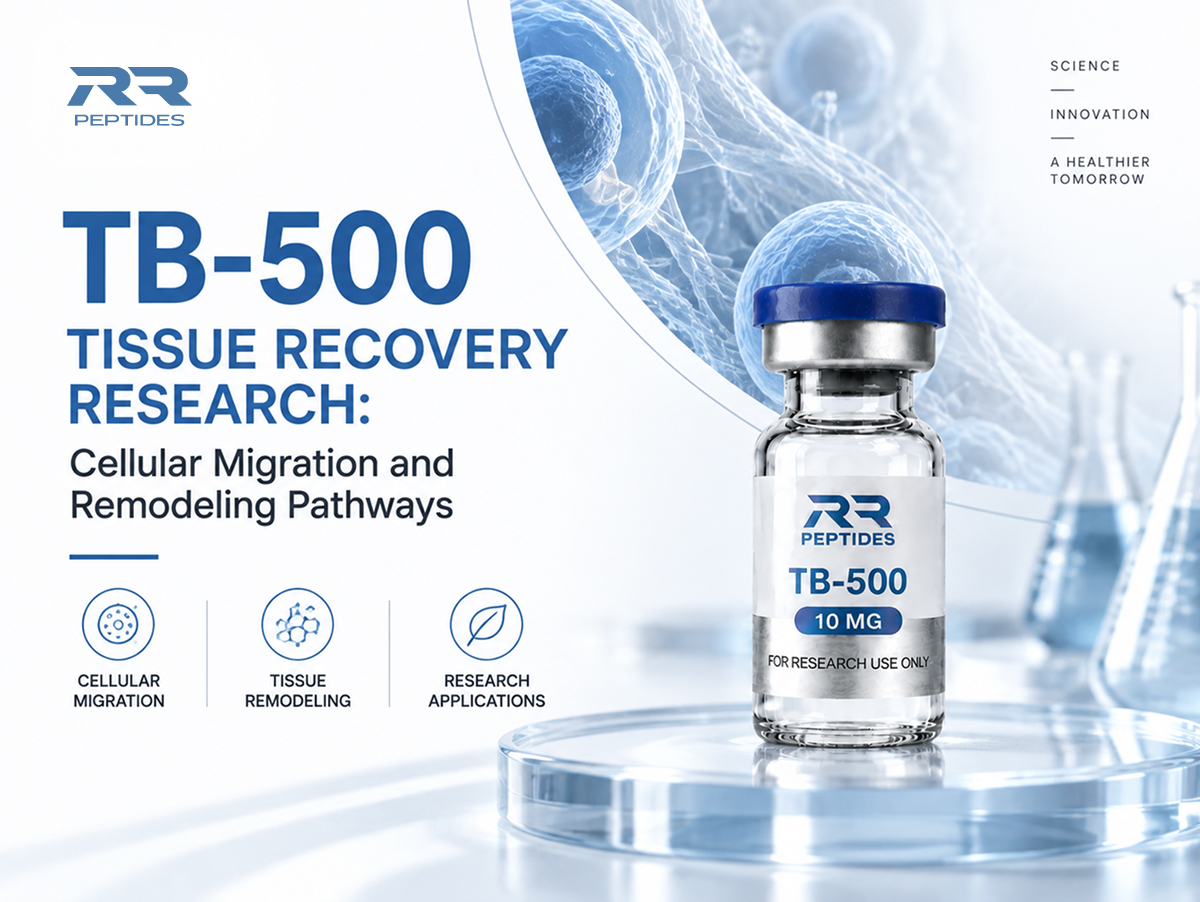
Learn more about the specifications and research overview of this peptide from RR Peptides featuring TB-500 10mg.
Angiogenesis and Tissue Remodeling
Angiogenesis refers to the formation of new blood vessels from existing vascular structures. It is a complex biological process involving endothelial cells, extracellular matrix interactions, signaling molecules, and changes in cellular organization.
Vascular biology is therefore another important focus within TB-500 tissue recovery research. Researchers may use endothelial cell systems, three-dimensional models, tissue preparations, or animal models to investigate vascular-associated behavior.
Angiogenesis research models
Common laboratory approaches can include endothelial migration assays, network formation models, three-dimensional systems, and tissue-based observations. Each model provides a different level of biological complexity.
Model
What researchers can examine
Key limitation
Endothelial cell culture
Migration and cellular behavior
Simplified environment
Network formation assay
Cellular organization
Does not reproduce complete vessel biology
Three-dimensional model
Cell interactions and structure
More complex interpretation
Tissue model
Tissue-associated vascular responses
Limited experimental control
Animal model
Integrated biological responses
Species differences
Within TB-500 tissue recovery research, a network-like structure produced by endothelial cells should not be interpreted as equivalent to functional blood-vessel development in a living organism. The model can provide useful information about a specific phenotype, but its biological scope remains limited.
Tissue remodeling pathways
Tissue remodeling involves changes in cells, extracellular matrix, structural organization, and signaling pathways. Depending on the model, researchers may examine collagen-associated markers, matrix proteins, gene expression, protein abundance, tissue architecture, or inflammatory signals.
Within TB-500 tissue recovery research, these measurements can help determine whether a particular experimental condition is associated with changes in remodeling-related processes. They do not, by themselves, establish improved recovery or therapeutic efficacy.
Time is also critical. Biological responses can differ considerably between early and later experimental stages. A molecular marker measured at one time point may not provide the same information at another.
For this reason, longitudinal experiments can sometimes provide more informative data than a single endpoint. Repeated measurements may help researchers understand whether a response is transient, sustained, delayed, or associated with another biological event.
Inflammation and remodeling
Inflammatory signaling can interact with tissue remodeling and vascular processes. Researchers may therefore examine cytokine-associated signals, inflammatory gene expression, protein abundance, or other molecular indicators.
However, inflammation should not be treated as a simple positive or negative variable. Its biological significance depends on timing, intensity, cellular source, and the wider experimental context. A single marker cannot provide a complete description of a complex inflammatory response.
Muscle, Tendon, and Connective Tissue Research
Muscle, tendon, and connective tissue models are particularly complex because these tissues contain multiple cell types and structural components. Research in these areas may investigate cellular behavior, extracellular matrix organization, mechanical properties, and tissue-associated molecular markers.
TB-500 tissue recovery research involving these tissues should therefore be interpreted according to the model used. A cell culture experiment may examine a specific cellular pathway, while a tissue or animal model can incorporate additional biological interactions.
Muscle-related models
Muscle research can involve cultured muscle cells, differentiated cellular systems, tissue preparations, or animal models. Researchers may examine cellular morphology, protein expression, differentiation-related markers, or structural characteristics.
The choice of endpoint determines what the experiment can actually demonstrate. A molecular change does not necessarily indicate improved muscle function, and a cellular observation cannot automatically be translated into a human outcome.
Tendon and connective tissue models
Tendons and other connective tissues contain substantial extracellular matrix components. Collagen organization, fibroblast behavior, matrix-associated proteins, and structural characteristics can therefore be relevant research endpoints.
Researchers may investigate how experimental conditions influence fibroblast activity or matrix-associated markers. Histological assessment can provide additional information in suitable tissue or animal models.
Research area
Potential endpoints
Interpretation
Muscle cells
Morphology, protein markers
Cellular response
Tendon models
Matrix markers, fibroblast behavior
Remodeling-associated response
Connective tissue
Structural organization, matrix proteins
Tissue-associated changes
Mechanical studies
Strength or material properties
Functional model-specific outcome
These models can provide useful information for TB-500 tissue recovery research, but each has specific experimental limitations. Mechanical measurements, for example, may provide information that molecular assays cannot. Conversely, molecular assays may help explain biological changes that are not immediately visible through structural measurements.
For this reason, comprehensive TB-500 tissue recovery research may benefit from combining complementary endpoints rather than relying on one measurement.
Researchers should also document the experimental material carefully. Peptide identity, purity, batch information, storage conditions, and analytical characterization can affect the interpretation and reproducibility of experimental findings.
Learn more about the specifications and research overview of this peptide from RR Peptides featuring TB-500 10mg.
Current Findings and Scientific Limitations
Current evidence related to TB-500 tissue recovery research should be evaluated according to the level of evidence provided by each experimental model. Preclinical observations can contribute to scientific understanding, but they do not automatically establish safety, efficacy, or clinical utility.
One important limitation is the distinction between TB-500 and thymosin beta-4 literature. A substantial amount of mechanistic discussion may involve thymosin beta-4, while commercial or research materials may be described as TB-500. Researchers should verify the material used in the original experiment before applying findings from one peptide to another.
Material characterization
Material characterization is fundamental to reproducible peptide research. Researchers should establish what was actually tested rather than relying solely on a product name.
Relevant information may include identity, sequence where applicable, purity, molecular mass, batch or lot information, and analytical testing. Techniques such as high-performance liquid chromatography and mass spectrometry may provide complementary information depending on the research objective.
Purity should also be distinguished from biological activity. An analytical purity measurement describes material characteristics; it does not independently demonstrate a biological effect.
Model limitations
Every research model used in TB-500 tissue recovery research represents only part of biological reality. Cell culture provides experimental control but lacks many interactions present in living tissues. Three-dimensional systems can increase complexity but remain simplified compared with intact organisms. Animal models provide additional physiological information but involve species-specific differences.
This hierarchy matters when interpreting TB-500 tissue recovery research. Evidence should remain proportional to the model that generated it.
Reproducibility and controls
A strong experiment should include appropriate controls and clearly defined endpoints. Researchers should also consider replication, statistical analysis, and transparent reporting.
A single positive observation can be useful for generating a hypothesis, but reproducibility provides stronger support for a biological interpretation. Independent replication can further strengthen confidence when methodology and material identity are clearly documented.
For Canadian laboratories, researchers should also follow the institutional requirements applicable to their specific research activities. Depending on the project, this may involve laboratory safety procedures, institutional policies, ethical oversight, procurement requirements, and rules associated with biological or animal research. Requirements can vary between institutions and study types, so researchers should consult the appropriate institutional compliance resources.
Overall, TB-500 tissue recovery research remains best approached as an area of experimental investigation rather than as evidence of an established treatment. The most informative studies are those that clearly define the material, model, controls, endpoints, and limitations.
What is the focus of TB-500 tissue recovery research?
The focus can include cellular migration, cytoskeletal behavior, tissue remodeling, angiogenesis-associated processes, extracellular matrix changes, and molecular signaling. These represent laboratory research areas rather than established therapeutic indications.
Why is cellular migration relevant?
Cell migration contributes to many biological remodeling processes. Laboratory assays allow researchers to measure cellular movement under controlled conditions and investigate associated changes in morphology, adhesion, and cytoskeletal organization.
Does migration prove tissue recovery?
No. Increased or altered cellular migration is only one experimental observation. It does not independently demonstrate tissue recovery, improved function, safety, or therapeutic efficacy.
Vascular and angiogenesis-associated processes can be investigated using endothelial cell systems, network formation assays, three-dimensional models, tissue models, and animal studies. Each model has specific strengths and limitations.
Can animal findings predict human outcomes?
Animal findings can provide additional biological information but cannot automatically predict human responses. Species differences and experimental conditions must be considered when interpreting preclinical evidence.
Why is material identity important?
Peptide terminology can sometimes create confusion between related materials. Researchers should verify the exact material, sequence where applicable, purity, batch information, and analytical characterization before comparing findings from different studies.
What should researchers measure?
The appropriate endpoints depend on the research question. Possible measurements include cellular migration, morphology, matrix-associated markers, gene expression, protein abundance, vascular-associated behavior, and tissue structure.
Are TB-500 tissue recovery research findings medical evidence?
Laboratory and preclinical findings should not automatically be interpreted as clinical evidence. Establishing medical efficacy and safety requires appropriate evidence from relevant research and regulatory pathways.
What should Canadian researchers consider?
Researchers in Canada should follow the institutional, safety, ethical, procurement, and regulatory requirements relevant to their specific laboratory activities. The applicable requirements depend on the research environment and study design.
Final Research Perspective
TB-500 tissue recovery research covers several interconnected biological areas, including cellular migration, actin-associated behavior, angiogenesis, extracellular matrix remodeling, and connective tissue models. These areas can provide researchers with useful experimental questions and measurable endpoints without assuming that a laboratory observation represents a therapeutic outcome.
The quality of the evidence depends heavily on study design. Researchers should consider the identity and characterization of the material, the biological model, experimental controls, selected endpoints, replication, and the limitations of each system. These factors determine how confidently an observation can be interpreted.
RR Peptides supports a laboratory-focused approach to peptide research, where scientific claims are considered alongside material information and experimental context. For readers exploring TB-500 tissue recovery research, focusing on reproducible measurements and clearly defined models provides a more useful framework than relying on broad claims about recovery.
In Canada, researchers should additionally consider the institutional and regulatory requirements applicable to their specific activities. Careful documentation, appropriate laboratory practices, and transparent interpretation can help maintain scientific quality while reducing the risk of overstating preliminary findings.
Ultimately, TB-500 tissue recovery research is most informative when it is treated as an investigation of defined biological processes. Cellular migration studies can examine movement, tissue models can investigate structural changes, and vascular systems can explore angiogenesis-associated behavior. Together, these approaches can contribute to a clearer understanding of the biological questions surrounding TB-500 and related peptide research.
RR Peptides encourages readers to evaluate research peptides through verifiable material information, appropriate experimental design, and evidence-based interpretation. Understanding what a study actually measured is essential when assessing TB-500 tissue recovery research and determining how its findings should be interpreted.
Disclaimer: All products and compounds discussed are intended strictly for laboratory and research purposes. This article is provided for educational and informational purposes only and is not medical advice, therapeutic guidance, or instructions for human administration.
3 Comments
The discussion of TB-500 and tissue recovery research provides an interesting overview of why this compound continues to attract scientific attention. I especially liked the focus on proposed biological mechanisms and the distinction between preclinical findings and established evidence.
I found the explanation of tissue recovery pathways particularly useful. Looking at how TB-500 is being investigated alongside the current limitations of the research gives a more balanced understanding of what scientists are currently exploring.
This is a useful introduction to the research surrounding TB-500 and tissue recovery. I appreciate the emphasis on interpreting available studies carefully, particularly because much of the evidence surrounding these compounds remains at the experimental or preclinical stage.





The discussion of TB-500 and tissue recovery research provides an interesting overview of why this compound continues to attract scientific attention. I especially liked the focus on proposed biological mechanisms and the distinction between preclinical findings and established evidence.
I found the explanation of tissue recovery pathways particularly useful. Looking at how TB-500 is being investigated alongside the current limitations of the research gives a more balanced understanding of what scientists are currently exploring.
This is a useful introduction to the research surrounding TB-500 and tissue recovery. I appreciate the emphasis on interpreting available studies carefully, particularly because much of the evidence surrounding these compounds remains at the experimental or preclinical stage.