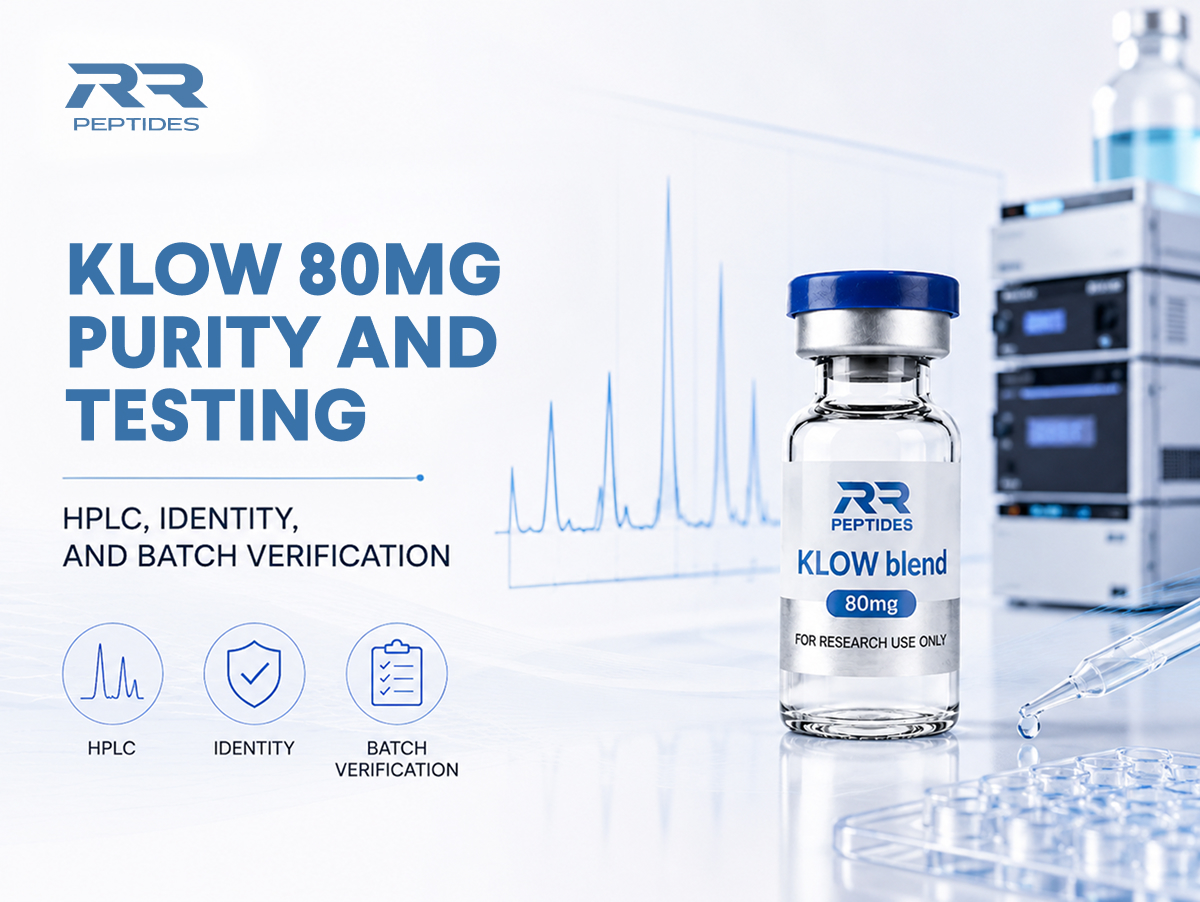
Understanding KLOW 80mg purity and testing requires more than checking whether a supplier advertises a purity percentage above 98% or 99%. KLOW is commonly presented in the Canadian research market as a multi-component lyophilized formulation containing GHK-Cu, BPC-157, TB-500, and KPV. Because these compounds are chemically distinct, researchers need analytical information that addresses several separate questions.
Does the sample contain the expected compounds? How clean is the chromatographic profile? Does the measured quantity correspond reasonably with the nominal formulation? Does the laboratory report belong to the exact batch being studied?
These questions form the foundation of KLOW 80mg purity and testing. A purity percentage, molecular identity result, quantitative assay, and Certificate of Analysis each provide different information. None should automatically be treated as a substitute for the others.
Researchers exploring analytical quality, batch documentation, and research peptide testing can find additional educational resources through RR Peptides. A careful approach to KLOW 80mg purity and testing can help laboratories evaluate research materials more critically before incorporating them into experimental workflows.
Why KLOW 80mg Purity Testing Matters
The first reason KLOW 80mg purity and testing requires careful interpretation is that KLOW is not a single 80 mg peptide.
The formulation commonly marketed by Canadian research suppliers is structured approximately as follows:
Component
Commonly Listed Amount
Share of Nominal Total
GHK-Cu
50 mg
62.5%
BPC-157
10 mg
12.5%
TB-500
10 mg
12.5%
KPV
10 mg
12.5%
Total
80 mg
100%
This composition creates a more complex analytical problem than evaluating a single-component research material. Four expected compounds may need to be distinguished from one another as well as from possible impurities, degradation products, or other unexpected signals.
Purity, Identity, and Quantity Answer Different Questions
One of the most important concepts in KLOW 80mg purity and testing is the distinction between purity, identity, and quantity.
Purity describes how clean a sample appears according to a defined analytical method. In peptide testing, this is commonly assessed using chromatography.
Identity addresses whether the measured material corresponds to the expected molecular species.
Quantity determines how much of the target material is present.
These measurements should not be treated as interchangeable.
For example, a sample could display high chromatographic purity while containing less material than the nominal label states. Conversely, obtaining a measured amount close to the expected quantity does not independently demonstrate that the material has the correct molecular identity.
This distinction is particularly relevant to KLOW 80mg purity and testing, because an 80 mg label describes the combined nominal content of four components rather than the purity of one compound.
Why Batch-Level Results Matter
Research materials can vary between manufacturing lots. Therefore, researchers gain more useful information from batch-specific analytical results than from a generic purity claim shown across every product page.
For KLOW 80mg purity and testing, the strongest documentation connects analytical results to the exact lot or batch of material entering the study.
This approach gives researchers a clearer record of what was actually analyzed and reduces the risk of assuming that results from an older or unrelated batch apply automatically to the current material.
Explore research composition and quality with KLOW 80mg.
Methods Used to Evaluate Peptide Blend Purity
There is no single laboratory test that establishes every aspect of peptide quality. Effective KLOW 80mg purity and testing depends on matching each analytical method to the question researchers need to answer.
Research Question
Common Method
Main Information Provided
How clean is the chromatographic profile?
HPLC or UPLC
Separation and purity-related data
Are expected molecular species present?
MS or LC-MS
Molecular identity support
How much material is present?
Quantitative assay
Component or total quantity
Does analytical data belong to this batch?
COA and lot verification
Traceability
Are specific contaminants present?
Test-specific analytical methods
Contaminant-specific information
Using Complementary Analytical Methods
A chromatographic test may provide excellent information about separation and relative purity but limited information about molecular identity by itself.
Mass spectrometry can provide identity-related information but does not automatically determine the exact quantity of each component.
Quantitative testing can estimate content but may not independently describe the purity profile.
For this reason, KLOW 80mg purity and testing is more informative when different analytical methods complement one another rather than when one method is presented as proof of every quality characteristic.
The combination of chromatography, identity analysis, quantitative data, and batch documentation can create a substantially clearer analytical profile.
Multi-Component Blends Require Suitable Methods
Analyzing KLOW is more complicated than testing one isolated peptide because several expected compounds are present simultaneously.
The analytical method should therefore be appropriate for the formulation being studied.
Researchers may need to consider whether the expected components can be adequately resolved, whether peak assignments are clearly supported, and whether the method is designed to address the intended research question.
In KLOW 80mg purity and testing, this method context is often more valuable than a standalone claim such as “laboratory tested.”
What “Third-Party Tested” Actually Means
Third-party testing can improve transparency when an independent laboratory performs the analysis. However, the phrase itself provides little scientific detail.
Researchers still need to know what was tested.
A report might contain HPLC purity data only. Another could include mass spectrometry and quantitative measurements. Additional reports may examine specific contaminants or other quality attributes.
Therefore, KLOW 80mg purity and testing should focus on the scope and results of the analysis rather than treating “third-party tested” as a complete quality conclusion.
Understanding HPLC Testing for KLOW 80mg
High-performance liquid chromatography is one of the analytical methods most commonly associated with research peptide purity.
HPLC is especially relevant to KLOW 80mg purity and testing because suppliers frequently summarize complex chromatographic data as a single percentage.
How HPLC Works
HPLC separates compounds according to how they interact with a mobile phase and stationary phase under controlled analytical conditions.
As compounds move through the chromatographic system, different substances can elute at different retention times. A detector records the resulting signal, producing a chromatogram.
The peaks on this chromatogram provide information about the sample’s analytical profile.
In KLOW 80mg purity and testing, however, researchers need to remember that multiple expected components are present. A chromatogram must therefore be interpreted according to the analytical method and the expected composition of the blend.
What an HPLC Purity Percentage Tells Researchers
HPLC purity generally describes the relative chromatographic signal associated with a target compared with other detected signals under the specific testing conditions.
It does not automatically tell researchers how many milligrams are present in a vial.
This is the key distinction behind many misunderstandings about peptide testing.
For example, a result showing 99% chromatographic purity does not by itself confirm that a vial contains exactly 80 mg of material or exactly 50 mg GHK-Cu, 10 mg BPC-157, 10 mg TB-500, and 10 mg KPV.
For KLOW 80mg purity and testing, researchers should therefore examine purity and quantitative content as separate analytical characteristics.
Why the Chromatogram Provides More Context
The headline percentage is useful for quick comparison, but researchers can learn more when the underlying chromatographic information is available.
Depending on the report, researchers may be able to examine retention times, expected peaks, unexpected peaks, signal separation, and how the analytical laboratory calculated the reported purity.
A strong KLOW 80mg purity and testing record should make it possible to understand what the stated purity result actually represents.
The analytical method matters as well. Differences in columns, mobile phases, detectors, sample preparation, and method conditions can affect how results are generated and interpreted.
Identity Verification and Mass Spectrometry
Chromatography can separate compounds effectively, but separation alone does not always establish molecular identity.
Mass spectrometry adds an important layer to KLOW 80mg purity and testing by helping researchers determine whether the measured species is consistent with the expected molecular mass.
What Mass Spectrometry Contributes
Mass spectrometry analyzes ions according to their mass-to-charge ratios.
When used appropriately, the resulting data can provide evidence supporting the identity of a peptide or related research compound.
For a multi-component preparation, this can help researchers verify that expected molecular species are represented in the sample.
Within KLOW 80mg purity and testing, chromatography and mass spectrometry therefore serve complementary roles rather than competing ones.
HPLC primarily contributes separation and purity-related information, while MS contributes molecular identity information.
Component-Level Identity Is More Informative
KLOW is defined by the presence of multiple compounds. Therefore, reporting component-level identity is more informative than simply stating that “KLOW” was confirmed.
Researchers ideally want to understand which expected components were identified and which analytical method supported those assignments.
This is especially relevant to KLOW 80mg purity and testing because commercial terminology surrounding compounds such as TB-500 may not always be presented identically between suppliers.
Analytical identity provides stronger scientific context than product naming alone.
What Mass Spectrometry Cannot Confirm Alone
Mass spectrometry should not be interpreted as proof of every quality characteristic.
Confirmation of an expected molecular mass does not automatically show that the material has high chromatographic purity. It also does not independently confirm that the correct quantity is present.
Likewise, detecting the expected molecular species does not prove that every possible impurity or contaminant has been excluded.
A defensible approach to KLOW 80mg purity and testing therefore interprets MS alongside chromatography, quantitative measurements, and batch-specific documentation.
Explore research composition and quality with KLOW 80mg.
How to Review Batch Data and Certificates of Analysis
A Certificate of Analysis can provide valuable research documentation, but its usefulness depends on the information it contains.
For KLOW 80mg purity and testing, researchers should review the COA as an analytical record rather than simply checking whether one exists.
Start With the Batch Number
The first step is to compare the lot or batch identifier on the COA with the material being studied.
If they do not match, the analytical report may not describe the research material in the laboratory.
This is one of the simplest but most important checks in KLOW 80mg purity and testing.
A valid report from a previous batch can still provide general information about a supplier’s testing practices, but it should not automatically be treated as analytical evidence for a different lot.
Review What Was Actually Tested
A useful COA should make the scope of testing clear.
Researchers can look for:
Product and sample identification
Batch or lot number
Testing date
Testing laboratory
Analytical method
Purity result
Identity data
Quantitative content when measured
Specifications or reference limits where applicable
These fields allow researchers to determine what the report does and does not establish.
For KLOW 80mg purity and testing, a COA containing only a purity percentage provides less information than one combining chromatographic purity, identity confirmation, and quantitative results.
Compare Nominal and Measured Content Carefully
The commonly marketed composition of KLOW totals 80 mg, but laboratories should distinguish this nominal label value from measured analytical content.
Batch testing can produce measured values that differ somewhat from the labeled amount.
The significance of any difference depends on the analytical method, measurement uncertainty, specification, sampling process, and established acceptance criteria.
Therefore, KLOW 80mg purity and testing should not treat every difference from exactly 80.00 mg as evidence of failure.
Instead, researchers should examine the measured result within its analytical context.
A Practical COA Checklist
The following framework can simplify batch review:
COA Element
What Researchers Should Check
Product identity
Does the report clearly describe the expected material?
Lot or batch
Does it match the physical sample?
Test laboratory
Is the laboratory identified?
Date
Is the analytical date provided?
HPLC/UPLC
Is chromatographic testing documented?
MS/LC-MS
Is identity verification provided where applicable?
Quantity
Are measured amounts reported?
Specifications
Are acceptance criteria provided where relevant?
Results
Are actual numerical or qualitative findings shown?
Using a consistent checklist makes KLOW 80mg purity and testing easier to compare across batches and suppliers.
It also prevents researchers from relying on visual design, marketing statements, or a single large purity percentage while overlooking the analytical details underneath.
Purity generally describes how clean the material appears according to a specified analytical method, often HPLC. It should not automatically be interpreted as confirmation of labeled quantity.
What is the standard marketed composition of KLOW 80mg?
Canadian research listings commonly describe the formulation as 50 mg GHK-Cu, 10 mg BPC-157, 10 mg TB-500, and 10 mg KPV, creating a nominal total of 80 mg.
Why are both HPLC and mass spectrometry useful?
HPLC provides separation and purity-related information, while mass spectrometry supports molecular identity. Using both creates a stronger analytical profile than relying on either technique alone.
Is a COA enough to prove peptide quality?
A COA documents only the tests shown on the certificate. It does not establish characteristics that were not measured.
Researchers evaluating KLOW 80mg purity and testing should therefore examine the methods, batch number, identity results, purity results, quantitative information, and scope of testing.
Why must the COA batch number match the product?
Analytical results describe the sample submitted for testing. If the batch does not match, there is no strong basis for assuming that the report characterizes the material currently being studied.
Is third-party testing always better?
Independent laboratory testing can improve transparency, but researchers still need to review the analytical methods and results. The phrase “third-party tested” alone does not indicate whether purity, identity, quantity, or contaminants were evaluated.
Can the appearance of KLOW confirm purity?
No. Visual characteristics cannot confirm molecular identity, chromatographic purity, or quantitative content. GHK-Cu may influence the appearance of a formulation, but color alone is not an analytical test.
Can a highly pure sample still contain the wrong amount?
Yes. This is why purity and quantity must remain separate concepts. A sample can have a clean chromatographic profile but contain a measured quantity above or below its nominal label value.
What should researchers prioritize when reviewing a KLOW COA?
A practical KLOW 80mg purity and testing review should prioritize batch matching, clear analytical methods, component identity where available, chromatographic purity, quantitative results, testing dates, and laboratory identification.
Final Thoughts
Reliable KLOW 80mg purity and testing depends on understanding what different analytical measurements actually mean.
HPLC can provide valuable information about chromatographic separation and purity. Mass spectrometry can support molecular identity. Quantitative analysis addresses how much material is present. A batch-specific COA then connects those analytical findings to the actual research material.
The most important lesson is that a single purity percentage cannot answer every quality question. Researchers should avoid assuming that “99% pure,” “80 mg,” “mass confirmed,” and “third-party tested” all mean the same thing.
For Canadian laboratories evaluating multi-component research blends, KLOW 80mg purity and testing becomes more useful when purity, identity, quantity, and batch traceability are reviewed separately and then interpreted together.
Researchers can explore RR Peptides for additional research-focused information covering peptide quality, laboratory testing, batch verification, COA interpretation, and analytical considerations. A structured approach to KLOW 80mg purity and testing provides a stronger foundation for selecting and documenting research materials before experimental work begins.
Disclaimer: All products and compounds referenced are intended strictly for laboratory and research purposes only. This content is provided for informational and educational purposes and is not intended as medical advice or to diagnose, treat, cure, or prevent any disease.
3 Comments
I found the discussion of KLOW 80mg purity and testing quite informative. Looking at analytical data and testing procedures is an important part of assessing the consistency and quality of research materials, especially when working with emerging compounds.
The focus on purity and analytical testing adds a useful layer to the broader discussion around KLOW 80mg research. I appreciate the emphasis on verifying research materials rather than relying solely on a stated purity percentage, since proper documentation can provide much more context.
A helpful reminder that purity testing is an essential consideration when evaluating research compounds. Clear analytical documentation, batch information, and appropriate testing methods can make it easier for researchers to assess the reliability and consistency of the material being studied.
Comments are closed.
×
Subscribe & Get 10% Off!
Enter your email address below to subscribe to our newsletter and receive an instant 10% OFF discount coupon code sent directly to your inbox!
Thank you for subscribing! Your 10% discount coupon has been sent to your email. Please check your inbox!




I found the discussion of KLOW 80mg purity and testing quite informative. Looking at analytical data and testing procedures is an important part of assessing the consistency and quality of research materials, especially when working with emerging compounds.
The focus on purity and analytical testing adds a useful layer to the broader discussion around KLOW 80mg research. I appreciate the emphasis on verifying research materials rather than relying solely on a stated purity percentage, since proper documentation can provide much more context.
A helpful reminder that purity testing is an essential consideration when evaluating research compounds. Clear analytical documentation, batch information, and appropriate testing methods can make it easier for researchers to assess the reliability and consistency of the material being studied.