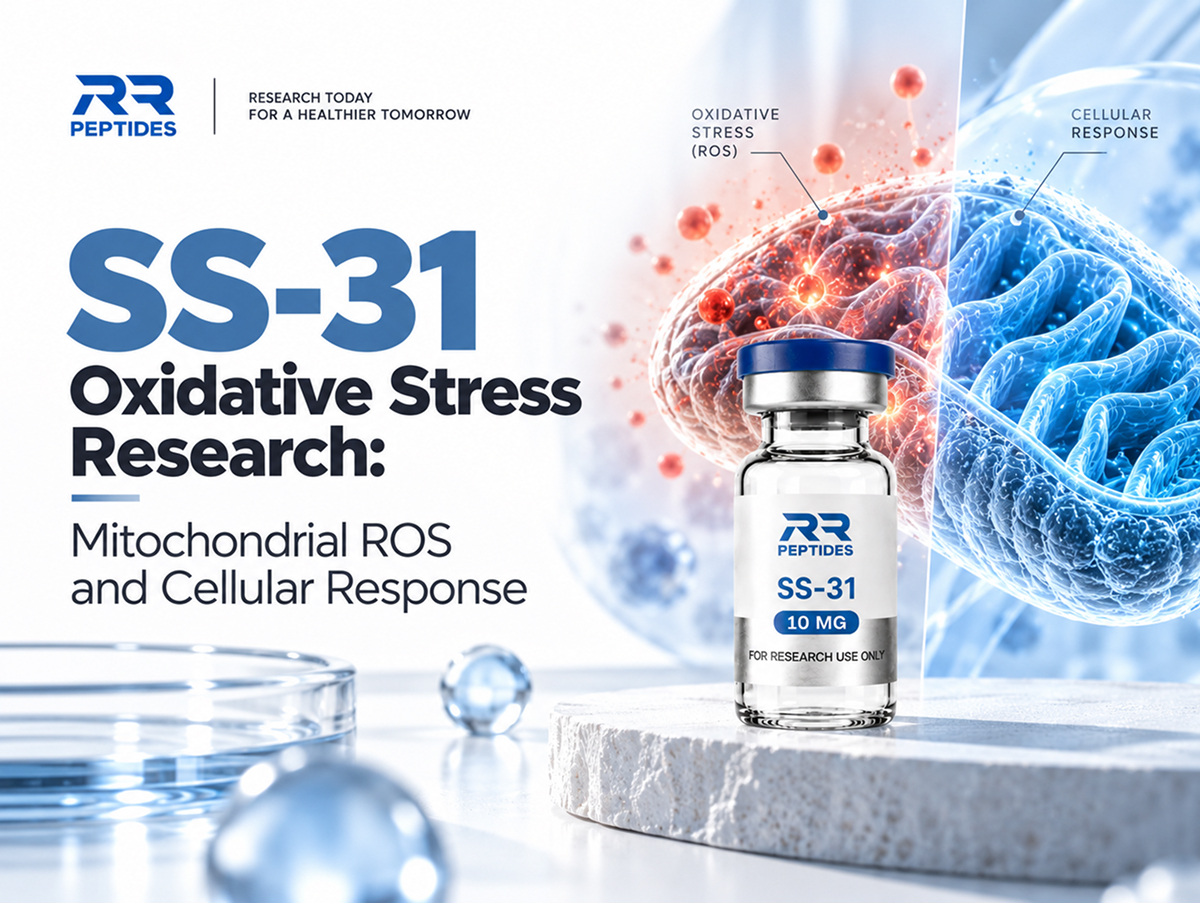
Mitochondria play an essential role in cellular energy production, but their metabolic activity also contributes to the formation of reactive oxygen species (ROS). These molecules participate in normal cellular signaling, yet excessive production or impaired antioxidant regulation can disrupt mitochondrial function, damage cellular components, and influence stress responses.
SS-31 oxidative stress research investigates how the synthetic tetrapeptide SS-31, also known as elamipretide, interacts with mitochondrial membranes and influences oxidative stress-related measurements. Scientific interest focuses particularly on cardiolipin, mitochondrial membrane organization, and the relationship between respiratory activity and ROS generation.
Although experimental findings suggest that SS-31 may influence selected mitochondrial processes, its effects depend on biological models, experimental conditions, and analytical methods. Changes in oxidative stress markers do not automatically establish direct antioxidant activity or therapeutic effectiveness.
For Canadian laboratories investigating mitochondrial biology, RR Peptides provides research-focused compound information and available product specifications.
This article examines SS-31 oxidative stress research through mitochondrial ROS biology, proposed molecular interactions, laboratory biomarkers, and current scientific limitations.
What Is Mitochondrial Oxidative Stress?
Understanding Reactive Oxygen Species
Reactive oxygen species are chemically reactive molecules derived from oxygen. Although commonly associated with cellular damage, certain ROS also participate in physiological signaling processes that regulate metabolism, adaptation, and cellular responses.
Mitochondria are important sources of ROS because electron transfer reactions can produce partially reduced oxygen species. The balance between ROS generation and cellular antioxidant systems influences whether these molecules participate in normal signaling or contribute to oxidative damage.
Understanding this balance provides the biological foundation for SS-31 oxidative stress research, particularly when interpreting changes in mitochondrial ROS measurements.
How Mitochondrial ROS Are Generated
The mitochondrial electron transport chain transfers electrons through protein complexes located within the inner mitochondrial membrane. During this process, some electrons may react with molecular oxygen, generating superoxide.
Several mitochondrial processes contribute to ROS production:
Complex I: Can generate superoxide under particular respiratory and substrate conditions.
Complex III: Contains sites associated with superoxide formation during electron transfer.
Electron transport imbalance: Changes in electron flow may influence ROS generation.
Mitochondrial membrane potential: Altered electrochemical conditions can affect ROS production.
Metabolic substrate availability: Different substrates influence respiratory activity and associated ROS formation.
SS-31 oxidative stress research must therefore distinguish changes in electron transport from direct effects on reactive oxygen species.
Oxidative Stress Versus Physiological ROS Signaling
ROS production is not inherently harmful. At controlled concentrations, reactive oxygen species contribute to cellular communication and adaptive responses. Oxidative stress occurs when reactive species and protective mechanisms become sufficiently imbalanced to disrupt normal cellular function.
Biological process
Normal physiological role
Potential consequence of imbalance
ROS signaling
Regulates cellular responses
Altered signaling pathways
Electron transport
Supports ATP production
Increased electron leakage
Antioxidant regulation
Controls reactive species
Reduced protective capacity
Lipid oxidation
Participates in selected reactions
Membrane damage
DNA oxidation
Reflects oxidative modification
Genomic instability
Protein oxidation
Influences protein regulation
Structural or functional changes
These relationships explain why SS-31 oxidative stress research commonly evaluates several molecular endpoints instead of treating lower ROS measurements as universally beneficial.
Explore mitochondrial function and cellular research with RR Peptides’ research compound, SS-31 10mg.
SS-31 is a synthetic aromatic-cationic tetrapeptide with the sequence D-Arg–dimethylTyr–Lys–Phe–NH₂. It has also been investigated under the names elamipretide, MTP-131, and Bendavia.
SS-31 oxidative stress research examines whether these membrane interactions influence respiratory organization, oxidative stress-related measurements, and cellular responses under experimental conditions.
However, mitochondrial association does not independently demonstrate direct ROS scavenging or improved cellular function.
Cardiolipin and Mitochondrial Membrane Organization
Cardiolipin is a specialized phospholipid enriched in the inner mitochondrial membrane. It contributes to membrane architecture, mitochondrial cristae organization, and interactions involving respiratory proteins.
Researchers have investigated how SS-31 interacts with cardiolipin-containing membranes and whether these interactions influence mitochondrial responses to stress.
The proposed relationship is relevant to SS-31 oxidative stress research because mitochondrial membrane organization can affect respiratory processes associated with ROS generation.
Nevertheless, a demonstrated molecular interaction does not automatically establish a specific antioxidant mechanism.
Why Cardiolipin Matters in Oxidative Stress
Cardiolipin participates in several biological processes relevant to mitochondrial stability:
Respiratory protein organization: Supports interactions among selected electron transport components.
Membrane structure: Contributes to the specialized architecture of mitochondrial cristae.
Oxidative modification: Can undergo changes associated with mitochondrial stress.
Protein interactions: Influences the local environment surrounding mitochondrial proteins.
Cellular stress responses: Participates in pathways associated with mitochondrial dysfunction.
SS-31 oxidative stress research evaluates whether peptide-associated membrane interactions correspond with measurable changes in ROS production, lipid oxidation, or cellular stress responses.
Researchers have investigated SS-31 using isolated mitochondrial preparations, cultured cells, animal models, and selected human clinical studies.
Research model
Common investigation
Main limitation
Isolated mitochondria
ROS generation and membrane interactions
Limited cellular context
Cultured cells
Oxidative stress and viability
Cell-specific responses
Animal models
Tissue injury and mitochondrial function
Species differences
Human clinical studies
Defined clinical outcomes
Mechanism may remain uncertain
The interpretation of SS-31 oxidative stress research depends on whether observations are reproducible and supported by complementary analytical methods.
How Is SS-31 Associated With Mitochondrial ROS Research?
Mitochondrial Membrane Interactions
Mitochondrial ROS production depends partly on respiratory activity, membrane organization, and metabolic conditions. Changes in these factors may influence the formation and distribution of reactive oxygen species.
Studies have investigated whether SS-31 association with mitochondrial membranes alters selected biochemical processes associated with oxidative stress.
SS-31 oxidative stress research frequently considers whether cardiolipin-related interactions influence mitochondrial responses to experimental stress.
However, observed changes in ROS measurements do not necessarily identify the molecular mechanism responsible.
Proposed Mechanisms Involving ROS Regulation
Several mechanisms have been investigated or proposed to explain experimental findings involving SS-31.
Proposed mechanism
Research interest
Interpretation limitation
Cardiolipin interaction
Mitochondrial membrane organization
Does not prove antioxidant activity
Respiratory regulation
Changes in electron transport
Requires functional validation
Lipid oxidation changes
Mitochondrial membrane integrity
May reflect indirect effects
ROS-associated signaling
Cellular stress responses
Pathway specificity remains uncertain
Mitochondrial stability
Structural and functional responses
Depends on experimental model
SS-31 oxidative stress research should distinguish these hypotheses from mechanisms demonstrated through direct molecular evidence.
Electron Transport and ROS Generation
The electron transport chain supports oxidative phosphorylation by transferring electrons through mitochondrial protein complexes. Under certain conditions, electrons can react with oxygen before reaching the final electron acceptor.
Researchers investigating SS-31 oxidative stress research may examine oxygen consumption alongside mitochondrial ROS measurements to determine whether experimental observations are related.
Nevertheless, increased respiratory activity does not necessarily produce increased oxidative stress, and reduced ROS signals do not automatically indicate improved respiratory efficiency.
Explore mitochondrial function and cellular research with RR Peptides’ research compound, SS-31 10mg.
Cardiolipin Oxidation and Cellular Stress
Cardiolipin can undergo oxidative modification under conditions involving reactive oxygen species. These changes may influence mitochondrial membrane organization and interactions with proteins.
However, SS-31 oxidative stress research must distinguish changes in lipid oxidation from direct chemical scavenging of reactive oxygen species.
A reduction in oxidative damage markers may arise through altered ROS generation, membrane organization, antioxidant responses, or other indirect processes.
Cellular Responses to Oxidative Stress
Researchers may evaluate whether SS-31 exposure corresponds with changes in these outcomes under controlled experimental conditions.
Important research questions include:
Does SS-31 exposure change mitochondrial ROS measurements?
Are observed responses dependent on cardiolipin-associated processes?
Do changes in ROS correspond with altered mitochondrial respiration?
Are oxidative damage markers affected consistently across experimental models?
Can independent laboratories reproduce the reported findings?
These questions help SS-31 oxidative stress research distinguish molecular observations from broader functional conclusions.
Which Oxidative Stress Biomarkers Are Commonly Measured?
Mitochondrial ROS Measurements
Researchers frequently use fluorescence-based methods to investigate reactive oxygen species in experimental systems. Certain probes are designed to accumulate in mitochondria or respond to selected oxidative reactions.
However, fluorescence intensity does not always provide a direct quantitative measurement of a specific ROS molecule. Probe localization, oxidation chemistry, mitochondrial membrane potential, and experimental conditions can influence results.
SS-31 oxidative stress research therefore requires careful assay validation and appropriate controls when interpreting mitochondrial ROS measurements.
Lipid Peroxidation Markers
Lipid peroxidation occurs when reactive species initiate oxidative reactions involving membrane lipids. Researchers commonly investigate markers associated with these processes to assess oxidative damage.
Measurements may include malondialdehyde, commonly abbreviated MDA, and 4-hydroxynonenal, known as 4-HNE.
These biomarkers can provide useful information about lipid oxidation, but they are not exclusive indicators of mitochondrial ROS production.
For SS-31 oxidative stress research, changes in lipid peroxidation markers should be interpreted alongside mitochondrial function and cellular viability measurements.
Protein and DNA Oxidation
Oxidative stress may also affect proteins and nucleic acids. Researchers investigate these modifications using biochemical and analytical methods appropriate to the experimental model.
Common measurements include protein carbonyl content and selected oxidized DNA products.
Biomarker
Research purpose
Important limitation
Mitochondrial ROS-sensitive fluorescence
Estimates selected oxidative signals
Probe specificity varies
MDA
Assesses lipid peroxidation-associated products
May lack analytical specificity
4-HNE
Investigates lipid oxidation products
Depends on sample conditions
Protein carbonyls
Measures oxidative protein modifications
Does not identify the ROS source
8-oxo-dG
Assesses oxidative DNA modification
Requires careful analytical validation
GSH/GSSG ratio
Examines cellular redox balance
Influenced by sample handling
Combining these measurements can strengthen SS-31 oxidative stress research by providing a broader assessment of oxidative processes.
Antioxidant Enzyme Activity
Cells contain antioxidant systems that regulate reactive oxygen species and maintain redox balance. Important components include superoxide dismutases, catalase, glutathione peroxidases, and related regulatory systems.
Researchers may investigate enzyme activity or expression to determine whether experimental exposure corresponds with altered antioxidant responses.
However, increased antioxidant enzyme expression does not necessarily indicate reduced oxidative stress. It may instead reflect an adaptive response to increased oxidative challenge.
SS-31 oxidative stress research should therefore distinguish antioxidant regulation from direct antioxidant activity.
Several variables can influence oxidative stress measurements:
Cell type: Different cells possess distinct metabolic and antioxidant characteristics.
Experimental stressor: Chemical, metabolic, and environmental challenges can produce different responses.
Exposure duration: Oxidative measurements may change over time.
Sample preparation: Handling procedures can introduce artificial oxidation.
Probe specificity: Analytical reagents may respond to multiple chemical species.
Normalization: Results depend on cell number, protein content, or other reference measurements.
Combining Oxidative and Bioenergetic Measurements
A comprehensive investigation may combine ROS-sensitive assays with oxygen consumption, ATP measurements, mitochondrial membrane potential, and cellular viability.
SS-31 oxidative stress research becomes more informative when independent analytical methods support a consistent interpretation rather than relying on one biomarker.
Explore mitochondrial function and cellular research with RR Peptides’ research compound, SS-31 10mg.
What Are the Limitations of Current SS-31 Oxidative Stress Findings?
Experimental Model Differences
Laboratory findings involving SS-31 vary according to the biological model, experimental stressor, and measured outcome.
Results from isolated mitochondria cannot automatically predict responses in intact cells, tissues, or living organisms.
SS-31 oxidative stress research must therefore account for differences in metabolic conditions, mitochondrial abundance, and cellular regulatory systems.
Biomarker Specificity and Analytical Limitations
Fluorescent probes may be influenced by chemical interactions unrelated to the intended target, while lipid oxidation measurements may reflect processes occurring outside mitochondria.
For SS-31 oxidative stress research, these limitations highlight the importance of validated analytical methods and complementary measurements.
Researchers should avoid describing a reduction in one oxidative marker as definitive evidence of a universal antioxidant mechanism.
Direct Versus Indirect Biological Effects
A major unresolved question concerns whether observed oxidative stress changes result from direct molecular interactions or secondary changes in mitochondrial function.
SS-31 oxidative stress research requires mechanistic experiments that distinguish these possibilities.
Without such evidence, molecular observations should remain separate from claims about specific biological pathways.
Translational Challenges
Experimental findings do not automatically establish clinical effectiveness. Human physiology introduces additional variables involving metabolism, tissue distribution, immune responses, and disease-specific mechanisms.
Although elamipretide has undergone clinical investigation, laboratory oxidative stress measurements cannot independently establish therapeutic benefits.
SS-31 oxidative stress research must distinguish preclinical findings from human clinical evidence and evaluate regulatory status separately for each indication and jurisdiction.
Canadian Research Considerations
Canadian laboratories should verify applicable Health Canada requirements and institutional policies before conducting research involving experimental peptides.
Research-grade materials should not be represented as authorized therapeutic products or considered suitable for human administration.
Research consideration
Recommended approach
Compound identity
Review analytical documentation
Experimental model
Document relevant biological characteristics
Assay selection
Use validated analytical methods
Biological replication
Include independent experimental samples
Statistical reporting
Present uncertainty and variability
Regulatory compliance
Verify applicable Canadian requirements
RR Peptides provides research-focused compound information, but laboratories remain responsible for independently evaluating material suitability and applicable research obligations.
Priorities for Future Investigation
Future studies should address several scientific questions to strengthen the available evidence:
Mechanistic validation: Identify whether observed changes arise from direct or indirect molecular interactions.
Independent replication: Confirm findings across different laboratories and biological models.
Improved ROS detection: Use complementary methods with appropriate analytical specificity.
SS-31 is a synthetic aromatic-cationic tetrapeptide also known as elamipretide. Researchers investigate its interactions with mitochondrial membranes, particularly cardiolipin-containing environments, and selected mitochondrial processes.
How Is SS-31 Related to Oxidative Stress?
SS-31 oxidative stress research examines whether peptide-associated mitochondrial interactions influence ROS measurements, oxidative damage markers, and cellular stress responses under experimental conditions.
Does SS-31 Directly Eliminate Reactive Oxygen Species?
Current findings should not be interpreted as establishing universal direct ROS scavenging. Observed changes may involve mitochondrial membrane interactions, respiratory regulation, or indirect cellular responses.
What Is the Difference Between ROS and Oxidative Stress?
Reactive oxygen species are molecules involved in normal cellular signaling and oxidative reactions. Oxidative stress occurs when reactive species and protective mechanisms become sufficiently imbalanced to disrupt cellular function.
Which Biomarkers Are Used in SS-31 Studies?
Researchers may examine mitochondrial ROS-sensitive fluorescence, lipid peroxidation products, protein oxidation, antioxidant enzyme activity, and cellular redox measurements.
Why Is Cardiolipin Important?
Cardiolipin contributes to inner mitochondrial membrane organization and interactions involving respiratory proteins. Its biological functions make it relevant to investigations involving mitochondrial-associated compounds.
Can Lower ROS Measurements Prove Better Mitochondrial Function?
No. Lower ROS signals may reflect several biological or analytical processes. Researchers need complementary functional measurements before drawing broader conclusions.
Can Laboratory Findings Be Applied Directly to Humans?
No. Preclinical findings cannot automatically establish human clinical effectiveness. Appropriate clinical evidence is required to evaluate defined therapeutic outcomes.
What Are the Main Research Limitations?
SS-31 oxidative stress research remains limited by experimental model differences, biomarker specificity, mechanistic uncertainty, and challenges translating laboratory observations into human outcomes.
Is Research-Grade SS-31 Intended for Human Use?
Research-grade SS-31 should not be treated as a medicine suitable for human administration. Canadian researchers must follow applicable regulatory and institutional requirements.
Conclusion
Mitochondrial oxidative stress involves complex interactions among electron transport, reactive oxygen species, membrane organization, and cellular antioxidant systems.
SS-31 has attracted scientific interest because of its association with cardiolipin-containing mitochondrial membranes and experimental observations involving oxidative stress-related measurements.
However, SS-31 oxidative stress research must distinguish changes in molecular biomarkers from demonstrated functional improvements. Reduced ROS signals or oxidative damage markers do not independently establish direct antioxidant activity or clinical benefits.
For Canadian laboratories investigating mitochondrial biology, RR Peptides provides research-focused compound information and available product specifications that can support preliminary material evaluation.
Explore RR Peptides to review research compound information while independently assessing analytical documentation and institutional requirements.
Ultimately, SS-31 oxidative stress research advances through validated analytical methods, reproducible experimental designs, and careful interpretation of mitochondrial findings without overstating the available scientific evidence.
Disclaimer: All products and compounds discussed are intended strictly for laboratory and research purposes. This article is provided for educational and informational purposes only. This article is not medical advice, therapeutic guidance, or instructions for human administration.
×
Subscribe & Get 10% Off!
Enter your email address below to subscribe to our newsletter and receive an instant 10% OFF discount coupon code sent directly to your inbox!
Thank you for subscribing! Your 10% discount coupon has been sent to your email. Please check your inbox!