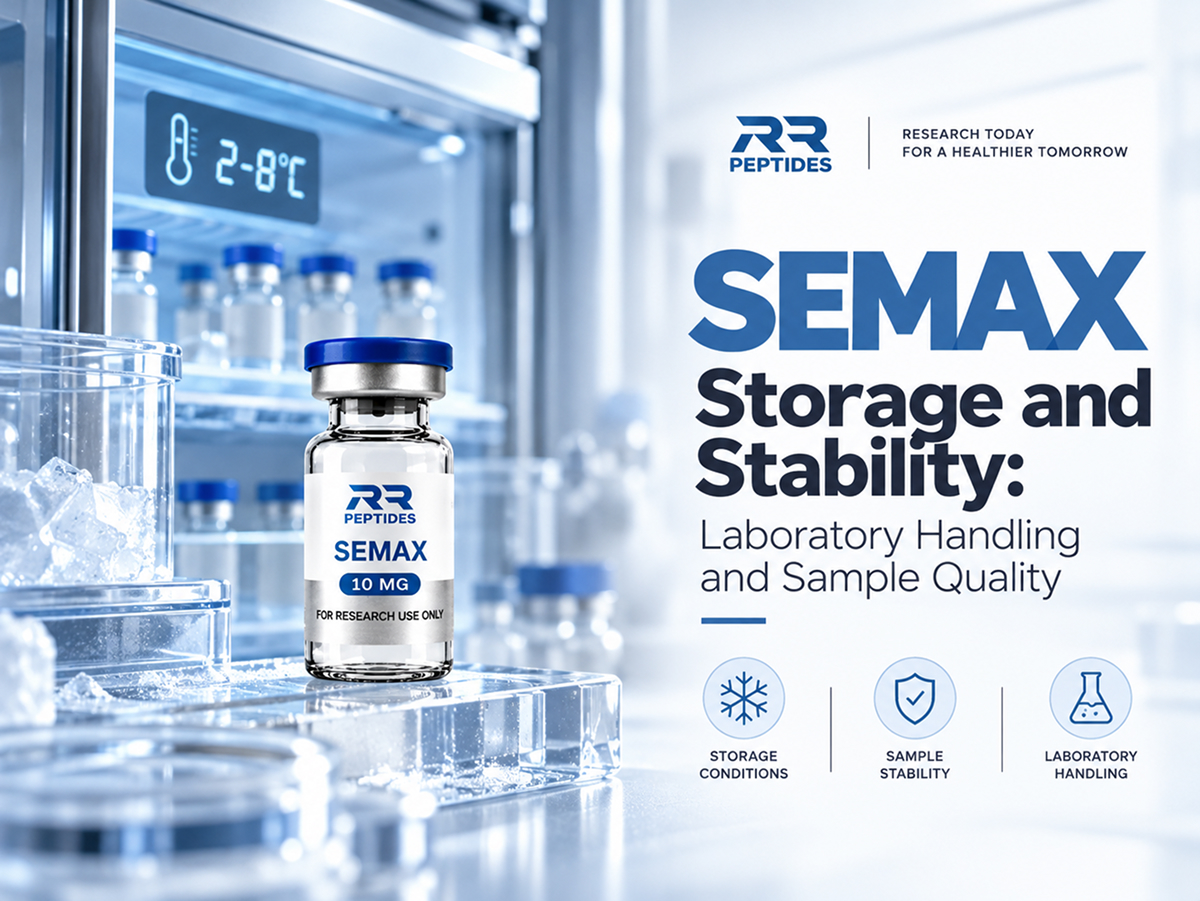
A peptide can arrive with an acceptable analytical profile yet produce unreliable laboratory results if storage conditions change its composition. Temperature excursions, moisture exposure, repeated handling, and poorly documented preparation may introduce variability long before an experiment begins. Maintaining sample integrity therefore requires more than placing a vial in a refrigerator.
Semax storage and stability deserves particular attention because Semax is a short synthetic peptide containing amino acids that can undergo chemical modification under unfavorable conditions. However, publicly available, formulation-specific stability data are limited. Researchers should distinguish general peptide-handling principles from conditions experimentally validated for a particular Semax batch.
Canadian laboratories exploring Semax 10mg can review research material listings at RR Peptides, request available analytical documentation, and verify that proposed storage conditions match the actual material supplied.
Semax is a synthetic heptapeptide with the sequence Met-Glu-His-Phe-Pro-Gly-Pro, commonly abbreviated MEHFPGP. Its relatively small size does not make it immune to degradation. Temperature, oxygen, light, water, and solution chemistry may alter peptides through different mechanisms.
Semax storage and stability assessments should consider methionine oxidation because methionine is susceptible to oxidative modification. Histidine may also participate in oxidation under certain conditions, while peptide-bond hydrolysis can occur in unsuitable environments. These are chemically plausible risks, not proof that a specific commercial sample has degraded.
Environmental and Formulation Variables
A peptide’s stability reflects both its molecular structure and the conditions surrounding it. Researchers should evaluate:
Temperature: Elevated temperatures can accelerate some chemical degradation reactions.
Water exposure: Moisture can change the physical state of a dried sample and facilitate reactions.
Oxygen: Air exposure may contribute to oxidation of susceptible residues.
Light: Certain peptide structures and impurities can undergo photochemical changes.
Solution pH: Strongly acidic or alkaline conditions can increase particular degradation risks.
Container contact: Adsorption onto glass or plastic can reduce measurable peptide recovery.
Formulation components: Salts, buffers, residual solvents, and excipients can influence behavior.
Semax storage and stability cannot be predicted accurately from a generic temperature recommendation alone. Two preparations with the same nominal peptide sequence may behave differently because their residual moisture, counterions, packaging, and manufacturing histories differ.
Assessing Baseline Material Quality
Before comparisons, laboratories should establish the sample composition. Supplier purity may describe chromatographic area percentage rather than exact peptide mass. Counterions and residual water affect interpretation. Recording analytical methods and reference standards helps researchers compare later measurements.
Chemical Degradation Versus Physical Loss
Researchers sometimes use the word degradation for every reduction in measured concentration. Yet several distinct events can explain an apparent loss. Oxidation or hydrolysis changes molecular identity, whereas adsorption can remove intact molecules from the sampled solution. Precipitation may lower soluble recovery without necessarily producing new chemical fragments.
Potential issue
Possible cause
Appropriate investigation
Oxidized species
Oxygen, reactive impurities, or light
LC-MS comparison with reference material
Hydrolytic fragments
Water, unsuitable pH, or prolonged exposure
Stability-indicating chromatographic profiling
Lower soluble recovery
Adsorption or precipitation
Recovery studies and container comparison
Increased moisture
Damaged seal or humid handling
Moisture assessment and packaging inspection
Unexpected impurity peaks
Manufacturing impurities or storage changes
Baseline and follow-up analytical comparison
Semax storage and stability studies should separate these mechanisms before assigning a cause.
Explore neurobiology and cognitive research with Semax 10mg.
Lyophilization removes water through freezing and controlled drying, leaving a solid preparation that may be more stable than an aqueous solution. It does not guarantee indefinite shelf life. Residual moisture, formulation design, and closure integrity still influence long-term behavior.
Semax storage and stability practices should begin with supplier-specific documentation. Check the batch identifier, certificate of analysis, recommended temperature range, packaging specifications, and any validated expiry or retest information. If the supplier cannot provide stability data, avoid presenting an assumed shelf life as scientifically established.
Choosing a Storage Environment
For Semax storage and stability, general peptide literature often describes frozen storage for long-term preservation of lyophilized analytical materials, but no universal temperature or duration can be assigned to every Semax preparation. A validated recommendation for one formulation should not automatically be transferred to another.
Semax storage and stability planning can follow a practical decision hierarchy:
Review verified instructions for the exact supplied batch and formulation.
Confirm that laboratory equipment can maintain the specified conditions.
Keep unopened containers sealed and protected from unnecessary moisture exposure.
Record receipt dates, storage locations, and any environmental deviations.
Establish a retest or disposal decision when the validated period expires.
Why Packaging Matters
Primary packaging creates a barrier between the peptide and its environment. A correctly fitted stopper, crimp, or sealed container can reduce moisture exchange and accidental contamination. However, closures may be damaged during shipping or repeated manipulation. Inspect seals before accepting a sample into inventory.
Semax storage and stability also depends on the environment encountered when a cold vial is removed. Opening it immediately in humid room air can permit condensation inside the container. Where consistent with the documented procedure, allow a sealed container to equilibrate before opening and record handling conditions.
Managing Repeated Access
For studies with several sampling dates, laboratories can plan separate containers or validated aliquots instead of repeatedly exposing one stock. Consider material availability, container compatibility, and analytical sensitivity. Each transfer introduces error; minimizing openings should not require excessive handling.
Establishing a Sample Inventory
A traceable inventory helps laboratories distinguish chemical changes from logistical mistakes. Record the product name, batch, stated quantity, arrival condition, storage unit, responsible operator, and analytical release status. Link these records to any preparation or subsequent testing.
Semax storage and stability records should follow each aliquot rather than only the original container.
How Can Temperature and Moisture Affect Semax Samples?
Temperature Excursions and Reaction Rates
Temperature influences reaction kinetics, but its effect cannot be reduced to one universal rule. Some reactions accelerate during warming, while freezing can create other stresses in solutions, including changes in solute concentration or pH within unfrozen regions. The relevant risk depends on the sample’s physical state.
Semax storage and stability evaluations should distinguish dried powder from reconstituted solution. A short excursion may have different consequences for each. Neither immediate disposal nor automatic acceptance is justified without appropriate stability evidence and an assessment of the actual exposure.
Moisture, Condensation, and Humidity
Moisture is especially relevant to lyophilized material because its physical properties may change as water enters the container. Condensation can occur when a cold, unsealed vial encounters warmer humid air. This is a practical concern during repeated retrieval from cold storage.
Semax storage and stability protocols should minimize unnecessary opening and track any suspected seal failures. Visible clumping may indicate a physical change, but some lyophilized preparations naturally vary in appearance. Analytical confirmation remains necessary before concluding that degradation occurred.
The Difference After Reconstitution
Adding a solvent creates a different stability environment. Dissolved peptides can experience oxidation, hydrolysis, adsorption, or microbial contamination, depending on solvent composition, handling, and storage. A preservative does not guarantee chemical stability or sterility, and research solutions should never be assumed suitable for administration.
Semax storage and stability in solution requires formulation-specific studies that assess concentration, solvent compatibility, pH, container type, and storage interval. Researchers should avoid borrowing an arbitrary number of days from another peptide or a different preparation.
Sample condition
Main concern
Useful control
Sealed lyophilized vial
Long-term chemical and moisture stability
Verified temperature and intact closure
Cold vial opened immediately
Condensation and humidity exposure
Controlled equilibration while sealed
Prepared laboratory solution
Chemical change and microbial contamination
Validated preparation and limited handling
Repeatedly frozen solution
Freeze-thaw stress and variable recovery
Planned aliquots and documented cycles
Shipment with temperature excursion
Unknown exposure history
Logger review and evidence-based assessment
Canadian Seasonal Conditions
Canada’s winter cold and summer heat can create different shipping risks. Packages may encounter loading docks, vehicle compartments, or delivery delays that differ sharply from indoor laboratory conditions.
Semax storage and stability assessments should therefore consider route conditions and documented package performance. Health Canada’s environmental-control guidance for regulated drug products emphasizes labelled conditions, monitoring, and scientifically justified excursion decisions. That drug guidance is useful context, not automatic proof that every research peptide falls under identical requirements.
Explore neurobiology and cognitive research with Semax 10mg.
What Handling Practices Help Maintain Sample Integrity?
Receiving and Initial Inspection
For Semax storage and stability, the first quality checkpoint is receipt. Verify the identity on the label, batch number, container condition, and accompanying analytical records. Where temperature control was specified, inspect available shipping-monitoring information. Quarantine material with unresolved discrepancies rather than assuming it remains suitable.
Semax storage and stability begins with a defensible baseline. If the laboratory has the capability, compare an initial analytical profile with later samples to detect changes attributable to storage instead of confusing them with pre-existing impurities.
A Practical Laboratory Workflow
Use a written procedure rather than relying on individual habits:
Confirm identity: Match the received vial with procurement and batch documentation.
Inspect packaging: Check seals, damage, and unexpected moisture indicators.
Log conditions: Record arrival time, storage placement, and monitoring records.
Assign responsibility: Identify who can approve release or investigate deviations.
Limit exposure: Plan sampling to avoid unnecessary repeated opening.
Track aliquots: Give each prepared portion a unique identifier and history.
Review results: Compare analytical findings against predefined acceptance criteria.
Semax storage and stability benefits from small, planned sample withdrawals when compatible with the study design. Reducing repeated manipulation can limit contamination and environmental exposure, although aliquoting itself introduces additional handling and container-contact risks.
Selecting Compatible Containers
Glass and polymer vessels can behave differently. Some peptides adsorb onto surfaces, especially at low concentrations, and certain additives or container materials may interfere with assays. Compatibility should be assessed using the intended concentration and analytical method rather than assumed from container appearance.
Semax storage and stability may be evaluated through recovery comparisons across candidate vessels. A decline in measured concentration without new degradation peaks can suggest adsorption, but researchers must still consider dilution errors and instrument variability.
Documentation That Supports Reproducibility
Good records allow another researcher to reconstruct what happened to a sample. Temperature logs, preparation dates, equipment identifiers, and deviations are useful only when linked to specific materials and reviewed consistently.
Record
Why it matters
Batch and analytical certificate
Establishes documented starting identity and purity
Receipt and shipping condition
Identifies possible pre-storage exposures
Storage location and logger
Supports reconstruction of temperature history
Preparation and aliquot record
Tracks additional handling events
Retest results
Detects change relative to baseline
Deviation assessment
Explains acceptance, quarantine, or rejection
Semax storage and stability is therefore both an analytical question and a traceability question. Even a chemically intact sample may be unsuitable for a study if its identity or handling history cannot be established reliably.
Explore neurobiology and cognitive research with Semax 10mg.
How Can Researchers Identify Potential Sample Degradation?
Visual Inspection Is Only a Screening Step
Discoloration, unexpected moisture, damaged closures, or unusual precipitation can justify further investigation. However, peptide degradation may occur without any visible change. Conversely, a difference in powder appearance may reflect formulation or manufacturing variation rather than chemical breakdown.
Semax storage and stability cannot be certified by visual inspection alone. Analytical testing is necessary to distinguish intact peptide from modified species and to determine whether a sample still meets predefined research specifications.
Chromatography and Mass Spectrometry
High-performance liquid chromatography can separate components and reveal changes in impurity profiles when the method is appropriately validated. Liquid chromatography coupled with mass spectrometry can help characterize molecular masses and investigate possible oxidation products or cleavage fragments. Method suitability matters because not every impurity will be resolved by every assay.
Semax storage and stability studies should compare initial and stored samples using consistent methods, reference materials, and instrument settings. A purity percentage without the underlying method, detection limits, or relevant chromatograms offers incomplete evidence.
Distinguishing Storage Effects From Assay Drift
Instrument performance can change between testing dates. Review reference controls, calibration records, and sample preparation before attributing differences to degradation. Comparing stored and baseline materials within analytical sequence reduces variability, provided the baseline reference remains suitable.
Stability-Indicating Study Design
A meaningful stability study uses planned time points, defined environmental conditions, and acceptance criteria established before results are examined. Replicate samples help distinguish real changes from analytical noise. Stress testing can identify potential degradation routes, but deliberately stressed results should not be confused with ordinary storage behavior.
Semax storage and stability evaluations should consider:
Identity: Is the expected peptide still present?
Purity: Have new chromatographic components appeared?
Recovery: Has measurable intact peptide declined?
Moisture: Has the dried material absorbed water?
Container integrity: Is the barrier against the environment intact?
Method precision: Could instrument variability explain the difference?
Interpreting Unexpected Results
An additional mass signal may suggest a chemical modification, but assignment requires suitable confirmation. A smaller peak area may reflect adsorption, preparation error, or genuine degradation. A single abnormal reading should trigger a documented investigation, not an unsupported mechanistic conclusion.
Semax storage and stability decisions should use trends, independent confirmation, and scientifically justified criteria. If available data cannot support continued use, quarantine or reject the sample according to the laboratory’s quality system.
Does Lyophilized Semax Have a Universal Storage Temperature?
No. General peptide literature supports careful temperature control, often including frozen storage for long-term dried analytical materials, but the appropriate condition for a specific Semax batch depends on validated supplier or laboratory data.
Is Refrigeration Always Enough?
Not necessarily. Semax storage and stability depends on formulation, duration, packaging, and documented performance. Refrigeration cannot substitute for evidence establishing a suitable storage period.
Can Semax Be Used After a Temperature Excursion?
For Semax storage and stability, an excursion requires assessment of its duration, severity, physical state, and available stability data. Without sufficient evidence, suitability cannot be assumed.
Does Reconstitution Change Stability?
Yes. Dissolving a peptide changes its environment and introduces additional chemical, physical, and contamination risks. Solution stability must be evaluated separately from dried-material stability.
Can Researchers Identify Degradation by Looking at the Vial?
No. Visual changes may raise concerns, but an unchanged appearance does not prove chemical integrity. Chromatographic and mass-spectrometric methods provide stronger evidence.
What Documentation Should Canadian Laboratories Keep?
Semax storage and stability records should include batch identity, supplier information, environmental history, preparation events, analytical findings, and decisions about deviations. Applicable requirements depend on the activity and regulatory classification.
Conclusion
Maintaining reliable peptide samples requires attention to chemical vulnerability, lyophilized packaging, temperature history, moisture exposure, and laboratory handling. No universal storage duration can replace batch-specific evidence, and a visually normal vial is not proof of intact material.
Semax storage and stability improves when laboratories establish clear acceptance criteria, minimize unnecessary manipulation, and compare analytical results over time. These practices support reproducible experiments while keeping uncertainty visible.
Canadian researchers can explore Semax 10mg and related research materials at RR Peptides, request available quality records, and independently verify the conditions appropriate to their studies.
Consistent sample histories also make unexpected experimental results easier to investigate systematically.
Disclaimer: All products and compounds discussed are intended strictly for laboratory and research purposes. This article is provided for educational and informational purposes only. This article is not medical advice, therapeutic guidance, or instructions for human administration.
×
Subscribe & Get 10% Off!
Enter your email address below to subscribe to our newsletter and receive an instant 10% OFF discount coupon code sent directly to your inbox!
Thank you for subscribing! Your 10% discount coupon has been sent to your email. Please check your inbox!