Cognitive performance is not a single biological process. Learning, attention, memory, motivation, and movement interact, making experimental results difficult to interpret. Semax, a synthetic heptapeptide, has been investigated in animal studies involving learning tasks and neurological injury. However, behavioural differences in rodents cannot establish cognitive enhancement in humans.
Semax cognitive function research models offer a useful framework for examining what researchers actually measure, which experimental conditions influence outcomes, and where the evidence remains uncertain. This article separates published Semax observations from broader methods used in neuroscience.
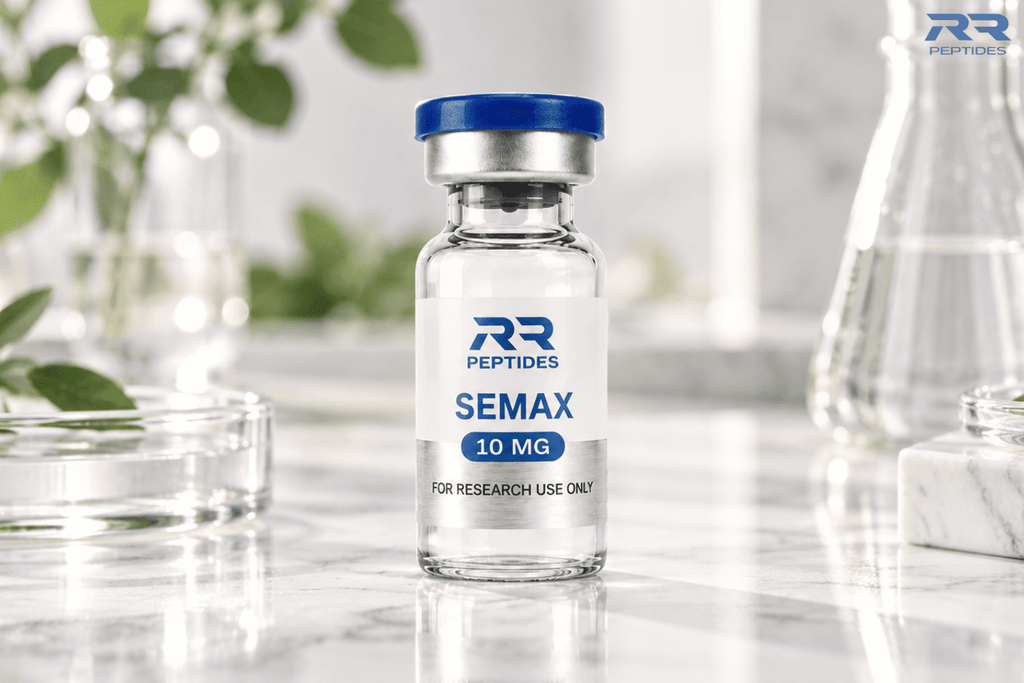
Canadian laboratories reviewing experimental neuropeptides can explore the Semax 10mg research listing at RR Peptides and assess available analytical documentation. Materials and proposed investigations require independent verification and compliance with Canadian requirements.
How Is Cognitive Function Studied in Semax Research?
Defining Cognition Before Measuring It
Cognition includes processes used to acquire, retain, retrieve, and apply information. Researchers divide these broad functions into narrower constructs because no single task captures them all. A rodent navigating a maze may depend on spatial learning, vision, movement, motivation, and stress tolerance simultaneously.
Semax cognitive function research models therefore need clearly defined questions. Investigators should specify whether they are studying acquisition during training, retention after a delay, flexibility when rules change, or performance following brain injury. These outcomes cannot be treated as interchangeable.
Important distinctions include:
Learning: Changes in performance across repeated training sessions.
Memory retention: Performance after a defined interval without practice.
Retrieval: Access to previously acquired information under testing conditions.
Attention: Selection or maintenance of responses to relevant stimuli.
Executive control: Adaptation when task rules or response demands change.
Exploration: Movement toward unfamiliar environments, which is not itself proof of better memory.
Why Behavioural Tasks Need Controls
A shorter time to reach a goal can reflect improved learning, faster swimming, reduced anxiety, or altered sensory processing. Researchers must therefore collect additional measurements that distinguish cognition from competing explanations.
Semax cognitive function research models should consider locomotor activity, sensory capability, body condition, stress exposure, and baseline task proficiency. These variables become especially important after experimental cerebral ischemia, when neurological injury may impair movement independently of memory.
Evidence Beyond a Single Score
Behavioural results are stronger when supported by learning curves, probe trials, and independent endpoints. Researchers should examine the pattern across sessions instead of focusing only on a final average. Predefined outcomes reduce the temptation to select whichever score appears most favourable. Baseline testing also helps identify animals that never learned the original task. Without this information, later differences may represent unequal starting ability rather than an experimental effect.
Research construct
Example measurement
Major confounder
Spatial acquisition
Escape latency across maze trials
Swimming speed or vision
Memory retention
Probe performance after a delay
Motivation and fatigue
Avoidance learning
Latency to enter an associated compartment
Pain sensitivity or anxiety
Exploration
Distance travelled in an open field
Motor impairment
Cognitive flexibility
Errors after a rule change
Incomplete initial learning
Semax cognitive function research models become more informative when these limitations are reported alongside the outcomes rather than hidden behind general claims about intelligence or focus.
Explore neurobiology and cognitive research with Semax 10mg.
Which Experimental Models Are Used to Study Semax?
Spatial Learning After Prefrontal Injury
One published rat investigation examined spatial learning after photochemically induced thrombosis affecting the prefrontal cortex. Researchers used a Morris water maze with a hidden platform and assessed animals approximately three weeks after surgery. Injury impaired maze learning compared with relevant controls.
The investigators reported improved learning performance in Semax-exposed injured rats following an experimental treatment period. Their interpretation included possible neuroprotective and neurotrophic contributions, but the behavioural findings alone did not identify a direct molecular mechanism.
Semax cognitive function research models based on this experiment are injury-specific. Recovery from experimentally induced impairment is not equivalent to enhancing memory in healthy people, and the findings should not be presented as clinical evidence.
Passive Avoidance Conditioning
Other Semax investigations have used passive avoidance tasks in rats. Animals learn an association between entering a compartment and an unpleasant event. Researchers later measure avoidance-related behaviour, often using entry latency or task acquisition as an endpoint.
Semax cognitive function research models using avoidance conditioning require particular caution. A longer avoidance latency may reflect memory retention, but it can also reflect altered pain sensitivity, fear, exploratory drive, or movement. Separate assessments help clarify these possibilities.
Developmental Exposure Models
Older studies investigated behavioural outcomes after experimental Semax exposure during early postnatal development in rats. Reports described later differences in exploration, anxiety-related behaviour, and passive avoidance performance. Importantly, outcomes varied with the developmental timing of exposure.
These findings are not evidence that the same intervention improves adult cognition. Developmental experiments involve sensitive biological periods, and their results cannot be generalized to routine human use.
Semax cognitive function research models should keep developmental, healthy-adult, and injury-related findings in distinct categories. Combining them creates an apparently consistent narrative from experiments asking fundamentally different questions.
Other Approaches Used in Neuroscience
Researchers also use recognition tasks, radial-arm mazes, reversal learning, and attention paradigms to study cognition generally. These are useful methodological comparisons, not proof that Semax has been rigorously evaluated in every paradigm.
Model or task
Typical scientific question
Semax evidence context
Morris water maze
Spatial learning across sessions
Published injured-rat study
Passive avoidance
Associative learning and retention
Published rat investigations
Developmental behavioural testing
Long-term consequences of early exposure
Limited preclinical reports
Novel object recognition
Recognition memory
General methodological option; evidence must be verified
Reversal learning
Adaptation to changed rules
General methodological option; not established clinical evidence
Semax cognitive function research models benefit from explicitly separating documented experiments from proposed future applications. Doing so prevents readers from mistaking a catalogue of standard neuroscience tests for a catalogue of proven peptide effects.
What Cognitive Outcomes Are Commonly Measured?
Acquisition, Retention, and Learning Curves
Learning is usually evaluated through repeated observations. In a maze, investigators may measure latency, distance travelled, errors, or successful trials. Improvement over successive sessions can indicate acquisition, but comparison groups must begin with sufficiently similar capabilities.
Semax cognitive function research models should report full trajectories rather than only the first and last measurements. A difference at one time point may disappear when trial order, fatigue, or individual variation is considered.
Spatial Memory and Navigation
The Morris water maze is frequently used to examine spatial learning in rodents. Animals navigate toward a hidden platform using environmental cues. Investigators can analyse how performance changes during training and, when appropriate, evaluate search preference during a probe trial without the platform.
Semax cognitive function research models involving water mazes need measures of swimming speed, visual function, and motor impairment. An injured animal may perform poorly because it cannot swim effectively, even if some spatial information remains intact.
Avoidance and Emotional Influences
Passive avoidance involves learning from an aversive association. Its simplicity makes it useful, but the endpoint mixes memory with emotional and sensory responses. Studies of Semax have also examined pain sensitivity, making these potential confounders particularly relevant.
Semax cognitive function research models should avoid equating stronger avoidance with better general intelligence. The result is specific to the experimental conditions and cannot independently predict attention, workplace performance, or academic learning.
Secondary Outcomes That Improve Interpretation
Semax cognitive function research models may be strengthened by collecting complementary endpoints:
Locomotor measurements: Establish whether treatment groups differ in basic movement.
Sensory checks: Identify visual or tactile impairments affecting task performance.
Retention intervals: Distinguish immediate task acquisition from delayed performance.
Error patterns: Reveal whether animals adopt different strategies rather than simply moving faster.
Blinded scoring: Reduce bias when interpreting behaviour from recordings.
Outcome
What a difference may suggest
What it cannot prove alone
Shorter escape latency
More efficient task performance
Better memory without motor controls
Fewer maze errors
Improved task acquisition
A specific molecular mechanism
Longer avoidance latency
Stronger avoidance response
Pure memory enhancement
Higher exploration
Altered activity or novelty response
Greater cognitive capacity
Better delayed performance
Retention under tested conditions
Durable human benefit
Semax cognitive function research models are most useful when authors state which interpretations their measurements support and which alternatives remain unresolved.
Explore neurobiology and cognitive research with Semax 10mg.
How Are Behavioral and Molecular Findings Compared?
Connecting Different Evidence Levels
Behaviour describes an observable outcome; molecular assays describe selected biological processes. Researchers sometimes measure both after Semax exposure, but results collected from different animals, tissues, or experiments cannot automatically be linked causally.
Semax cognitive function research models should distinguish three levels of evidence: an association between exposure and behaviour, an association between exposure and a molecular marker, and direct evidence that the marker mediates the behavioural difference. The third requires targeted causal experiments.
BDNF and Neurotrophic Signaling
Brain-derived neurotrophic factor, or BDNF, participates in neuronal development and activity-dependent adaptation. Some rat investigations reported changes in BDNF expression, protein abundance, or TrkB-associated signaling following Semax exposure. These findings support research questions about neurotrophic regulation.
However, an increase in a neurotrophin marker does not demonstrate improved memory. The measurement may vary by brain region, timing, injury condition, and cell population. Nor does TrkB phosphorylation establish direct binding of Semax to that receptor.
Semax cognitive function research models should compare neurotrophic measurements with clearly defined behavioural endpoints, ideally within compatible experimental designs and observation windows.
Gene Expression and Injury-Related Networks
Transcriptomic studies of Semax in rodent cerebral ischemia have described changes in genes associated with inflammation and neurotransmission. Such networks are relevant to neural function, but pathway enrichment is a statistical interpretation of gene lists, not a direct measure of learning.
Semax cognitive function research models can use transcriptomic findings to generate hypotheses. They cannot conclude that an animal remembered better because a particular pathway name appeared in an enrichment analysis.
Designing a Stronger Integrated Study
An informative design would combine:
Predefined behaviour: Select one primary learning or retention endpoint.
Matched controls: Include sham, injury, and vehicle conditions where appropriate.
Regional sampling: Identify hippocampal, cortical, or other tissue precisely.
Temporal alignment: Compare behavioural and molecular observations at relevant intervals.
Pathway testing: Examine whether disrupting a proposed mechanism changes the result.
Independent replication: Confirm findings beyond one cohort or laboratory.
Semax cognitive function research models should also report negative results. If a molecular marker changes without behavioural improvement, that discrepancy limits a proposed mechanism rather than invalidating the experiment.
Why Correlation Is Not Mechanism
Two endpoints can move together because of a third variable, such as injury severity or general activity. Causal testing requires suitable interventions, controls, and attention to unintended effects of the experimental manipulation.
Semax cognitive function research models become stronger when they identify alternative explanations before interpreting molecular and behavioural associations as one connected pathway.
Explore neurobiology and cognitive research with Semax 10mg.
What Are the Limitations of Cognitive Research Models?
Translation From Rodents to Humans
Rodent tasks model selected aspects of learning, not the full complexity of human cognition. Laboratory animals experience controlled environments, standardized challenges, and relatively narrow genetic backgrounds. Human memory and attention depend on language, social context, sleep, health, and many other factors.
Semax cognitive function research models cannot establish that Semax improves concentration, prevents dementia, or supports recovery after stroke in humans. These claims would require appropriately designed human studies assessing clinically meaningful outcomes.
Study Quality and Reproducibility
Much of the published behavioural literature is relatively old and concentrated within a limited number of research groups. Some reports provide restricted methodological detail or are difficult to evaluate across languages. Small cohorts and inconsistent controls can amplify uncertainty.
Semax cognitive function research models need transparent randomization, sample-size justification, blinded assessment, and complete reporting. Repeating several trials in one animal does not create additional independent biological replicates. Publication bias deserves attention because studies reporting striking improvements may be easier to find than experiments showing no measurable difference.
Route, Timing, and Experimental Context
Differences in exposure route, developmental stage, injury status, and testing schedule can change behavioural observations. Semax cognitive function research models should not pool findings after early-life exposure with adult injury experiments. Similarly, different tasks can measure different constructs even when both are described as memory tests.
Semax cognitive function research models should document these design features and avoid treating results from unrelated protocols as directly comparable.
Canadian Regulatory Considerations
Health Canada specifically identified Semax among unauthorized injectable peptide drugs in a 2025 safety advisory. Canadian authorities warn that unauthorized peptide products have not undergone the required assessment of safety, efficacy, and quality. A research-use label does not automatically make importing, selling, or administering a product lawful.
Semax cognitive function research models conducted by Canadian institutions must follow applicable ethical, procurement, and regulatory requirements. Preclinical findings should not be used to promote unauthorized human treatment or personal experimentation.
Priorities for Future Research
The most useful next steps are methodological rather than promotional:
Replicate published learning findings in independent laboratories.
Distinguish motor, emotional, and sensory effects from memory outcomes.
Compare healthy, injured, and developmental models without conflating them.
Semax is a synthetic seven-amino-acid peptide based on an ACTH-related fragment with an added proline-glycine-proline sequence. It has been investigated in preclinical neurobiology and behavioural experiments.
Has Semax Been Studied in Memory Tasks?
Yes. Published rat investigations include spatial learning after prefrontal ischemic injury and passive avoidance conditioning. Results are specific to their experimental models.
Does Better Maze Performance Prove Better Memory?
No. Maze performance also depends on vision, motor ability, motivation, stress, and learning strategy. Appropriate controls are essential.
Are BDNF Changes Evidence of Cognitive Enhancement?
No. BDNF-related measurements can suggest neurotrophic responses but do not independently establish improved learning or clinical benefit.
Are These Findings Relevant to Healthy Adults?
Semax cognitive function research models cannot reliably predict cognitive outcomes in healthy humans. Animal observations require separate clinical evaluation.
Is Semax Authorized for Cognitive Enhancement in Canada?
Health Canada has warned about unauthorized injectable Semax products. A laboratory research label is not evidence of authorization for human use.
What Would Improve the Evidence?
Independent replication, better behavioural controls, matched molecular measurements, and transparent reporting would strengthen interpretation.
Conclusion
Semax cognitive function research models include published rodent experiments involving spatial learning, passive avoidance, and developmental behavioural outcomes. These studies provide useful questions about learning under defined conditions, but they do not establish a general cognitive benefit in humans.
Semax cognitive function research models should separate task performance from motor and emotional confounders, and distinguish molecular associations from proven mechanisms. Reproducibility matters more than appealing claims about sharper focus or memory.
Canadian laboratories can review Semax 10mg and related research materials at RR Peptides, verify specifications independently, and assess institutional requirements before proceeding with legitimate investigations.
Disclaimer: All products and compounds discussed are intended strictly for laboratory and research purposes. This article is provided for educational and informational purposes only. This article is not medical advice, therapeutic guidance, or instructions for human administration.
×
Subscribe & Get 10% Off!
Enter your email address below to subscribe to our newsletter and receive an instant 10% OFF discount coupon code sent directly to your inbox!
Thank you for subscribing! Your 10% discount coupon has been sent to your email. Please check your inbox!