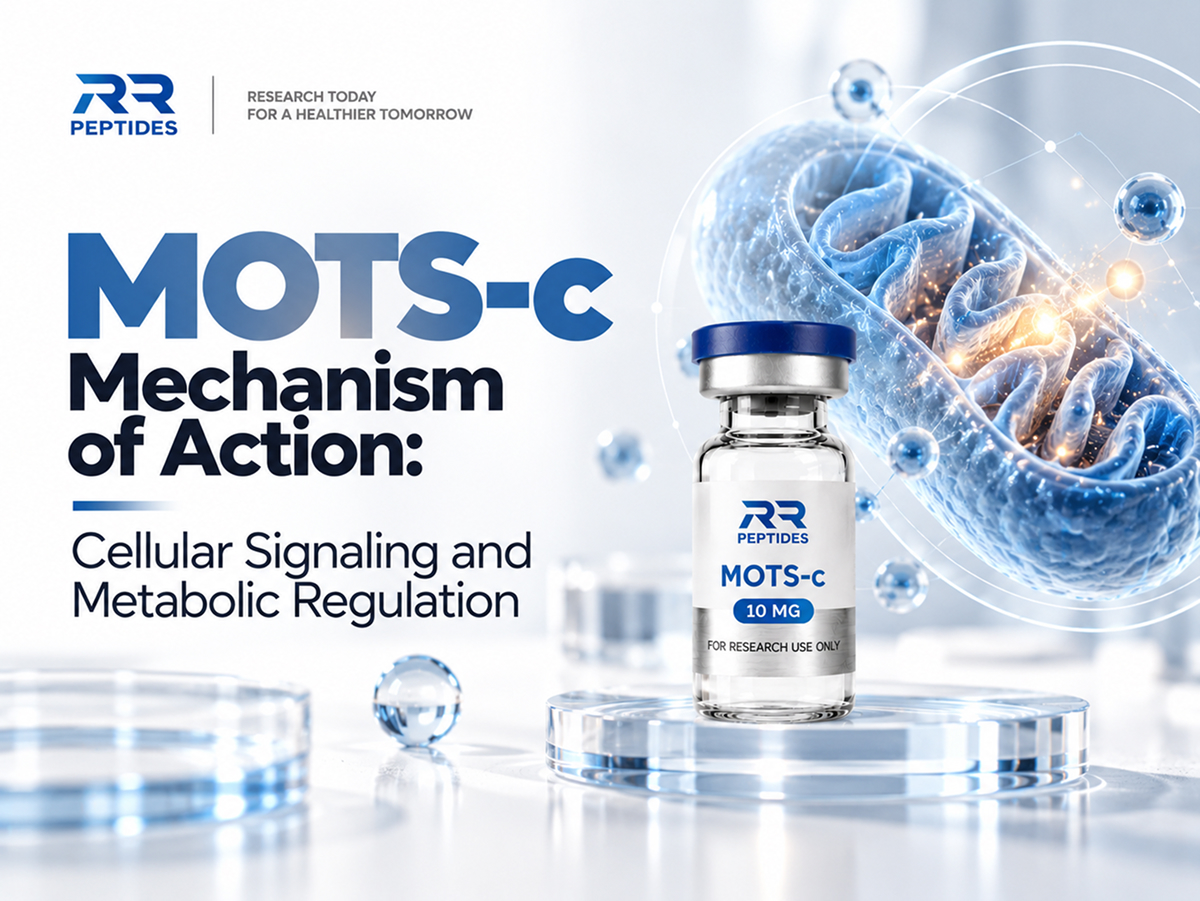
Mitochondria are commonly described as cellular energy producers, yet their functions extend into metabolic communication, stress responses, and regulation of gene activity. MOTS-c is a short peptide encoded by a small open reading frame associated with mitochondrial DNA. Its unusual origin has encouraged scientists to investigate how mitochondrial genetic information may influence processes beyond conventional respiration. Understanding the MOTS-c mechanism of action requires separating experimentally observed effects from proposed molecular explanations.
Early studies have connected MOTS-c with metabolic signaling, energy sensing, and cellular adaptation. However, most mechanistic evidence comes from cultured cells and animal models. These findings do not establish therapeutic effectiveness, approved human applications, or a complete pathway from peptide exposure to physiological response. This article examines established observations, important uncertainties, and research methods relevant to Canadian laboratories.
Explore RR Peptides research materials and product specifications when designing laboratory investigations. Review identity, analytical documentation, and institutional requirements before selecting compounds for experimental use.
How Is MOTS-c Thought to Act at the Cellular Level?
A mitochondrial genetic origin
MOTS-c is described as a 16 amino acid mitochondrial derived peptide. Its proposed coding sequence lies within the mitochondrial 12S ribosomal RNA region, distinguishing it from many signaling peptides encoded by nuclear genes. This origin has prompted questions about whether mitochondrial genomes contribute additional signals to cellular regulation. Genetic origin, however, does not by itself identify a receptor, binding partner, or physiological function.
The MOTS-c mechanism of action is therefore best considered a developing mechanistic framework rather than one established sequence of molecular events. Researchers studying the MOTS-c mechanism of action must verify peptide presence, location, and whether candidate pathways are necessary for an observed outcome.
Intracellular signaling versus direct binding
Several experimental reports associate MOTS-c exposure with changes in metabolic pathways, including AMP activated protein kinase, or AMPK. AMPK helps cells respond to energy related conditions and regulates multiple metabolic processes. Observing increased AMPK phosphorylation, however, does not prove that MOTS-c binds AMPK directly. An upstream change in metabolites or cellular stress could produce a similar downstream response.
For the MOTS-c mechanism of action, distinguishing direct target engagement from indirect pathway activation is essential. Experiments involving pathway inhibition, genetic perturbation, and complementary biochemical measurements can strengthen mechanistic interpretation, although each approach has limitations.
Why cellular context matters
A peptide may produce different responses depending on cell identity, nutrient conditions, exposure duration, and baseline metabolic state. Cultured muscle cells, transformed cell lines, and primary human cells do not necessarily respond alike. Even a reproducible signaling change may depend on the concentration used in the experiment.
Investigators examining the MOTS-c mechanism of action should report culture conditions and distinguish physiological hypotheses from effects produced by experimental exposure.
Question
Evidence researchers seek
Main caution
Is the peptide present?
Specific detection and sequence confirmation
Assay interference is possible
Where does it act?
Validated localization measurements
Localization does not prove function
Which pathway changes?
Signaling and metabolic assays
Association is not direct binding
Is a pathway necessary?
Perturbation and rescue experiments
Interventions may have off target effects
Discover a high-purity synthetic peptide designed for advanced laboratory studies with RR Peptides MOTS-c 10mg.
Which Cellular Pathways Are Associated With MOTS-c?
AMPK and energy sensing
AMPK is frequently discussed because it responds to changes in cellular energy status. In some preclinical experiments, MOTS-c related interventions have been associated with AMPK activation and altered metabolic endpoints. Nevertheless, AMPK controls many processes, so its activation alone cannot identify a unique upstream signal.
The MOTS-c mechanism of action may involve metabolic conditions that influence AMPK rather than a simple one step interaction. Researchers should measure appropriate upstream indicators and downstream functional changes before assigning causality.
Furthermore, comparing AMPK responses across different cellular environments may reveal whether signaling changes depend on nutrient availability or experimental stress. Such comparisons can help researchers distinguish context dependent metabolic adaptations from consistent pathway responses associated with MOTS-c exposure in laboratory models.
Folate metabolism and purine biosynthesis
Early mechanistic work proposed connections between MOTS-c, folate related one carbon metabolism, and purine synthesis. Altered levels of metabolic intermediates could influence cellular energy sensing, offering a possible bridge between peptide exposure and signaling responses. However, metabolite changes do not independently establish which enzyme or interaction initiates the process.
In studying the MOTS-c mechanism of action, targeted metabolomics can help test whether proposed metabolic intermediates change consistently across conditions. Investigators should account for nutrient composition, cell growth, and normalization because these variables can influence metabolite abundance.
Stress response and gene regulation
Some cellular studies report stress associated redistribution of MOTS-c toward the nucleus. This observation has motivated hypotheses about links between metabolic state and transcriptional regulation. Yet nuclear detection does not demonstrate direct DNA binding, identify regulatory partners, or establish that a particular gene expression change is caused by the peptide.
Research into the MOTS-c mechanism of action benefits from combining imaging with fractionation, transcriptional analysis, and independent validation.
Pathways are interconnected
Energy sensing, redox regulation, mitochondrial activity, and gene expression influence one another. A shift in one endpoint may therefore accompany several secondary changes. Pathway diagrams are useful summaries, but they should not imply that every arrow has been experimentally demonstrated.
A careful MOTS-c mechanism of action study distinguishes among three levels of evidence:
An observed association between peptide exposure and a measured endpoint.
Experimental evidence that a particular pathway contributes to the response.
Direct biochemical evidence identifying a molecular interaction or target.
These levels support different conclusions. For example, a phosphorylation change supports pathway involvement but does not necessarily establish a receptor or binding mechanism.
Pathway or process
Reported research interest
Remaining question
AMPK signaling
Energy sensing responses
What initiates activation?
One carbon metabolism
Metabolic intermediate changes
Which steps are causally involved?
Purine metabolism
Proposed links with energy status
Are changes consistent across models?
Nuclear signaling
Stress associated localization
Which molecular partners mediate effects?
How Can MOTS-c Influence Cellular Metabolic Signaling?
Glucose utilization in experimental systems
Preclinical studies have investigated whether MOTS-c exposure changes glucose handling under defined experimental conditions. Measurements may include cellular uptake, glucose tolerance in animals, and signaling associated with metabolic regulation. These outcomes describe different biological scales and cannot be treated as interchangeable.
The MOTS-c mechanism of action should be interpreted in relation to the actual measurement. Increased uptake in cultured cells does not demonstrate improved glucose regulation in humans. Likewise, a change in an animal tolerance test may involve several tissues and hormonal responses.
Metabolic flexibility and substrate use
Cells adapt their use of carbohydrates and lipids to changing conditions. Researchers may assess oxygen consumption, extracellular acidification, metabolite profiles, and related indicators to explore these adjustments. However, each assay captures only part of the metabolic picture.
When examining the MOTS-c mechanism of action, researchers should avoid describing increased respiration as universally beneficial. Higher oxygen consumption may reflect increased demand, altered substrate availability, or compensatory stress rather than improved mitochondrial efficiency.
Exercise related signaling
Exercise changes energy demand, circulation, endocrine signaling, and cellular stress responses. Experimental literature has investigated MOTS-c in relation to exercise adaptation, including selected animal performance outcomes and measurements in human samples. Such findings are valuable for hypothesis generation but do not demonstrate human performance enhancement from peptide administration.
The MOTS-c mechanism of action in exercise models remains difficult to isolate because physical activity affects numerous pathways simultaneously. Researchers should document training status, collection timing, activity conditions, and relevant comparison groups.
Interpreting multiple metabolic endpoints
A convincing mechanistic argument connects biochemical measurements with a predefined functional outcome. For example, a study may measure AMPK phosphorylation alongside glucose uptake and metabolite changes. Agreement can strengthen interpretation, but shared responses may still arise from an unmeasured upstream factor.
For the MOTS-c mechanism of action, researchers should use complementary assays without assuming that more measurements automatically prove causation. Replication, controls, and appropriate statistical analysis remain essential.
Experimental endpoint
What it can show
What it cannot establish alone
Glucose uptake
Transport or utilization in a defined model
Human clinical benefit
AMPK phosphorylation
Selected signaling response
Direct peptide binding
Oxygen consumption
Respiratory activity during measurement
Overall mitochondrial health
Metabolite profiling
Changes in chemical intermediates
Unique causal pathway
Animal performance
Outcome under specified conditions
Human effectiveness or safety
What Is Known About MOTS-c Cellular Localization and Signaling?
Cytoplasmic and nuclear observations
Investigators have examined where MOTS-c can be detected within cells and whether localization changes during stress. Selected studies report nuclear accumulation under experimental conditions. This is relevant because cellular location can influence which molecular partners are available to a peptide.
Nevertheless, the MOTS-c mechanism of action cannot be inferred from localization alone. Fluorescent tags, fixation, antibody specificity, and cellular fractionation can alter or complicate observations. Researchers should confirm localization using independent techniques when possible.
Endogenous versus introduced peptide
Detecting naturally occurring MOTS-c differs from examining cells exposed to synthetic material. Experimental delivery may produce concentrations, distribution patterns, or uptake behavior unlike those arising physiologically. These differences matter when researchers attempt to explain the function of endogenous mitochondrial signals.
For the MOTS-c mechanism of action, reports should specify whether conclusions concern endogenous peptide, introduced peptide, or a genetic manipulation. Combining these categories without distinction can create an apparently coherent mechanism unsupported by any single experiment.
Measurement specificity
Immunoassays and microscopy can be useful, but researchers must assess cross reactivity, background signal, and sample preparation. Mass spectrometry may offer additional molecular identification when the method has adequate sensitivity and validated peptide recovery. Transcript measurements, meanwhile, do not necessarily quantify mature peptide abundance.
The MOTS-c mechanism of action depends partly on establishing that the intended molecule was measured. Appropriate blanks, controls, reference materials, and independent replication help reduce uncertainty.
Canadian laboratory considerations
Canadian research institutions may use cell culture, targeted metabolomics, microscopy, and animal models to investigate mitochondrial biology. Applicable oversight depends on the study and materials involved. Institutional biosafety procedures, animal care requirements, and human research ethics review may be relevant.
Researchers examining the MOTS-c mechanism of action in Canada should preserve clear records of material identity, storage history, assay validation, and experimental deviations. Health Canada requirements depend on intended use and activity; research availability does not imply authorization for human administration.
A useful documentation checklist includes:
Source, identity, purity, and batch information for research materials.
Sample preparation, storage conditions, and processing timelines.
Controls supporting localization and molecular detection.
Instrument calibration, analytical limits, and normalization methods.
Institutional approvals and reporting of unexpected results.
Discover a high-purity synthetic peptide designed for advanced laboratory studies with RR Peptides – MOTS-c 10mg.
Which Mechanistic Questions About MOTS-cRemain Unresolved?
Identifying direct molecular targets
One central uncertainty is whether MOTS-c engages a defined receptor or intracellular partner responsible for the reported signaling responses. Downstream pathway activation is not equivalent to direct target identification. Binding experiments require appropriate controls, and any proposed interaction should be tested for functional relevance.
The MOTS-c mechanism of action remains incomplete until key molecular interactions can be reproduced and connected to outcomes through convincing causal experiments.
Physiological concentrations and tissue distribution
The relationship between circulating measurements, local tissue concentrations, and experimentally applied doses remains uncertain. A peptide may be detectable in blood without having the same availability in muscle, liver, or brain. Differences in clearance and uptake can further complicate comparisons.
For the MOTS-c mechanism of action, investigators need validated measurements across relevant compartments and conditions. Without such information, results obtained at experimental concentrations may not describe ordinary physiological signaling.
Additionally, differences in peptide stability and degradation across biological environments may influence experimental observations. Researchers should consider how sample handling, analytical sensitivity, and tissue specific conditions affect measured concentrations before drawing conclusions about the relationship between peptide availability and cellular signaling.
Species differences and translation
Cell lines and rodents provide valuable mechanistic tools, but their metabolism, genetics, and responses to interventions differ from those of humans. Even when animal findings are reproducible, translation requires independent investigation. Observational human studies cannot establish causation simply because a peptide concentration correlates with a characteristic.
The MOTS-c mechanism of action should therefore be described as a research question rather than a validated therapeutic explanation. Clinical claims require appropriately designed human evidence, including safety evaluation and meaningful outcomes.
Reproducibility and reporting
Different laboratories may use distinct peptide preparations, cell models, analytical platforms, and endpoint definitions. These differences can contribute to apparently conflicting results. Transparent reporting helps determine whether disagreement reflects biology or methodology.
To strengthen the MOTS-c mechanism of action evidence base, investigators should prioritize:
Independent replication across relevant biological models.
Validated peptide detection and analytical recovery.
Appropriate randomization, blinding, and statistical planning.
Experiments distinguishing correlation from pathway necessity.
Clear reporting of negative and inconsistent findings.
These practices strengthen MOTS-c mechanism of action research without overstating preliminary observations.
Some preclinical experiments associate MOTS-c exposure with AMPK related signaling. However, pathway activation does not establish direct binding. The MOTS-c mechanism of action requires additional experiments to identify upstream events and determine whether AMPK is necessary for specific outcomes.
Is MOTS-c produced by mitochondria?
Its proposed coding sequence is associated with mitochondrial DNA, specifically the 12S ribosomal RNA region. Researchers continue to investigate peptide production, localization, and biological significance in different experimental systems.
Does nuclear localization prove gene regulation?
No. Nuclear detection suggests a possible context for signaling but does not identify transcriptional partners or establish direct regulation of particular genes. Independent localization and functional studies are needed.
Can MOTS-c improve human metabolic health?
Preclinical findings do not establish clinical effectiveness. The MOTS-c mechanism of action remains under investigation, and human benefit cannot be inferred from cell signaling changes or animal metabolic outcomes.
Why do researchers use multiple experimental models?
Each model addresses different questions. Biochemical assays explore interactions, cultured cells investigate signaling, animal studies connect pathways with physiology, and human observations examine associations. No single model resolves every uncertainty.
What should Canadian laboratories prioritize?
Laboratories should use characterized research materials, validated assays, suitable controls, and applicable institutional oversight. The MOTS-c mechanism of action also requires transparent reporting of model limitations and a clear separation between laboratory findings and human clinical claims.
Conclusion
MOTS-c illustrates an intriguing possibility: mitochondrial genetic information may contribute to signaling processes that influence cellular metabolism and stress responses. Research has linked the peptide with AMPK related activity, metabolic intermediates, and changes in cellular localization. Yet these findings do not establish a complete molecular pathway, universal physiological effects, or therapeutic benefit.
The MOTS-c mechanism of action is best investigated through carefully controlled experiments that distinguish direct interactions from downstream associations. For Canadian laboratories, reproducible methods, appropriate oversight, and accurate reporting provide a sound foundation for future work.
Explore RR Peptides research materials, product specifications, and educational resources to support laboratory planning. Compare available documentation with your protocol and confirm relevant institutional and regulatory requirements before proceeding.
Disclaimer: All products and compounds discussed are intended strictly for laboratory and research purposes. This article is provided for educational and informational purposes only. This article is not medical advice, therapeutic guidance, or instructions for human administration.
×
Subscribe & Get 10% Off!
Enter your email address below to subscribe to our newsletter and receive an instant 10% OFF discount coupon code sent directly to your inbox!
Thank you for subscribing! Your 10% discount coupon has been sent to your email. Please check your inbox!