A reproductive hormone result begins with events too small for an ordinary blood test to capture. A peptide approaches a receptor, changes its activity, and influences electrical signaling in neurons before the pituitary releases measurable hormones. Separating these events is essential for interpreting endocrine experiments.
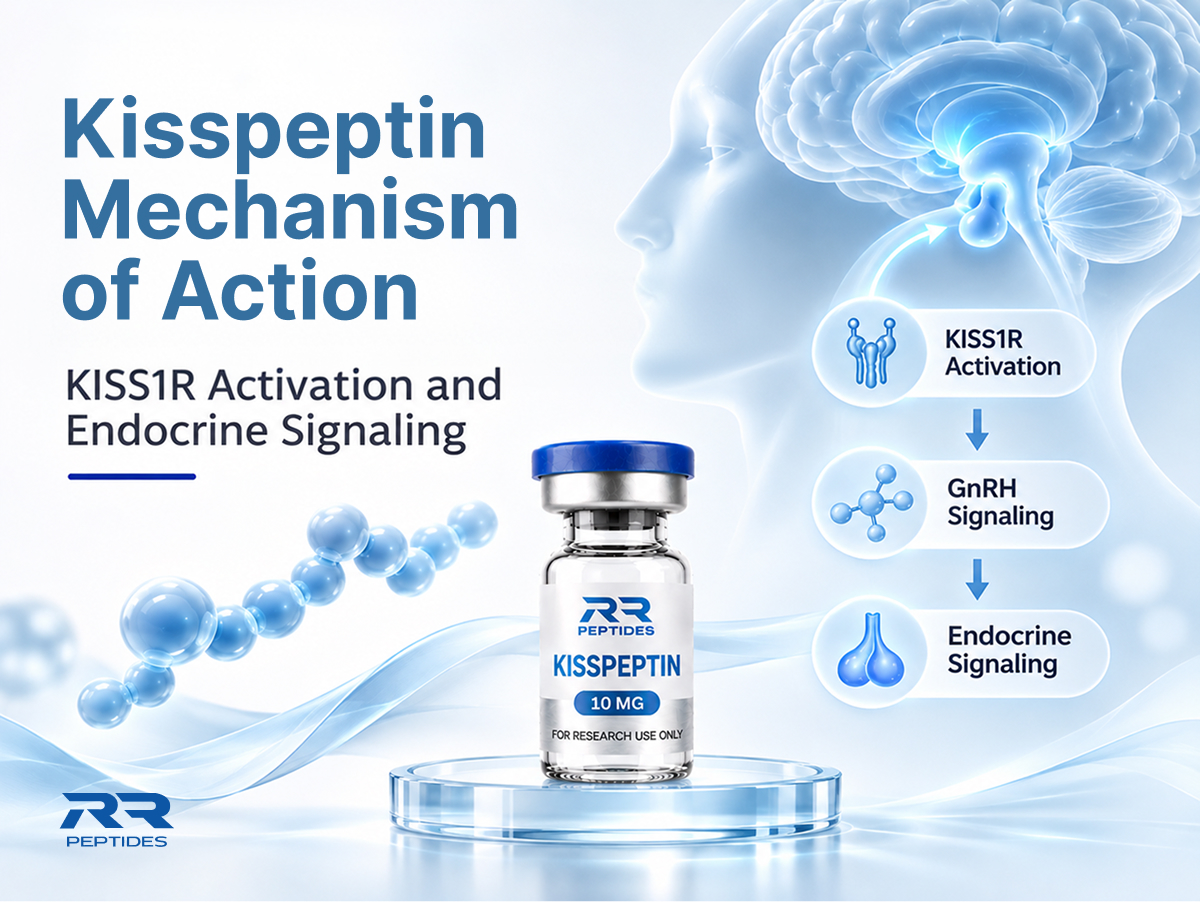
The Kisspeptin mechanism of action links peptides derived from KISS1 to the kisspeptin receptor KISS1R, formerly GPR54. This system helps regulate gonadotropin-releasing hormone (GnRH), but receptor binding, neuronal excitation, and reproductive outcomes are not equivalent claims. Their evidence comes from different models.
Canadian laboratories can explore RR Peptides for research-focused product information while independently evaluating primary studies, batch identity, and applicable requirements. This guide examines the kisspeptin mechanism of action through receptor recognition, intracellular messengers, GnRH neuronal activity, and unresolved mechanistic questions. It distinguishes findings involving kisspeptin-10 from human investigations involving longer fragments rather than promising treatment benefits.
The human KISS1 gene encodes a 145-amino-acid precursor processed into active peptides, including kisspeptin-54, kisspeptin-14, kisspeptin-13, and kisspeptin-10. These fragments share a conserved carboxyl-terminal sequence ending in an RFamide motif, important for receptor activity. Kisspeptin-10 is the shortest commonly recognized active fragment, while many landmark human endocrine studies used kisspeptin-54.
For the kisspeptin mechanism of action, identifying the tested fragment is essential. Shared receptor recognition does not establish identical circulating half-lives, distribution, or responses after experimental exposure. A laboratory studying a product labeled kisspeptin-10 should not automatically reuse exposure data from a different peptide form.
From Ligand Recognition to Activation
KISS1R is a seven-transmembrane G protein-coupled receptor. Binding of an agonist can stabilize receptor conformations that enable communication with intracellular G proteins. This molecular event differs from the downstream detection of LH or FSH in blood. The kisspeptin mechanism of action therefore begins at a defined receptor, not with the assumption that an endocrine marker explains every earlier step.
A 2024 cryo-electron microscopy study resolved Gq-coupled KISS1R structures bound to kisspeptin-10 and the synthetic agonist TAK-448. It described important interactions involving extracellular receptor loops and a distinctive arrangement associated with Gq coupling. These structures provide direct molecular evidence for receptor recognition; they do not establish that the two ligands produce identical clinical outcomes.
These structures help explain how a short fragment can occupy a receptor recognition site without carrying the entire precursor sequence. They also offer a starting point for comparing engineered analogues, although structural similarity alone cannot predict receptor residence time, endocrine selectivity, or safety.
Receptor-level question
Experimental evidence
Remaining boundary
Which ligand is present?
Sequence and analytical identity
Commercial labels require verification
Does KISS1R recognize it?
Binding or structural studies
Recognition does not prove endocrine benefit
Does the receptor activate?
Functional G protein assays
Readout varies with cellular context
Does the effect reach neurons?
Relevant neuronal preparations
Engineered cells are not intact human brains
Why Genetics Strengthens the Mechanistic Case
In 2003, human investigations associated loss-of-function GPR54 mutations with hypogonadotropic hypogonadism and disrupted pubertal development. Related animal studies reinforced the pathway’s importance. For kisspeptin mechanism of action investigations, genetic evidence shows that normal receptor function is important for reproductive maturation. It does not demonstrate that external kisspeptin corrects every cause of infertility or pubertal dysfunction.
Explore reproductive hormone signaling and endocrine research with Kisspeptin 10mg.
What Happens After KISS1R Activation?
The Gq/11–PLC Signaling Cascade
KISS1R predominantly couples to Gq/11 proteins. Following receptor activation, phospholipase C cleaves the membrane lipid phosphatidylinositol 4,5-bisphosphate into inositol trisphosphate and diacylglycerol. Inositol trisphosphate promotes calcium release from intracellular stores. Diacylglycerol contributes to protein kinase C activation and downstream signaling. These established steps anchor the kisspeptin mechanism of action in molecular observations rather than a generic description of hormone release.
One useful way to follow the cascade is to distinguish consecutive experimental events:
Recognition: Kisspeptin binds a functional KISS1R molecule.
Coupling: The receptor engages intracellular Gq/11-related machinery.
Messenger generation: Phospholipase C generates IP3 and DAG.
Calcium signaling: Internal calcium stores contribute to cellular responses.
Regulation: Kinases and receptor-associated proteins influence later activity.
Each point corresponds to measurements requiring appropriate controls. In kisspeptin mechanism of action studies, identifying a calcium response alone does not prove that every upstream interaction occurred exclusively through KISS1R, particularly in cells expressing several signaling receptors.
Calcium and Electrical Excitability
In neurons, chemical signaling can alter ion-channel activity and electrical firing. Studies of mouse GnRH neurons have linked kisspeptin exposure to changes involving potassium conductance and nonselective cation channels, including TRPC-like channels. These observations offer a bridge from molecular activity to neural excitation. They are not direct recordings from human hypothalamic neurons.
The Kisspeptin mechanism of action is therefore best represented as a sequence of testable connections rather than a single uninterrupted claim. Receptor assays identify molecular responses, electrophysiology measures neuronal excitability, and endocrine sampling evaluates later hormonal output.
Receptor Internalization and Recovery
GPCR activation can also recruit G protein-coupled receptor kinases and beta-arrestins. Research on KISS1R has described desensitization, internalization, recycling, and additional signaling associated with these processes. Prolonged receptor stimulation does not necessarily generate an indefinitely sustained endocrine response. In kisspeptin mechanism of action experiments, time and prior exposure can be as important as the initial signal intensity.
An assay collected immediately after stimulation may indicate strong activation, whereas a later assay could reveal reduced responsiveness. Both can be valid observations. The interpretation requires information about receptor recovery, experimental duration, and whether the same cells were exposed repeatedly.
Cellular readout
What it describes
Interpretation caution
Intracellular IP3 or related products
PLC pathway activity
Other receptors may use similar messengers
Calcium mobilization
Early cellular response
Calcium alone does not establish receptor specificity
Kisspeptin-expressing neurons influence the GnRH neuronal network, which regulates reproductive hormone secretion through the pituitary. GnRH travels through the hypothalamic-pituitary portal circulation to gonadotrophs, stimulating LH and FSH release. The kisspeptin mechanism of action thus acts upstream of the pituitary hormones commonly measured in clinical and laboratory studies.
This distinction matters when experiments detect an LH rise. A peripheral blood test supports an endocrine response, but it does not directly measure KISS1R occupancy, neuronal depolarization, or GnRH concentrations at the portal circulation. Those steps require different experimental methods, usually in specialized preclinical models.
How Neuronal Activity Changes
In 2008, electrophysiology and calcium-imaging experiments involving transgenic mouse GnRH neurons demonstrated kisspeptin-associated excitation. Investigators described a phospholipase C and calcium-dependent pathway involving several ion-channel mechanisms. Separate work implicated TRPC-like cation channels and reduced inwardly rectifying potassium conductance. These are important findings for the kisspeptin mechanism of action because they connect receptor signaling with the electrical behavior needed for neurosecretion.
Neurosecretory event: GnRH output can change within a regulated neural network.
Pituitary event: LH and FSH may subsequently vary over distinct timescales.
Pulse Generation and KNDy Neurons
Some hypothalamic kisspeptin neurons also produce neurokinin B and dynorphin; these are known as KNDy neurons. Research implicates their coordinated activity in GnRH pulse generation. However, the functional organization of kisspeptin populations and reproductive feedback differs between species. Rodent studies often distinguish arcuate and rostral populations more sharply than human neuroanatomy permits.
For kisspeptin mechanism of action research, this network perspective prevents investigators from treating kisspeptin as a hormone that merely turns GnRH secretion on. Pulse timing, inhibition, and feedback contribute to the resulting pattern. A change in LH amplitude need not mean the GnRH pulse generator has increased its frequency.
Human studies have additional uncertainty because portal GnRH secretion is not routinely sampled directly. Investigators often infer upstream activity from serial LH measurements, then test alternative explanations using endocrine context. This makes pulse-analysis methods and adequate observation periods central to kisspeptin mechanism of action research.
Receptor Activity Is Not the Entire Feedback Loop
Estradiol, progesterone, testosterone, and other factors influence reproductive neuroendocrine signaling. Their effects can be mediated through neuronal populations upstream of GnRH, including kisspeptin-related circuits. For the kisspeptin mechanism of action, endocrine state and developmental stage are therefore relevant experimental conditions, not incidental participant characteristics. A response measured in one menstrual phase or species cannot automatically be generalized to another.
Explore reproductive hormone signaling and endocrine research with Kisspeptin 10mg.
Which Downstream Endocrine Pathways Are Involved?
Pituitary Gonadotropins and Peripheral Responses
GnRH activates its own receptor on pituitary gonadotrophs, distinct from KISS1R. That signal helps regulate LH and FSH secretion. LH and FSH then act on gonadal tissues, influencing steroid hormone production and reproductive processes. The kisspeptin mechanism of action is consequently upstream, while downstream hormones integrate multiple additional influences.
Biological level
Typical measurement
What cannot be inferred automatically
KISS1R activation
Binding or cell signaling
Successful reproductive treatment
GnRH neuron response
Electrophysiology or model-based release
Identical response in all humans
Pituitary output
Serial LH and FSH
Direct receptor binding by the original ligand
Gonadal response
Estradiol or testosterone
A single specific upstream mechanism
Reproductive endpoint
Ovulation or oocyte maturation
Generalized clinical effectiveness
Why LH and FSH May Behave Differently
Although both hormones arise from pituitary gonadotrophs, their secretion and regulation differ. LH is strongly associated with pulsatile GnRH signaling, while FSH also reflects distinct feedback mechanisms, including inhibin-related regulation. Kisspeptin mechanism of action research must therefore avoid presenting both hormones as interchangeable biomarkers of receptor activation.
Human endocrine investigations have repeatedly demonstrated that kisspeptin-54 can affect gonadotropin secretion in selected conditions. However, receptor-to-hormone translation depends on the participant’s endocrine state, exposure pattern, and the fragment studied. The existence of an LH response does not establish improved fertility or any long-term outcome.
Adaptation Is a Real Experimental Finding
In a 2009 study involving women with hypothalamic amenorrhea, repeated kisspeptin-54 administration produced an initial LH and FSH response that diminished during continued exposure. Other research with different schedules identified responses that were not entirely abolished. These patterns show why the kisspeptin mechanism of action requires attention to receptor regulation and intact-axis feedback rather than a simplistic assumption of constant stimulation.
A careful interpretation distinguishes three possibilities:
Receptor desensitization: Cellular responsiveness may decrease after sustained activation.
System-level adaptation: Other endocrine or neural components may change their responses.
Protocol dependence: Different exposure schedules or fragments can produce different observations.
These explanations are not interchangeable, and blood hormone data alone may not identify which mechanism dominates.
Explore reproductive hormone signaling and endocrine research with Kisspeptin 10mg.
What Mechanistic Questions Remain Under Investigation?
Fragment-Specific Activity and Exposure
The conserved active region makes multiple kisspeptin fragments capable of KISS1R activation. Yet their molecular size, disposition, and experimental behavior are not guaranteed to match. Kisspeptin-10 and kisspeptin-54 should be treated as distinct research materials when discussing circulating exposure, receptor kinetics, and sustained responses. This is an important limitation in kisspeptin mechanism of action research and in commercial descriptions that combine different studies.
How Much Is Directly Measured?
The 2024 receptor structures offer detailed molecular insight, but static snapshots do not capture every dynamic event inside a living neuron. Likewise, recordings from mouse brain slices cannot establish identical signaling architecture in humans. The kisspeptin mechanism of action remains an active research topic because molecular, neuronal, and clinical datasets answer different parts of a larger question.
Future work could prioritize:
Direct comparison of well-characterized fragments under matched receptor assay conditions.
Measurements separating G protein signaling from beta-arrestin-associated regulation.
Tests of neuronal responses across relevant physiological and developmental states.
Longitudinal analysis distinguishing adaptation from ongoing hormonal feedback.
Independent replication with transparent reporting of negative results.
Distinguishing Molecular Results From Clinical Claims
Experimental investigations of kisspeptin-54 in assisted reproduction have evaluated endocrine and oocyte maturation outcomes. These findings provide a context for future research, but they do not establish that kisspeptin-10 shares the same results or that every KISS1R agonist has comparable effects. For kisspeptin mechanism of action studies, mechanistic plausibility should never substitute for adequately controlled clinical evidence.
Canadian Research and Product Oversight
Health Canada identified kisspeptin among unauthorized injectable peptide drugs seized in a 2025 advisory. Its published guidance also explains that a label such as “research use only” does not automatically make a product lawful to import or sell in Canada. Product authorization, scientific research, and laboratory quality are distinct considerations.
For Canadian kisspeptin mechanism of action investigations, researchers should verify applicable regulatory requirements, institutional oversight, and the identity of any experimental material. An analytical certificate can document selected batch characteristics, but it does not establish sterility, clinical effectiveness, or authorization for human administration. A sound study also documents possible impurities, storage history, and the distinction between research-grade and clinical-grade materials.
A reproducible report should identify the experimental model, receptor assay, primary endpoint, and statistical approach. For kisspeptin mechanism of action studies, this transparency enables readers to distinguish established signaling results from extrapolation and to evaluate whether findings from different laboratories are genuinely comparable.
Explore endocrine signaling, reproductive pathways, and scientific findings in Kisspeptin Peptide Research: Endocrine Signaling and Current Scientific Evidence.
No. Kisspeptin activates KISS1R, while GnRH acts at a different pituitary receptor. The endocrine connection involves neural signaling followed by gonadotropin secretion. In kisspeptin mechanism of action research, these receptor systems must be distinguished.
Is Kisspeptin-10 the Same as Kisspeptin-54?
No. Both share an active carboxyl-terminal region and can activate KISS1R, but their peptide lengths differ. Results involving one fragment cannot automatically establish pharmacokinetics or clinical outcomes for the other.
Which Intracellular Pathway Is Most Established?
The Gq/11–phospholipase C pathway is well characterized. IP3 and DAG generation, calcium signaling, and related kinase activity contribute to observed cellular responses.
Why Do Researchers Measure LH?
LH is a downstream pituitary marker that can reflect changes in GnRH-associated endocrine signaling. It is not a direct measure of KISS1R binding or neuronal receptor occupancy.
Can Repeated Stimulation Reduce Responses?
Yes. Some experiments show attenuation during continued or repeated kisspeptin exposure. The explanation may involve receptor desensitization and wider endocrine regulation, depending on the model.
Does KISS1R Activation Demonstrate Fertility Benefits?
No. Receptor activation and hormone changes are mechanistic or biochemical findings. Meaningful clinical outcomes require separate trials, appropriate comparisons, and safety assessment.
What Must Canadian Laboratories Confirm?
Kisspeptin mechanism of action investigations require accurate material identification, suitable quality documentation, legitimate procurement, and compliance with applicable institutional and regulatory obligations.
Conclusion
The Kisspeptin mechanism of action connects KISS1R recognition with Gq/11 signaling, calcium-dependent neuronal activity, GnRH regulation, and downstream reproductive hormones. Structural biology, genetic evidence, electrophysiology, and human endocrine studies support different links in this pathway, but no single experiment establishes every step.
For legitimate Canadian laboratory projects, explore RR Peptides for research-oriented product information while independently checking scientific publications, batch records, and applicable requirements. The strongest research conclusions identify the exact kisspeptin fragment and distinguish molecular observations from clinical outcomes.
Ultimately, the kisspeptin mechanism of action remains a productive field because it can be tested at several biological levels. Precise models, consistent transparent reporting, independent replication, and careful treatment of uncertainty help turn promising signals into reliable scientific knowledge.
Disclaimer: All products and compounds discussed are intended strictly for laboratory and research purposes. This article is provided for educational and informational purposes only. This article is not medical advice, therapeutic guidance, or instructions for human administration.
×
Subscribe & Get 10% Off!
Enter your email address below to subscribe to our newsletter and receive an instant 10% OFF discount coupon code sent directly to your inbox!
Thank you for subscribing! Your 10% discount coupon has been sent to your email. Please check your inbox!