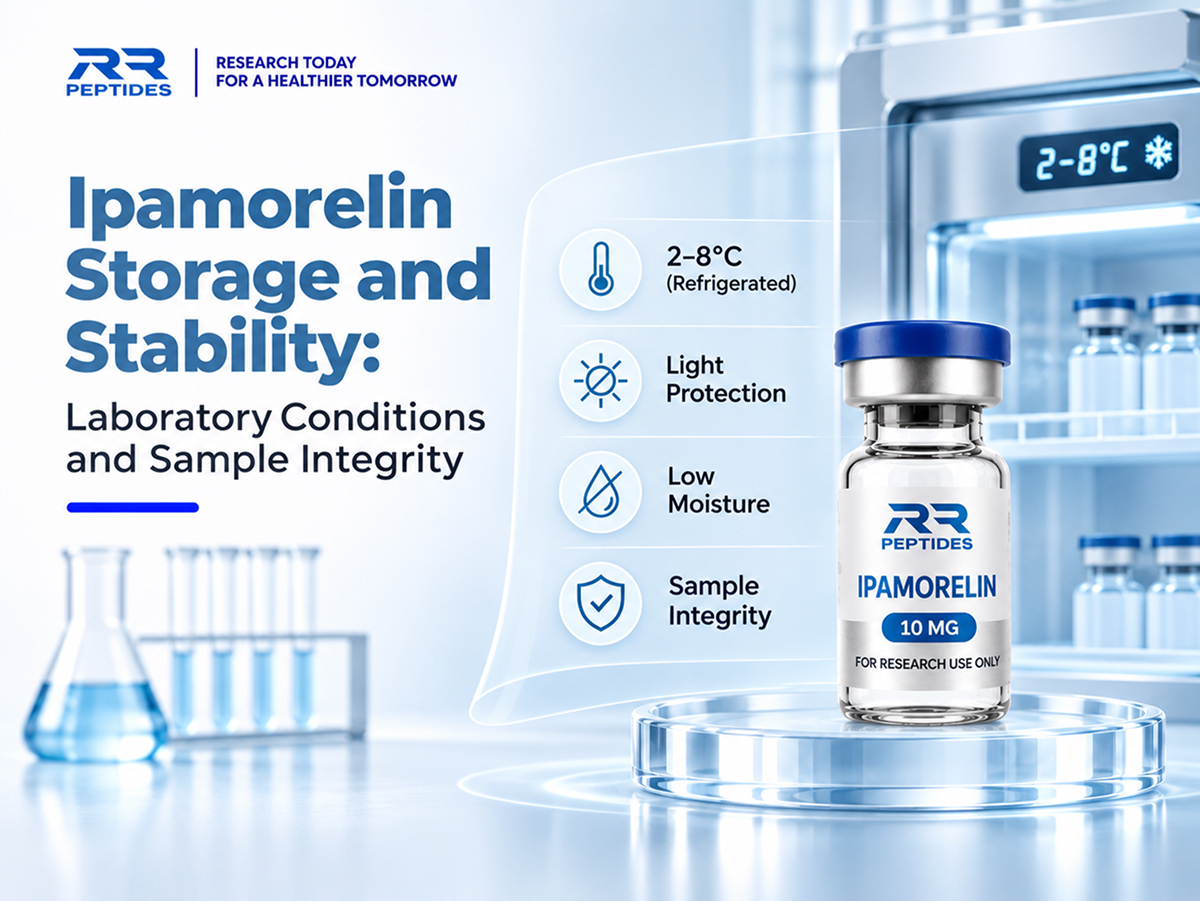
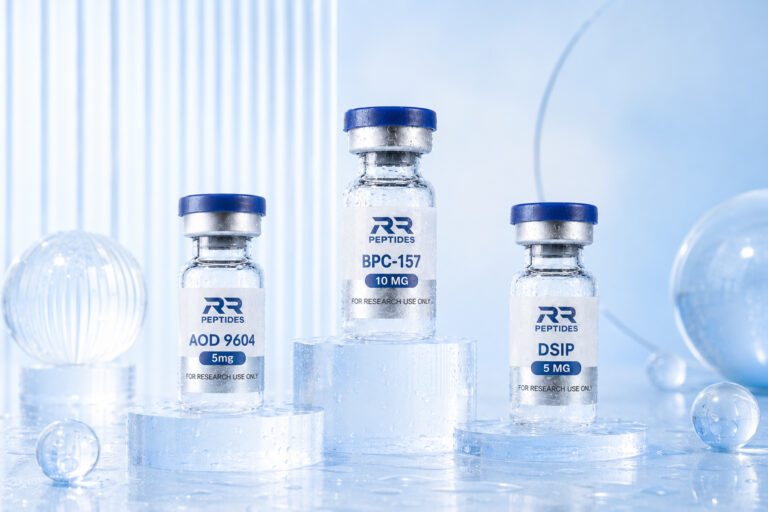
A vial can look unchanged even after its contents depart from the original analytical profile. Intact powder does not establish identity, concentration, or freedom from degradation. Sample integrity depends on documented conditions and measurements, not appearance.
Ipamorelin storage and stability is therefore an analytical question as much as a logistical one. Ipamorelin is a synthetic pentapeptide investigated in growth hormone secretagogue research, but its biological activity does not establish how long a particular commercial sample remains chemically unchanged. Formulation, packaging, transport, and handling can all influence the result.
Canadian researchers can explore the RR Peptides catalog while independently checking batch documents and institutional requirements. This guide approaches Ipamorelin storage and stability through material identity, lyophilized storage, environmental exposure, and quality testing. It does not provide instructions for human administration or claim a universal expiry date.
Ipamorelin was described by Raun and colleagues as Aib-His-D-2-Nal-D-Phe-Lys-NH2. This five-residue sequence contains unusual amino acid configurations and a terminal amide. Laboratories should distinguish the identified peptide from its counterions, residual solvents, and any formulation excipients. A label reporting a nominal mass is not a complete chemical specification.
In Ipamorelin storage and stability studies, researchers must know whether the material is a dry salt, a formulated preparation, or a solution. These forms can have different physical properties and degradation pathways. A stability observation for one preparation cannot automatically establish the shelf life of another, even when both labels say ipamorelin.
Physical Loss and Chemical Degradation Are Different
A declining analytical signal can have several explanations:
Chemical degradation: The peptide may form new impurities even when its original appearance remains unchanged.
Surface adsorption: Contact with container walls can lower recovered concentration without destroying the molecule.
Incomplete dissolution or transfer: Less material may reach the instrument than was originally present.
Evaluating Ipamorelin storage and stability therefore requires separate measurements of chemical purity and recovered content.
Potential influence
Possible consequence
Useful laboratory evidence
Heat exposure
Faster degradation in susceptible conditions
Recorded time and temperature
Moisture uptake
Changes in dried material and reaction rates
Water content and closure integrity
Light or oxygen
Possible chemical modifications
Protected versus exposed comparisons
Container surfaces
Reduced recovery through adsorption
Container compatibility testing
Formulation and pH
Changes in solution behaviour
Defined matrix and validated assays
Handling history
Variable exposure or contamination
Chain-of-custody records
Avoid Assuming Every Peptide Shares the Same Weak Points
Generic peptide guidance often mentions deamidation of asparagine or glutamine and oxidation of methionine or cysteine. Those residues are absent from ipamorelin’s reported sequence. Therefore, those particular residue-specific pathways should not be presented as demonstrated ipamorelin degradation mechanisms. Histidine and other structural groups may warrant investigation, but compound-specific degradation products require analytical identification.
Ipamorelin storage and stability assessments are more credible when proposed pathways follow the actual molecular structure. Stress testing can reveal which changes occur under defined conditions; theoretical susceptibility alone does not establish their rates in a particular vial.
Explore ghrelin receptor signaling and growth hormone regulation in laboratory research with Ipamorelin 10mg, available at RR Peptides.
Lyophilization removes much of the water from a prepared solution through freezing and drying under controlled pressure. Lower water availability can slow reactions that occur more readily in solution, but residual moisture may remain. The dried cake can also absorb atmospheric water when a closure fails or a container is opened under unsuitable conditions.
For Ipamorelin storage and stability, freeze-dried appearance is not proof of a validated shelf life. The original manufacturing process, residual moisture, counterion, container closure, and exposure history all influence the starting material. Laboratories should use lot-specific instructions supported by appropriate data wherever available.
Interpreting Common Cold-Storage Guidance
General peptide suppliers often recommend keeping lyophilized materials sealed, dry, protected from unnecessary light, and frozen for longer storage. Temperatures around minus twenty degrees Celsius are widely referenced in general peptide handling guidance. However, these are broad preservation practices, not proof that every ipamorelin formulation retains its specifications for any particular number of months.
In Ipamorelin storage and stability programs, the scientifically relevant question is whether a defined lot meets predefined acceptance criteria throughout a stated period. A freezer setpoint is only one part of that claim. Researchers should also document temperature monitoring, packaging integrity, and excursions.
A Receiving and Storage Checklist
A practical documentation workflow separates receipt, placement, and subsequent access:
Identify the material: Match the label to the purchase record, lot number, and available analytical documentation.
Review the shipment: Record arrival conditions, visible damage, and available transport-temperature evidence.
Confirm the storage plan: Apply documented, formulation-specific requirements rather than an unverified universal rule.
Track conditions: Use monitored equipment and retain records of deviations or alarm events.
Control access: Limit unnecessary handling and maintain a traceable inventory history.
Ipamorelin storage and stability benefits from this sequence because it creates an evidence trail. Without a receiving record, an unexpected impurity result months later may be impossible to connect to transport, storage, or original batch quality.
Do Not Confuse a COA With a Stability Study
A certificate of analysis can document tests performed on a batch at a particular time. It does not necessarily establish how long the sample remains acceptable after shipping or repeated laboratory access. An expiry or retest period should be supported by a stability program using defined conditions and appropriate analytical methods.
Ipamorelin storage and stability decisions should therefore distinguish initial purity, remaining content, and time-dependent degradation. These are separate questions, even if a supplier presents them together on a product page.
How Can Temperature and Moisture Affect Ipamorelin?
Temperature Excursions Need Context
Many chemical reaction rates rise with temperature, but actual behaviour depends on molecular structure and formulation. Storage at a lower temperature may slow certain processes without preventing every type of physical or chemical change. Freezing a solution, for instance, can introduce phase separation or local concentration differences that are absent in dry powder.
Ipamorelin storage and stability assessments should record three details:
Temperature: How warm or cold the material actually became.
Duration: How long the exposure lasted.
Sample state: Whether the material was dry powder or an aqueous solution.
Labels such as ‘briefly warm’ or ‘kept cold’ are insufficient for comparing experimental conditions.
Why Moisture Matters After Lyophilization
Drying reduces water content; it does not guarantee that a material is nonhygroscopic. Moisture can enter through compromised closures or condense when a cold container is opened in warmer humid air. Such exposure may change the physical cake, dissolution behaviour, or chemical stability, even without obvious droplets.
In Ipamorelin storage and stability testing, water content can be measured with a suitable validated method, such as Karl Fischer analysis where applicable. Investigators can then examine whether moisture changes correspond to new impurities or reduced sample recovery. Association alone does not identify the underlying chemical reaction.
Exposure scenario
Possible concern
Appropriate evidence-based response
Unrecorded shipping delay
Unknown temperature excursion
Review transport records and acceptance criteria
Cold container opened in humid air
Condensation on dry material
Follow validated sealed-equilibration procedures
Damaged stopper or seal
Moisture or contaminants entering
Document damage and assess or quarantine
Repeated transfer between storage units
Variable temperature history
Record excursions and minimize handling
Previously frozen solution
Potential physical changes
Verify recovery and solution-specific stability
A Canadian Shipping Reality
Canadian laboratories may receive parcels after winter freezing, summer heat, or distribution delays. Outdoor temperatures cannot reveal conditions inside insulated packaging. Neither cold arrivals nor shipping promises establish uninterrupted temperature control.
For Ipamorelin storage and stability, documented shipping conditions are more useful than assumptions about the season. When records are unavailable, acceptance should follow the laboratory’s documented risk assessment rather than a visual inspection alone.
Do Not Turn Excursions Into Automatic Verdicts
A short excursion does not always mean that a sample has degraded, and a normal appearance does not prove that it remains suitable. Ipamorelin storage and stability programs should define when to quarantine material, when confirmatory testing is justified, and when an analytical result no longer meets specifications. The decision depends on evidence, not reassurance.
Explore ghrelin receptor signaling and growth hormone regulation in laboratory research with Ipamorelin 10mg, available at RR Peptides.
What Handling Practices Help Preserve Sample Quality?
Reduce Unnecessary Container Openings
Each handling event can expose a sample to ambient conditions or create opportunities for transfer losses. Even technically competent staff may produce inconsistent outcomes when procedures are undocumented. A standardized chain of custody improves reproducibility by making storage locations, opening events, and analytical transfers traceable.
For Ipamorelin storage and stability, a handling record should explain what happened before the sample reached an instrument. That is especially important when comparing experiments conducted weeks apart or at different laboratories.
Treat Dry Powder and Solutions Separately
Dissolving a lyophilized peptide creates a different chemical environment. Solvent composition, pH, concentration, surfaces, and time in solution may alter stability and analytical recovery. A dry-state storage claim cannot simply be carried over to a prepared analytical solution. Likewise, an assay-compatible solution is not necessarily sterile or suitable for clinical use.
Ipamorelin storage and stability documentation should state which physical form was tested. A report describing an aqueous sample must not be presented as direct evidence about the original sealed powder, or vice versa.
A Focused Handling Checklist
Use clear identifiers: Record the sample name, lot, preparation date, and storage location.
Follow controlled procedures: Keep transfers, containers, and analytical conditions consistent.
Limit environmental exposure: Avoid unnecessary light, moisture, and temperature changes.
Consider aliquots thoughtfully: Verify that additional transfer surfaces do not compromise recovery.
Document deviations: Record spills, unexpected warming, damaged packaging, or unusual appearance.
Apply rejection criteria: Quarantine questionable samples pending review rather than assuming acceptability.
These practices support Ipamorelin storage and stability without implying that careful handling can guarantee permanent integrity. Good documentation reduces ambiguity; analytical testing is still needed to establish whether specifications remain satisfied.
Compatibility Matters More Than Appearance
Peptides can interact with glass, plastics, filters, or other materials in different ways. A lower measured concentration might reflect adsorption rather than degradation. For Ipamorelin storage and stability, container compatibility studies may compare recovery under defined conditions with appropriate controls. Such experiments should distinguish material losses from formation of new chemical species.
Explore ghrelin receptor signaling and growth hormone regulation in laboratory research with Ipamorelin 10mg, available at RR Peptides.
How Can Researchers Monitor Sample Degradation?
Establish a Meaningful Starting Point
A stability program needs baseline characterization. At minimum, investigators should know what material was tested, which method was used, and which attributes were initially acceptable. Subsequent measurements can then detect changes that exceed normal analytical variability. Without a reliable starting point, a later purity percentage tells only part of the story.
Ipamorelin storage and stability studies benefit from validated, stability-indicating analytical methods. These methods should distinguish intact peptide from degradation products.
Quality attribute
Potential analytical tool
Important limitation
Molecular identity
Mass spectrometry and suitable reference
Identity alone does not prove purity
Related impurities
Stability-indicating HPLC or UHPLC
Peaks may require structural assignment
Recovered peptide content
Validated quantitative assay
Low recovery may reflect adsorption
Residual moisture
Validated water-content method
Moisture alone does not prove degradation
Physical changes
Appropriate appearance or particle testing
Invisible chemical changes can remain
Microbial quality
Suitable microbiological methods
HPLC purity cannot establish sterility
Separate Purity From Content
Chromatographic purity is often reported as a relative peak-area percentage. That percentage does not necessarily measure the absolute quantity of intact peptide remaining. If material is lost to a container surface, the relative percentage of the largest peak could remain high while recovered content falls.
For Ipamorelin storage and stability, researchers should specify whether results describe impurity distribution, assay content, or both. A convincing stability conclusion requires measurements suited to its precise claim.
Build a Time-Course Study
A well-designed time-course study should define its evaluation framework before data collection:
Baseline: Establish initial identity, recovered content, and the impurity profile.
Conditions: Specify storage environments and predetermined sampling points.
Methods: Select stability-indicating assays and acceptance criteria.
Quality controls: Document replicates, instrument performance, and measurement uncertainty.
Interpretation: Separate changes under routine storage from accelerated or forced-stress observations.
Accelerated studies can reveal potential degradation pathways, but harsh-stress results do not alone establish a reliable shelf life. In Ipamorelin storage and stability research, independent testing can strengthen decisions when an observed change matters.
Canadian Quality and Regulatory Boundaries
Health Canada’s April 2026 advisory specifically named ipamorelin among unauthorized injectable peptide drugs marketed online. In November 2026, the agency reported bacterial contamination in certain other unauthorized injectable peptide and non-peptide products. Those findings should not be interpreted as proof of contamination in every ipamorelin batch. They do reinforce the importance of traceability, appropriate quality controls, and lawful procurement.
Canadian Ipamorelin storage and stability work should account for applicable import requirements and institutional oversight. A label stating ‘for research use only’ does not automatically exempt a product from Canadian law or authorize use in humans. Chemical purity and sterility are also distinct quality attributes, neither of which establishes clinical efficacy.
Is There a Universal Shelf Life for Lyophilized Ipamorelin?
No. A validated shelf life depends on the specific material, formulation, packaging, environmental conditions, and supporting stability data. Generic peptide guidance cannot establish a universal expiry date. Ipamorelin storage and stability claims should identify the tested lot and evidence.
Should Every Lyophilized Sample Be Kept at Minus Twenty Degrees Celsius?
Cold, dry storage is a common general practice for preserving research peptides, but no temperature alone guarantees stability. Follow documented requirements for the material and review excursion records when conditions change.
Does a White Powder Prove That the Sample Is Intact?
No. Chemical modifications and changes in recovered concentration may be invisible. Appropriate analytical measurements are necessary to assess identity, impurities, and retained content.
Are Dry and Reconstituted Samples Equally Stable?
Not necessarily. Solutions introduce solvent, pH, concentration, and surface interactions that differ from dry powder. Ipamorelin storage and stability evidence for one form cannot automatically establish performance in the other.
Can HPLC Purity Confirm Sterility?
No. Chromatographic analysis assesses chemical attributes, while sterility and microbial quality require different methods. A clean-looking chromatogram does not establish freedom from microbial contamination.
What Should Researchers Do After an Unrecorded Temperature Excursion?
Review available evidence and follow laboratory acceptance procedures. Where justified, quarantine the material and perform confirmatory testing. An excursion alone is not a validated degradation measurement.
Does Research Labeling Remove Canadian Regulatory Obligations?
No. Health Canada warns that research-use wording does not automatically exempt peptide products from regulatory requirements. Ipamorelin storage and stability investigations should remain within legitimate laboratory and institutional frameworks.
Conclusion
Ipamorelin storage and stability depends on verified molecular identity, suitable packaging, controlled environmental exposure, and measurements capable of distinguishing chemical degradation from physical loss. Lyophilization can improve preservation, but it does not establish a universal shelf life or eliminate the need for appropriate analytical checks.
Canadian laboratories can explore RR Peptides for research-focused product information while independently reviewing batch documentation, published technical guidance, and applicable requirements. The most defensible approach combines traceable handling records with validated tests rather than relying on appearance or unsupported temperature claims.
Ultimately, Ipamorelin storage and stability research advances through transparent methods, meaningful acceptance criteria, and honest reporting of uncertainty.
Disclaimer: All products and compounds discussed are intended strictly for laboratory and research purposes. This article is provided for educational and informational purposes only. This article is not medical advice, therapeutic guidance, or instructions for human administration.
×
Subscribe & Get 10% Off!
Enter your email address below to subscribe to our newsletter and receive an instant 10% OFF discount coupon code sent directly to your inbox!
Thank you for subscribing! Your 10% discount coupon has been sent to your email. Please check your inbox!