A peptide can alter hormones without exclusively targeting one receptor. This difference is especially important when scientists interpret findings about growth hormone secretagogues. A growth hormone measurement describes an endocrine outcome; identifying the molecular target requires a different experiment.
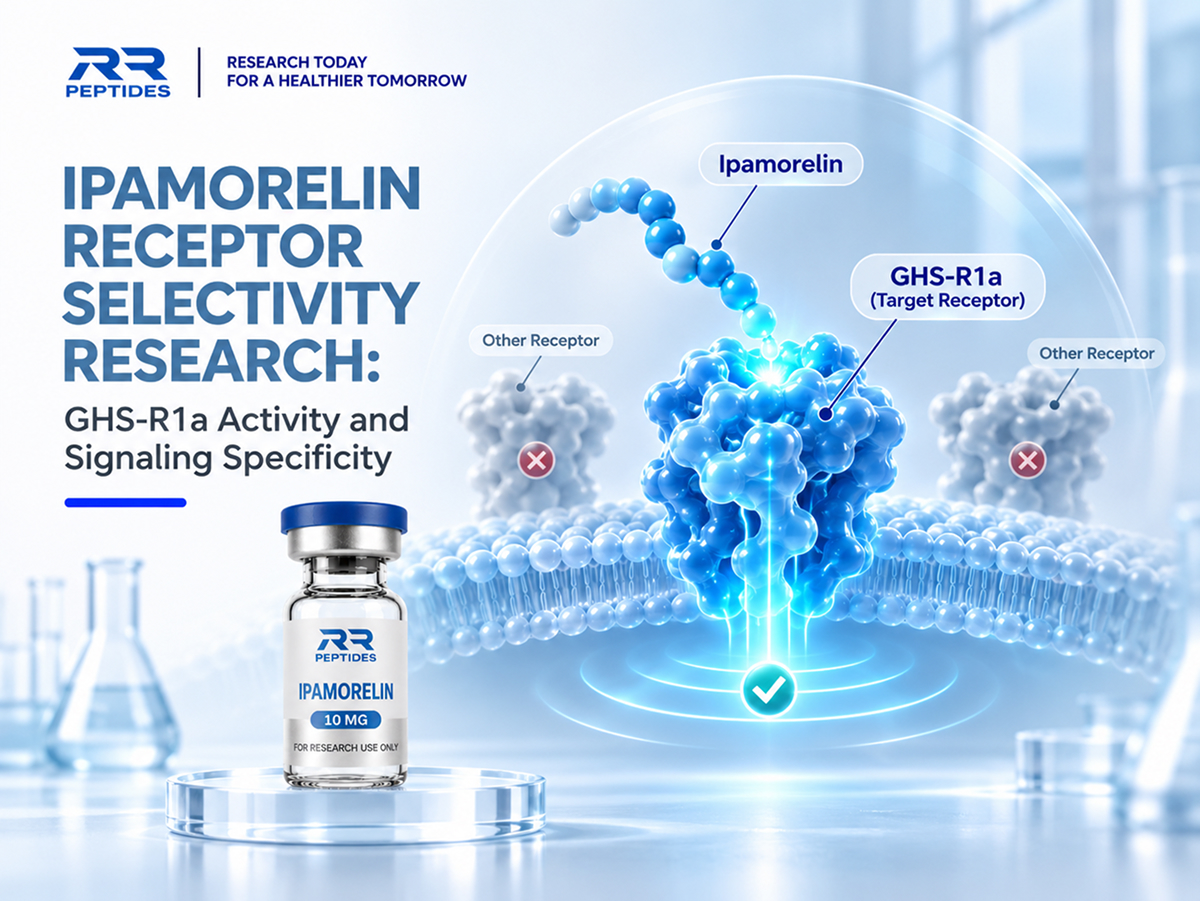
Ipamorelin receptor selectivity research examines a synthetic pentapeptide associated with the ghrelin receptor GHS-R1a. Early experiments established meaningful growth hormone-releasing activity and a distinctive hormone profile in animal models. They did not provide an exhaustive survey of every possible receptor or demonstrate clinical benefits in humans.
Canadian researchers can explore RR Peptides while independently reviewing publications, analytical records, and institutional requirements. This article explains ipamorelin receptor selectivity research through questions that make selectivity claims scientifically credible: what was compared, which signal was measured, and which alternative explanations remain possible.
What Does Receptor Selectivity Mean in Peptide Research?
Receptors, Hormones, and Pathways Represent Different Levels
Three distinct forms of selectivity describe different levels of biological activity:
Receptor selectivity: Preferential interaction or activation at one molecular target relative to specified alternatives.
Hormonal selectivity: A more pronounced response in certain hormones than in others after experimental exposure.
Signaling bias: Differences among intracellular pathways activated through the same receptor.
All three concepts are useful, but evidence supporting one does not automatically establish the others.
For Ipamorelin receptor selectivity research, an investigator should begin by naming the proposed comparison. A claim that ipamorelin favors GHS-R1a over another receptor needs a receptor panel. A claim that growth hormone rises without a parallel cortisol response needs endocrine measurements. A claim that G protein activity dominates beta-arrestin recruitment requires matched pathway assays.
Selectivity question
Comparison
Most informative evidence
Molecular target
GHS-R1a versus another receptor
Binding and functional receptor assays
Hormonal output
GH versus ACTH or cortisol
Controlled endocrine sampling
Signaling preference
G protein versus beta-arrestin pathways
Matched, quantitative signaling experiments
Tissue response
Pituitary versus another tissue
Relevant cellular or physiological models
Affinity Is Not the Same as Efficacy
Affinity describes the tendency of a ligand to bind a target under defined conditions. Potency often refers to the concentration required to generate a specified functional response. Efficacy describes the magnitude of the response in that system. These properties may differ because cells have different receptor densities, signaling proteins, and amplification mechanisms.
A low EC50 in one assay does not establish superior receptor specificity. Nor does an observed hormone increase reveal binding affinity. Ipamorelin receptor selectivity research should report assay conditions, comparison ligands, uncertainty, and the specific meaning of each numerical parameter.
Selectivity Claims Have Boundaries
Negative findings require careful wording. Failure to detect an interaction may reflect the assay’s detection limit or an incomplete panel, rather than universal inactivity. Strong research describes the tested receptors and exposure conditions. The aim of ipamorelin receptor selectivity research is not to declare a compound perfectly selective, but to specify what the available experiments actually exclude.
Why Statistical Significance Is Not Selectivity
Ipamorelin receptor selectivity research also needs effect sizes and uncertainty intervals. A nonsignificant cortisol difference in a particular experiment should be described as no statistically significant increase detected, not as mathematical proof that cortisol responses are impossible elsewhere.
Explore ghrelin receptor signaling and growth hormone regulation in laboratory research with Ipamorelin 10mg, available at RR Peptides.
Which Receptor Is the Primary Target of Ipamorelin?
The GHS-R1a Connection
Ipamorelin is a synthetic pentapeptide with the reported sequence Aib-His-D-2-Nal-D-Phe-Lys-NH2. It is classified as a growth hormone secretagogue. Its established pharmacological association is the growth hormone secretagogue receptor, GHS-R1a, which also recognizes the endogenous hormone acylated ghrelin. GHS-R1a belongs to the G protein-coupled receptor family.
The growth hormone-releasing hormone receptor is a different protein, although both systems can influence pituitary hormone secretion. Distinguishing the two is fundamental to ipamorelin receptor selectivity research. A shared downstream GH response does not make receptor mechanisms interchangeable.
What the 1998 Experiments Showed
Raun and colleagues investigated ipamorelin in primary rat pituitary cultures, rats, and conscious swine. Their antagonist profiling supported a growth hormone-releasing peptide-like receptor mechanism, rather than action through the GHRH receptor. In primary rat pituitary cells, the compound stimulated GH release with potency and efficacy comparable to GHRP-6 in the tested setting.
The frequently cited selectivity findings came from hormone comparisons in swine:
Growth hormone: Ipamorelin stimulated GH release in the tested model.
ACTH and cortisol: Neither increased significantly beyond the values associated with the GHRH comparator.
Comparator peptides: GHRP-2 and GHRP-6 produced clearer ACTH and cortisol increases.
Additional hormones: The tested secretagogues showed no measured effects on FSH, LH, prolactin, or TSH.
Those observations support relative endocrine selectivity, not complete molecular specificity. Ipamorelin receptor selectivity research should preserve the distinction between a carefully measured animal hormone profile and an unperformed comprehensive off-target receptor screen.
The Receptor Has Basal Activity
GHS-R1a can signal constitutively, even without an added agonist. Its behavior is also influenced by cellular context. Consequently, background activity in receptor-expressing cells does not necessarily indicate experimental contamination. Investigators need vehicle controls and appropriate receptor-negative or receptor-blocked comparisons.
For ipamorelin receptor selectivity research, expression level matters: an engineered cell line containing abundant GHS-R1a can amplify responses differently from a native pituitary preparation. A result from one model should not be assigned unchanged to every human tissue.
Why Physiological Relevance Matters
A target observed in engineered cells is only one part of the evidence. Ipamorelin receptor selectivity research can gain biological context from primary pituitary models, provided their limitations are reported. Receptors may be distributed differently across tissues, and endogenous hormones may change the apparent response. Those differences make external validation important before extending a cellular finding to an intact organism.
Use Complementary Assays Instead of a Single Readout
Binding studies assess whether a molecule associates with a receptor preparation. Functional assays ask whether that interaction produces signaling. Hormone studies measure outcomes farther downstream. Each approach can strengthen a hypothesis, but none provides complete information alone.
Ipamorelin receptor selectivity research is more convincing when multiple methods address the same question from different directions. A calcium signal may support receptor function without proving selective binding. Reduced activity after an antagonist may support receptor involvement, provided the antagonist itself has been characterized appropriately.
Technique
Primary question
Common interpretive limitation
Competition binding
Does a test ligand compete for receptor binding?
Association does not establish activation
Concentration-response assay
How much functional activity is observed?
Receptor abundance can change apparent potency
Antagonist comparison
Is a response reduced by receptor blockade?
Blockers may affect additional targets
Receptor-negative cells
Does the response depend on receptor expression?
Cell backgrounds may differ independently
Hormone measurements
Which endocrine signals change?
Hormone data do not identify every receptor
Orthogonal assay
Is the effect reproducible using another method?
Shared experimental biases can remain
A Practical Logic for Study Design
Confirm the peptide’s identity and relevant analytical characteristics.
Define the primary selectivity claim before selecting the assays.
Include vehicle controls and a well-characterized reference agonist.
Test appropriate receptor-specific controls and alternative targets.
Report concentration-response curves, variability, and detection limits.
Separate exploratory findings from predefined outcomes.
These laboratory steps are not instructions for human administration. They are principles for improving the interpretability of legitimate laboratory experiments. For ipamorelin receptor selectivity research, the design should match the exact conclusion the investigator intends to support.
Why Published Potency Numbers May Disagree
Assays with different receptor densities, incubation periods, readout technologies, or reference ligands can produce different EC50 estimates. Even compounds with unchanged binding properties can appear more potent when signal amplification differs. Comparing values across papers without considering those differences can create a misleading ranking.
Ipamorelin receptor selectivity research benefits from matched comparisons within a study and transparent reporting of system conditions. The uncertainty surrounding a value is as important as the value itself. Selectivity ratios are especially fragile if one comparator response falls below a poorly defined assay threshold.
Material Quality Influences Interpretation
Impurities or misidentified peptides can confound experiments. A certificate of analysis may help document identity and purity at one testing point, but it cannot automatically demonstrate receptor specificity or long-term stability. Independent analytical confirmation becomes especially valuable when small differences drive the main claim. Good ipamorelin receptor selectivity research connects every biological dataset to a traceable test material and recorded handling history.
Explore ghrelin receptor signaling and growth hormone regulation in laboratory research with Ipamorelin 10mg, available at RR Peptides.
How Does Receptor Selectivity Affect Downstream Signaling?
GHS-R1a Has More Than One Signaling Route
The established ghrelin receptor framework includes coupling to Gq/11 proteins, phospholipase C activity, and intracellular calcium mobilization. Other work describes beta-arrestin recruitment, receptor trafficking, and context-dependent signaling involving additional pathways. These mechanisms help explain why activation of the same receptor need not produce identical cellular outcomes in every system.
However, ipamorelin receptor selectivity research must distinguish receptor-level knowledge from ligand-specific measurements. A ghrelin-associated pathway cannot automatically be attributed to ipamorelin without direct testing.
What Signaling Bias Actually Means
Biased agonism refers to a ligand favoring one receptor-associated response over another, normally judged against a reference ligand under controlled analytical conditions. This is different from preferential growth hormone release relative to cortisol. The latter compares endocrine outputs, not molecular signaling pathways.
A claim about bias in ipamorelin receptor selectivity research would require direct comparisons of multiple intracellular readouts. Investigators should also account for system bias caused by receptor expression and pathway amplification. Without those precautions, a difference between calcium and beta-arrestin assays may reflect their measurement systems rather than a stable property of the ligand.
Researchers can use a limited set of complementary endpoints:
Calcium mobilization: A rapid downstream response consistent with certain G protein pathways.
Beta-arrestin recruitment: A distinct receptor-associated process that may affect signaling and regulation.
Receptor localization: Changes in internalization or trafficking after stimulation.
Pituitary GH secretion: A later endocrine output shaped by additional physiological influences.
Endocrine Selectivity Does Not Establish Molecular Bias
The swine findings reported by Raun and colleagues provide a meaningful GH-versus-ACTH-and-cortisol comparison. They do not by themselves show that ipamorelin preferentially recruits Gq over beta-arrestin or selectively activates an ERK-related pathway. Those hypotheses require different experiments.
Ipamorelin receptor selectivity research gains precision by maintaining the distinction between a downstream hormone profile and the molecular routes responsible for it. A favorable endocrine comparison is evidence worth exploring, not a shortcut around mechanistic testing.
Think Beyond a Single Signal
For ipamorelin receptor selectivity research, a useful analysis considers the direction, timing, and reproducibility of each measured response. A large early calcium signal might coexist with a weaker later recruitment result. Without appropriate normalization, those findings cannot establish ligand bias. Investigators should describe each assay independently before interpreting the combined pattern.
Explore ghrelin receptor signaling and growth hormone regulation in laboratory research with Ipamorelin 10mg, available at RR Peptides.
Why Is Selectivity Important in Experimental Research?
Better Causal Claims and Stronger Comparators
Selectivity information helps researchers identify whether a biological response is likely to arise from the intended target or from other processes. It also informs comparator selection: GHRH, native ghrelin, and other synthetic secretagogues do not answer identical questions. Their differences should be the reason for including them, not simply their popularity in peptide discussions.
Ipamorelin receptor selectivity research is especially useful when investigators want to explain why different secretagogues yield different endocrine patterns. But mechanistic evidence does not prove effects on muscle mass, athletic performance, longevity, or clinical recovery. Those require separate outcome measures and controlled clinical studies.
Mistakes That Weaken a Scientific Conclusion
Describing hormone selectivity as proof of exclusive receptor binding.
Treating an animal result as comprehensive evidence of human safety.
Assuming that all GHS-R1a agonists activate every pathway equally.
Comparing EC50 values without describing the underlying assays.
Ignoring nonsignificant findings or missing comparator measurements.
For ipamorelin receptor selectivity research, correcting these errors improves both reproducibility and scientific communication. A negative result in a well-controlled assay can be more informative than a positive result lacking sufficient controls.
Canadian Regulation Is a Separate Requirement
Health Canada explicitly identified ipamorelin among unauthorized injectable peptide drugs in an April 9, 2026 advisory. A separate November 6, 2026 notice reported bacterial contamination in certain unauthorized injectable peptide and non-peptide products. That later finding concerned particular identified products and should not be misrepresented as laboratory evidence about every ipamorelin preparation.
Canadian ipamorelin receptor selectivity research must consider lawful procurement, applicable import requirements, institutional oversight, and verification of the experimental material. Research-use labeling does not automatically provide an exemption from Canadian law. Likewise, analytical purity or receptor selectivity does not establish sterility, clinical authorization, or treatment efficacy.
Questions Future Experiments Should Resolve
Future work could evaluate ipamorelin against carefully selected alternative receptors, compare GHS-R1a signaling pathways in matched systems, and reproduce key findings using native endocrine models. Studies should specify reference compounds, report complete datasets, and distinguish plausible mechanisms from established facts.
The enduring value of ipamorelin receptor selectivity research lies in drawing sharper boundaries around what is known. Such boundaries lead to more useful experiments and help prevent scientific results from being presented as medical promises.
Translating Findings Responsibly
Ipamorelin receptor selectivity research benefits from conclusions matched to the evidence. Useful reporting practices include:
Name the model: Describe preferential GH release in the tested swine rather than claiming universal selectivity.
State the limits: Avoid unsupported assurances of harmlessness or ideal receptor targeting.
Explain discrepancies: Identify differences in materials, assays, or biological contexts before comparing laboratories.
GHS-R1a is its primary established pharmacological target. Complete exclusivity against every other receptor has not been demonstrated by the foundational endocrine experiments. Ipamorelin receptor selectivity research should specify the tested receptors and methods.
Is Selective Growth Hormone Release the Same as Receptor Selectivity?
No. Selective GH release compares hormone outcomes, while receptor selectivity compares molecular targets. The two observations answer distinct questions.
What Did the Original Swine Study Find?
Ipamorelin stimulated growth hormone without significantly increasing ACTH or cortisol beyond the GHRH comparison under the tested conditions. This does not eliminate other possible effects.
Can Ipamorelin Be Described as a Biased Agonist?
A definitive bias claim would require matched, ligand-specific measurements across multiple pathways. A favorable hormonal profile alone is insufficient.
Does Receptor Selectivity Establish Clinical Safety?
No. Even a highly selective ligand could produce undesirable effects through its intended receptor. Long-term safety and clinical efficacy require dedicated evidence.
Why Are Antagonist Experiments Useful?
Antagonists can help establish whether a response depends on a specific receptor. Their own pharmacological selectivity and the experimental conditions must also be considered.
What Should Canadian Laboratories Verify?
Investigators should confirm material identity, supporting documentation, institutional requirements, and applicable regulation. Ipamorelin receptor selectivity research does not authorize human or veterinary administration.
Conclusion
Ipamorelin receptor selectivity research becomes clearer when receptor preference, hormone selectivity, and signaling bias are treated as separate scientific questions. Foundational animal experiments support relatively selective growth hormone release under defined conditions, but they do not establish complete receptor exclusivity or an exhaustive signaling profile.
For legitimate Canadian laboratory investigations, explore RR Peptides for research-oriented product information while independently checking primary literature, analytical records, and regulatory requirements. Well-controlled experiments and transparent reporting are essential to meaningful interpretation.
Future ipamorelin receptor selectivity research should prioritize direct receptor comparisons, reproducible pathway assays, and careful statements about uncertainty. Scientific precision offers more lasting value than unsupported claims of perfect selectivity.
Disclaimer: All products and compounds discussed are intended strictly for laboratory and research purposes. This article is provided for educational and informational purposes only. This article is not medical advice, therapeutic guidance, or instructions for human administration.
×
Subscribe & Get 10% Off!
Enter your email address below to subscribe to our newsletter and receive an instant 10% OFF discount coupon code sent directly to your inbox!
Thank you for subscribing! Your 10% discount coupon has been sent to your email. Please check your inbox!