A hormone response begins long before a laboratory instrument detects it. Receptors must recognize a signal, intracellular messengers must transmit information, and secretory cells must respond within a system that continuously adjusts its activity. Understanding these stages is more informative than treating a rise in growth hormone as an explanation by itself.
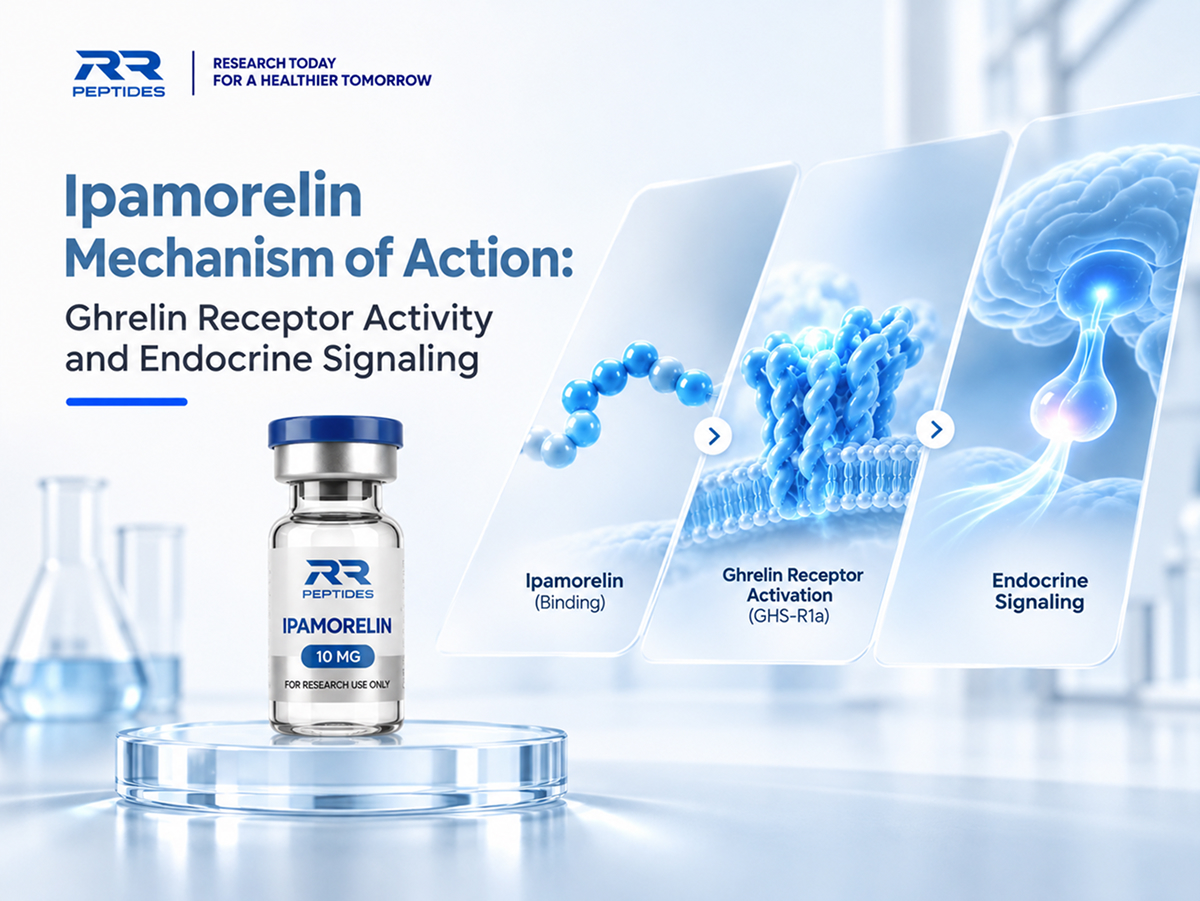
The Ipamorelin mechanism of action concerns a synthetic pentapeptide studied as a growth hormone secretagogue. Its principal pharmacological connection is the ghrelin receptor, also called growth hormone secretagogue receptor type 1a (GHS-R1a). Yet receptor stimulation, hormone release, and health outcomes represent different scientific claims.
For Canadian laboratories, RR Peptides offers research-oriented product information to assess alongside published studies, analytical records, and applicable institutional requirements. Explore its catalog when identifying materials for legitimate experiments. This article examines the ipamorelin mechanism of action through receptor recognition, signal transduction, endocrine feedback, and unresolved mechanistic questions, without suggesting therapeutic uses.
How Does Ipamorelin Interact With the Ghrelin Receptor?
A Small Peptide With a Defined Pharmacological Target
Ipamorelin was described by Raun and colleagues in 1998 as a synthetic pentapeptide with the sequence Aib-His-D-2-Nal-D-Phe-Lys-NH2. Its design differs from native ghrelin, a stomach-derived hormone whose active form bears an acyl modification. Although chemically distinct, both are associated with the growth hormone secretagogue receptor system. The ipamorelin mechanism of action therefore begins with receptor pharmacology rather than structural resemblance to the endogenous hormone.
GHS-R1a belongs to the class A family of seven-transmembrane G protein-coupled receptors. It appears in pituitary and neural tissues and participates in several physiological processes. The receptor is not the same as the growth hormone receptor on peripheral cells, nor is it the receptor for hypothalamic growth hormone-releasing hormone (GHRH).
What the Foundational Experiments Demonstrated
The original study tested primary rat pituitary cells and animal models. Antagonist profiling supported action through a growth hormone-releasing peptide-like receptor rather than the GHRH receptor. In rat pituitary cultures, ipamorelin stimulated growth hormone secretion with potency comparable to GHRP-6. These experiments established a functional receptor-associated response, not a detailed atomic picture of peptide binding.
The Ipamorelin mechanism of action can be investigated through several complementary observations:
Receptor engagement: Determine whether a candidate compound interacts with GHS-R1a in a validated assay.
Functional specificity: Compare responses with receptor antagonists and relevant alternative receptor systems.
Cellular output: Measure intracellular signaling separately from secreted growth hormone.
Model dependence: Confirm whether observations persist across recombinant cells and primary endocrine cultures.
An antagonist reducing a response supports receptor involvement, but its own selectivity and experimental concentration require scrutiny. In the ipamorelin mechanism of action, each method narrows uncertainty without resolving every downstream biological question.
Why Receptor Activity Is Not the Same as Hormone Selectivity
The 1998 researchers also evaluated endocrine responses in conscious swine. Ipamorelin increased growth hormone without producing significant adrenocorticotropic hormone (ACTH) or cortisol increases relative to the GHRH comparison, whereas certain other secretagogues affected both markers. That was an important model-specific observation.
However, the ipamorelin mechanism of action should not convert relative selectivity into a claim of zero off-target effects. Species, experimental conditions, receptor distribution, and measurement windows all influence what is detected.
Explore ghrelin receptor signaling and growth hormone regulation in laboratory research with Ipamorelin 10mg, available at RR Peptides.
What Happens After GHS-R1a Activation?
The Classical Gq/11 Signaling Route
When a ligand activates GHS-R1a, the receptor can engage heterotrimeric G proteins. Its classical signaling route involves Gq/11, which activates phospholipase C (PLC). PLC acts on a membrane phospholipid to generate inositol trisphosphate (IP3) and diacylglycerol (DAG). IP3 promotes calcium release from intracellular stores, while DAG and calcium can participate in protein kinase C signaling.
These events provide a mechanistic framework for the ipamorelin mechanism of action. Importantly, much of the detailed pathway map comes from broader ghrelin-receptor research. Individual steps should be attributed specifically to ipamorelin only when the experiment directly tests that ligand.
Stage
General GHS-R1a signaling event
What researchers can measure
Ligand recognition
Receptor activation at the cell membrane
Binding or functional response assays
G protein coupling
Recruitment of Gq/11-associated machinery
Pathway-sensitive reporter signals
Messenger production
PLC generation of IP3 and DAG
Biochemical or biosensor readouts
Calcium mobilization
Increased cytosolic calcium availability
Time-resolved calcium imaging
Secretory response
Potential contribution to GH granule release
GH measured in culture medium
From Chemical Messengers to Secretory Granules
Pituitary somatotrophs package growth hormone in intracellular granules. Calcium-related changes and electrical activity help regulate their release. However, immediate release of stored hormone and slower changes in hormone synthesis are different outcomes. Detecting GH after receptor stimulation does not demonstrate increased transcription of the GH gene.
A methodical Ipamorelin mechanism of action study therefore separates rapid events from later responses. Calcium signals may arise within seconds, secretion can be assessed across minutes, and changes in gene expression require an appropriate longer observation period.
Constitutive Activity and Receptor Adaptation
GHS-R1a can show constitutive activity, meaning signaling may occur even without an added ligand. Receptor internalization, desensitization, and interactions with other proteins can modify observed responses. These are established topics in ghrelin-receptor biology, although the precise relevance to ipamorelin depends on direct evidence.
For the Ipamorelin mechanism of action, baseline activity is a practical problem: a signal in untreated cells should not automatically be interpreted as assay failure. Researchers need controls that distinguish spontaneous receptor activity, vehicle effects, and ligand-dependent changes.
Designing a Meaningful Pathway Test
A useful sequence for mechanistic experiments includes:
Verify peptide identity and determine whether the model expresses functional GHS-R1a.
Establish basal signaling and natural variability before adding any test material.
Compare candidate agonist responses against appropriate reference and antagonist controls.
Measure intracellular activity and hormone secretion as separate endpoints.
Report assay limitations, replicate variability, and alternative explanations.
This structure keeps the ipamorelin mechanism of action grounded in testable observations rather than an assumed chain of effects.
How May Ipamorelin Influence Growth Hormone Signaling?
Pituitary Stimulation Within a Regulated Axis
Growth hormone secretion is controlled by several interacting signals. GHRH supports secretion through its own receptor, somatostatin inhibits release, and ghrelin-related signaling can stimulate somatotroph activity through GHS-R1a.
The ipamorelin mechanism of action becomes clearer when the pituitary is viewed as an integrated system. Receptor stimulation may contribute to a GH pulse, while endogenous inhibition and feedback influence its magnitude and timing.
Human Evidence for a Short-Term Hormonal Response
Gobburu and colleagues reported a 1999 pharmacokinetic-pharmacodynamic analysis in healthy male volunteers who received controlled intravenous infusions. The study found a single episode of GH release, with peak concentration around 0.67 hours and subsequent decline. The estimated terminal half-life of the compound was approximately two hours under those experimental conditions.
The human results inform the ipamorelin mechanism of action because they demonstrate a measurable endocrine response. They do not, however, establish receptor occupancy in human pituitary tissue or prove a complete intracellular sequence.
Observation
Scientific meaning
What it cannot establish
Circulating ipamorelin
Compound exposure over time
Continuous receptor activation
Peak GH concentration
Maximum observed hormonal response
Increased tissue growth or recovery
Time to GH peak
Temporal relationship to exposure
Exact intracellular signaling sequence
GH area under the curve
Integrated hormone exposure
Long-term clinical efficacy
IGF-I, if measured
Downstream endocrine context
A direct action of ipamorelin on every tissue
In the ipamorelin mechanism of action, pharmacokinetics and pharmacodynamics should remain separate even when their curves are displayed together. The point of peak drug concentration does not necessarily coincide with the largest hormonal response.
Downstream Hormones Are Not Direct Targets
Once released, GH interacts with growth hormone receptors on responsive tissues. Those receptors belong to a different family and commonly signal through JAK2 and STAT5. GH can also influence hepatic and peripheral production of insulin-like growth factor I (IGF-I). None of this proves that ipamorelin itself directly activates the GH receptor or IGF-I receptor.
The Ipamorelin mechanism of action therefore benefits from a clear causal distinction: ipamorelin-associated receptor activity is upstream, pituitary GH is an intermediate endocrine output, and peripheral signaling represents a subsequent response.
Pulses, Feedback, and Biological Variation
GH fluctuates naturally with sleep, nutrition, age, and other physiological conditions. A single blood sample can capture a spontaneous peak or a low point between pulses. This makes frequent sampling and suitable controls essential when the question concerns endocrine dynamics.
Researchers evaluating the ipamorelin mechanism of action should distinguish pulse amplitude, frequency, and overall exposure. A stronger peak does not automatically mean more frequent secretion, and a larger integrated response does not identify the precise receptor-level event responsible.
Explore ghrelin receptor signaling and growth hormone regulation in laboratory research with Ipamorelin 10mg, available at RR Peptides.
Which Downstream Pathways Are Associated With Ipamorelin?
Separate Established Receptor Biology From Compound-Specific Results
GHS-R1a can engage signaling routes beyond classical Gq/11-mediated calcium mobilization. Research on the ghrelin receptor has described interactions involving other G proteins, beta-arrestin, extracellular signal-regulated kinases (ERK), and AKT-related pathways.
A critical principle in the ipamorelin mechanism of action is that pathway association is not proof of direct activation by ipamorelin. A paper establishing ERK activation after native ghrelin exposure does not automatically demonstrate the same magnitude, direction, or duration after exposure to a synthetic secretagogue.
The following distinctions help organize the evidence:
Gq/11–PLC–calcium: A well-characterized GHS-R1a signaling framework relevant to secretory responses.
Beta-arrestin and receptor trafficking: Mechanisms that may influence receptor localization and response timing.
ERK and AKT-related signaling: Pathways reported in broader ghrelin-receptor research, requiring ligand-specific confirmation.
GH receptor–JAK2–STAT5: A separate downstream pathway activated by circulating GH, not proof of direct secretagogue action.
Why Different Cells Can Produce Different Results
A receptor expressed in a recombinant cell line may interact with different regulatory proteins than the same receptor in a pituitary somatotroph. Therefore, the ipamorelin mechanism of action should not treat one cell-based result as a universal description of human endocrine physiology.
An informative comparison uses more than one readout. Calcium imaging can reveal rapid signaling, while an independently validated secretion assay assesses hormonal output.
Receptor Crosstalk and Biased Signaling
GHS-R1a is known for constitutive activity and potential interactions with other receptors. These properties can change signaling behavior depending on the cellular environment. Biased signaling describes situations in which different ligands favor different signaling routes at the same receptor. It is an important research concept, not an established comprehensive profile for every marketed peptide.
For the ipamorelin mechanism of action, identifying possible bias would require comparative experiments measuring multiple pathways under matched conditions. Results should account for receptor expression, assay amplification, reference agonists, and statistical uncertainty. Without these controls, declaring an analogue preferentially activates a specific pathway may be premature.
Why the Endocrine Endpoint Matters
The 1998 study observed GH selectivity relative to ACTH and cortisol responses in swine. That is a hormone-output observation, not direct measurement of every receptor-associated kinase or neural circuit.
The Ipamorelin mechanism of action is most useful when investigators connect molecular and endocrine levels through measurements rather than assumptions. Doing so clarifies which links in a proposed causal chain are supported and which remain theoretical.
Explore ghrelin receptor signaling and growth hormone regulation in laboratory research with Ipamorelin 10mg, available at RR Peptides.
What Mechanistic Questions Remain Under Investigation?
Unresolved Receptor-Level Details
Later receptor biology provides richer explanations of GHS-R1a signaling. Nevertheless, direct evidence describing every intracellular event caused specifically by ipamorelin, particularly in human pituitary cells, remains limited.
The Ipamorelin mechanism of action still raises questions about receptor binding kinetics, tissue-specific signaling, interactions with endogenous ghrelin, and potential adaptation after repeated exposure. These questions require specialized experiments; they cannot be answered simply by reading a GH concentration graph.
Evidence Limitations Across Research Models
Several evidence gaps deserve particular attention:
Molecular specificity: Not all proposed signaling events have been demonstrated directly with ipamorelin.
Human tissue relevance: Animal and recombinant-cell findings may differ from native human pituitary behavior.
Longitudinal effects: Short experiments do not establish receptor adaptation over extended exposure.
Functional significance: Changes in GH concentration do not prove improvements in clinical outcomes.
Reproducibility: Independent methods and documented peptide identity are necessary for comparisons.
For the ipamorelin mechanism of action, it is also important to report negative and inconclusive results. A phase II study investigating postoperative gastrointestinal recovery found a numerically shorter median time to tolerate a meal with ipamorelin than with placebo, but the difference was not statistically significant.
Regulatory and Quality Context in Canada
Health Canada’s April 9, 2026 advisory explicitly identified ipamorelin among unauthorized injectable peptide drugs marketed online. A separate November 6, 2026 advisory reported bacterial contamination in certain unauthorized peptide products.
For Canadian investigations into the ipamorelin mechanism of action, analytical identity, lawful procurement, applicable import rules, and institutional oversight matter. Research-use labeling does not automatically exempt a product from Canadian requirements. A certificate of analysis may help document a batch, but it does not prove that a product is authorized for human use.
What Stronger Future Studies Could Deliver
More rigorous studies would combine verified test materials, receptor-specific controls, multiple intracellular endpoints, and appropriately timed endocrine sampling. Researchers should specify primary hypotheses before analyzing results and avoid inferring clinical benefits from exploratory biomarkers.
The strongest contribution to the ipamorelin mechanism of action may come from locating the boundary between established receptor pharmacology and compound-specific evidence. A clear boundary enables meaningful new questions rather than repeating attractive but unverified claims.
No. Foundational antagonist experiments supported action through a growth hormone secretagogue receptor-like pathway rather than the GHRH receptor. Both can influence pituitary GH release, but they are distinct receptor systems.
Is GHS-R1a the Same as the Growth Hormone Receptor?
No. GHS-R1a is a ghrelin-related G protein-coupled receptor involved upstream of GH secretion. The GH receptor responds to circulating growth hormone in peripheral tissues and engages different signaling mechanisms.
Does Ipamorelin Directly Activate ERK or AKT?
ERK and AKT-related signaling has been reported in broader ghrelin-receptor research. However, a claim that ipamorelin directly activates either pathway in a specific tissue requires ligand-specific experimental evidence.
Does Selective GH Release Establish Complete Endocrine Safety?
No. The original swine experiments found comparatively selective GH release under defined conditions. They did not establish long-term human safety or eliminate the possibility of other biological effects.
Have Human Studies Demonstrated a Hormone Response?
Yes. A 1999 controlled volunteer study documented a transient GH response following intravenous ipamorelin exposure. The ipamorelin mechanism of action does not establish therapeutic benefits for muscle growth, recovery, or aging.
Can a Research Product Be Used as an Approved Treatment in Canada?
No authorization follows from a research label. Health Canada has warned against unauthorized injectable ipamorelin products, and laboratory documentation does not substitute for regulatory approval.
Conclusion
The Ipamorelin mechanism of action is best described as a series of distinct events: activation of a ghrelin-related receptor system, intracellular signaling that can support pituitary secretion, and a measurable GH response within a regulated endocrine axis. Broader GHS-R1a biology offers plausible additional pathways, but not every detail is directly established for this particular ligand.
For legitimate Canadian laboratory work, RR Peptides provides research-focused product information that investigators can evaluate alongside original publications and analytical records. Explore the RR Peptides catalog while confirming molecular identity, institutional approvals, and applicable legal requirements.
Ultimately, the ipamorelin mechanism of action advances when experiments distinguish direct receptor observations from downstream hormone changes and unproven clinical claims.
Disclaimer: All products and compounds discussed are intended strictly for laboratory and research purposes. This article is provided for educational and informational purposes only. This article is not medical advice, therapeutic guidance, or instructions for human administration.
×
Subscribe & Get 10% Off!
Enter your email address below to subscribe to our newsletter and receive an instant 10% OFF discount coupon code sent directly to your inbox!
Thank you for subscribing! Your 10% discount coupon has been sent to your email. Please check your inbox!