A single growth hormone measurement can be misleading. Concentrations rise and fall in pulses, and a result that looks remarkable at one moment may look ordinary an hour later. The challenge is establishing what produced the observed change.
Ipamorelin growth hormone signaling research examines that problem through a synthetic growth hormone secretagogue. Ipamorelin has been investigated for its ability to stimulate growth hormone (GH) release, primarily through the ghrelin receptor system. Understanding the relationship requires distinguishing compound exposure, receptor activity, pituitary secretion, and downstream endocrine responses.
For Canadian laboratories, RR Peptides provides research-focused product information that can be evaluated alongside primary literature, analytical records, and institutional requirements. Explore its catalog when identifying materials for legitimate experimental projects. This article approaches Ipamorelin growth hormone signaling research through the design and interpretation of endocrine studies rather than repeating broad claims about peptide benefits.
How Is Ipamorelin Connected to Growth Hormone Signaling?
A Secretagogue Rather Than Growth Hormone
Ipamorelin is a synthetic pentapeptide first described in a 1998 study by Raun and colleagues. Its sequence is reported as Aib-His-D-2-Nal-D-Phe-Lys-NH2. It belongs to the growth hormone secretagogue class: compounds that can stimulate the organism’s own GH release under suitable experimental conditions. It is not recombinant growth hormone, nor does it replace the hormone directly.
This distinction frames Ipamorelin growth hormone signaling research: pituitary secretion and peripheral GH receptor activity require separate evidence.
Where the Compound Fits in the Endocrine Axis
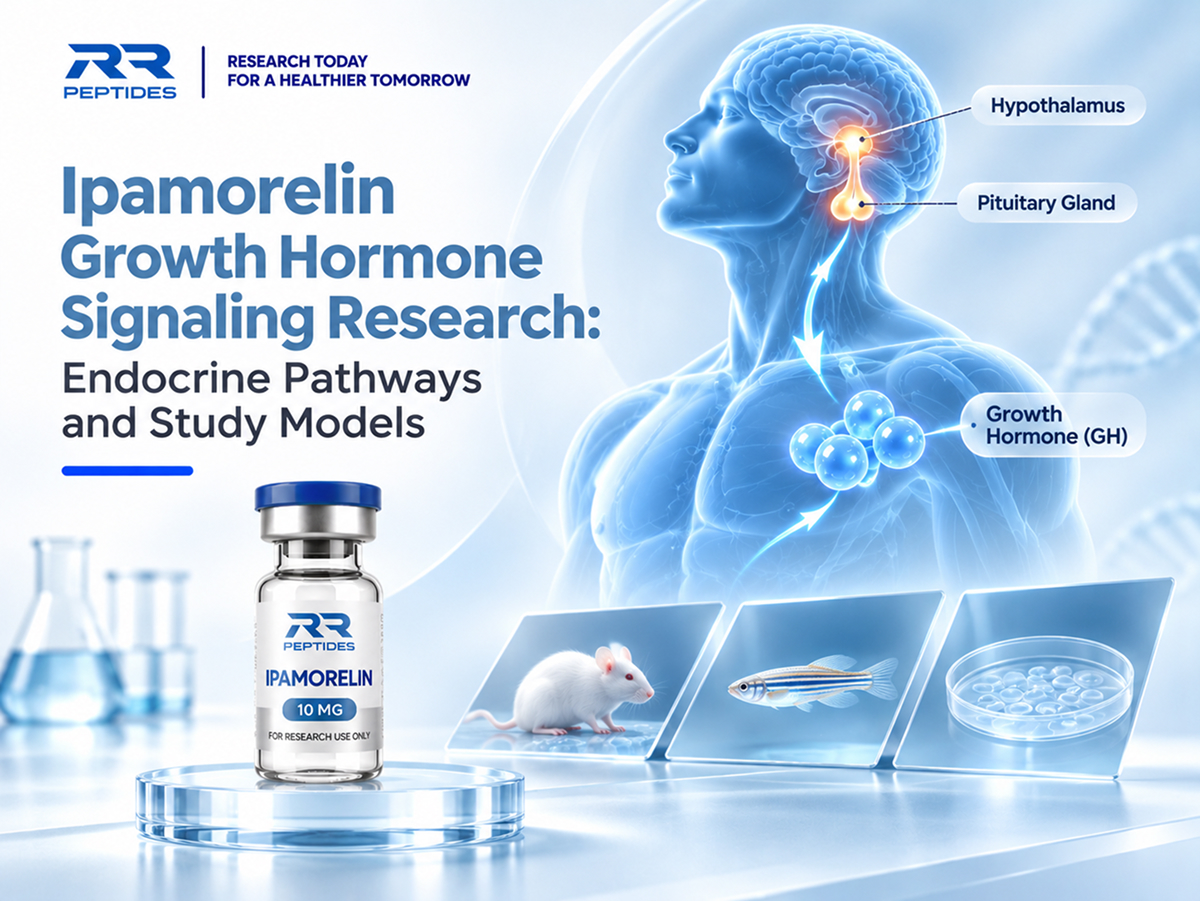
The GH axis integrates signals from the hypothalamus, anterior pituitary, liver, and peripheral tissues. Hypothalamic growth hormone-releasing hormone (GHRH) supports GH secretion, while somatostatin provides inhibitory control. Ghrelin-related signals act through a different receptor family. Once GH is released, it can influence insulin-like growth factor I (IGF-I) production and other tissue responses. Feedback from these processes modifies subsequent hormone secretion.
Level of the axis
Main biological role
Relevant observation
Hypothalamus
Integrates stimulatory and inhibitory signals
Context of GHRH and somatostatin activity
Pituitary somatotroph
Synthesizes and releases GH
Timing and magnitude of secretory episodes
Circulating GH
Carries pituitary endocrine signals
Serial GH concentrations and integrated exposure
Liver and other tissues
Respond to GH and contribute IGF-I
Downstream endocrine markers
Feedback networks
Regulate future hormone output
Adaptation and variability over time
In Ipamorelin growth hormone signaling research, specify the observed level: GH assays measure pituitary output, while IGF-I suggests downstream activity without proving intermediate signaling steps.
Why Timing Changes the Scientific Question
GH secretion is episodic, with pulse patterns shaped by sleep, age, metabolic status, and other physiological variables. Ipamorelin growth hormone signaling research therefore needs controls that distinguish spontaneous peaks from intervention-associated changes. Consequently, a difference between two isolated measurements may not represent a reproducible effect.
Ipamorelin growth hormone signaling research is strongest when investigators distinguish three outcomes: a change in pulse frequency, a change in pulse amplitude, and a change in integrated hormone exposure. These are related but not identical. A larger peak does not necessarily mean more secretory episodes, while increased average GH cannot reveal the molecular trigger without appropriate controls.
Explore ghrelin receptor signaling and growth hormone regulation in laboratory research with Ipamorelin 10mg, available at RR Peptides.
What Role Does the Ghrelin Receptor Play in GH Release?
GHS-R1a Connects Receptor Activation to Endocrine Output
The growth hormone secretagogue receptor type 1a (GHS-R1a) is a G protein-coupled receptor associated with ghrelin and synthetic secretagogues. Its biological activity is distinct from that of the GHRH receptor. Both receptor systems can influence pituitary GH secretion, but they initiate different signaling events and respond to different ligands.
For Ipamorelin growth hormone signaling research, this distinction prevents a common mechanistic error: assuming any compound that increases GH necessarily operates through GHRH signaling. Ipamorelin was characterized as a growth hormone secretagogue, and early antagonist experiments supported activity through a GHRP-related receptor rather than the GHRH receptor.
From Membrane Activation to Cellular Signals
Broader research on GHS-R1a describes coupling to Gq/11 proteins, activation of phospholipase C, and changes in intracellular calcium signaling. Such events can contribute to secretory activity in responsive cells. However, the full signaling map of the ghrelin receptor comes from experiments involving various ligands and cellular models.
An important boundary for Ipamorelin growth hormone signaling research is that receptor biology does not automatically equal compound-specific proof. A pathway observed with endogenous ghrelin is a plausible mechanism to investigate with ipamorelin, but researchers need direct measurements before presenting that pathway as conclusively established for the synthetic ligand.
Distinguishing Receptor Evidence From Pituitary Evidence
A methodical study can separate several links in the proposed chain:
Molecular identity: Confirm that the experimental material contains the intended peptide.
Receptor dependence: Test whether appropriate receptor controls alter the cellular response.
Early signaling: Measure a receptor-associated intracellular endpoint.
Hormone secretion: Assess GH released by a suitable pituitary model.
Biological context: Consider endogenous inhibition, feedback, and differences between species.
Ipamorelin growth hormone signaling research must distinguish direct observations from inferred biological pathways.
Why Endogenous Signals Still Matter
Ghrelin receptor activity does not operate independently of the wider endocrine system. Somatostatin can inhibit GH release, GHRH can promote it, and spontaneous pulses can occur even without experimental stimulation. Receptor abundance and cellular responsiveness may also differ between cultured cells and intact organisms.
For Ipamorelin growth hormone signaling research, a receptor-associated response is best interpreted alongside the model’s physiological limitations. Evidence from rat pituitary cultures provides mechanistic context but does not establish the same response magnitude in every human population.
Which Endocrine Responses Are Studied With Ipamorelin?
Findings From Foundational Animal Experiments
Raun and colleagues reported GH release in experimental models including rats and swine. In their swine comparisons, ipamorelin produced GH responses while ACTH and cortisol measurements were not significantly different from those following GHRH stimulation. Certain other secretagogues showed clearer effects on ACTH and cortisol. The investigators described this as relative selectivity for GH release.
Ipamorelin growth hormone signaling research should treat those findings as model-specific. They do not demonstrate that ACTH and cortisol can never change under other conditions, and they do not establish long-term human safety. Selectivity refers to outcomes observed with particular methods, comparators, and sampling windows.
Human Pharmacokinetic and Pharmacodynamic Evidence
A 1999 study by Gobburu and colleagues examined healthy male volunteers receiving controlled intravenous ipamorelin infusions. Researchers measured circulating peptide concentrations and GH responses. Their model estimated a terminal pharmacokinetic half-life of approximately two hours, while the GH response reached a peak around 0.67 hours and subsequently declined. The authors characterized the hormone response as a single secretory episode under those conditions.
For Ipamorelin growth hormone signaling research, the study shows an exposure-response relationship, not a universal duration applicable across populations.
Study observation
What it supports
What it does not establish
GH rise in animal models
Secretagogue activity under tested conditions
Identical responses in all species
Relative ACTH and cortisol selectivity
Differences from comparator secretagogues
Absence of every endocrine risk
Short-term GH release in volunteers
Measurable human pharmacodynamic response
Long-term treatment effectiveness
Estimated plasma half-life
Compound disposition in the studied setting
Duration of every downstream effect
Variable individual responses
Need for population-level analysis
Predictable results for an individual
Endocrine Responses Are Not Clinical Benefits
GH is involved in numerous physiological processes, but a temporary rise in GH does not independently demonstrate improved muscle mass, recovery, sleep, or longevity. Those outcomes would require appropriate functional endpoints, adequate controls, and follow-up. Likewise, a change in circulating hormones is not proof that the original peptide directly engages receptors in peripheral tissues.
Ipamorelin growth hormone signaling research should describe measured hormone responses precisely. When clinical claims go beyond the available experiments, the correct approach is to identify them as untested rather than translating a biomarker change into a promised result.
The Importance of Negative and Mixed Findings
Ipamorelin growth hormone signaling research should also acknowledge a randomized phase II trial investigating postoperative gastrointestinal recovery. The trial reported a numerical difference in time to tolerate a standardized meal, but the primary comparison was not statistically significant. This was a separate clinical question from GH secretion, yet it illustrates why biological plausibility and promising numerical trends are insufficient evidence of efficacy.
In Ipamorelin growth hormone signaling research, inconclusive findings help define the boundary between established endocrine observations and proposed applications. Such boundaries are useful for designing stronger studies rather than obstacles to scientific progress.
Explore ghrelin receptor signaling and growth hormone regulation in laboratory research with Ipamorelin 10mg, available at RR Peptides.
What Biomarkers Are Used in Growth Hormone Research?
Choosing Measurements for Specific Hypotheses
Ipamorelin growth hormone signaling research requires biomarkers that distinguish immediate pituitary secretion, cumulative exposure, and downstream endocrine changes. GH itself fluctuates rapidly, while IGF-I usually changes more gradually. ACTH and cortisol may be measured when the question concerns endocrine selectivity. Compound concentration assays characterize exposure rather than hormone release.
Ipamorelin growth hormone signaling research becomes more interpretable when protocols identify a primary endpoint before data collection. Selecting whichever result changes the most after a study introduces bias and makes replication difficult.
Biomarker or measurement
Primary question
Main limitation
Serial GH concentration
How does pituitary secretion vary over time?
Natural pulsatility complicates isolated samples
GH peak concentration
What is the largest observed response?
Highly sensitive to sampling frequency
GH area under the curve
Has integrated hormone exposure changed?
Does not identify the precise mechanism
IGF-I
Is downstream endocrine activity altered?
Affected by age, nutrition, and physiology
ACTH and cortisol
Are other endocrine axes responding?
Timing and stress can influence measurements
Plasma ipamorelin
What was the circulating exposure?
Concentration is not equivalent to receptor activity
Sampling Frequency Can Change the Answer
Consider two groups: one measures only baseline and a late follow-up; the other collects serial samples. The first may miss a brief peak, while the second can characterize response timing.
For Ipamorelin growth hormone signaling research, serial sampling is particularly useful when pulse dynamics are the endpoint. Nevertheless, frequent samples alone do not eliminate bias. Sleep conditions, meal timing, physical activity, stress, and assay handling may still influence endocrine data.
A useful reporting checklist covers:
Assay specificity: Identify the laboratory method and what molecular species it detects.
Collection timing: State the observation window and relationship to relevant physiological conditions.
Baseline variability: Report the distribution of control measurements rather than a single average.
Prespecified endpoints: Distinguish primary outcomes from exploratory analyses.
Statistical uncertainty: Include variability, confidence intervals, and missing-data handling.
The goal of Ipamorelin growth hormone signaling research is not simply to collect more numbers. It is to select measurements that distinguish competing biological explanations.
Interpreting IGF-I Correctly
IGF-I often serves as a downstream marker in GH-axis investigations, but it does not move in perfect synchrony with GH pulses. Its concentration depends on additional physiological factors. A single IGF-I observation cannot determine which GH pulses occurred, and its presence in a study should never be assumed unless the investigators actually measured it.
Ipamorelin growth hormone signaling research should also distinguish a biomarker of endocrine activity from a validated clinical endpoint. Even reliable changes in GH or IGF-I do not establish benefits for strength, body composition, or healthy aging.
Explore ghrelin receptor signaling and growth hormone regulation in laboratory research with Ipamorelin 10mg, available at RR Peptides.
What Are the Limitations of Current Ipamorelin Findings?
The foundational literature supports secretagogue activity and a transient GH response in studied models. However, relatively small human investigations and limited follow-up leave substantial uncertainty about longer-term endocrine adaptation, rare adverse events, and clinical outcomes. Model-specific hormonal selectivity should not be presented as comprehensive evidence of safety.
Ipamorelin growth hormone signaling research must also address population differences. Healthy male volunteers are not interchangeable with children, older adults, people with pituitary disorders, or individuals with other medical conditions. Translating observations between these groups requires new evidence.
Common Sources of Overinterpretation
Common errors include equating receptor activation with clinical benefit, treating transient GH release as lasting improvement, and generalizing animal results to humans.
Researchers developing Ipamorelin growth hormone signaling research protocols should ask whether the material is correctly identified, whether the chosen endpoint tests the stated hypothesis, and whether the controls can separate treatment-associated changes from spontaneous hormone variation.
Canadian Regulatory and Quality Considerations
Health Canada identified ipamorelin among unauthorized injectable peptide drugs in its April 9, 2026 advisory. In November 2026, the agency also warned of bacterial contamination detected in certain unauthorized injectable peptide products sold online. These alerts highlight safety and quality concerns; they do not constitute research findings about the efficacy of ipamorelin.
For Canadian Ipamorelin growth hormone signaling research, lawful procurement, relevant import requirements, institutional oversight, and analytical verification all warrant attention. A research-use label does not automatically exempt a product from Canadian regulatory requirements. A certificate of analysis also cannot establish authorization for human treatment.
Research Priorities Worth Pursuing
Future investigations could strengthen the evidence by combining validated compound identity, receptor-specific controls, repeated GH measurements, and transparent statistical plans. Longer observation periods may help determine whether endocrine responses adapt under continuing exposure. Independent replication would also help distinguish robust biological effects from assay-specific findings.
The most valuable contribution to Ipamorelin growth hormone signaling research is not a more ambitious claim but a clearer causal explanation. Strong experiments report measured pathways, observed changes, and alternative explanations.
No. Ipamorelin is a synthetic secretagogue investigated for its ability to stimulate endogenous GH release. It is not GH itself and should not be described as directly replacing the hormone.
Does Ipamorelin Act Through the GHRH Receptor?
Its established pharmacological classification involves the growth hormone secretagogue receptor system rather than the separate GHRH receptor. Both pathways can influence pituitary GH secretion.
Have Studies Demonstrated a GH Response in Humans?
Yes. A controlled 1999 study observed short-term GH release in healthy male volunteers. The result does not establish clinical effectiveness or long-term safety.
Why Is One GH Measurement Often Insufficient?
GH secretion is pulsatile. One sample may capture an ordinary peak or trough, making controlled serial measurements more informative for studying secretory dynamics.
Does Higher IGF-I Prove Improved Health?
No. IGF-I is a downstream endocrine marker influenced by several physiological factors. Changes in its concentration do not independently establish meaningful clinical benefits.
Does Selective GH Release Mean No Other Hormones Are Affected?
No. The original selectivity observations came from defined preclinical comparisons. They cannot rule out different responses in other species, settings, or longer studies.
What Should Canadian Researchers Check First?
Verify molecular identity, research documentation, institutional approval, and applicable regulatory requirements. Ipamorelin growth hormone signaling research should not be confused with authorization for human or veterinary use.
Conclusion
Ipamorelin growth hormone signaling research offers a framework for connecting ghrelin-receptor pharmacology, pituitary GH release, and downstream endocrine biomarkers. Foundational experiments and a controlled human volunteer study support short-term secretagogue activity, while important questions remain about longer-term responses and clinical relevance.
For legitimate Canadian laboratory projects, explore RR Peptides for research-focused product information and review its documentation alongside primary studies and institutional policies. Responsible interpretation begins with verified material identity and clearly defined measurements.
Ultimately, Ipamorelin growth hormone signaling research advances when investigators separate receptor mechanisms, measured hormone changes, and unproven health claims. That distinction produces more reproducible science and more useful questions for future studies.
Disclaimer: All products and compounds discussed are intended strictly for laboratory and research purposes. This article is provided for educational and informational purposes only. This article is not medical advice, therapeutic guidance, or instructions for human administration.
×
Subscribe & Get 10% Off!
Enter your email address below to subscribe to our newsletter and receive an instant 10% OFF discount coupon code sent directly to your inbox!
Thank you for subscribing! Your 10% discount coupon has been sent to your email. Please check your inbox!