A receptor can activate several cellular pathways without producing the same result in every tissue. That distinction is particularly important when investigating synthetic peptides that influence hormone secretion. A measured rise in growth hormone may confirm a biological response, but it cannot independently reveal every molecular event responsible for that response.
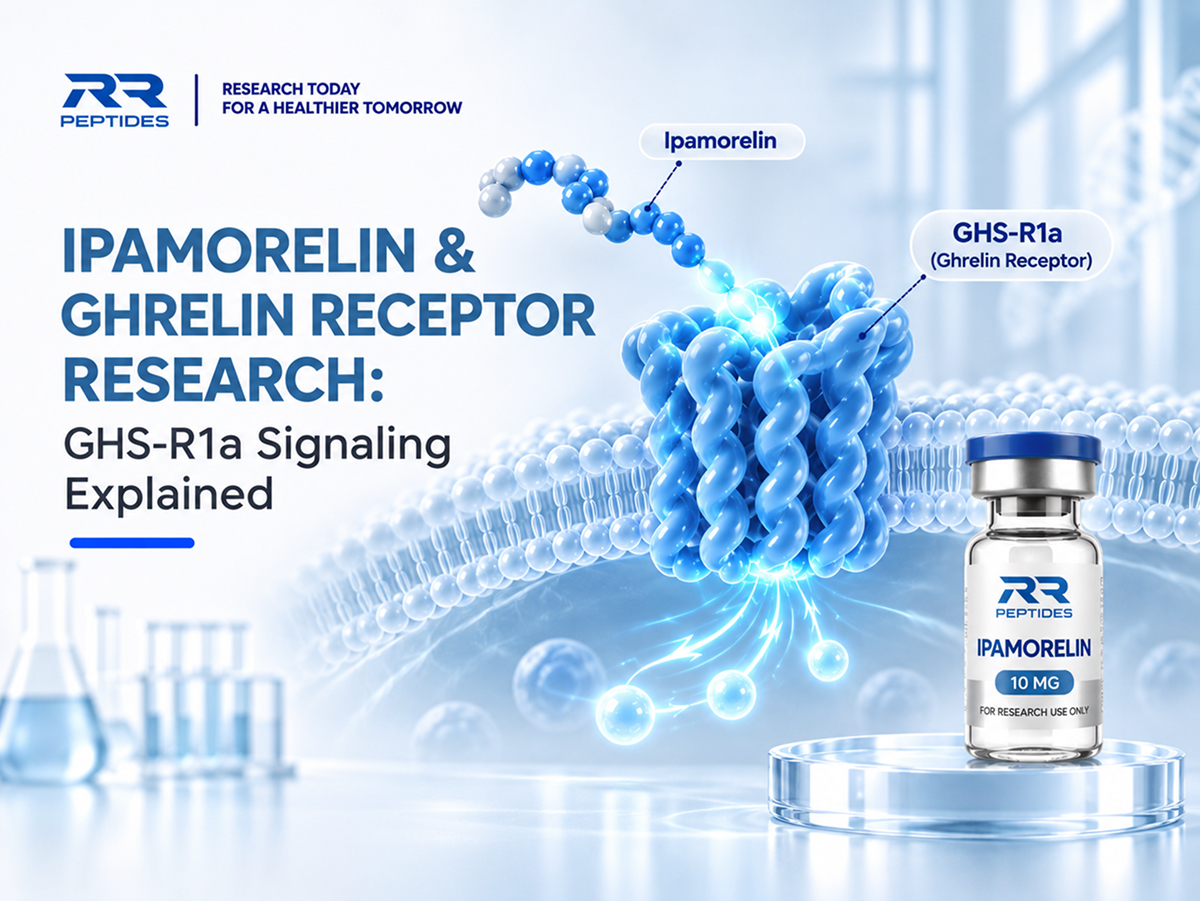
Ipamorelin and ghrelin receptor research examines how a synthetic growth hormone secretagogue relates to GHS-R1a, the receptor normally activated by acylated ghrelin. The central questions concern receptor identity, evidence for agonism, intracellular signaling, and how researchers distinguish a direct receptor response from a downstream endocrine effect.
For Canadian laboratories, RR Peptides provides research-oriented product information that investigators can review alongside primary publications and independent analytical records. Explore the RR Peptides catalog when assessing materials for legitimate laboratory projects, while verifying molecular identity and applicable institutional requirements. This guide approaches ipamorelin and ghrelin receptor research through receptor-specific experiments rather than unsupported claims about performance or anti-aging.
What Is the Ghrelin Receptor GHS-R1a?
A Receptor Identified Before Its Natural Ligand
GHS-R1a is a seven-transmembrane G protein-coupled receptor, or GPCR, encoded by the human GHSR gene. Researchers cloned the receptor in 1996 while investigating synthetic growth hormone secretagogues. In 1999, Kojima and colleagues identified ghrelin, an acylated peptide found in the stomach, as an endogenous ligand. That historical sequence matters: synthetic secretagogues helped reveal a receptor before its natural signaling molecule was known.
For Ipamorelin and ghrelin receptor research, the name GHS-R1a identifies a molecular target rather than a therapeutic outcome. Receptor activity is not synonymous with increased tissue growth, clinical recovery, or an improvement in health. Those claims would require distinct studies and appropriate endpoints.
Full-Length GHS-R1a Versus GHS-R1b
The full-length human GHS-R1a receptor contains 366 amino acids and seven membrane-spanning segments. An alternatively spliced form, GHS-R1b, lacks the final two transmembrane segments. It is not considered a conventional functional ghrelin receptor, although potential regulatory interactions have been studied. Assays must identify which receptor form is expressed, especially when engineered cells are involved.
GHS-R1a is notable for constitutive activity: it can signal even without an externally added agonist. Studies using purified receptor systems have demonstrated intrinsic G protein activation under ligand-free conditions. Consequently, ipamorelin and ghrelin receptor research requires a meaningful baseline. A signal in untreated cells may represent receptor biology rather than contamination or experimental failure.
Another distinction concerns tissue context. The receptor participates in neural and metabolic networks as well as pituitary signaling. However, identifying receptor expression in a tissue does not prove that ipamorelin produces a specific outcome there. Ipamorelin and ghrelin receptor research should match biological claims to directly measured responses in the tested system.
Ipamorelin and ghrelin receptor research should also distinguish receptor abundance from receptor responsiveness. A cell with more receptors may generate a larger signal even when ligand binding chemistry is unchanged. Reporting expression levels and normalizing responses can prevent misleading comparisons across cell models.
Explore ghrelin receptor signaling and growth hormone regulation in laboratory research with Ipamorelin 10mg, available at RR Peptides.
Why Is Ipamorelin Studied as a Ghrelin Receptor Agonist?
The Evidence That Established Its Pharmacology
Ipamorelin is a synthetic pentapeptide described by Raun and colleagues in 1998. Its reported sequence is Aib-His-D-2-Nal-D-Phe-Lys-NH2. Unlike endogenous ghrelin, it does not share the natural hormone’s full peptide structure or its characteristic fatty-acid modification. Instead, it belongs to the synthetic growth hormone secretagogue family.
Early ipamorelin and ghrelin receptor research focused on functional evidence. Primary rat pituitary cultures released growth hormone following exposure, and antagonist comparisons indicated involvement of a growth hormone-releasing peptide receptor pathway rather than the separate GHRH receptor. This early pharmacology supports the secretagogue classification, although the original experiments did not resolve every structural detail of ligand binding.
Relative Selectivity Is Not Absolute Specificity
Investigators also evaluated hormone responses in rats and conscious swine. In the swine model, ipamorelin stimulated growth hormone without producing ACTH or cortisol responses significantly different from those seen with the GHRH comparator. Certain other synthetic secretagogues increased those additional hormones. The contrast contributed to the compound’s description as relatively selective.
Ipamorelin and ghrelin receptor research must preserve the limits of that finding. Relative selectivity in an animal experiment does not mean complete pathway exclusivity, absence of side effects, or established long-term human safety. Different species and measurement conditions can change what an investigator observes.
The distinction can be summarized in three questions:
Target engagement: Is the intended receptor responsible for the observed signal?
Hormonal selectivity: Does the experimental model show a larger GH response than responses in other measured hormones?
Clinical relevance: Has any meaningful patient outcome been tested independently of the hormone measurements?
These questions require different evidence. Ipamorelin and ghrelin receptor research becomes less reliable when an observation addressing one question is presented as an answer to all three.
Why Compare Synthetic Ligands?
Reference ligands such as acylated ghrelin and characterized growth hormone secretagogues provide useful context. Potency describes the concentration associated with a defined effect, while efficacy describes the size of that effect in the assay. Neither quantity is automatically transferable between cell lines, receptor densities, or species. Ipamorelin and ghrelin receptor research benefits from comparisons performed under matched conditions rather than marketing comparisons assembled from unrelated studies.
A compound can associate with a receptor without activating it. An agonist, by contrast, produces a receptor-dependent functional response. Scientists distinguish binding affinity from functional potency because a tightly binding molecule is not necessarily a stronger activator. Receptor expression and signal amplification can further separate these measurements.
For ipamorelin and ghrelin receptor research, a convincing experiment pairs molecular and functional evidence. Binding measurements may estimate receptor association, while calcium-based or other signaling assays test whether the receptor changes cellular activity. An antagonist or genetic control helps establish whether the response truly depends on GHS-R1a.
What an Agonist Experiment Can Establish
A careful receptor study might proceed through the following sequence:
Verify the peptide’s chemical identity and the receptor expressed by the experimental cells.
Establish ligand-free activity and include vehicle-treated controls.
Compare responses with an established GHS-R1a agonist under identical assay conditions.
Test whether receptor blockade or reduced expression changes the response.
Report concentration-response relationships with variability and assay limitations.
These steps are research principles, not procedures for human use. Ipamorelin and ghrelin receptor research also requires attention to assay artifacts, including nonspecific fluorescence, cell toxicity, and differences in receptor abundance.
Why Ghrelin and Ipamorelin Are Not Interchangeable
Native acylated ghrelin is a 28-amino-acid hormone whose serine-associated fatty acid contributes to receptor activity. Ipamorelin is a much smaller synthetic molecule with a different chemical architecture. Both can be discussed within GHS-R pharmacology, but structural differences may affect binding kinetics, receptor conformations, or downstream signaling. Those possibilities must be tested, not assumed.
In ipamorelin and ghrelin receptor research, an observed GH response should not be interpreted as proof that both ligands produce identical receptor conformations. Nor does a result obtained with ghrelin directly establish a specific binding constant for ipamorelin.
Avoiding Overinterpretation of Potency
An EC50 describes the concentration associated with half the maximal observed functional response in a particular experiment. It is not automatically a binding affinity, a clinical concentration target, or evidence of superior safety. Ipamorelin and ghrelin receptor research should state the assay, reference ligand, and model whenever such numbers are compared.
Explore ghrelin receptor signaling and growth hormone regulation in laboratory research with Ipamorelin 10mg, available at RR Peptides.
What Cellular Responses Follow Receptor Activation?
From G Proteins to Calcium Signals
The best-established framework for GHS-R1a activation involves coupling to Gq/11 proteins. This can stimulate phospholipase C, leading to production of inositol trisphosphate and diacylglycerol. Inositol trisphosphate promotes intracellular calcium release, while diacylglycerol participates in protein kinase C signaling. These events can support secretory responses in appropriate cells.
Ipamorelin and ghrelin receptor research uses this framework to formulate mechanistic hypotheses. Nevertheless, the detailed pathway literature includes experiments with native ghrelin and other ligands. Researchers should not describe every demonstrated ghrelin response as an ipamorelin-specific finding without corresponding evidence.
Cellular event
Typical research readout
Interpretation limit
Receptor activation
Functional signaling response
Does not establish a clinical effect
Gq/11-related signaling
Biosensor or pathway reporter
Depends on assay system
Intracellular calcium increase
Fluorescence-based calcium measurement
Other receptors may also affect calcium
Beta-arrestin recruitment
Recruitment assay
Not equivalent to GH secretion
Pituitary GH release
Hormone concentration in culture medium
Does not identify every upstream molecular step
Multiple Pathways and Receptor Adaptation
GHS-R1a biology also includes beta-arrestin recruitment, receptor trafficking, and signaling involving other G proteins in some experimental settings. Researchers have investigated biased signaling, in which ligands favor particular signaling outcomes. Yet a complete ligand-specific bias profile cannot be inferred for ipamorelin from experiments on ghrelin alone.
Ipamorelin and ghrelin receptor research should distinguish three concepts: initial activation, adaptation during continued exposure, and downstream endocrine response. Changes in receptor localization or signaling intensity need their own measurements. A sustained circulating peptide concentration does not establish sustained activation of every intracellular pathway.
GH Release Is a Downstream Event
Pituitary somatotrophs store growth hormone in secretory granules. Receptor-related signaling can contribute to release, but the hormone axis also responds to GHRH, somatostatin, sleep, nutritional status, and feedback from other hormones. In humans, a 1999 volunteer study by Gobburu and colleagues documented a transient GH response following controlled intravenous ipamorelin exposure. The study characterized compound concentration and hormone output; it did not map every intracellular signal in human pituitary tissue.
For ipamorelin and ghrelin receptor research, that difference is essential. A measured rise in GH supports an endocrine effect, not a claim that ipamorelin directly activates peripheral growth hormone receptors. Those receptors use distinct signaling machinery, including JAK2 and STAT5.
Explore ghrelin receptor signaling and growth hormone regulation in laboratory research with Ipamorelin 10mg, available at RR Peptides.
How Is Ghrelin Receptor Activity Measured in Research?
Choose an Assay That Matches the Question
A receptor study should start with its scientific question rather than the most convenient laboratory instrument. Some assays measure binding, others detect early intracellular events, and endocrine experiments quantify a later hormonal output. Each answers something different.
Ipamorelin and ghrelin receptor research can involve a combination of methods:
Binding assays: Evaluate interactions with receptor-containing preparations using validated tracers or competition methods.
Calcium assays: Track rapid changes in intracellular calcium following stimulation.
Inositol phosphate assays: Assess downstream activity of phospholipase C-related pathways.
Recruitment biosensors: Examine G protein or beta-arrestin engagement in suitable engineered systems.
Hormone assays: Measure GH released from appropriate pituitary models or sampled in controlled studies.
The best design includes controls sufficient to distinguish receptor specificity from generic cellular activation. Ipamorelin and ghrelin receptor research should not equate a calcium signal with demonstrated binding when the experimental model contains other calcium-responsive receptors.
Compare Readouts Without Combining Them
Experimental question
Relevant method
Reporting priority
Does the ligand bind?
Validated receptor binding assay
Assay conditions and specificity
Does it activate G protein signaling?
Functional biosensor or second messenger assay
Baseline, response, and controls
Does it recruit beta-arrestin?
Recruitment assay
Timing and reference agonist
Does receptor activity cause GH release?
Pituitary secretion model
Receptor dependence and GH variability
Is an effect reproduced?
Independent experimental replication
Confidence intervals and methods
A measured EC50 may change with receptor expression, assay amplification, and incubation conditions. Comparing numbers from unrelated systems can create false rankings. Ipamorelin and ghrelin receptor research is stronger when results are presented alongside appropriate uncertainty rather than only a single favorable value.
Control Basal Signaling and Sample Quality
Because GHS-R1a exhibits constitutive activity, untreated cells can generate measurable background responses. Suitable controls help separate that baseline from added-ligand effects. Receptor-negative cells, validated antagonists, and orthogonal assays can strengthen interpretation when appropriate.
Sample quality matters too. A supplier’s certificate may describe identity or purity at one testing point, but it does not independently establish receptor activity, sterility, clinical safety, or lawful use. Investigators should document molecular identity, relevant impurities, storage history, and assay compatibility. Ipamorelin and ghrelin receptor research depends on knowing what material the cells actually encountered.
Canadian Research and Regulatory Considerations
Health Canada identified ipamorelin among unauthorized injectable peptide drugs in an April 9, 2026 advisory. On November 6, 2026, the agency also warned of bacterial contamination detected in certain unauthorized injectable peptide products sold online. These notices concern product safety and authorization; they do not invalidate properly conducted receptor experiments or authorize human use of laboratory material.
For Canadian ipamorelin and ghrelin receptor research, legitimate procurement, applicable import requirements, and institutional oversight should be checked before work begins. Research-use labeling does not automatically exempt a product from Canadian regulatory obligations. Scientific quality control and regulatory compliance are related responsibilities, but neither substitutes for the other.
FAQs About Ipamorelin and Ghrelin Receptor Research
Is GHS-R1a Different From the GHRH Receptor?
Yes. GHS-R1a is the ghrelin receptor, while GHRH acts through a separate receptor. Both systems can influence growth hormone secretion, but their initiating mechanisms differ. Ipamorelin and ghrelin receptor research should not combine evidence from the two pathways without a justified experimental comparison.
Does Ipamorelin Have to Resemble Ghrelin Structurally?
No. Synthetic ligands can activate a receptor without sharing the full structure of its endogenous hormone. Similar functional outcomes do not establish identical binding interactions or signaling profiles.
Does a Calcium Response Prove Specific Receptor Binding?
No. Calcium mobilization is a functional readout that can arise through several receptors. Confirming GHS-R1a involvement requires controls or complementary assays appropriate to the model.
Is GHS-R1b Another Fully Functional Ghrelin Receptor?
No. GHS-R1b is a truncated splice form and is not considered equivalent to the full-length signaling receptor. Possible regulatory roles are a separate topic of investigation.
Have Human Studies Demonstrated Hormonal Activity?
Yes. Controlled volunteer research reported a short-term GH response after ipamorelin exposure. However, ipamorelin and ghrelin receptor research does not thereby establish improvements in athletic performance, recovery, body composition, or longevity.
Does Receptor Selectivity Establish Long-Term Safety?
No. Relative hormone selectivity observed in animal experiments is not a comprehensive human safety assessment. Longer-term outcomes, additional tissues, and other biological effects require separate evidence.
What Should Canadian Laboratories Verify?
Confirm the exact research material, supporting analytical documentation, applicable institutional requirements, and relevant Canadian regulations. Ipamorelin and ghrelin receptor research cannot rely on a research-use label as automatic legal authorization.
Conclusion
Ipamorelin and ghrelin receptor research provides a focused way to examine how a synthetic secretagogue engages the GHS-R1a system, how receptor activity is measured, and how those findings relate to endocrine responses. Its strongest conclusions distinguish receptor-specific observations from broader ghrelin biology and from unproven clinical claims.
Canadian investigators can explore RR Peptides for research-oriented product information while independently reviewing original studies, batch documentation, and institutional requirements. Clear assay design, appropriate controls, and accurate reporting remain more valuable than unsupported assumptions about a peptide’s benefits.
Disclaimer: All products and compounds discussed are intended strictly for laboratory and research purposes. This article is provided for educational and informational purposes only. This article is not medical advice, therapeutic guidance, or instructions for human administration.
×
Subscribe & Get 10% Off!
Enter your email address below to subscribe to our newsletter and receive an instant 10% OFF discount coupon code sent directly to your inbox!
Thank you for subscribing! Your 10% discount coupon has been sent to your email. Please check your inbox!